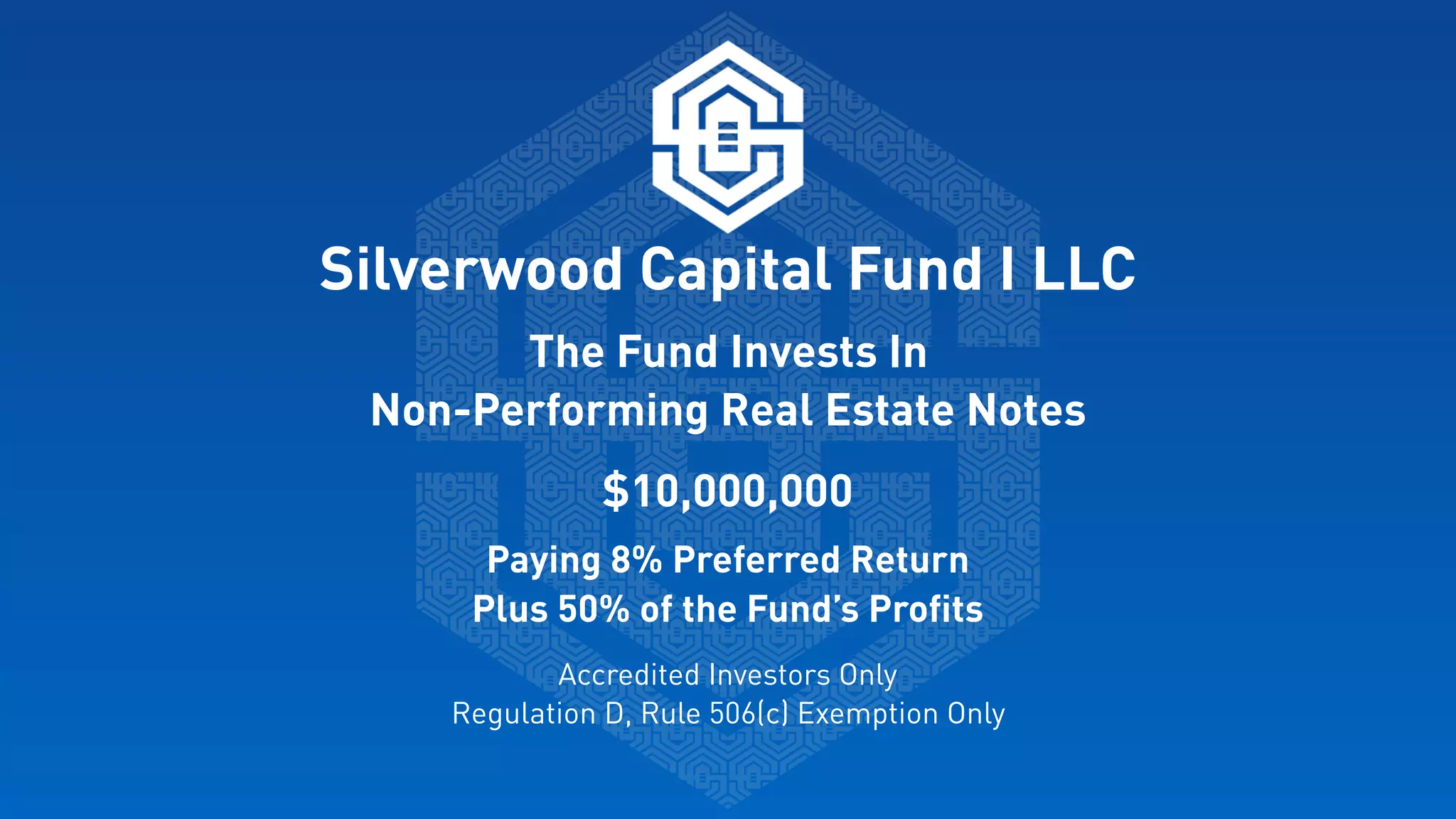
Silverwood Capital Fund I is a real estate investment vehicle seeking $10 million to acquire non-performing junior mortgages and Home Equity Lines of Credit (HELOCs). The fund leverages a market opportunity cited at $31.219 billion in non-paying real estate debt, as reported by the FDIC in Q3 2018. The management team claims a combined 88 years of business experience, specifically focusing on the workout and disposition of thousands of notes. The investment proposition is structured as a Regulation D, Rule 506(c) offering for accredited investors, featuring an 8% preferred return and a 50/50…
Key takeaways
- The fund is seeking a total of $10,000,000 from accredited investors under Regulation D, Rule 506(c) (Slide 1).
- The primary investment target is Non-Performing Notes (NPN) and Real Estate Owned (REO) properties, citing a $31.219 billion market opportunity (Slide 2).
- Silverwood positions itself as a 'controlling lender' that purchases promissory notes far below the underlying balance (Slide 3).
- The management team claims 35 years of specific experience in note workouts and thousands of notes handled (Slide 4).
- The deck explicitly names four competitors—Reliant Liquidity Fund, PPR DE IV Fund, NNG Capital Fund I, and Notable Capital Fund—to highlight its superior profit-sharing model (Slide 5).
- The strategy focuses on junior and HELOC notes in non-judicial states to achieve 50% lower legal fees and faster foreclosure times (Slide 6).
- Investors are offered an 8% preferred return plus 50% of the fund's profits, with a projected IRR of 17% (Slide 6).
- The deck omits specific individual bios, historical fund performance data, and detailed exit timelines for the $10M raise.
Silverwood Capital Fund I: Pitch Deck Analysis
Silverwood Capital Fund I presents a highly specialized real estate debt fund deck. Unlike typical startup decks that focus on technology or scale, this deck is a financial product offering. It is designed to attract accredited investors into a specific niche: the acquisition and workout of distressed residential debt. The deck relies heavily on market distress data and a clear comparison of investor distributions against established competitors in the note-buying space.
Slide 1: Title and Offering Summary
The cover slide serves as a summary of the entire offering. It identifies the entity as Silverwood Capital Fund I LLC and immediately states the investment focus: Non-Performing Real Estate Notes. The slide lists the target raise of $10,000,000 and the core investor incentive: an 8% Preferred Return plus 50% of the Fund's profits. It also includes necessary legal signifiers, noting that the offering is for Accredited Investors Only under Regulation D, Rule 506(c). This is a functional, albeit text-heavy, start that qualifies the reader immediately.
Slide 2: The Opportunity
This slide establishes the Macro environment using FDIC data from Q3 2018. It notes that out of $10.8 trillion in outstanding mortgage debt, $31.219 billion is in 'non-paying real estate debt' (NPNs and REOs). The slide argues that the 'regulatory and litigious environment' forces institutional lenders to sell these defaulted mortgages in bulk prior to listing them on the MLS. This creates a 'niche industry' for specialized funds that can mobilize capital to purchase these assets at a discount.
Slide 3: The Solution
Silverwood defines its 'solution' as acting as the 'controlling lender.' By purchasing promissory notes and mortgages 'far below the underlying balance,' they gain the legal rights and remedies of the original lender. The slide emphasizes a dual-purpose mission: making money for investors while 'helping qualified homeowners to achieve financial stability' through workouts. This positioning attempts to soften the image of distressed debt acquisition by suggesting a collaborative path to resolution with the borrower.
Slide 4: Track Record
The track record slide focuses on aggregate experience rather than individual resumes. It claims the Managers and Advisors have 'eighty-eight years of business experience,' with thirty-five of those years specifically in the 'purchase, workout, and disposition of thousands of Notes worth tens of millions of dollars.' It mentions a 'nationwide network of ancillary companies' used to minimize timelines and maximize yields, though it does not name these partners or provide specific case studies of past fund performance.
Slide 5: Competition
This is a rare example of a pitch deck naming specific competitors and their exact financial terms. Silverwood lists Reliant Liquidity Fund, PPR DE IV Fund, NNG Capital Fund I, and Notable Capital Fund. The slide points out that while these funds offer interest between 7% and 12%, they offer 'no split of the profits.' Silverwood uses this to justify its own 8% preferred return plus 50/50 profit split, claiming this structure will 'beat these returns' based on their historic numbers.
Slide 6: Investing Strategy and Terms
The final slide in this set details the tactical execution. The fund targets 'Non-Performing Junior & HELOC Notes' specifically in 'non-judicial states.' The rationale is that legal fees and foreclosure times are 'sometimes 50% less' than in judicial states. The slide reiterates the 50/50 equity split between Class A (Investors) and Class B (Managers) units and provides a projected IRR of 17%. It concludes by referring the reader to a separate business plan for detailed income statements and cash flows.
What Silverwood Capital Fund I Does Well
The deck is exceptionally clear about its value proposition to the investor. By naming competitors and listing their specific return percentages, Silverwood creates a compelling 'why us' argument based on the upside of the profit split rather than just a fixed interest rate. The focus on non-judicial states shows a sophisticated understanding of the operational friction in the debt industry, signaling to investors that the managers know how to optimize for speed and cost.
Furthermore, the use of specific FDIC data (Slide 2) grounds the opportunity in reality. It moves the conversation from 'we think this is a good idea' to 'there is a $31 billion pool of assets we are qualified to buy.' The clear mention of the 506(c) exemption also shows professional compliance, which is critical for a fund of this nature.
What is Missing from the Deck
The most glaring omission is the lack of specific team biographies. While 'eighty-eight years of combined experience' sounds impressive, investors in a $10 million fund generally want to see the names and specific backgrounds of the principals managing their capital. Without names, the 'Track Record' slide (Slide 4) feels somewhat anonymous.
Additionally, the deck lacks a 'Use of Funds' breakdown beyond the general statement of buying notes. It does not specify the expected fund life, the lock-up period for investors, or the frequency of distributions. While the deck mentions a 'projected IRR of 17%,' it does not provide a sensitivity analysis or a breakdown of how that IRR is achieved (e.g., how much comes from interest vs. how much comes from the sale of REO properties). Finally, there are no visual examples or 'deal walk-throughs' that show a typical purchase price, workout cost, and eventual exit for a single note.
Instructions for the Founder
If you are modeling a fund deck after this one, keep the competitive comparison slide (Slide 5). It is a powerful tool for showing why your structure is superior to the market standard. However, you must supplement the aggregate experience claims with specific bios and headshots of the management team to build trust.
You should also include at least one 'Case Study' slide. Show a real-world example of a note purchased by the team in the past: the purchase price, the face value of the note, the time to resolution, and the final return on investment. This moves the deck from theoretical projections to proven execution. Lastly, ensure you clearly define the 'Exit Strategy'—how and when do the investors get their principal back? A fund deck without a clear timeline is a difficult sell for sophisticated LPs.
Frequently asked questions
- What is the specific investment focus of Silverwood Capital Fund I?
- According to Slide 6, the fund focuses on purchasing Non-Performing Junior and HELOC (Home Equity Line of Credit) Notes. They specifically target non-judicial states because they have found that legal fees and foreclosure timelines in these jurisdictions are often 50% lower than in judicial states, allowing for faster asset recovery or resolution.
- How is the $10 million investment structured for participants?
- The fund is a Delaware LLC offering Class A Units to accredited investors. As stated on Slide 1 and Slide 6, investors receive an 8% preferred return. After this preference is met, the remaining profits are split 50/50 between the Class A investors and the Managers, who hold Class B Units.
- What market data does the fund use to justify the opportunity?
- Slide 2 cites FDIC reports from Q3 2018. It notes that US Banks held $10.8 trillion in mortgage debt, with $28.435 billion in Non-Performing Notes (NPN) and $2.783 billion in Real Estate Owned (REO) properties, totaling over $31 billion in non-paying real estate debt available for purchase.
- Who are the competitors mentioned in the deck?
- Slide 5 identifies four specific competitors: Reliant Liquidity Fund (7% return), PPR DE IV Fund (10% return), NNG Capital Fund I (9-11% return), and Notable Capital Fund (8-12% return). Silverwood differentiates itself by offering a profit split, which these competitors allegedly do not provide.
- What is the projected return for investors in this fund?
- Slide 6 states a projected Internal Rate of Return (IRR) of 17%. This is based on the combination of the 8% preferred return and the 50% share of net profits. The deck mentions that detailed income statements and cash flows are available in their full business plan, though they are not in the slides.