Creatio’s 2024 Series B deck is a high-signal presentation that prioritizes market validation and ecosystem scale over granular unit economics. By positioning themselves as the leader of the 'Composable no-code architecture' era (Slide 2), the company successfully raised $200M led by Sapphire Ventures. The deck leans heavily on third-party credibility, featuring three distinct Gartner Magic Quadrant placements (Slide 5) and a massive global footprint of 750+ partners (Slide 10). While it lacks a traditional team slide or detailed financial projections in the provided 14-slide sample, it compe…
Key takeaways
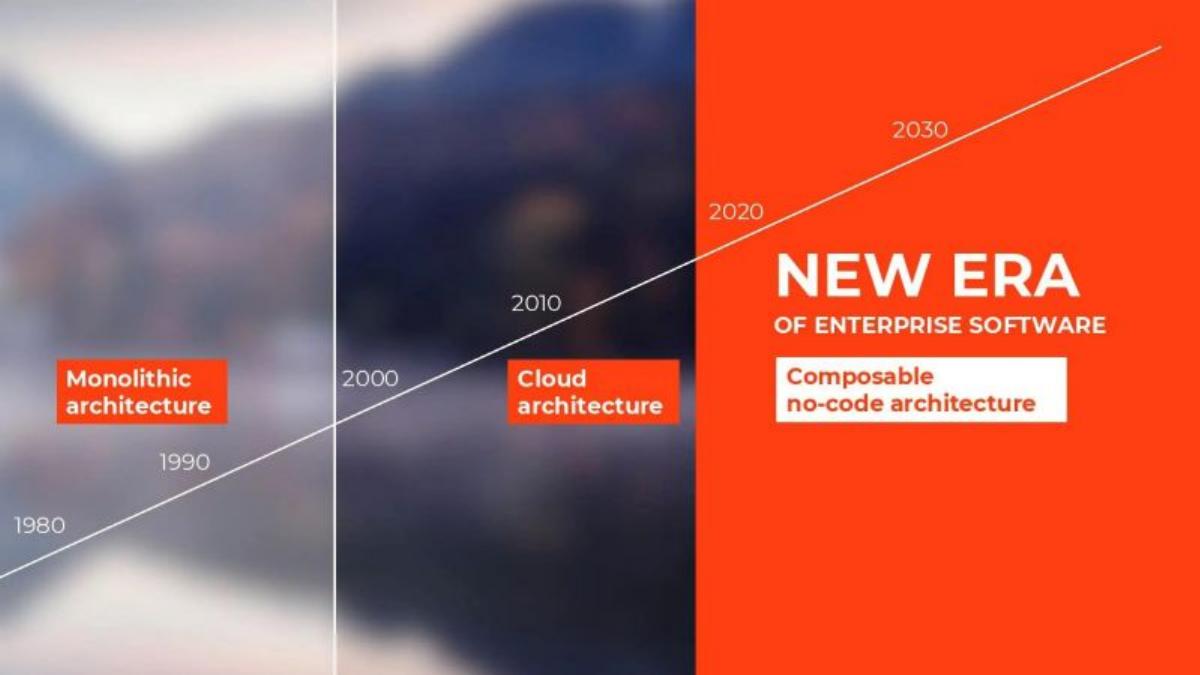
- The deck positions no-code as the third major era of enterprise software, following monolithic and cloud architectures (Slide 2).
- Creatio utilizes Gartner Magic Quadrant recognition across three categories—Sales Force Automation, B2B Marketing Automation, and Low-Code Application Platforms—to establish multi-vertical dominance (Slide 5).
- The company has built a significant content moat with a 'No-Code Playbook' that has surpassed 15,000 downloads (Slide 6).
- A massive distribution advantage is showcased through 750 active partners in 110 countries, with 250 added in 2023 alone (Slide 10).
- The R&D strategy is explicitly focused on four pillars: Copilot, limitless no-code automation, CRM, and workflow tools (Slide 8).
- The 'Creatio Copilot' feature integrates Gen AI directly into the app creation and scenario-building process (Slide 9).
- Global physical presence is a core part of the growth strategy, with 150+ in-person events planned for FY2024 (Slide 11).
- Investment areas are clearly defined as R&D innovation, partner channel expansion, and team growth (Slide 12).
The Macro Narrative: Defining a New Era
Slides 1-2: The Evolution of Software
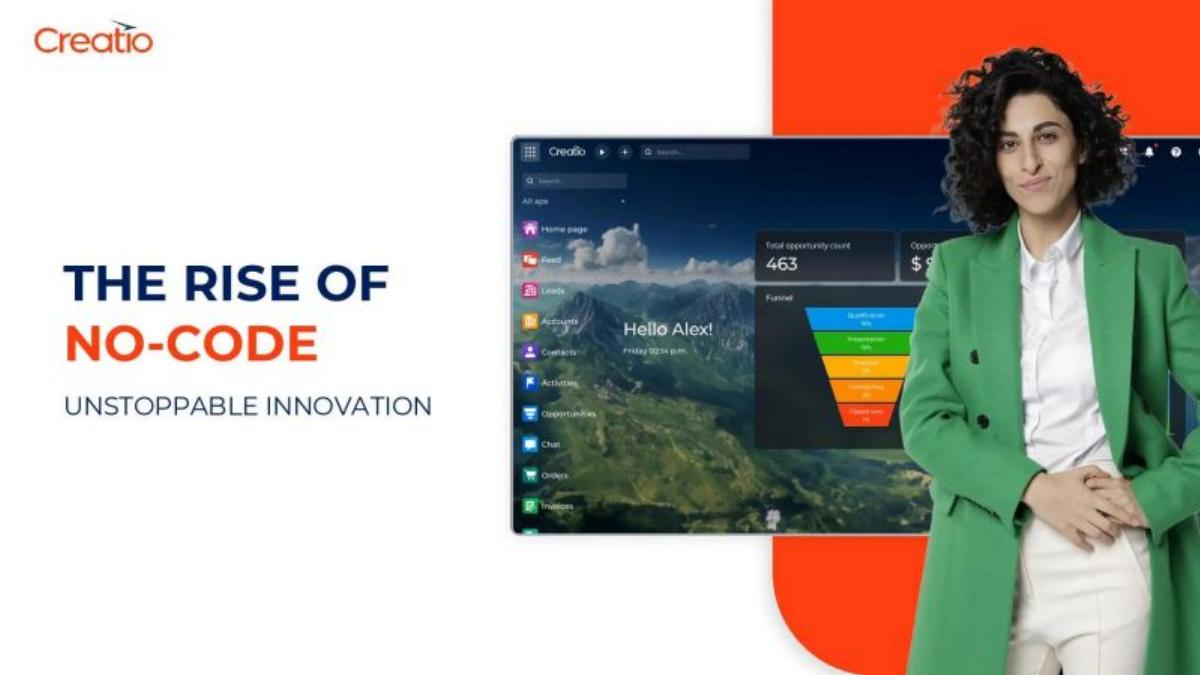
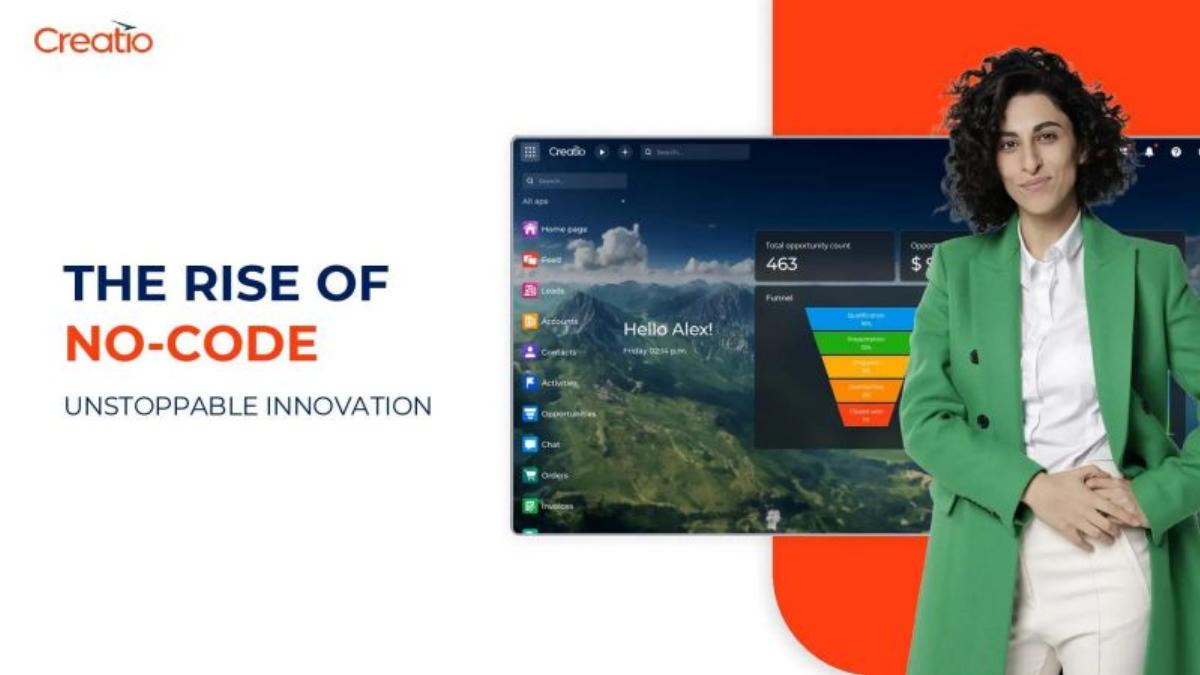
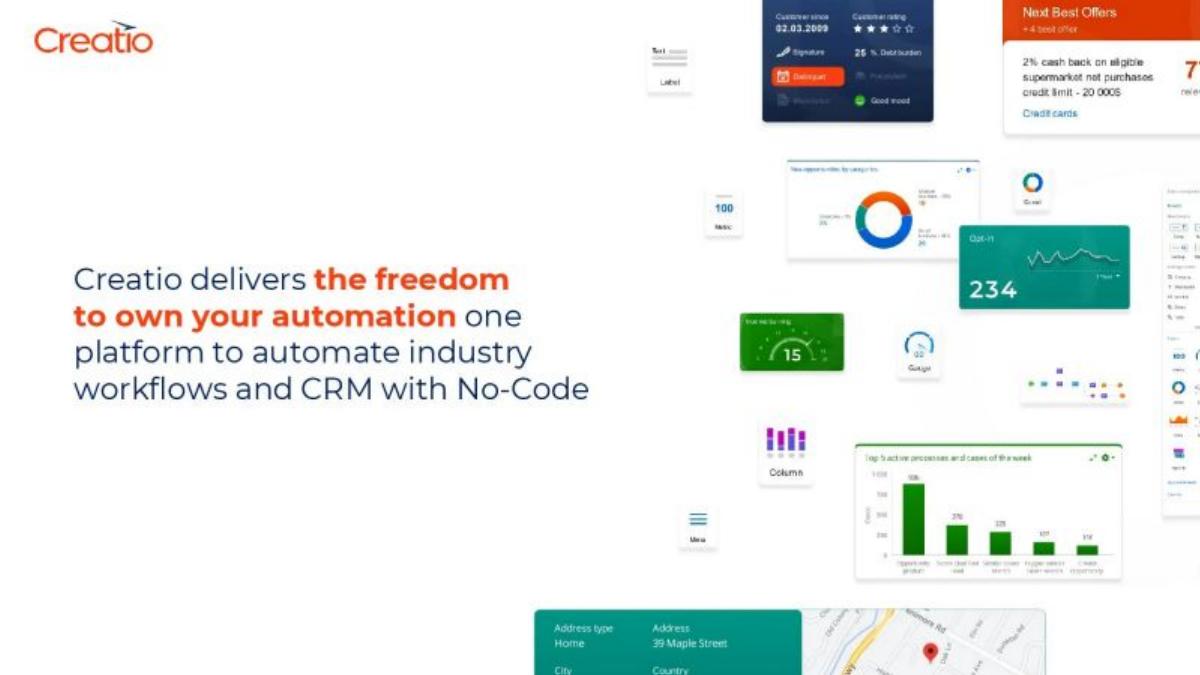
Creatio opens with a bold thematic statement: "The Rise of No-Code." Slide 1 features a clean, professional interface mockup alongside a human element, signaling that their software is designed for people, not just machines. The subtitle, "Unstoppable Innovation," sets an aggressive tone for a Series B raise.
Slide 2 is a classic 'market shift' slide. It charts the history of enterprise software from 1980 to 2030. It categorizes the 1990s as the era of Monolithic architecture and the 2010s as the era of Cloud architecture . By placing Composable no-code architecture as the defining trend of 2020 and beyond, Creatio frames its product not just as a tool, but as an inevitable technological evolution. This narrative is designed to make investors feel they are investing in a paradigm shift rather than a feature set.
Product and AI Integration
Slides 3-4: The Interface and the Copilot
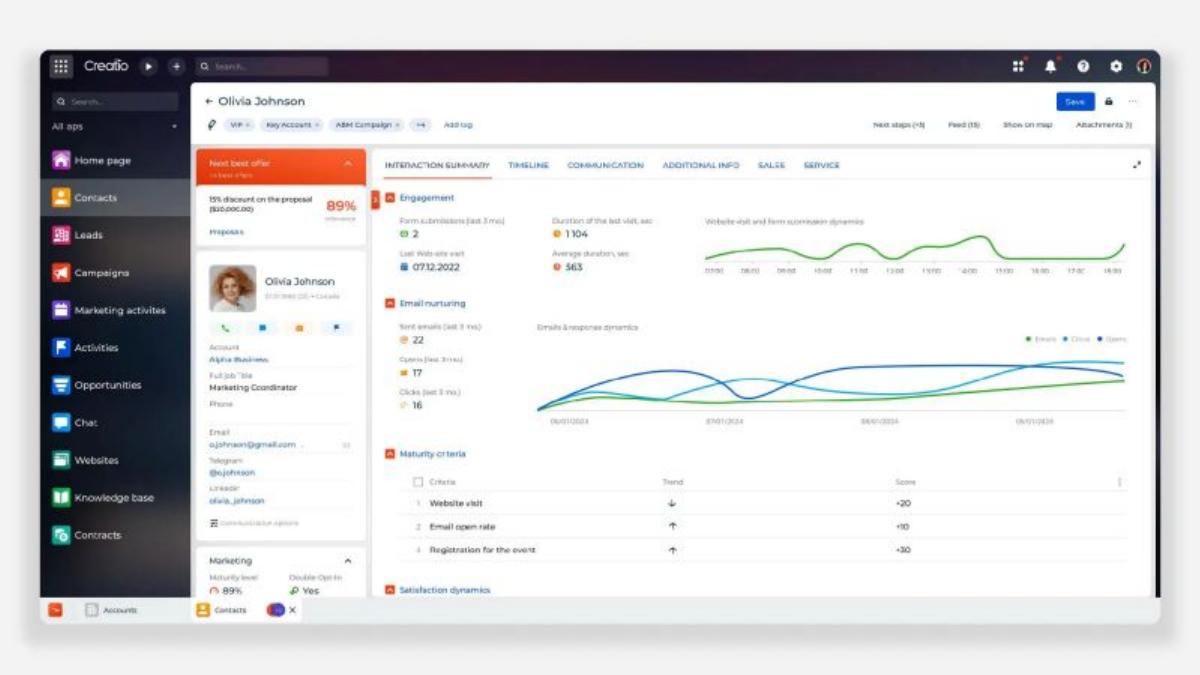
Slide 3 provides a high-fidelity look at the product interface. It shows a CRM dashboard for a contact named "Olivia Johnson," highlighting engagement metrics, email nurturing, and maturity criteria. The UI is modern and data-dense, suggesting a platform capable of handling complex enterprise needs.
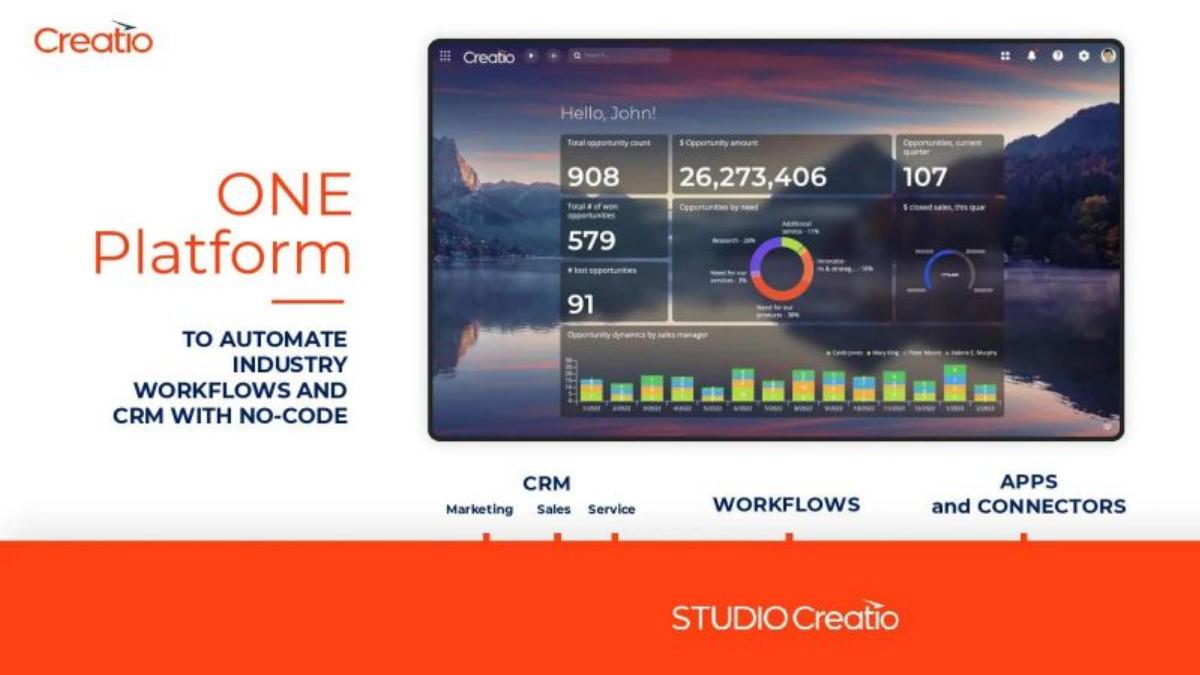
Slide 4 introduces Creatio Copilot . The messaging here is specific: "Gen AI and No-Code deliver tremendous value for mid-size and large enterprises." This is a crucial distinction. By targeting the mid-to-large enterprise segment, Creatio is signaling higher ACVs (Annual Customer Values) and lower churn compared to SMB-focused tools. The visual of the product floating in the clouds is a bit cliché, but it reinforces the 'new era' theme from the previous slides.
Third-Party Validation as a Moat
Slide 5: The Gartner Triple-Threat
This is arguably the most powerful slide in the deck for a Series B investor. Creatio displays three different Gartner Magic Quadrants from 2023. They are recognized as:
A Challenger in Sales Force Automation. · A Leader in B2B Marketing Automation Platforms. · A Visionary in Enterprise Low-Code Application Platforms.
By showing their logo (circled in red) alongside incumbents like Salesforce, Microsoft, and Oracle, they bypass the need for a self-made competitive matrix. They are letting the world’s leading industry analysts do the selling for them. This level of cross-category recognition is rare and suggests a highly versatile platform.
Community and Thought Leadership
Slides 6-7: The Playbook and Global Events
Slide 6 focuses on the No-Code Playbook . With 15,000+ downloads, this represents a significant top-of-funnel lead magnet and establishes the company as a thought leader. The slide lists specific frameworks included in the book, such as the "12 stages of the no-code development lifecycle" and "Governance framework." This indicates that Creatio isn't just selling software; they are selling a methodology for digital transformation.
Slide 7 reinforces this with "No-Code Day events" across major global hubs including Paris, Toronto, Austin, Dubai, and Riyadh. This global physical footprint suggests a mature marketing engine and a community-led growth strategy that is difficult for younger startups to replicate.
R&D Strategy and AI Depth
Slides 8-9: The Roadmap and AI Command Center
Slide 8 outlines the Key R&D Themes : Copilot, Limitless no-code automation, CRM capabilities, and Workflow tools. It’s a balanced roadmap that addresses both the 'shiny' new object (AI) and the core 'bread and butter' of enterprise software (CRM/Workflow).
Slide 9 dives deeper into the Creatio Copilot . It showcases "AI-Powered App Creation" and "AI Scenarios in the Apps." The ability to generate a "Hospital" application or a "Predict case resolution time" scenario via a simple text description demonstrates how AI significantly lowers the barrier to entry for building complex business logic. This is the 'how' behind their promise of "maximum degree of freedom."
The Distribution Engine
Slides 10-11: Global Partner Ecosystem
Slide 10 is a 'logo soup' slide, but it is organized and backed by impressive numbers: 750 active partners in 110 countries, with 250 new partners added in 2023. For a B2B SaaS company, a robust partner channel (including SIs and consultants) is a massive force multiplier for sales. It allows the company to scale revenue without linearly scaling its own headcount.
Slide 11 maps out 150+ in-person events for FY2024. The map shows a heavy concentration in Europe and North America, but with significant activity in Southeast Asia, the Middle East, and South America. This is a clear signal of global ambitions and the infrastructure to support them.
The Ask and Culture
Slides 12-13: Areas of Investment and Values
Slide 12 explicitly states where the Series B capital will go: Driving Innovations in No-code and AI , Expanding The Partner Channel , and Growing One Team . While it doesn't list a dollar amount (the catalogue fact confirms $200M), it aligns the spending with the strengths shown in the previous slides.
Slide 13 is the culture slide. It features a collage of team photos and five core values: Genuine Care, Passion, Strive for Excellence, Grow Every Day, and One Team. In a high-growth environment, showing a cohesive and motivated workforce is a way to de-risk the 'execution' element of the investment.
What Works, What is Missing, and What to Copy
What Works
Third-Party Credibility: Using Gartner charts instead of internal tables is a high-authority move. · Ecosystem Scale: The partner count (750) and playbook downloads (15,000) provide a sense of inevitability. · Strategic Categorization: Positioning no-code as the "New Era" of software creates a compelling macro reason to invest now.
What is Missing
Financial Data: There are no slides showing ARR growth, NRR (Net Revenue Retention), or LTV/CAC ratios in this 14-slide sample. · Team Pedigree: While there is a culture slide, there is no traditional team slide highlighting the founders' or executives' previous successes. · Case Studies: While the product is shown, specific ROI data from named enterprise customers is absent.
What a Founder Should Copy
The 'Era' Slide: If you are building in a crowded space, don't just compare features. Create a timeline that shows why the old way of doing things is obsolete and why your category is the logical next step. The Partner Slide: If you have a channel strategy, visualize the scale. Showing that hundreds of other companies are incentivized to sell your product is a powerful indicator of market fit. The Content Moat: Show that you own the 'manual' for your industry. Creatio’s Playbook proves they aren't just a vendor; they are the authority on no-code.
Frequently asked questions
- What is Creatio's core value proposition according to the deck?
- Creatio positions itself as a 'composable no-code architecture' for mid-size and large enterprises. The deck emphasizes that the combination of Gen AI and no-code delivers 'tremendous value' by allowing organizations to automate workflows and CRM with a high degree of freedom and speed, moving away from the rigid structures of previous software eras.
- How does Creatio demonstrate market traction without showing revenue?
- Instead of raw ARR figures, the deck uses ecosystem metrics as a proxy for scale. This includes 750+ active partners globally, 15,000+ downloads of their proprietary 'No-Code Playbook,' and a schedule of 150+ global events. This suggests a deeply embedded market presence that goes beyond simple customer counts.
- What role does Artificial Intelligence play in their Series B strategy?
- AI is central to their R&D roadmap. Slide 9 introduces 'Creatio Copilot,' which enables AI-powered app creation and the generation of AI scenarios within those apps. By framing AI as a natural extension of no-code, they position themselves to capture the 'Gen AI' tailwinds currently driving enterprise spend.
- How does the deck handle competition?
- Rather than a standard 'check-box' comparison slide, Creatio uses Gartner Magic Quadrants. This allows them to show their position relative to giants like Salesforce, Microsoft, and Oracle. It frames them as a 'Challenger,' 'Leader,' and 'Visionary' across different sectors, providing objective third-party validation of their competitive standing.
- What is missing from this pitch deck sample?
- The provided slides omit several standard venture components: there is no dedicated team slide (though 'One Team' is mentioned as a value), no detailed financial historicals or projections, no specific 'Ask' regarding valuation or terms, and no breakdown of unit economics like CAC or LTV.