Coworker’s 14-slide deck is a masterclass in minimalist, high-conviction storytelling for the generative AI era. Eschewing traditional slides like detailed competition grids or five-year financial projections, the deck focuses heavily on the technical 'moat'—specifically its OM1 organizational memory engine. By claiming to be the first agent capable of 'complex knowledge work' (Slide 3) and demonstrating immediate traction with 25+ companies (Slide 2), the founders successfully argued for a $13M Seed round. The deck relies on a sophisticated 2x2 matrix (Slide 7) to position itself above incum…
Key takeaways
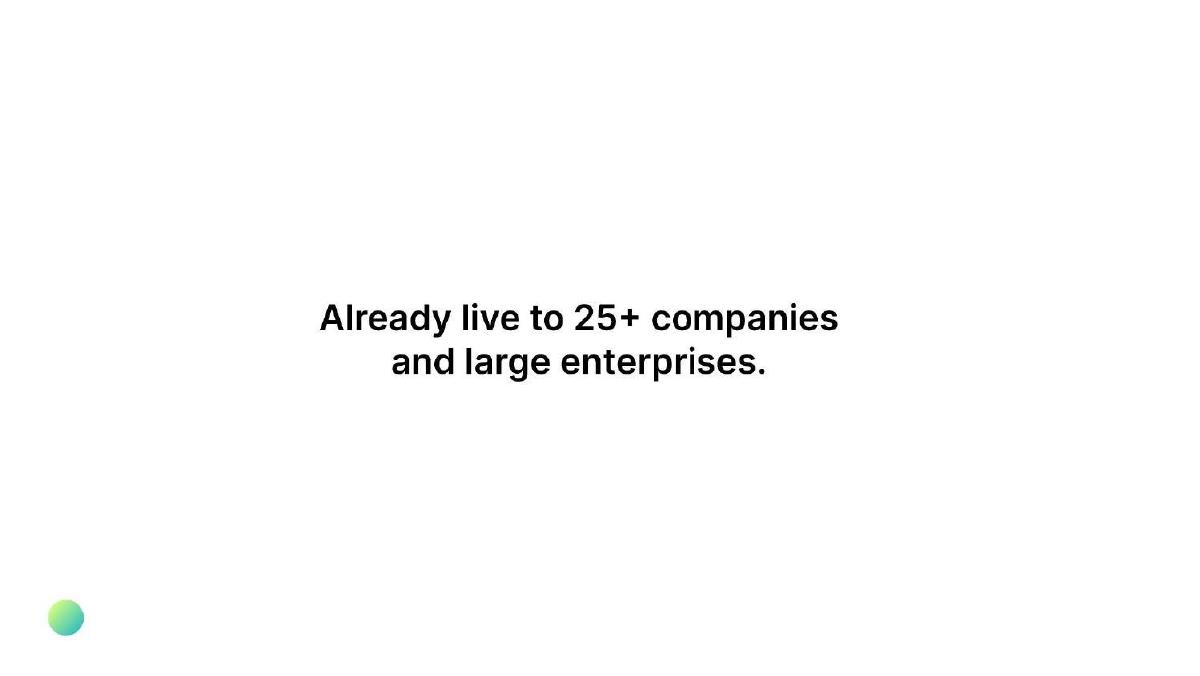
- The company claims immediate market validation, stating they are already live with 25+ companies and large enterprises (Slide 2).
- Coworker positions itself as the first agent capable of performing 'complex knowledge work' within an enterprise setting (Slide 3).
- The technical core is defined by 'OM1,' described as a 'company brain' that builds deep organizational memory (Slide 4).
- The product architecture is split into three pillars: Fully Connected inputs, Organizational Memory (OM1), and Full Output Capabilities (HO1) (Slide 4).
- The platform is model-agnostic, designed to create context 'across any foundational model' (Slide 5).
- Use cases are broad, spanning Engineering (tech debt), GTM (deal tracking), and Product Management (PRD creation) (Slide 6).
- A strategic 2x2 matrix positions Coworker in the 'Deep Context' and 'Full Autonomy' quadrant, contrasting with 'Responsive AI' like Notion or Slack (Slide 7).
- The deck omits traditional fundraising elements such as a team slide, business model, or specific use of funds in the 7 visible slides.
The Vision: A General-Purpose AI Teammate
Coworker’s pitch deck is a product of the 2024 AI boom, where the narrative has shifted from 'chatbots' to 'agents.' The deck is visually sparse, using a clean, white aesthetic with a single gradient orb as the primary brand element. This minimalism suggests a company that is focused on high-level architecture and enterprise-grade sophistication rather than flashy consumer features. The core thesis presented throughout the 14 slides is that for AI to be truly useful in a business, it needs more than just a large language model; it needs a 'brain' that understands the specific context of the company it works for.
Slide 1: The Introduction
The deck opens with a simple title slide: 'Meet Coworker.' There is no subtitle, no mission statement, and no list of founders. This approach relies entirely on the brand name to convey the value proposition. In the context of a $13M raise, this suggests that the investors were likely already familiar with the team or the space, allowing the deck to act as a visual aid for a deeper technical conversation.
Slide 2: Immediate Traction
Slide 2 delivers a quick punch of social proof: 'Already live to 25+ companies and large enterprises.' For a Seed round, this is a significant metric. It moves the conversation from 'what we might build' to 'what is already working.' By mentioning 'large enterprises,' the company signals that its software is robust enough to pass the security and integration hurdles required by major corporations, which is a common pain point for early-stage AI startups.
Slide 3: The Problem/Solution Gap
Slide 3 identifies the specific niche Coworker aims to fill. It claims to be the 'first agent capable of doing complex knowledge work inside enterprises.' The emphasis on the word 'complex' is a direct challenge to the current generation of AI assistants that primarily handle simple summarization or drafting. This slide sets the stage for the technical explanation that follows, implying that existing tools are failing at the 'complex' part of the equation.
Slide 4: The Architecture of the 'Company Brain'
This is arguably the most important slide in the deck. It breaks down the 'Coworker' system into three distinct components: Fully Connected (data ingestion), Organizational Memory (OM1) (the brain), and Full Output Capabilities (HO1) (the hands). By naming these components (OM1, HO1), Coworker is creating proprietary terminology that makes their solution feel like a unique piece of engineering rather than a simple wrapper around an API. The tagline 'The capabilities of a human with the superintelligence of the company behind it' perfectly encapsulates the 'AI Teammate' concept.
Slide 5: Model Agnosticism
Slide 5 clarifies that 'OM1 is purpose built to create deep organizational context across any foundational model.' This is a strategic move to de-risk the investment. By being model-agnostic, Coworker ensures they aren't tied to the success or failure of a single provider like OpenAI or Anthropic. They are positioning themselves as the essential 'context layer' that sits between the enterprise data and whatever LLM happens to be the best at the time.
Slide 6: Multi-Functional Utility
To prove the 'general-purpose' claim, Slide 6 lists specific use cases across three major departments: Engineering, GTM/Sales, and Product Management. The tasks listed are not trivial; they include 'Tech debt management,' 'Customer risk scoring,' and 'PRD creation.' This slide demonstrates that the product is not a vertical tool (like an AI for lawyers) but a horizontal platform that can scale across an entire organization. This breadth is key to justifying a large valuation and a $13M round.
Slide 7: The Competitive Landscape (The 2x2 Matrix)
The final visible slide is a classic 2x2 matrix that maps the AI landscape based on 'Context' and 'Autonomy.' Coworker places itself in the top-right quadrant ('Full Autonomy' and 'Deep Context'). Interestingly, it places well-known tools like Notion, Slack, and Glean in the 'Responsive AI' category, suggesting they are reactive rather than proactive. It also places OpenAI and Anthropic (represented by logos) in the 'LLM' category with 'No Context.' The most telling part of this slide is the grayed-out area in the bottom right, labeled 'Not possible w/out organizational memory,' which reinforces the necessity of their OM1 engine.
What Coworker Does Well
The deck excels at category creation . Instead of calling itself an 'AI assistant,' it uses terms like 'AI Teammate' and 'Organizational Memory.' This helps the company avoid being compared to the hundreds of simple GPT wrappers on the market. By defining a new technical requirement (OM1), they force investors to judge them on their ability to build a 'company brain' rather than just their ability to write prompts.
The minimalist design also works in their favor. In a high-tech sector like AI, a deck that is too busy can feel amateurish. Coworker’s clean lines and simple diagrams suggest a level of technical maturity. Furthermore, the focus on 'Complex Work' is a strong differentiator. Most AI pitches focus on 'saving time' or 'efficiency,' but Coworker focuses on 'capability,' implying that their AI can do things other AIs simply cannot.
What is Missing from the Deck
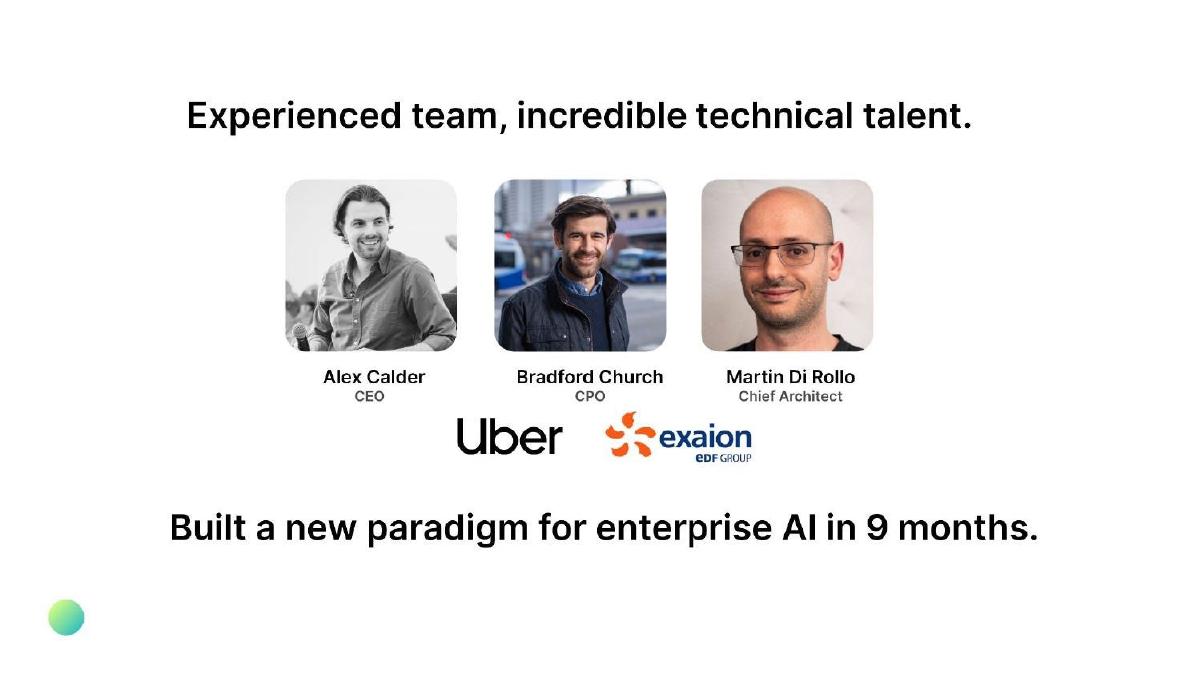
The most glaring omission in the provided slides is the Team Slide . For a $13M Seed round, the pedigree of the founders is usually the primary driver of the investment. Without seeing the team's background in AI, distributed systems, or enterprise sales, it is hard to evaluate the execution risk. Also missing is a Business Model slide. While enterprise AI is often seat-based or usage-based, specifying the intended revenue model would clarify the path to a billion-dollar valuation.
There is also a lack of Case Studies . While Slide 2 mentions 25+ companies, the deck doesn't provide a deep dive into how one of those companies is actually using the tool. A 'before and after' look at a specific process (like PRD creation) would make the 'complex work' claim much more tangible. Finally, the Go-To-Market (GTM) strategy is absent. How does a small startup plan to sell into 'large enterprises' against incumbents like Microsoft and Salesforce? This is a major hurdle that isn't addressed in these slides.
Advice for Founders Copying This Style
If you are building in a crowded space like AI, the 'Coworker approach' of naming your components is a powerful way to build a moat. Don't just say you have a database; call it an 'Organizational Memory Engine.' This creates a 'proprietary' feel even if the underlying tech is standard. However, founders should only use this minimalist style if they have the traction (like the '25+ companies' on Slide 2) or the personal reputation to back it up. Without those two things, a minimalist deck can come across as vague or unprepared.
Additionally, the 2x2 matrix on Slide 7 is a great example of how to frame competition. Instead of a checklist of features, Coworker uses 'Context' and 'Autonomy' as the axes. This allows them to group all their competitors into one 'inferior' bucket while carving out a unique space for themselves. When building your own matrix, choose axes that highlight your specific technical advantage, just as Coworker did with 'Organizational Memory.'
Frequently asked questions
- What is the primary technical differentiator for Coworker?
- According to Slide 4 and Slide 5, the differentiator is 'OM1,' an organizational memory engine. It is designed to ingest company apps and data to create a 'company brain.' This allows the AI to have deep context that foundational models like GPT-4 lack on their own, enabling the agent to perform complex tasks rather than just answering simple queries.
- How does Coworker compare itself to other AI tools like Notion or Glean?
- On Slide 7, Coworker uses a 2x2 matrix. It places tools like Notion, Slack, and Glean in the 'Responsive AI' category, which requires lower context or offers less autonomy. Coworker positions its roadmap (OM1 to HO1 to AO1) in the top-right quadrant, aiming for 'Full Autonomy' and 'Deep Context,' which they claim is not possible without organizational memory.
- What specific tasks can the Coworker AI perform?
- Slide 6 lists several functions. For Engineering, it handles tech debt management and PR reviews. For GTM/Sales, it performs funnel optimization and customer risk scoring. For Product Management, it assists with roadmap planning and PRD (Product Requirement Document) creation. The deck emphasizes that the agent is 'general-purpose' across these business functions.
- Is there evidence of product-market fit in the deck?
- Slide 2 explicitly states that the product is 'Already live to 25+ companies and large enterprises.' While it does not list specific revenue figures or logos, this early traction in the enterprise sector is a strong signal for a Seed stage company, especially when paired with the breadth of functions described on Slide 6.
- What is missing from this pitch deck?
- The provided slides lack a Team slide, which is usually critical for a $13M Seed round to verify the founders' technical pedigree. It also omits a Business Model slide (pricing), a detailed Competition slide (beyond the matrix), a Financial Projections slide, and a specific 'Ask' slide detailing how the $13M will be spent.