Crazy Town's October 2017 investor deck presents a hybrid business model that combines physical co-working spaces with a scalable 'co-working as a service' layer. At the time of the pitch, the company operated three Finnish locations (Jyväskylä, Hämeenlinna, and Tampere) serving over 100 companies and 350 professionals. The deck emphasizes a shift away from pure real estate toward community-driven 'Hollywood models' of ad hoc project teams. Financially, the company sought a modest 210,000 EUR investment in exchange for 23.3% equity, valuing the business at approximately 900,000 EUR post-money…
Key takeaways
- The company defines its mission as building a community for freelancers and startups to 'go further together' (Slide 1).
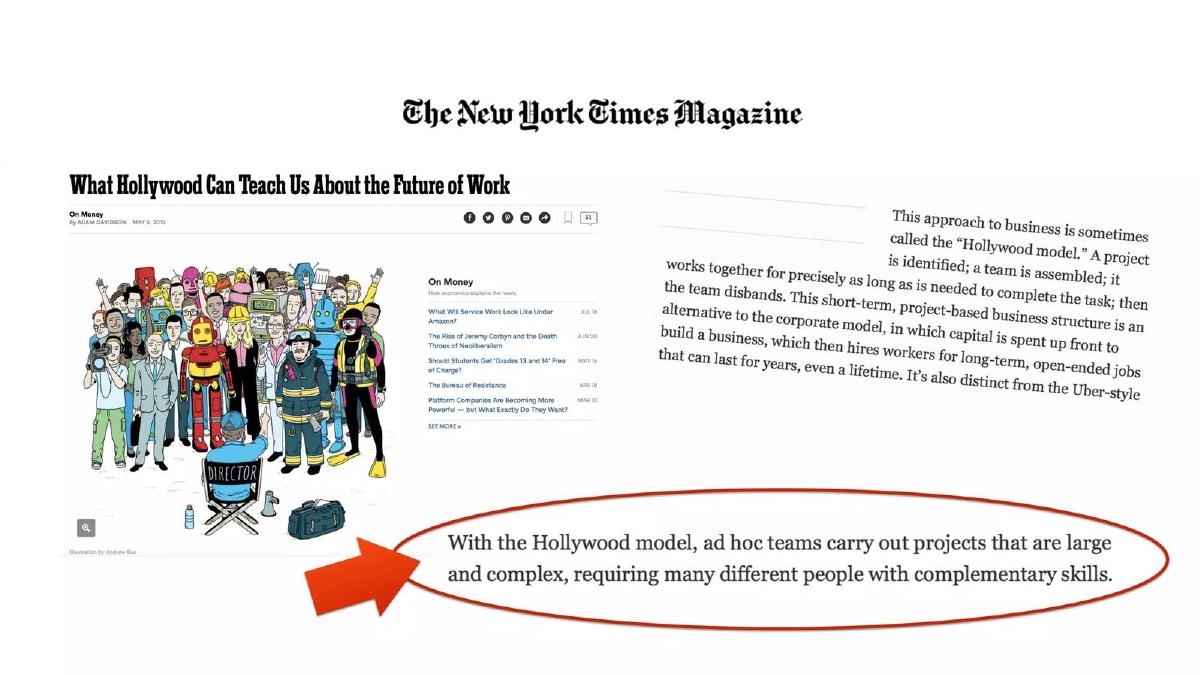
- Crazy Town utilizes the 'Hollywood model' of work, facilitating ad hoc teams for complex projects (Slide 2).
- Pricing is transparently tiered from 195 EUR for a hotdesk to 790+ EUR for 'Team Plus' organizations (Slide 3).
- As of the deck date, the company managed 2,450 square meters across three Finnish cities (Slide 4).
- The product roadmap transitions from 'difficult to scale' consulting to '100% scalable' virtual memberships and services brokering (Slide 5).
- Competitive positioning places Crazy Town in the high-community, high-business-maturity quadrant compared to Regus and WeWork (Slide 6).
- The total addressable market in Finland is estimated at 738,000 to 1.2 million individuals (Slide 8).
- The investment ask is 210,000 EUR for 23.3% ownership, priced at 300 EUR per share (Slide 9).
Slide-by-Slide Analysis
Slide 1: Title and Mission
The cover slide introduces the brand 'Crazy Town' with a red, abstract geometric logo. The subtitle defines the target audience: freelancers, solopreneurs, micro-sized companies, and startups. The core value proposition is stated as building a community for those who want to "go further together rather than alone." The date 10/2017 establishes the context of the Finnish co-working market before the global industry consolidation.
Slide 2: The Hollywood Model
This slide uses a New York Times Magazine clipping to establish the 'Problem/Solution' context. It highlights the "Hollywood model" of work, where ad hoc teams with complementary skills assemble for specific projects. This serves as the philosophical foundation for Crazy Town's community-building efforts, suggesting that their spaces are not just offices, but hubs for project-based collaboration.
Slide 3: Membership Packages
Crazy Town presents a clear, four-tier pricing strategy. Hotdesk is priced at 195 EUR + VAT/month; Fixed Desk at 290-320 EUR; Team starting from 590 EUR; and Team Plus starting from 790 EUR. Notable terms include 24/h access for all tiers and a low-friction 'one month notice period' for hotdesks, while larger team rooms require a 3-month deposit. This slide provides the necessary transparency for an investor to understand the primary revenue drivers.
Slide 4: Current Footprint
The deck highlights three active locations in Finland: Jyväskylä (600 m2), Hämeenlinna (350 m2), and Tampere (1050 + 500 m2). The Tampere location is noted as having opened recently in April 2017. With 100 member companies and 350 professionals, the company demonstrates existing traction. Crucially, the slide notes that physical space is 'only a small part' of the goal, signaling a move toward a service-based model.
Slide 5: Product Scalability Roadmap
This is a strategic pivot slide. It maps products on a spectrum from "Difficult to scale" (Consulting) to "100% scalable" (Virtual memberships and Services brokering). It categorizes current offerings like physical memberships as 'in production,' while 'Powered by CT' (a licensing or management model) is 'under development.' This is intended to reassure investors that the business is not limited by the capital-intensive nature of real estate.
Slide 6: Competitive Landscape
The company uses a standard 2x2 matrix. The X-axis ranges from 'Focus on real estate' to 'Focus on community,' and the Y-axis from 'Early stage business' to 'Established businesses.' Crazy Town places itself in the top-right quadrant (High Community / Established Business). They position WeWork and M.O.W. as closer to the center, while Regus and Technopolis are relegated to the 'real estate' focused left side.
Slide 7: Expansion Roadmap (Winter 2017-2018)
A map of Finland illustrates the growth plan. It identifies specific cities for new units (Lahti, Kuopio) and 'Powered by CT' partner locations (Äänekoski, Mikkeli). The slide also mentions a training program (Y-Koulu) in cooperation with Fennia and an accelerator program (#digirockstars). Interestingly, it mentions a connection to "+300 identified business needs in China," though no further detail is provided on how this translates to revenue.
Slide 8: Total Market in Finland
The market sizing slide estimates a total workforce of 2.46 million in Finland, with 30% being location-independent. They calculate a total market size of 738,000 to 1.2 million individuals. The slide presents a table showing that even a 1% market share of virtual memberships would yield 518,400 EUR, while 1% of physical memberships would yield 16.8 million EUR. These figures are speculative but grounded in basic workforce statistics.
Slide 9: The Ask (Financials)
The financial slide is direct. The company is looking for 210,000 EUR . This is calculated as 700 shares at 300 EUR per share. The resulting equity stake for the new investors would be 23.3%. This implies a pre-money valuation of approximately 690,000 EUR and a post-money valuation of 900,000 EUR. There are no mentions of use of funds or burn rate on this slide.
Slide 10: Contact and Leadership
The final slide features Mikko Markkanen , Co-founder and CEO. It provides his direct phone number and email, along with the company's social media links. While it puts a face to the company, it is the only slide in the 10-slide sample that mentions personnel, leaving the rest of the team's composition unknown to the reader.
What Works
Clear Revenue Tiers: Slide 3 removes all ambiguity about how the company makes money today. The pricing is specific and the terms (deposits, notice periods) are clearly defined. · Scalability Argument: Slide 5 is the most important slide for a venture investor. By acknowledging that physical real estate is hard to scale and presenting a 'Virtual' and 'Powered by' alternative, the founders show they understand the limitations of their current model. · Geographic Focus: The deck doesn't try to claim global dominance immediately. It focuses on winning the Finnish market city-by-city, which feels achievable given the requested 210k EUR.
What is Missing
Historical Financials: There is no slide showing past revenue growth, P&L, or EBITDA. For a company already operating three locations, this is a significant omission. · Unit Economics: Investors need to know the cost to build out a square meter versus the expected return. The deck provides pricing but not the cost side of the real estate equation. · Team Depth: Only the CEO is mentioned. A co-working space is an operations-heavy business; the lack of information on community managers, operations leads, or tech leads (for the 'scalable' products) is a weakness. · Use of Funds: While the ask is clear (210k EUR), the deck does not specify how that money will be spent (e.g., marketing, new lease deposits, or software development for virtual memberships).
Founder's Guide: What to Copy
The 'Hollywood Model' Hook: Using a recognized concept from a reputable source (NYT) to explain a complex social shift is a great way to build immediate credibility for a 'community' play. · The Scalability Spectrum: If you are in a low-margin or capital-intensive business (like hardware or real estate), use a slide like Slide 5 to show how you will eventually layer on high-margin, scalable software or service revenue. · Simple Equity Math: Slide 9 is a model of clarity. Instead of hiding behind complex convertible note terms, it states the share price, the number of shares, and the resulting percentage. This is very effective for seed-stage rounds.
Frequently asked questions
- What is the core business model of Crazy Town?
- Crazy Town operates a hybrid model. While it manages physical co-working spaces in Finland, the deck explicitly states that physical space is 'only a small part of the offering.' The company aims to deliver 'co-working as a service,' which includes ecosystem partnerships, virtual memberships, and services brokering to create a more scalable revenue stream than traditional real estate leasing.
- How does Crazy Town differentiate itself from competitors like WeWork or Regus?
- According to their competitive matrix on slide 6, Crazy Town differentiates through a heavy focus on 'community' and 'established businesses.' They position themselves away from 'real estate' focused players like Regus and Technopolis, and away from 'early stage' focused entities like student societies (Aaltoes) or typical accelerators, aiming for a middle ground of professional maturity and high social interaction.
- What are the specific financial terms of the 2017 fundraise?
- The company was seeking a total investment of 210,000 EUR. This was structured as the sale of a maximum of 700 shares at a price of 300 EUR per share. Successfully raising this amount would result in the new investors holding a 23.3% ownership stake in the company, Crazy Town Oy.
- What geographic regions does Crazy Town target?
- The deck focuses exclusively on the Finnish market. At the time of writing, they were in Jyväskylä, Hämeenlinna, and Tampere. Their expansion roadmap (Slide 7) included new units or 'Powered by CT' partner locations in Lahti, Kuopio, Mikkeli, Äänekoski, and Helsinki (Kamppi), as well as identifying business needs in China.
- What is the 'Hollywood model' mentioned in the deck?
- The 'Hollywood model' refers to a project-based business structure where ad hoc teams are assembled to complete a specific, complex task and then disbanded. Crazy Town positions its community as the infrastructure that allows freelancers and micro-companies to find complementary skills and execute these large-scale projects without the overhead of a traditional corporate structure.