Pearpop’s pitch deck for its $18M Series A round centers on solving the 'manual and unpredictable' nature of creator marketing. By positioning itself as a technology platform rather than an agency, Pearpop emphasizes speed and measurability, specifically moving the industry toward CPM, CPV, and CPA models. The deck reveals significant traction, including over 200,000 creators on the platform and more than $10 million in payouts. A key strategic highlight is the focus on micro-influencers, with 71% of payouts going to creators with fewer than one million followers. The presentation introduces…
Key takeaways
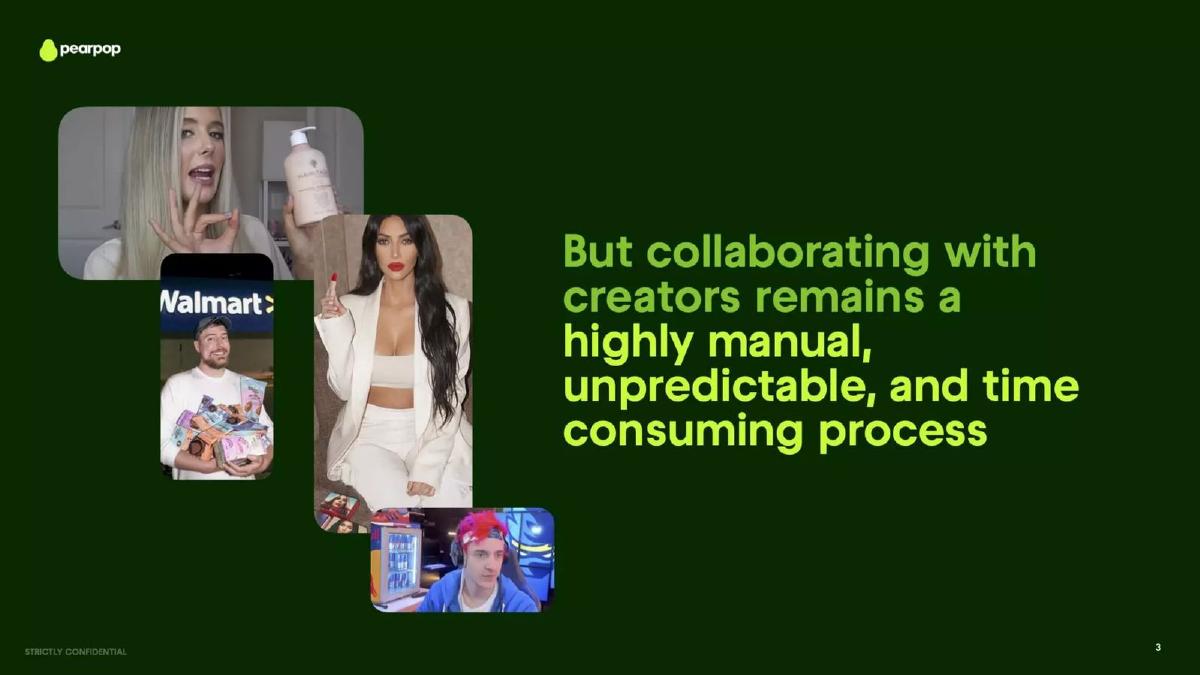
- Pearpop identifies the core problem as creator collaboration being a 'highly manual, unpredictable, and time consuming process' (Slide 3).
- The platform enables brands to stop paying for follower counts and start paying for verified views and engagements on a CPM, CPV, or CPA basis (Slide 7).
- Traction is evidenced by $10M+ paid out to creators and a network of 200,000+ individuals (Slide 9).
- The company prioritizes the 'long tail' of creators, with 71% of payouts going to those with less than 1M followers (Slide 9).
- The 'Ovation' product aims to mobilize a brand's existing userbase for on-demand influence based on performance achievements (Slide 13).
- Pearpop is developing 'Passport Protocol' to create a unified, measurable value for creators both on and off-chain (Slide 15).
- The leadership team features executives with experience from major tech and media firms including TikTok, Shopify, Tinder, and Netflix (Slide 18).
- The deck omits a specific 'Ask' slide, detailed revenue figures, and a competitive landscape analysis in this 10-slide selection.
Pearpop Series A Teardown: The Shift to Performance Influencer Marketing
Pearpop’s $18M Series A deck is a masterclass in positioning a service-heavy industry as a scalable technology product. By focusing on the friction of manual collaboration and the lack of measurable ROI, Pearpop pitches a future where influencer marketing looks more like programmatic advertising than talent management.
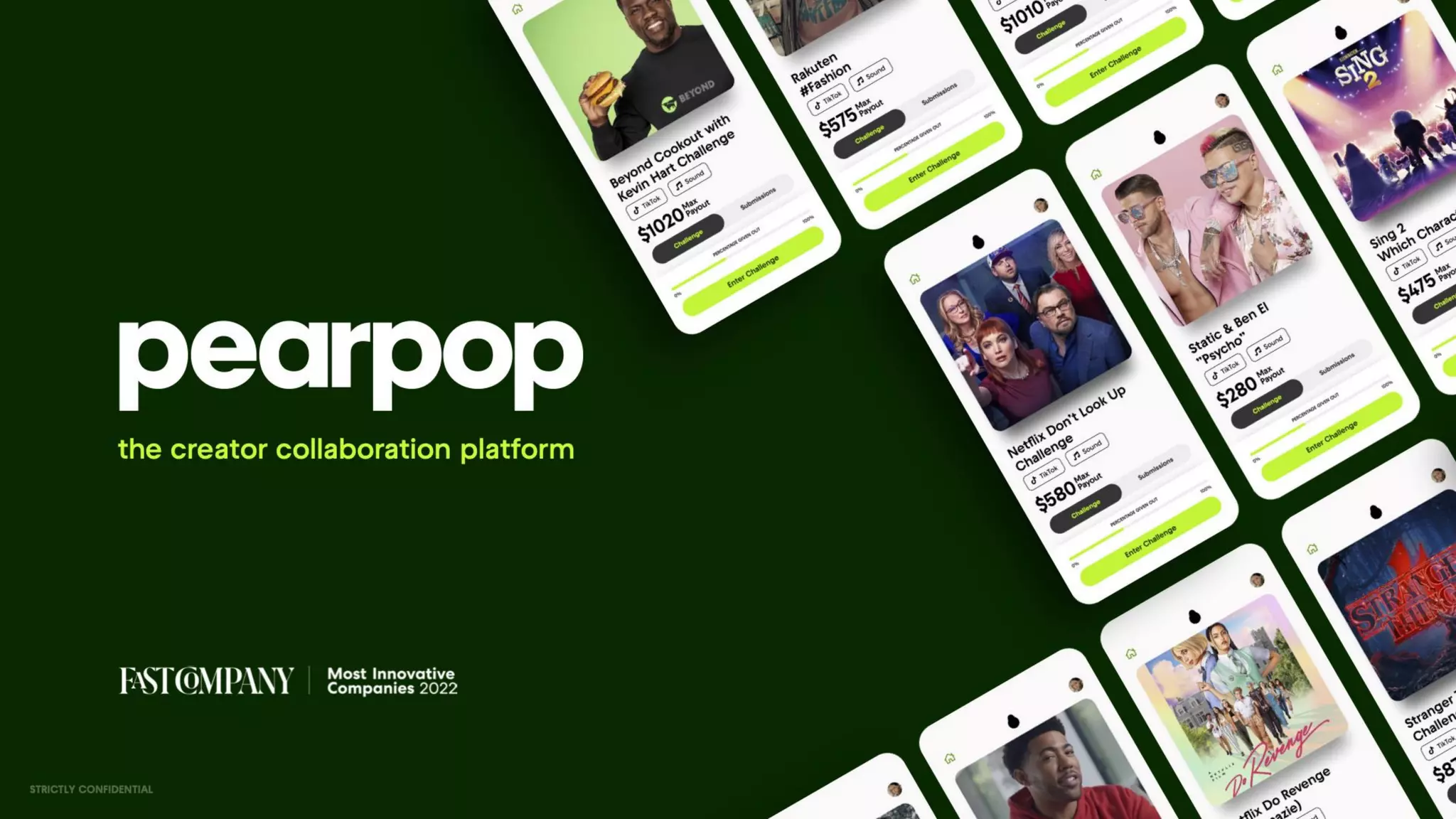
Slide 1: Title and Social Proof
The cover slide establishes the brand identity immediately with its signature green color palette. Notably, it includes a 'Fast Company Most Innovative Companies 2022' badge. For a Series A pitch, this kind of external validation serves as a powerful hook, signaling to investors that the company has already captured market attention and industry respect before the first word of the pitch is read.
Slide 3: The Problem Statement
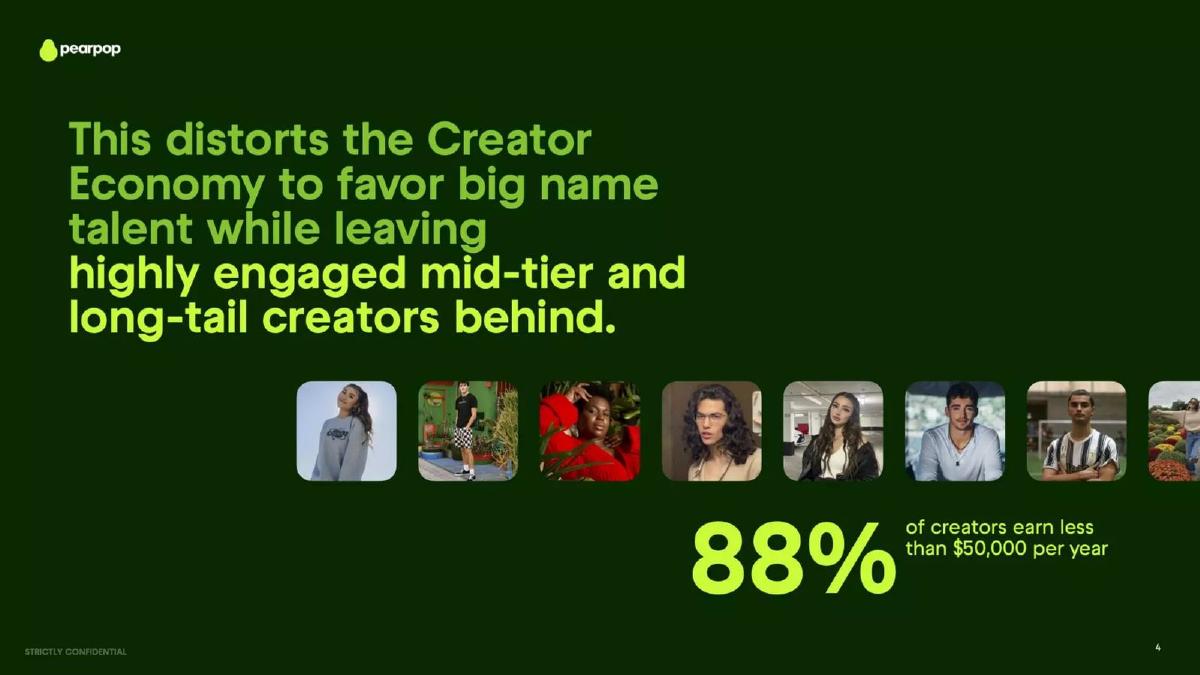
Pearpop identifies the status quo of creator marketing as 'highly manual, unpredictable, and time consuming.' The visuals use high-profile creators like MrBeast and Kim Kardashian to represent the current landscape, but the text focuses on the operational inefficiency. This is a classic 'hair on fire' problem for brands: they want to spend money on creators but are throttled by the sheer amount of human labor required to manage individual relationships.
Slide 5: The 'What If' Transition
This is a standard bridge slide. It asks the investor to imagine a world where influencer marketing is 'tech-enabled, measurable, and virtually instant.' By using these three specific adjectives, Pearpop sets the criteria by which its own solution will be judged in the subsequent slides.
Slide 7: The Solution and Business Model
Slide 7 is the meat of the platform's value proposition. It breaks down the solution into three pillars: Simpler/Faster/Better, Performance-Based, and Authentic/Brand Safe. The most important detail here is the mention of 'CPM, CPV, or CPA basis.' This tells investors that Pearpop is moving the industry away from 'pay-for-post' (which is hard to scale) to 'pay-for-results' (which is how the largest digital ad budgets are spent).
Slide 9: Traction and Market Dynamics
The metrics on Slide 9 are impressive for a Series A. $10M+ paid out to creators proves the marketplace has liquidity. However, the most strategic data point is the '71% paid to creators with less than 1M followers.' This demonstrates that Pearpop isn't just a tool for celebrities; it is a platform that unlocks the 'long tail' of the creator economy, which is where the majority of the market volume resides.
Slide 11 & 13: Product Evolution (Ovation)
Slide 11 introduces 'Ovation' as the next step. Slide 13 explains it as a way for brands to 'instantly activate your userbase.' This moves Pearpop from a marketplace where brands find new creators to a CRM-like tool where brands can turn their existing customers into influencers. The mockup shows specific 'Achievements' based on performance, further reinforcing the performance-marketing angle.
Slide 15: The Data Play (Passport Protocol)
With 'Passport Protocol,' Pearpop pitches a data play. By aggregating data from 200,000+ creators, they aim to create a standardized 'value' for creators that works 'on and off platforms, on and off chain.' This is a high-level vision slide meant to show that Pearpop isn't just a marketplace, but potentially the underlying data infrastructure for the entire creator economy.
Slide 18: The Leadership Team
The team slide is exceptionally strong for this stage. Rather than just listing names, it prominently features the logos of where these individuals came from: Tinder, TikTok, Shopify, Netflix, and Accenture. This gives investors confidence that the team has the 'DNA' required to build a platform that sits at the intersection of social media, e-commerce, and entertainment.
What Works in the Pearpop Deck
Focus on Scalability: The deck repeatedly emphasizes that the platform is 'tech-enabled' and 'instant.' This is crucial for a venture-backed startup; investors want to see a software platform, not a glorified ad agency that requires more headcount for every new client.
Performance Metrics: By adopting the language of traditional digital advertising (CPM, CPA), Pearpop makes it easy for brands (and investors) to understand how this fits into a larger marketing budget. It removes the 'mystery' of influencer pricing.
Long-Tail Strategy: Highlighting that 71% of payouts go to micro-influencers is a brilliant move. It proves the platform can handle high-volume, low-touch transactions, which is much harder to replicate than a few high-value celebrity deals.
What is Missing from the Pearpop Deck
Unit Economics: While the deck mentions $10M+ paid to creators, it does not state Pearpop's take rate or gross margins. For a marketplace, understanding the spread between what a brand pays and what a creator receives is vital for evaluating the business model.
Competitive Landscape: The creator economy is a crowded space with many marketplaces (e.g., Grin, Captiv8). This deck does not explicitly address how Pearpop's technology or data protocol is defensible against these incumbents.
The Ask: In this version of the deck, there is no slide detailing how much capital is being raised or how it will be allocated. While common in public versions of decks, it leaves the 'so what?' of the presentation unanswered.
What Founders Should Copy
The 'Problem-Solution' Bridge: Slide 5 is a perfect example of how to reset the investor's mindset before showing the product. It defines the 'ideal state' so that the product slides feel like a logical fulfillment of that vision.
Visualizing the Network: Slide 9 uses a 'bubble' visualization for its 200k creators. This is much more effective than a simple bar chart because it visually represents the diversity and scale of the community they have built.
Leveraging Past Logos: The team slide (Slide 18) is a masterclass in using previous employers to build credibility. If you have team members from recognizable tech giants, their logos should be as large as their headshots.
Frequently asked questions
- What is Pearpop's primary value proposition for brands?
- Pearpop moves influencer marketing away from manual negotiations and arbitrary pricing based on follower counts. According to slide 7, the platform allows brands to collaborate instantly and pay based on performance metrics like CPM (cost per mille), CPV (cost per view), or CPA (cost per acquisition), making the spend predictable and measurable.
- How does Pearpop handle the long-tail creator market?
- The deck highlights that 71% of payouts go to creators with fewer than one million followers (Slide 9). This suggests a strategy focused on micro-influencers who often have higher engagement rates and lower costs than celebrity-tier creators, allowing brands to achieve scale through volume rather than individual high-cost partnerships.
- What are 'Ovation' and 'Passport Protocol'?
- These represent Pearpop's expansion beyond a simple marketplace. Ovation (Slide 13) is a tool for brands to activate their own community for influence. Passport Protocol (Slide 15) is a data layer intended to provide a 'predictable and measurable value' for creators across different social platforms and even on-chain environments.
- Which social media platforms does Pearpop support?
- Slide 7 explicitly mentions that the platform allows brands to collaborate with creators across TikTok, Instagram, and Twitter. The visual mockups on Slide 13 also show integrations for Instagram Reels, indicating a focus on short-form video content which is currently the high-growth sector of creator marketing.
- Who is behind the Pearpop leadership team?
- The team is composed of seasoned executives from high-growth tech companies. Notable members include Alex Morrison (ex-Grey/R/GA), Rebecka Marcucci (ex-Tinder), Sam Christie (ex-TikTok), and Arik Betesh (ex-Netflix). This suggests a blend of advertising agency experience and platform-side operational expertise (Slide 18).