WeFitter’s 11-slide deck from 2015 is an exceptionally lean presentation that prioritizes macro-economic impact and clear financial incentives over technical complexity. The deck identifies a $68B problem in corporate health and counters it with a simple $5-$10 per employee monthly subscription model. With a focus on API-driven health data integration and gamification, the company demonstrated strong early traction, showing a 22% month-over-month growth rate and reaching $33k MRR by June. While the deck lacks a formal 'Ask' slide and detailed competitor analysis, its strength lies in its 'Res…
Key takeaways
- The deck leads with a massive $68B figure on Slide 2 to establish the scale of the corporate health problem.
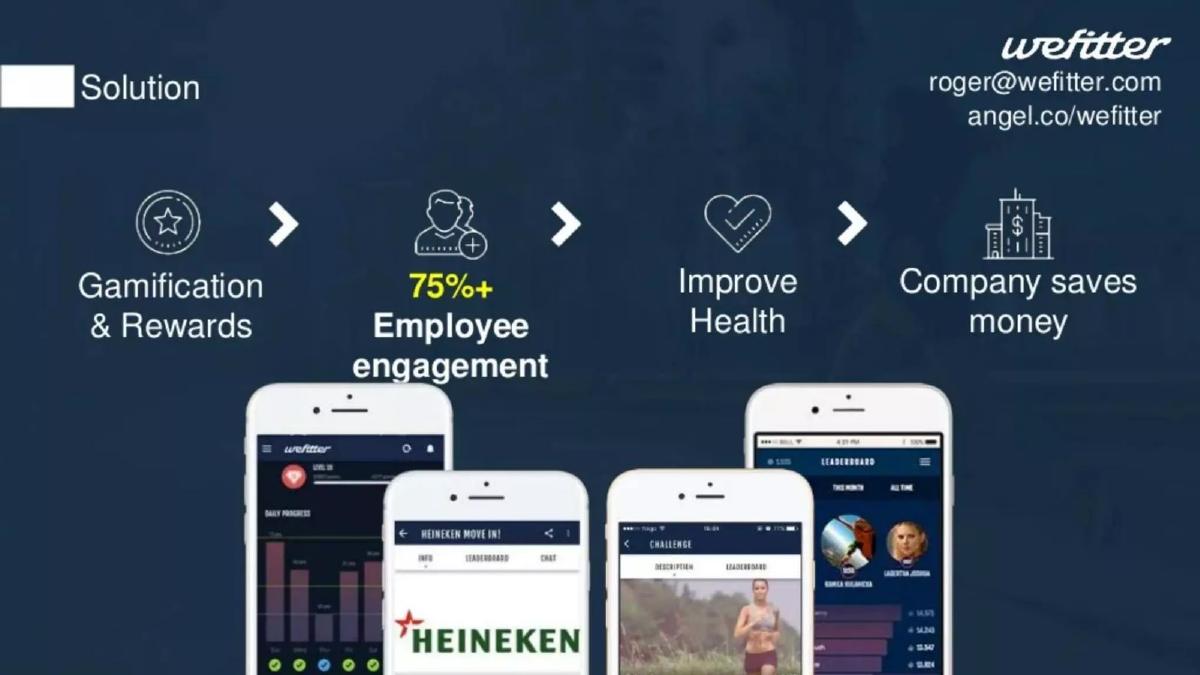
- WeFitter claims to achieve 75%+ employee engagement through gamification and rewards on Slide 4.
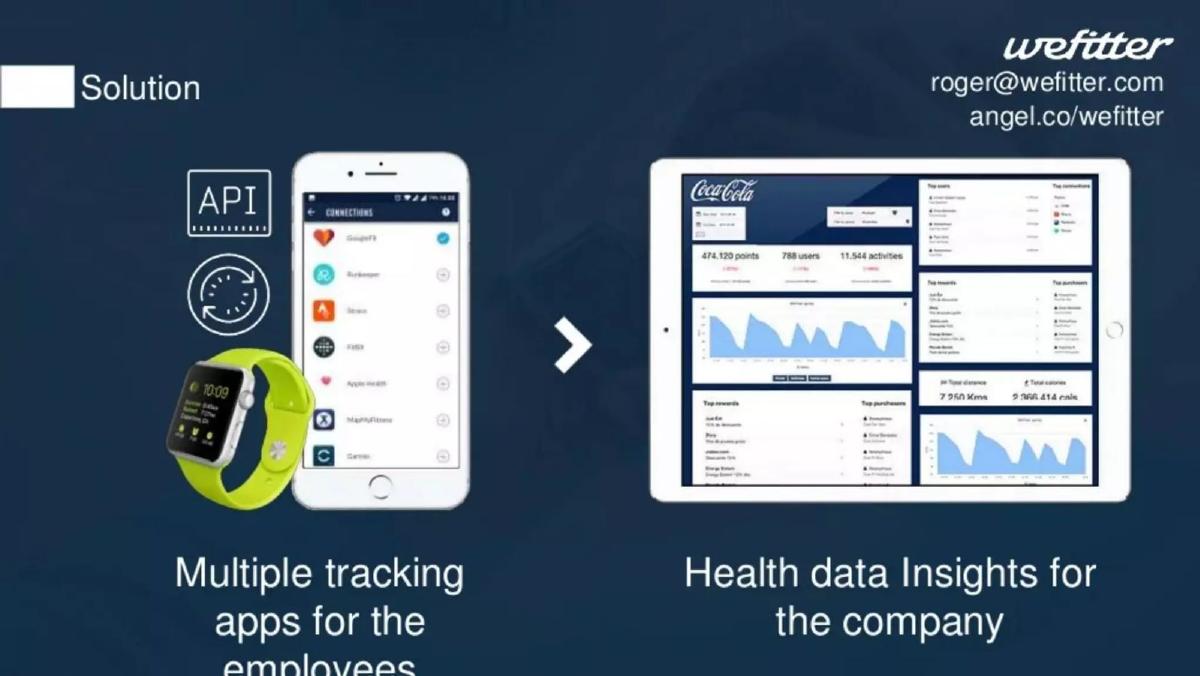
- The product functions as a bridge between multiple tracking apps and corporate health data insights, as shown on Slide 5.
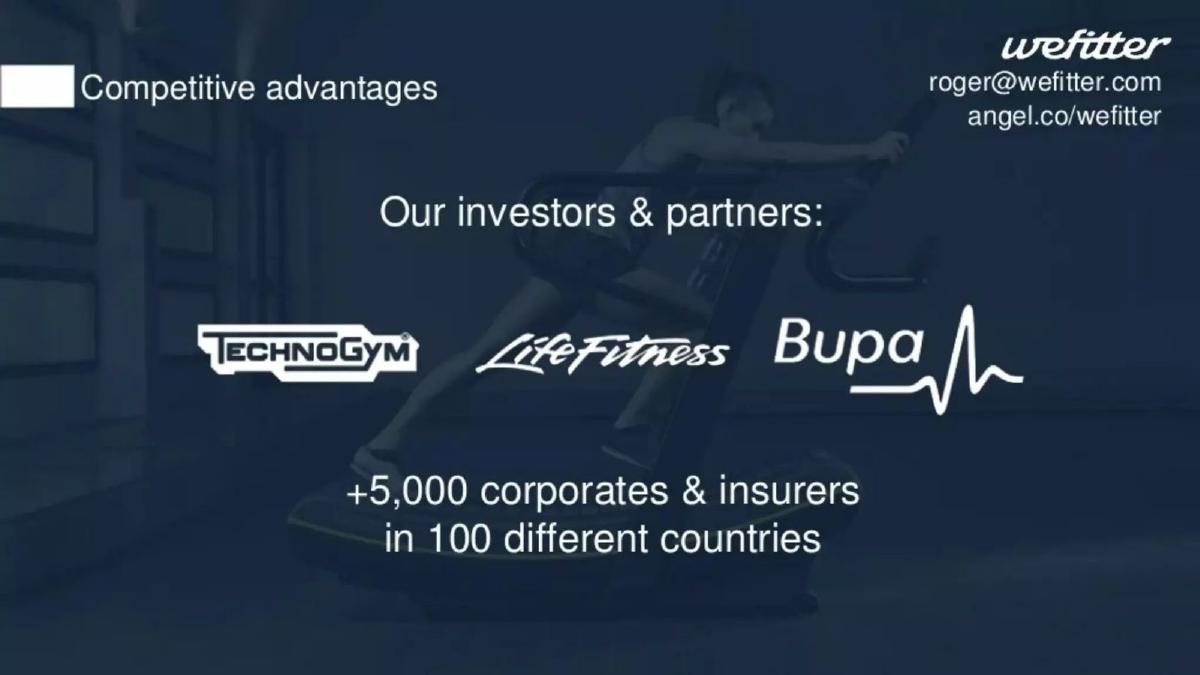
- Strategic partnerships with industry giants like Technogym, Life Fitness, and Bupa are highlighted as competitive advantages on Slide 6.
- The company quantifies its impact as $2,500 in savings per employee per year on Slide 7.
- The business model is a straightforward SaaS play, charging $5-$10 per employee per month (Slide 8).
- Traction is visualized with a steep growth curve, reaching $33k MRR and 22% MoM growth by June (Slide 9).
- The founding team leverages past experience at major corporations like P&G, Mitsui & Co., and Coca-Cola to build credibility (Slide 10).
The WeFitter Seed Deck: A Study in ROI-Driven Minimalism
The 2015 WeFitter deck is a classic example of the 'less is more' philosophy in startup fundraising. Spanning only 11 slides, it avoids the dense blocks of text and complex architectural diagrams that often plague health-tech presentations. Instead, it focuses on three pillars: the massive cost of the problem, the quantifiable ROI of the solution, and the undeniable momentum of their traction. By the time an investor reaches the end of the deck, the message is clear: health data is fragmented, companies are losing billions, and WeFitter has a scalable API to fix it.
The Hook: Problem and Scale (Slides 1-3)
Slide 1: Title The deck opens with a high-contrast cover slide featuring the logo and the tagline: 'Turning companies into engaged and active communities.' The background image of professionals walking suggests a corporate B2B focus immediately.
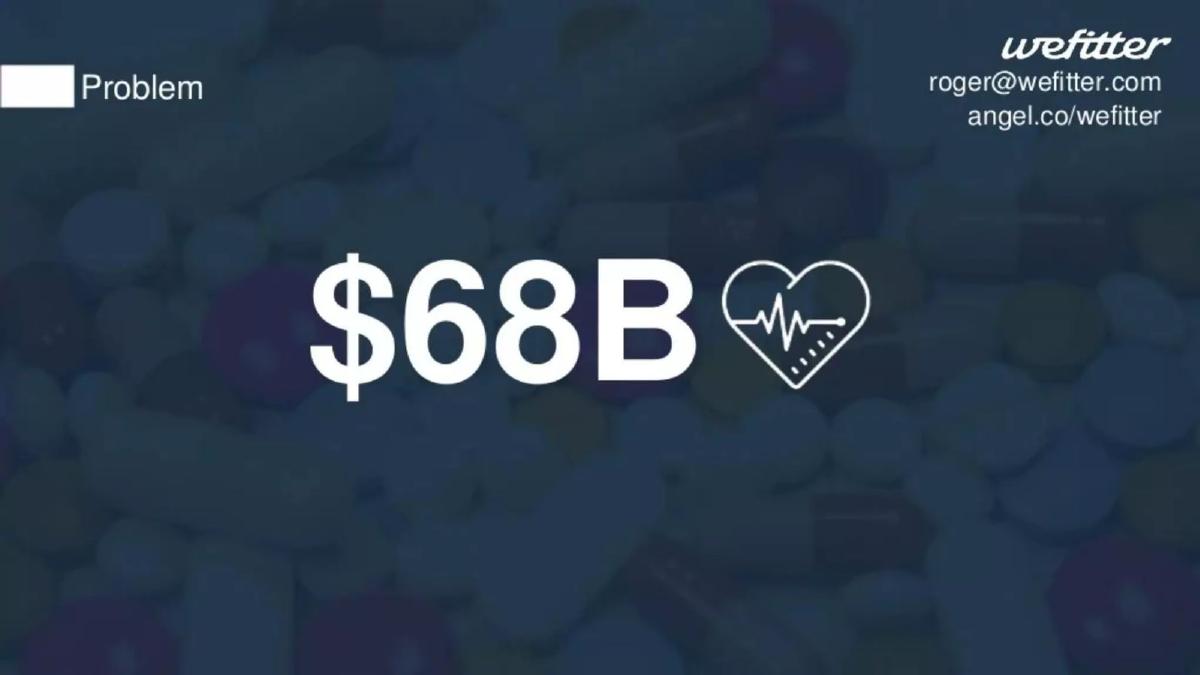
Slide 2: The $68B Problem WeFitter uses a 'big number' strategy here. There is no explanatory text, just '$68B' and a heart-rate icon. This forces the presenter to explain the figure (likely the cost of sedentary lifestyles or corporate healthcare spend) while keeping the audience focused on the scale of the opportunity.
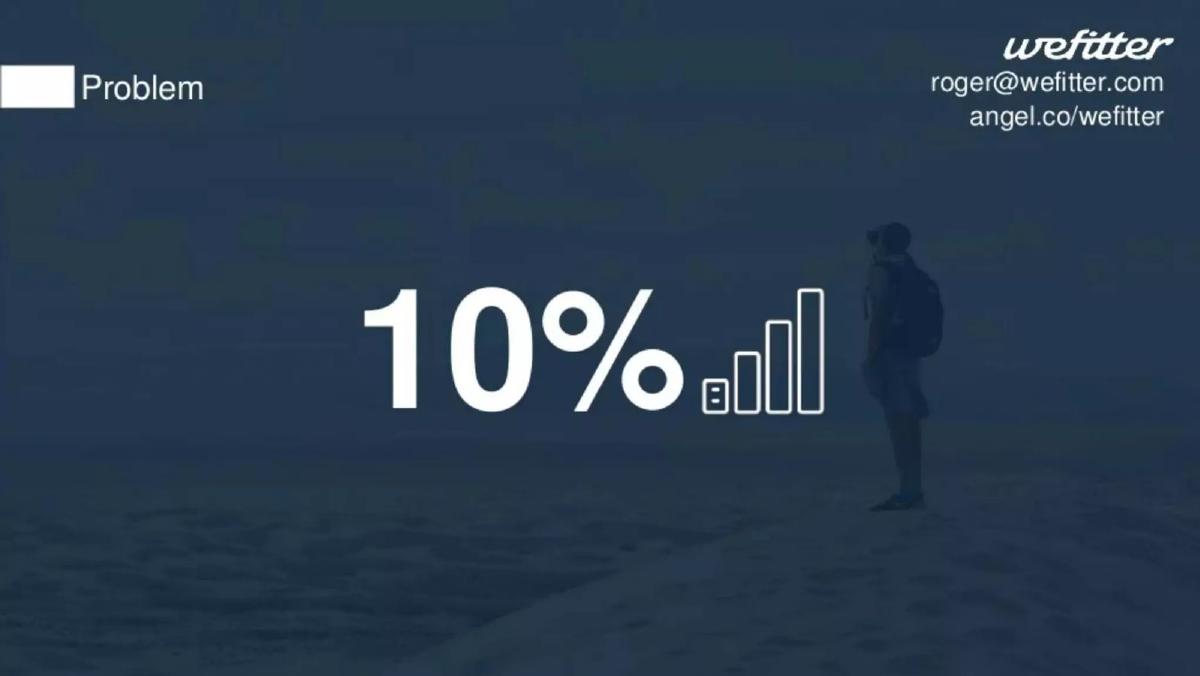
Slide 3: The Engagement Gap A second problem slide shows '10%' next to a signal-strength icon. In the context of the company's mission, this likely refers to the low engagement rates of traditional corporate wellness programs. By highlighting a 10% baseline, they set the stage for their own '75%+' engagement claim later in the deck.
The Solution: Gamification and Integration (Slides 4-5)
Slide 4: The Process This slide introduces the WeFitter solution as a four-step linear journey: Gamification & Rewards leads to 75%+ Employee Engagement, which leads to Improved Health, finally resulting in 'Company saves money.' The slide features mockups of the mobile app, including a 'Heineken Move In!' challenge, demonstrating the white-label or branded potential of the platform.
Slide 5: The API and Dashboard This is the most technical slide in the deck, yet it remains simple. It shows the 'API' and 'Sync' icons connecting various wearables (Apple Watch, etc.) and apps (Strava, Fitbit, Garmin) to a tablet dashboard. The dashboard, branded for Coca-Cola, shows metrics like '474,120 points' and '11,544 activities,' illustrating how raw data is transformed into 'Health data Insights for the company.'
Validation: Partners and Results (Slides 6-7)
Slide 6: Competitive Advantages Rather than a feature comparison grid, WeFitter defines its advantage through its network. It lists Technogym, Life Fitness, and Bupa as 'investors & partners.' The slide claims a presence in '+5,000 corporates & insurers in 100 different countries.' This is a massive claim for a seed-stage company and serves as a powerful de-risking mechanism for investors.
Slide 7: Quantifiable Results This is arguably the 'money slide.' It lists three key metrics: '+75,000 Employees,' '2x Physical activity,' and a bold '$2,500 Savings x employee x year.' Underneath, several logos (Santander, Heineken, Sanofi, Samsung, Cisco) are visible but faded, suggesting a deep roster of enterprise clients.
The Business Case: Model and Traction (Slides 8-9)
Slide 8: Business Model The pricing is transparent: '$5-$10 / employee / month.' The quote 'We make money when our customer saves money' reinforces the ROI-driven narrative established on Slide 7. It positions WeFitter not as a cost center, but as a profit-generator for the HR department.
Slide 9: Traction The traction slide shows a classic 'hockey stick' growth curve from January to June. It highlights '$33K CURRENT MRR' and '22% MoM GROWTH.' For a 2015 seed round, $33k MRR is exceptionally strong, providing a solid foundation for the $826k raise.
The Team and Contact (Slides 10-11)
Slide 10: Our Team The team slide features the three co-founders: Carlos Rodés (CEO), Roger del Sol (CSO), and Alvaro Moya (CTO). Below their names are the logos of P&G, Mitsui & Co., and Coca-Cola. This signals that the founders have 'blue-chip' experience and understand the corporate environments they are selling into.
Slide 11: Closing The deck ends with the tagline 'Be active. Be rewarded.' and contact information. It maintains the visual consistency of the rest of the deck, using the same dark blue overlay and white typography.
What Works in This Deck
Extreme Clarity: Every slide has a single, dominant message. Whether it is the $68B problem or the $33k MRR, the investor never has to hunt for the point. · ROI Focus: By putting a specific dollar value on the savings ($2,500/employee), WeFitter moves the conversation from 'wellness is nice' to 'wellness is a financial necessity.' · Social Proof: The inclusion of global brands like Coca-Cola and Heineken, alongside industry partners like Technogym, suggests the product has already passed enterprise-level scrutiny. · Strong Traction: Showing 22% month-over-month growth leading up to the pitch is the most effective way to create FOMO (Fear Of Missing Out) among investors.
What Is Missing from This Deck
The Ask: There is no slide detailing how much money they are raising, the terms of the round, or what the milestones will be for the next 18 months. · Competitive Landscape: The deck assumes the investor knows the corporate wellness space. It doesn't address how WeFitter differs from incumbents like Virgin Pulse or other gamified fitness apps. · Unit Economics: While the pricing is clear ($5-$10/user), there is no mention of Customer Acquisition Cost (CAC) or Lifetime Value (LTV), which are critical for evaluating a SaaS business. · Technical Depth: The 'API' is mentioned, but there is no detail on the ease of integration, data privacy (HIPAA compliance), or how they handle the high churn rates typical of fitness apps.
What a Founder Should Copy
The 'Big Number' Problem Slide: Use a single, massive, verified statistic to anchor the importance of your industry. · The Logo Bar: If you have worked with or are partnered with major brands, use their logos prominently. It acts as a proxy for trust. · The Simple Pricing Slide: Don't hide your business model. A simple 'X dollars per Y per month' shows you have a clear path to revenue. · Visual Consistency: The use of a consistent color palette and high-quality background imagery makes the company look professional and 'expensive' even at the seed stage.
Frequently asked questions
- How much did WeFitter raise with this deck?
- According to the catalogue facts, WeFitter raised $826,700 in a Seed round in 2015. The deck itself does not state the amount being raised or the valuation, which is a common omission in decks shared publicly after a round closes.
- What is the core value proposition for employers?
- The core value proposition is financial. Slide 7 explicitly states that the platform generates $2,500 in savings per employee per year. This is achieved by doubling physical activity and increasing engagement to over 75%, which presumably lowers insurance premiums and absenteeism.
- What is the pricing model for WeFitter?
- WeFitter uses a per-seat SaaS model. Slide 8 shows a pricing range of $5 to $10 per employee per month. The slide includes the tagline 'We make money when our customer saves money,' suggesting a value-based sales approach.
- How does WeFitter handle the fragmented wearable market?
- The company positions itself as an aggregator. Slide 5 shows an API-driven approach that connects 'Multiple tracking apps' (like Google Fit, Runkeeper, Strava, Fitbit, and Garmin) into a single dashboard for the company to view 'Health data Insights.'
- Who are the key partners mentioned in the deck?
- Slide 6 lists Technogym, Life Fitness, and Bupa as investors and partners. It also claims a reach of over 5,000 corporates and insurers across 100 different countries, providing significant social proof for a seed-stage company.