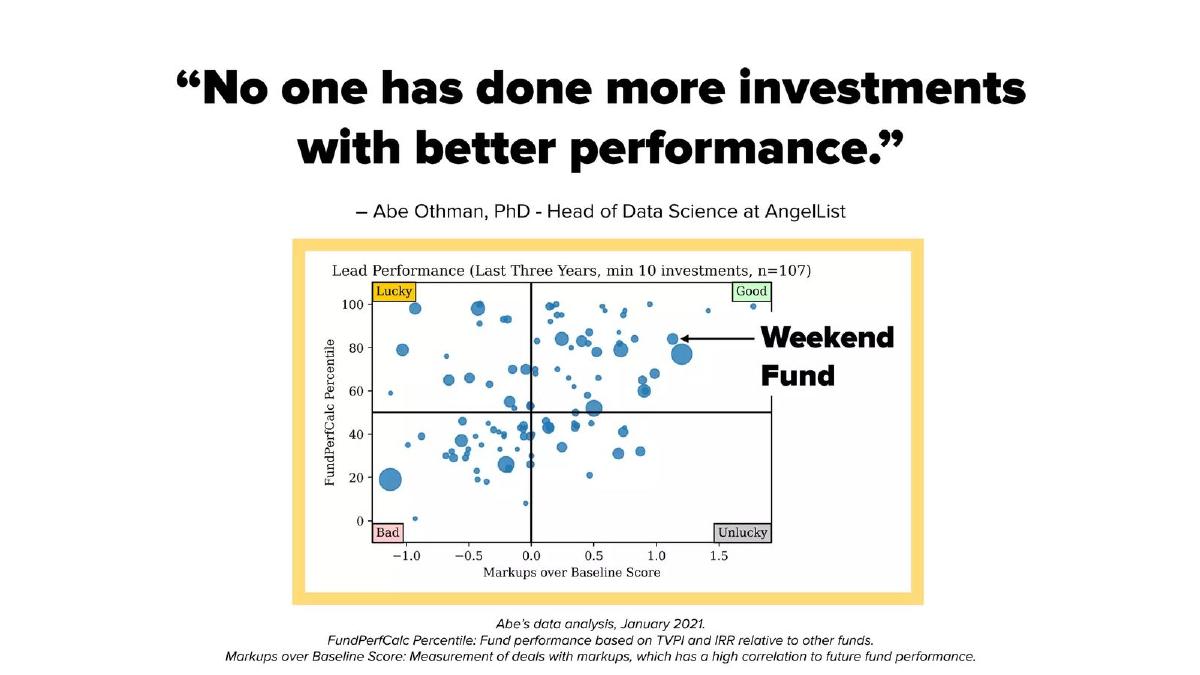
Weekend Fund 3.0 is an $18M vehicle (raised to $21M per catalogue data) led by Ryan Hoover and Vedika Jain. The deck is a masterclass in 'Founder-Market Fit' for venture capitalists, positioning Hoover’s role as the creator of Product Hunt as a permanent top-of-funnel advantage. The fund demonstrates exceptional early performance, with Fund 1 showing a 36.5% IRR and Fund 2 at 117.6% IRR as of April 2021. The strategy relies on being the 'first call' for founders and providing high-signal social proof that attracts follow-on capital from Tier-1 firms like Sequoia and a16z. While the deck lacks…
Key takeaways
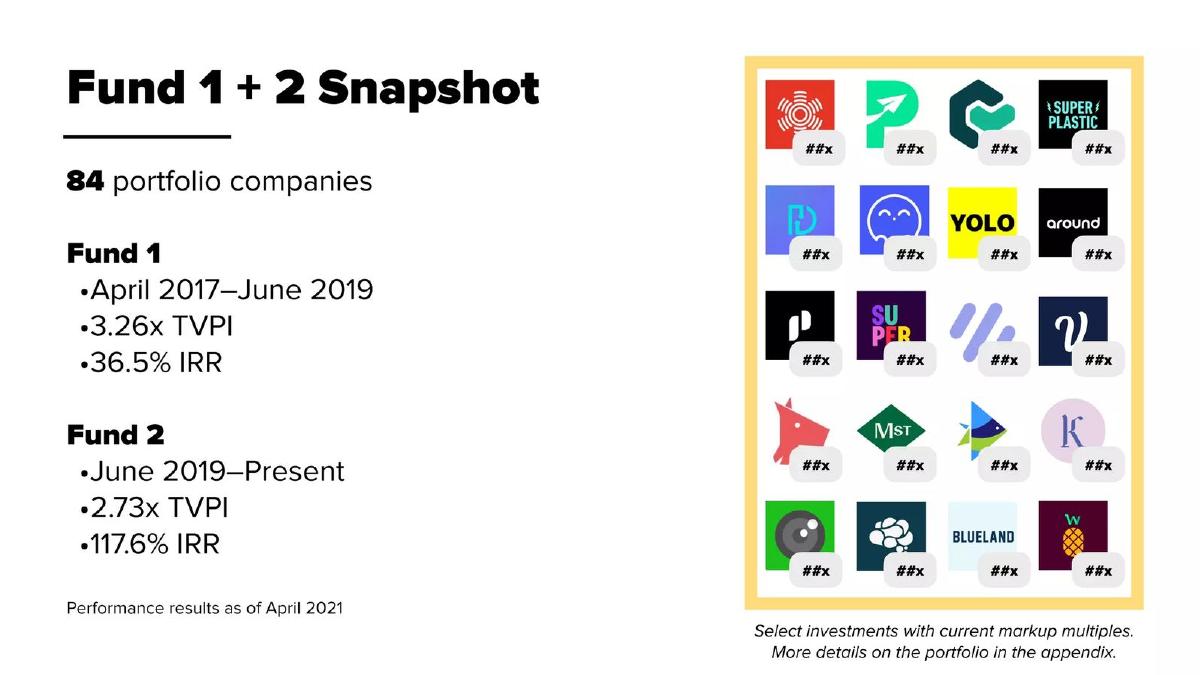
- Fund 1 (2017-2019) achieved a 3.26x TVPI and 36.5% IRR across 84 portfolio companies (Slide 3).
- Fund 2 (2019-2021) showed a 2.73x TVPI and a significant 117.6% IRR (Slide 3).
- The fund leverages Ryan Hoover’s massive social reach, including 375K LinkedIn followers and 165K on Twitter (Slide 4).
- Weekend Fund 3.0 increased its target fund size to $18M with check sizes between $150K and $250K (Slide 8).
- The fund allocates 30% of its capital for follow-on reserves, an increase from 25% in Fund 2 (Slide 8).
- A survey of founders reveals that 57% rate Weekend Fund as 'one of the most helpful' on their cap table (Slide 6).
- The fund has successfully 'graduated' companies to top-tier leads, such as Deel to a16z and InVideo to Sequoia (Slide 5).
- Operational transparency is a selling point, with the fund providing LP updates every 2 months (Slide 13).
Introduction: The Power of Personal Brand in Venture
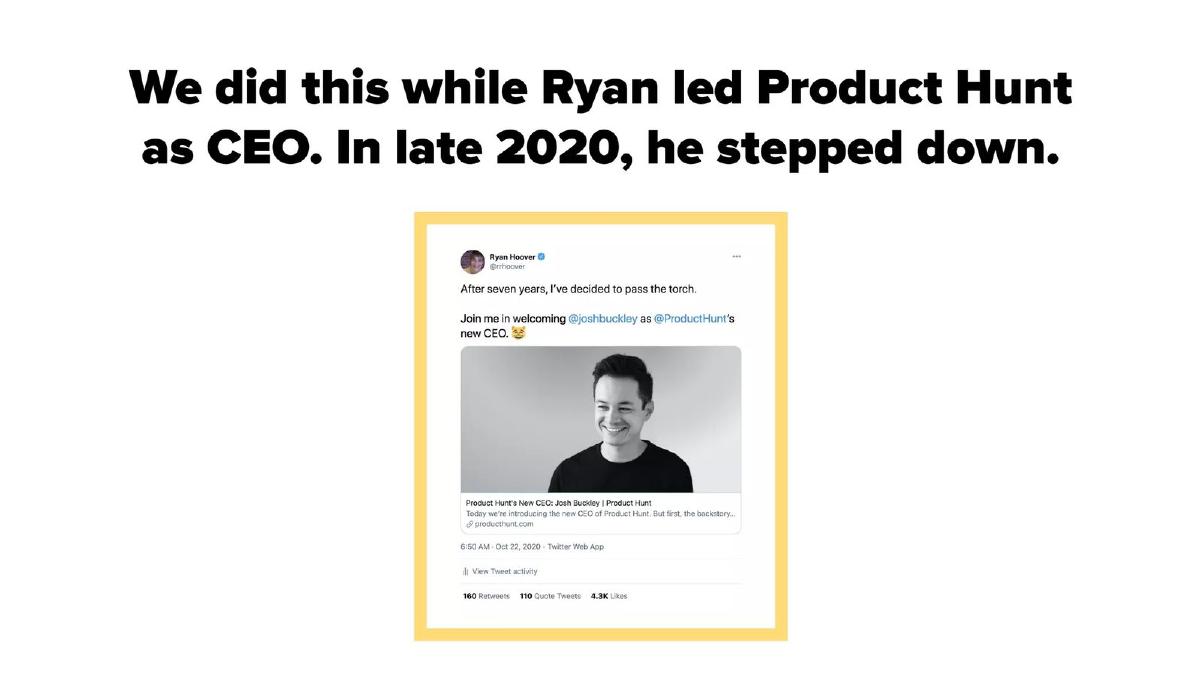
The Weekend Fund 3.0 pitch deck is a 28-slide document (14 provided for this analysis) that serves as a fundraising tool for a venture capital vehicle rather than a traditional startup. In the world of 'solo capitalists' and micro-VCs, the product being sold is the manager’s access and judgment. This deck, dated Q2 2021, focuses heavily on the 'unfair advantage' provided by Ryan Hoover’s legacy as the creator of Product Hunt.
Slide 1: Title Slide
The deck opens with a minimalist aesthetic, featuring a sun-like gradient logo and the title Weekend Fund 3.0 . The tagline, 'Backing your next favorite thing,' aligns with the Product Hunt ethos of discovery and consumer-facing innovation. The slide notes the deck is 'Confidential, Q2 2021.'
Slide 2: Team Spotlight - Vedika Jain
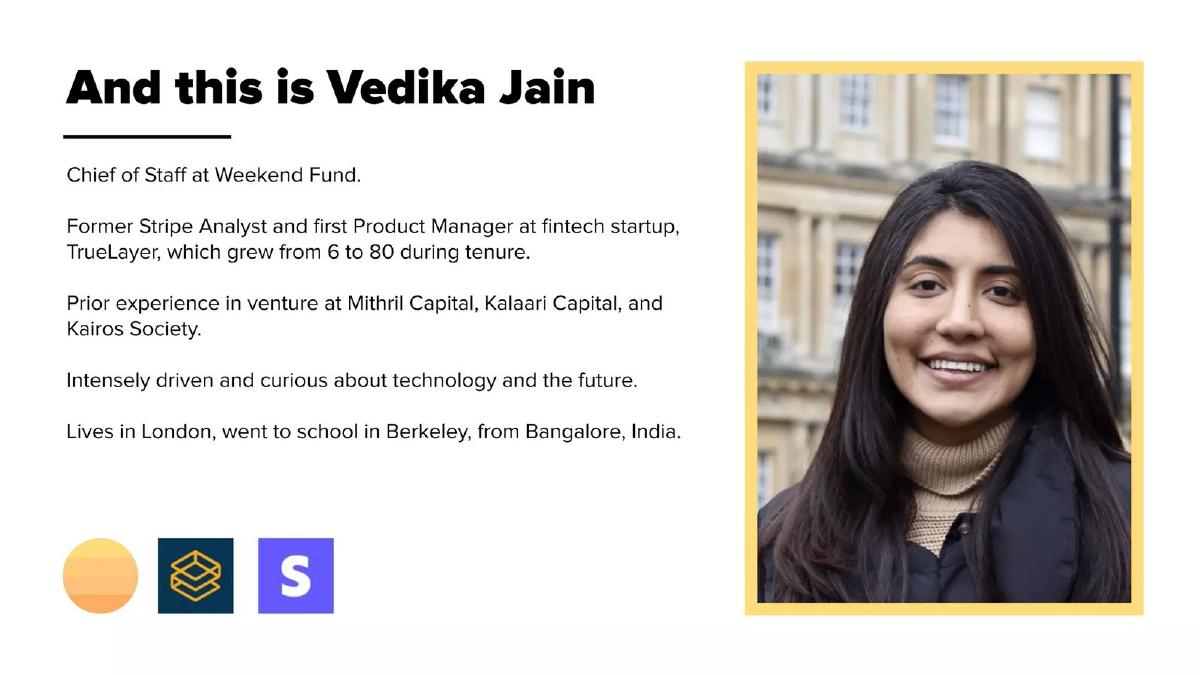
Unusually, the deck leads with a team slide for Vedika Jain, Chief of Staff. It highlights her pedigree: former Stripe Analyst and the first PM at TrueLayer (scaling from 6 to 80 employees). Her prior venture experience at Mithril Capital and Kalaari Capital is noted to establish her as a professional investor, balancing Hoover’s entrepreneurial background. This slide signals that the fund is more than a one-man show.
Slide 3: Fund 1 + 2 Performance Snapshot
This is the 'traction' slide for a VC fund. It lists 84 portfolio companies and provides specific performance data as of April 2021. Fund 1 (2017-2019) reports a 3.26x TVPI and 36.5% IRR. Fund 2 (2019-Present) reports a 2.73x TVPI and a massive 117.6% IRR. The right side of the slide features a grid of logos with redacted markup multiples (indicated by ##x), showing a diversified but high-performing portfolio.
Slide 4: The Inbound Engine
Titled 'Founders Come To Us,' this slide explains the fund's competitive moat. It explicitly links the fund’s deal flow to Product Hunt, described as the 'launchpad for startups.' It claims Ryan’s reputation earns him 'goodwill at scale.' The slide includes social proof via follower counts: 375K on LinkedIn, 165K on Twitter, and 180K on Clubhouse . This is a clear argument for a zero-cost acquisition model for high-quality deal flow.
Slide 5: Case Studies in Access
This slide provides two specific examples of how the fund wins deals. For InVideo , Vedika sourced the deal on Product Hunt; the founder allowed WF to invest at previous round terms (6 months prior) just for the social proof. For Deel , the founder reached out to Ryan for feedback in 2016, leading to a seed investment in 2019 and a subsequent 10.1x markup after Spark Capital led the Series B. These stories prove that WF isn't just 'getting in'—they are often the catalyst for the next round.
Slide 6: Founder Testimonials and NPS
The deck uses a quantitative approach to 'helpfulness.' A bar chart shows that 57% of surveyed founders rate Weekend Fund as 'One of the most helpful' on their cap table, with 0% rating them as 'less helpful than average.' Quotes from founders of Deel, Pattern, Unicycle, Wise, and Lobus reinforce the narrative that Ryan and Vedika are tireless advocates for their portfolio.
Slide 7: The Network Effect
Titled 'We Love Making Intros,' this slide is a logo wall of Tier-1 VC firms (Sequoia, a16z, Benchmark, Founders Fund) and headshots of individual angels. The message is clear: Weekend Fund is a 'feeder' fund. They are intentionally small to avoid competing with lead investors, making them the ideal co-investor for both founders and larger firms.
Slide 8: Evolution of the Fund
This slide, 'What’s New,' shows the scaling of the firm. Fund 1.0 was $3M; Fund 2.0 was $10M; Fund 3.0 is targeted at $18M (the catalogue suggests they eventually closed $21M). Check sizes have grown from $50K-$100K to $150K-$250K . Notably, reserves for follow-on investments have increased from N/A in Fund 1 to 30% in Fund 3.0 , indicating a more mature, defensive fund management strategy.
Slide 9: Legal Disclaimer
A standard, dense legal slide. It mentions the use of AngelList Venture for back-office services and notes that valuations are as of April 26, 2021, and have not been audited. This transparency is vital for LP (Limited Partner) trust.
Slide 10-12: Appendix and Portfolio Detail
The appendix includes a 'Meet the Portfolio' section. It lists companies like MainStreet (WF 2), Superplastic (WF 1), Mindbloom (WF 1), and Certn (WF 2). A second portfolio slide features YOLO , Dispo , Supergreat , and InVideo . Each entry lists the description, the fund, and the co-investors (e.g., Benchmark, Thrive Capital, Tiger Global). The 'Investment / MOIC' column is redacted in this version but clearly exists for the full pitch.
Slide 13: LP Communications
Titled 'How We Work With LPs,' this slide highlights operational excellence. It shows a screenshot of an inbox full of bi-monthly updates. Quotes from LPs like Rui Ma and Ben Parr praise the updates as 'succinct but with lots of clickthroughs.' This addresses a common LP pain point: the 'black hole' of information after capital is committed.
Slide 14: FAQ
The final slide answers two key questions. First, the minimum check size is $25K , with a focus on 'meaningful ownership.' Second, it reiterates the 30% reserve strategy and the use of SPVs for later-stage rounds, giving LPs additional 'first look' investment opportunities.
What Works in This Deck
The Moat is Explicit: Most VC decks claim to have 'great deal flow.' This deck proves it by linking it to a specific, world-class asset (Product Hunt) and providing the social media metrics to back it up. · Graduation Metrics: By showing that their seed investments consistently lead to Series A rounds from Sequoia and a16z, they prove their 'signal' is respected by the market. · Founder NPS: Using a survey (Slide 6) rather than just cherry-picked quotes adds a layer of data-driven credibility to the claim of being 'founder-friendly.' · Clear Scaling Path: Slide 8 shows a logical progression in fund size and professionalization (adding a Chief of Staff, increasing reserves).
What Is Missing
The 'Why Now' for the Sector: While the deck proves the fund is good, it doesn't spend much time on why the specific sectors they invest in (Software, Hardware, Consumer) are poised for growth in 2021. It assumes the LP already wants exposure to tech. · Exit Data: While the IRR and TVPI are impressive, there is no mention of realized exits (DPI). In a 2021 market, this was common, but for a Fund 3, LPs often look for returned capital. · Specific Allocation Strategy: The deck mentions check sizes but doesn't detail the expected number of investments for Fund 3.0.
What a Founder Should Copy
The 'Case Study' Format: Slide 5 is excellent. Instead of just saying 'we help founders,' it tells a chronological story of how they added value from the first email to the Series B markup. · The Evolution Table: Slide 8 is a perfect way to show growth. If you are a founder on your second or third startup, or raising a Series B, a table showing how your metrics/team/strategy have evolved since the last round is very effective. · Addressing Operational Friction: Slide 13 (LP updates) is a great example of 'selling the relationship.' Founders can use a similar slide to show how they communicate with their board or investors, reducing the perceived risk of 'founder ghosting.'
Frequently asked questions
- What is the primary investment thesis of Weekend Fund?
- The thesis centers on 'backing your next favorite thing' by leveraging Ryan Hoover's reputation as the founder of Product Hunt. The fund positions itself as a high-signal, early-stage partner that founders seek out for advice and social proof before they even begin formal fundraising, allowing the fund to capture meaningful ownership in competitive rounds.
- How does the fund perform compared to industry benchmarks?
- As of April 2021, the fund reported top-quartile performance metrics. Fund 1 (2017) had a 36.5% IRR, while Fund 2 (2019) had a 117.6% IRR. These figures are supported by high-profile markups, such as a 10.1x markup on Deel after its Series B led by Spark Capital.
- What is the typical check size for Fund 3.0?
- Weekend Fund 3.0 has moved up-market compared to its predecessors. It targets check sizes between $150,000 and $250,000, which is an increase from the $50k-$100k checks in Fund 1.0 and $100k-$200k in Fund 2.0.
- How does the fund support its portfolio companies?
- Support is primarily focused on networking and fundraising. The deck highlights their ability to make introductions to Tier-1 lead investors (Sequoia, Benchmark, a16z) and help founders close rounds. Founder testimonials emphasize Ryan's ability to help with hiring, enterprise sales, and establishing credibility.
- What is the fund's strategy for follow-on investments?
- For Fund 3.0, the fund has increased its reserves for follow-on investments to 30% of the total fund. Additionally, the fund manages SPVs (Special Purpose Vehicles) for larger follow-on opportunities in later-stage rounds, giving LPs a 'first look' at these deals.