Wefox’s 2021 deck is a masterclass in positioning a 'hybrid' model against pure-play digital competitors. While most insurtechs burn capital on direct customer acquisition, Wefox targets the 90% of the European market controlled by intermediaries. The deck highlights a massive €119m gross revenue for 2020 and an automation rate of over 80%, significantly higher than the 10-15% industry average. By digitizing the advisor experience rather than replacing it, Wefox claims to achieve day-one profitability on customer acquisition. However, the deck is notably missing a team slide and a specific fu…
Key takeaways
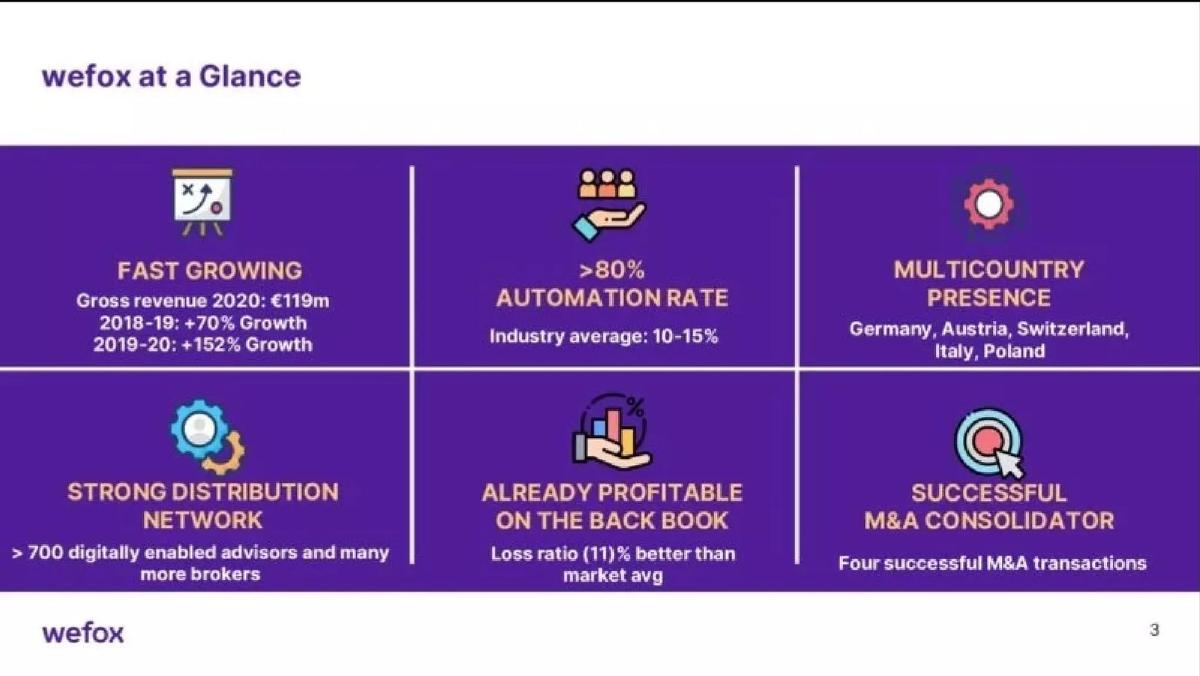
- The company reported €119m in gross revenue for 2020 with a 152% year-over-year growth rate (Slide 3).
- Wefox achieves an automation rate of >80%, compared to an industry average of 10-15% (Slide 3).
- The strategy focuses on the 90% of the European insurance market controlled by intermediaries rather than the 10% direct market (Slide 7).
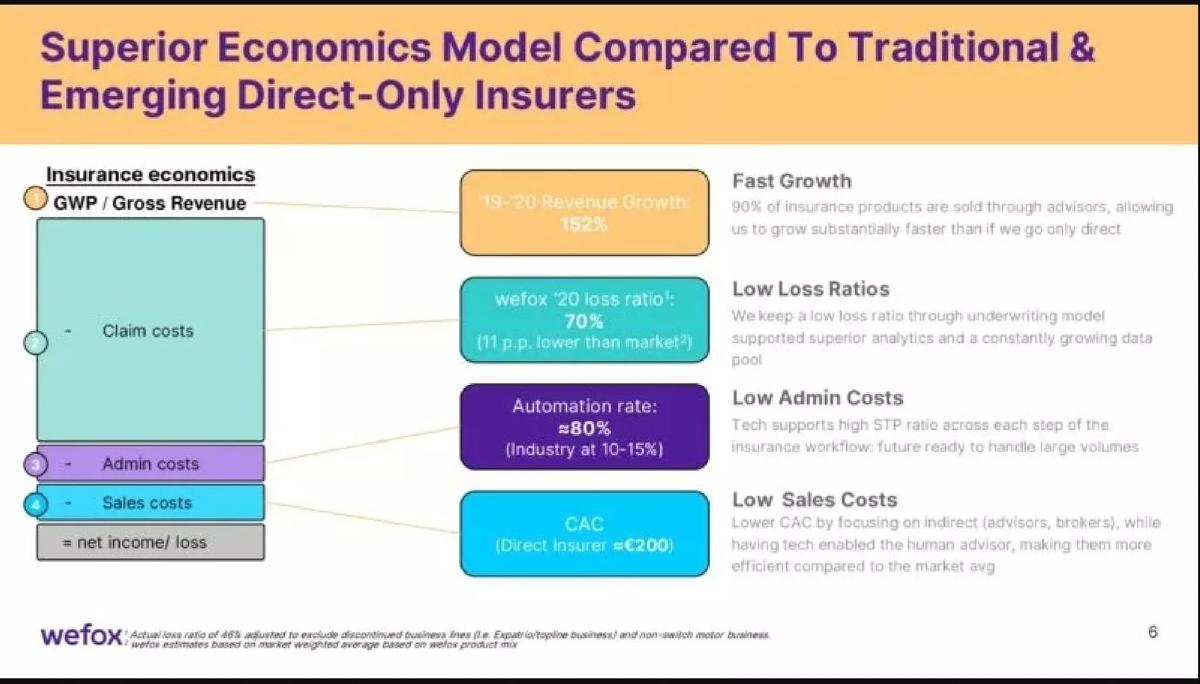
- Loss ratios are reported at 70% for 2020, which the company states is 11 percentage points lower than the market average (Slide 6).
- The platform enables a 3-month time-to-market for new products, significantly faster than the 12-18 month industry average (Slide 13).
- Wefox utilizes a network of over 700 digitally enabled advisors plus additional brokers for distribution (Slide 3).
- The deck claims a 'Day 1 profit greater than CAC' due to large initial policies sold via advisors (Slide 14).
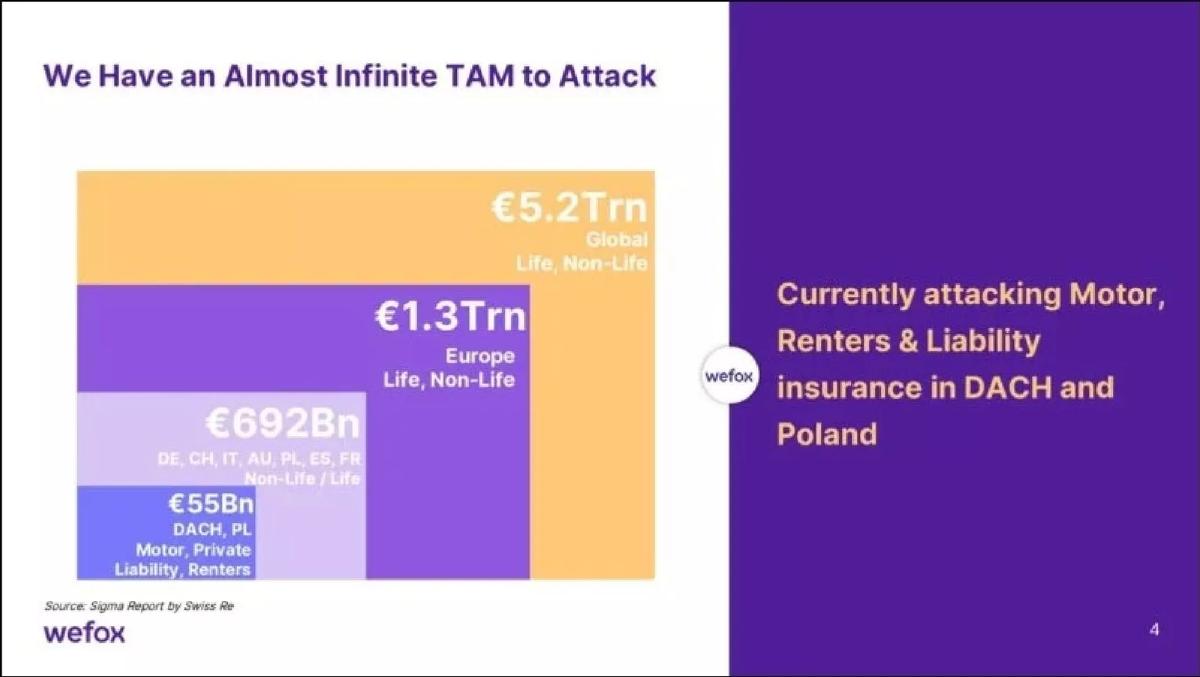
- The total addressable market is framed as an 'almost infinite' €5.2 trillion global opportunity (Slide 4).
Wefox 2021: A Strategic Pivot Toward Intermediary Dominance
The Wefox pitch deck from March 2021 represents a significant departure from the standard 'disruptor' narrative in the FinTech and Insurtech space. While most startups in this sector attempt to cut out the middleman, Wefox leans into the middleman. This 15-slide presentation is designed to convince later-stage investors that the most efficient way to capture the insurance market is not by fighting for the 10% of consumers who buy direct, but by digitizing the 90% who still rely on advisors.
The Executive Summary and Market Opportunity
Slide 1: Title Slide The deck opens with a bold claim: "The Most Profitable Digital Insurer." This immediately sets a tone of financial maturity, moving away from the 'growth at all costs' messaging typical of earlier-stage startups. The date is clearly marked as March 2021.
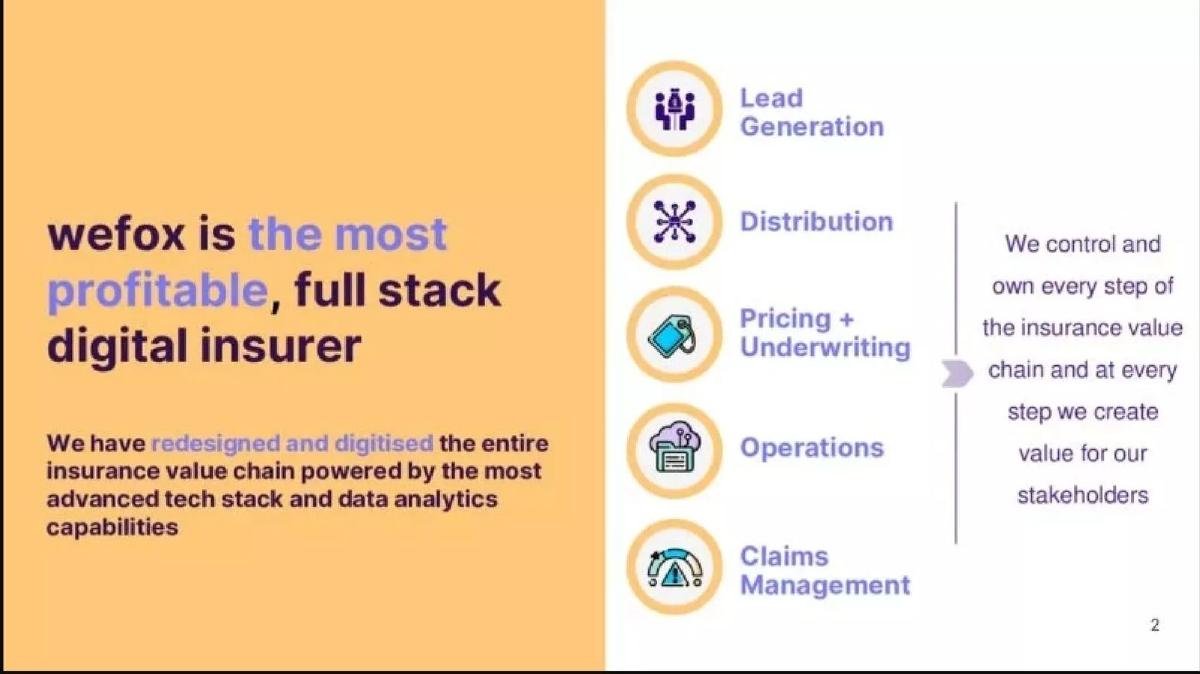
Slide 2: The Value Proposition Wefox defines itself as a "full stack digital insurer." The slide lists five key areas of control: Lead Generation, Distribution, Pricing + Underwriting, Operations, and Claims Management. The central thesis is that by owning the entire value chain, they create value for all stakeholders through a redesigned and digitized process.
Slide 3: Wefox at a Glance This is the primary 'traction' slide. It contains several high-impact figures: €119m gross revenue for 2020, 152% growth between 2019 and 2020, and an automation rate exceeding 80%. It also notes their presence in Germany, Austria, Switzerland, Italy, and Poland, and mentions four successful M&A transactions, positioning the company as a consolidator in the market.
Slide 4: Total Addressable Market (TAM) The company describes its TAM as "almost infinite." They visualize this with a nested box diagram starting at a €55Bn market (Motor, Private Liability, and Renters in DACH and Poland) and scaling up to a €5.2Trn global market for Life and Non-Life insurance. This slide serves to show that despite their current size, they have only captured a fraction of the available opportunity.
The Economic Model and Competitive Advantage
Slide 5: Competitive Advantage Divider A simple transition slide titled "wefox Competitive Advantage."
Slide 6: Superior Economics Model This slide breaks down the unit economics. It compares their model to traditional and direct-only insurers across four pillars: Fast Growth (90% of products sold through advisors), Low Loss Ratios (70% in 2020), Low Admin Costs (80% automation), and Low Sales Costs (focusing on indirect channels). A footnote clarifies that the 70% loss ratio is 11 percentage points lower than the market average.
Slide 7: The 90/10 Market Split This is perhaps the most important strategic slide in the deck. Using McKinsey research, Wefox shows that 90% of the European insurance market is controlled by intermediaries. They explicitly state their focus is on "digitising the 90%, rather than growing the 10%." This frames their competitors (who focus on direct-to-consumer) as fighting over a small, expensive sliver of the market.
Slide 8: Wefox vs. Other Digital Insurers A direct comparison slide. Wefox claims their focus on advisors, brokers, and affinity partners leads to lower CAC, lower loss ratios, and lower churn. Conversely, they claim other digital insurers focusing on direct distribution suffer from higher costs and higher churn.
Operational Excellence and Product Strategy
Slide 9: Product Roadmap Wefox outlines its product evolution. Core products today include Car, Home, and Private Liability. They are "preparing for launch" in Supplementary Health and Pet insurance, with Health and Life insurance listed as future modules. This demonstrates a clear path toward becoming a multi-line insurer.
Slide 10: Advisor Efficiency This slide contrasts "Traditional" advisors with "wefox Advisors." The traditional side is plagued by no lead generation, offline channels, and bureaucracy. Wefox offers digital lead generation, AI-driven cross-selling, and a 100% digital customer journey. The takeaway is that Wefox makes the human advisor more efficient rather than replacing them.
Slide 11: Underwriting Playbook Wefox explains how they use data to drive down loss ratios. The playbook involves four steps: Distribution Selection (choosing channels with lowest loss), Product Selection (LTV must be higher than commission), Underwriting Selection (excluding unprofitable segments), and Pricing (undercutting the market due to the previous three steps).
Slide 12: Loss Ratio Trends A bar chart shows the loss ratio dropping from 115% in 2018 to 92% in 2019, and finally to 70% in 2020. They project to be 13 percentage points below the market in 2021. They also mention a reinsurance framework agreement with MunichRe as a risk mitigation factor.
Scalability and The Flywheel
Slide 13: Technical Efficiency This slide focuses on speed. Wefox claims a 3-month time-to-market for new products compared to an 18-month industry average. A bar chart shows their Straight Through Processing (STP) ratio consistently hovering between 78% and 92% throughout 2019 and 2020, which they contrast against a 10-15% industry average.
Slide 14: Profitability on First Sale Wefox argues their model is superior to the direct model because they generate profit from "Day 1." Because advisors sell large policies, the initial profit is greater than the CAC. They contrast this with the direct model, where companies spend heavily on websites and apps for unqualified leads and low conversion rates.
Slide 15: The Growth Flywheel The final slide summarizes the business as a "well oiled machine." The flywheel consists of: Huge market -> Focus on 90% with bespoke products -> Reducing loss ratios with analytics -> Reducing admin costs with technology -> Optimizing unit economics with digitally enabled sales. This circular logic is intended to show that each part of the business reinforces the others.
What Works in the Wefox Pitch Deck
Counter-Intuitive Positioning: The most successful aspect of this deck is the rejection of the 'Direct-to-Consumer' (D2C) trend. By showing that 90% of the market is still offline, Wefox makes a compelling case that the biggest opportunity is in enabling existing behaviors rather than trying to change them. This is a sophisticated take that appeals to later-stage investors who have seen the high burn rates of D2C startups.
Hard Metrics: The deck is dense with specific numbers. Citing a €119m revenue figure and a specific 70% loss ratio provides a level of transparency that builds trust. The comparison of their 80% automation rate against the 10-15% industry average is a powerful way to quantify their technical moat.
Visual Clarity: Despite the complexity of insurance economics, the slides are generally clean and easy to follow. The use of the 90/10 split graphic on Slide 7 is a perfect example of how to visualize a complex market thesis in a single, memorable image.
What is Missing from the Wefox Pitch Deck
The Team: There is no mention of the founders, the executive team, or the board. For a company at a "Later" stage, investors want to see the pedigree of the people managing hundreds of millions in revenue and navigating complex regulatory environments across multiple countries.
The Ask: The deck does not specify how much money is being raised or how the funds will be used. This suggests the deck was either used for general investor relations or was a high-level teaser meant to be followed by a detailed financial model and use-of-funds document.
Regulatory and Compliance Detail: Insurance is one of the most heavily regulated industries in the world. While the deck mentions a "full stack" model, it doesn't touch on the capital requirements or the specific licenses held in each of the five countries they operate in. This is a significant omission for a later-stage pitch.
What a Founder Should Copy from this Deck
The 'Economics of the Industry' Slide: Slide 6 is a great template for any founder in a traditional industry. It breaks down exactly where the money goes (Claims, Admin, Sales) and shows how the company's specific technology improves each individual bucket. It moves the conversation from "we have an app" to "we have a better business model."
Focusing on the 'Un-Disrupted' Market: If you are entering a crowded space where everyone is chasing the same 'digital-native' customer, look for the '90%' that everyone else is ignoring. Wefox’s strategy of digitizing the existing intermediary layer is a lesson in finding the path of least resistance to massive scale.
Benchmarking Against Industry Averages: Don't just say your tech is good; say it is 80% automated while the industry is at 10%. Don't just say you are fast; say you launch in 3 months while the industry takes 18. These specific benchmarks (found on Slide 13) make your claims verifiable and impressive.
Conclusion The Wefox deck is a highly professional, metric-driven presentation that successfully argues for a hybrid approach to digital transformation. By valuing the human advisor and providing them with superior tools, Wefox positioned itself as a high-growth, high-efficiency alternative to the capital-intensive D2C insurers that dominated the early insurtech wave. While it lacks the personal touch of a team slide, its focus on unit economics and market share makes it a potent tool for later-stage fundraising.
Frequently asked questions
- What is Wefox's core distribution strategy?
- Unlike many digital insurers that sell directly to consumers, Wefox focuses on indirect distribution. They target the 90% of the European insurance market that is still controlled by human intermediaries like advisors and brokers. They provide these intermediaries with digital tools for lead generation, AI-driven cross-selling, and automated workflows to increase efficiency and lower acquisition costs.
- How does Wefox justify its claims of superior profitability?
- Wefox points to four economic levers: fast growth through advisor networks, low loss ratios (70%) driven by data analytics, low admin costs due to an 80% automation rate, and low sales costs. They specifically claim that selling through advisors allows for larger 'Day 1' policies where the initial profit exceeds the customer acquisition cost (CAC).
- What are the key performance metrics mentioned in the deck?
- The deck highlights €119m in 2020 gross revenue, 152% growth from 2019 to 2020, and a loss ratio that improved from 115% in 2018 to 70% in 2020. It also emphasizes their technical efficiency, citing a straight-through-processing (STP) ratio of over 80% and a 3-month launch cycle for new insurance products.
- What is missing from this pitch deck?
- This deck is missing several standard elements found in early-stage pitches. There is no slide introducing the founding team or leadership, no specific 'Ask' detailing how much capital is being raised, and no detailed roadmap for future geographic expansion beyond the current DACH and Poland regions. It functions more as a strategic business model overview.
- How does Wefox compare itself to traditional and direct digital insurers?
- Wefox positions itself as the 'best of both worlds.' It claims traditional insurers suffer from offline channels and high bureaucracy, while direct-only digital insurers face high CAC, high churn, and high loss ratios. Wefox argues its tech-enabled advisor model results in lower CAC, lower churn, and better underwriting selection.