Tangifi's deck is a classic example of a Startup Weekend presentation designed for immediate impact rather than long-term institutional fundraising. The company positions itself as a social platform to connect 'ideas with their makers,' targeting the gap between non-technical dreamers and developers looking for projects. With only 9 slides, the deck relies heavily on visual metaphors—including the 'I haz idea' cat meme—to communicate the problem. While it lacks a business model, financial projections, or a specific capital ask, it successfully leverages Google Trends data to show a rising int…
Key takeaways
- The deck leans on a 'Popular Vote Award at SW Lansing, 2012' win to establish early credibility (Slide 1).
- Problem identification is handled through relatable personas: the idea person, the hungry developer, and the confused beginner (Slide 2).
- The solution is defined by three core functions: posting ideas, finding teams, and finding co-founders (Slide 3).
- A high-fidelity mockup shows a grid-based UI featuring concepts like 'Custom Shoes' and 'Virtual Keyboard' to demonstrate platform utility (Slide 4).
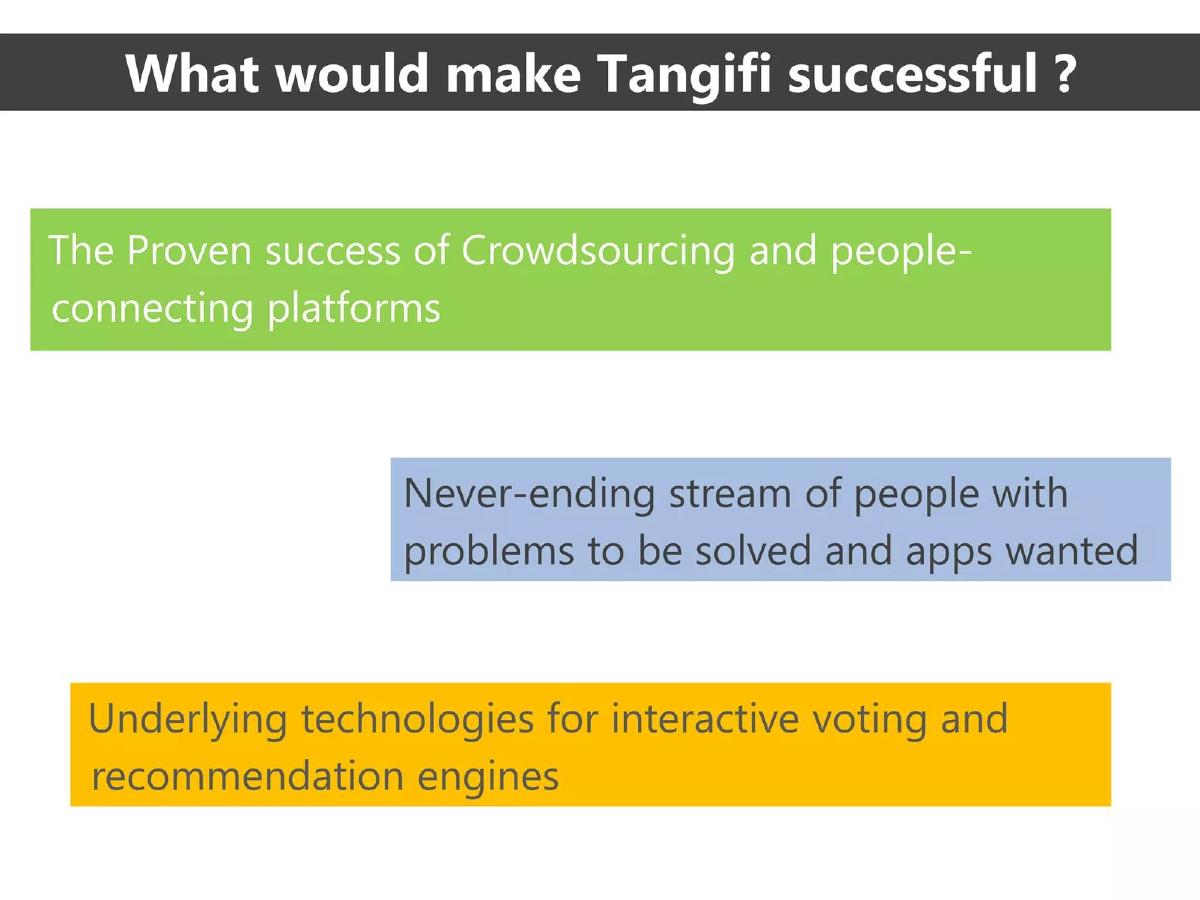
- Success factors are attributed to the macro trend of crowdsourcing and 'interactive voting' technologies (Slide 5).
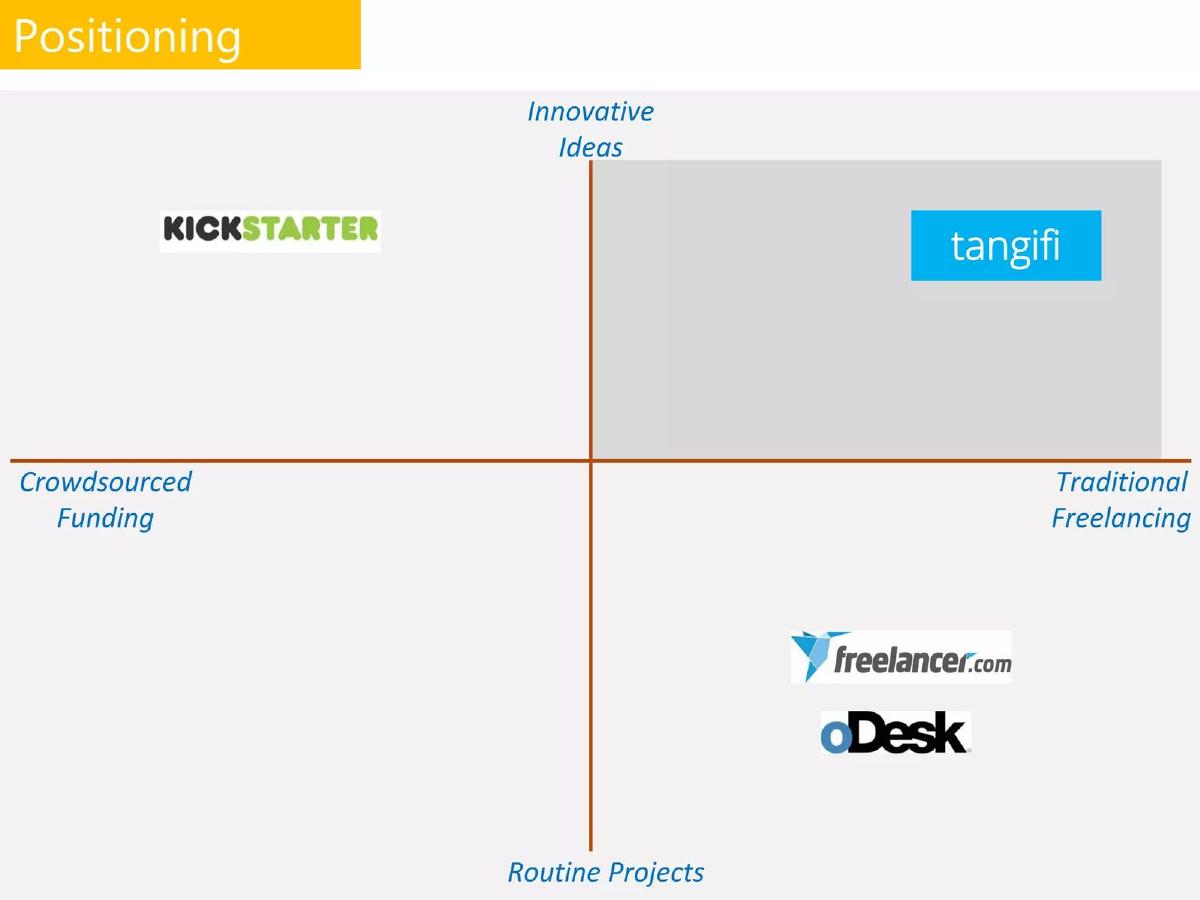
- Competitive positioning places Tangifi in a unique quadrant between 'Innovative Ideas' and 'Traditional Freelancing,' distinct from Kickstarter and oDesk (Slide 6).
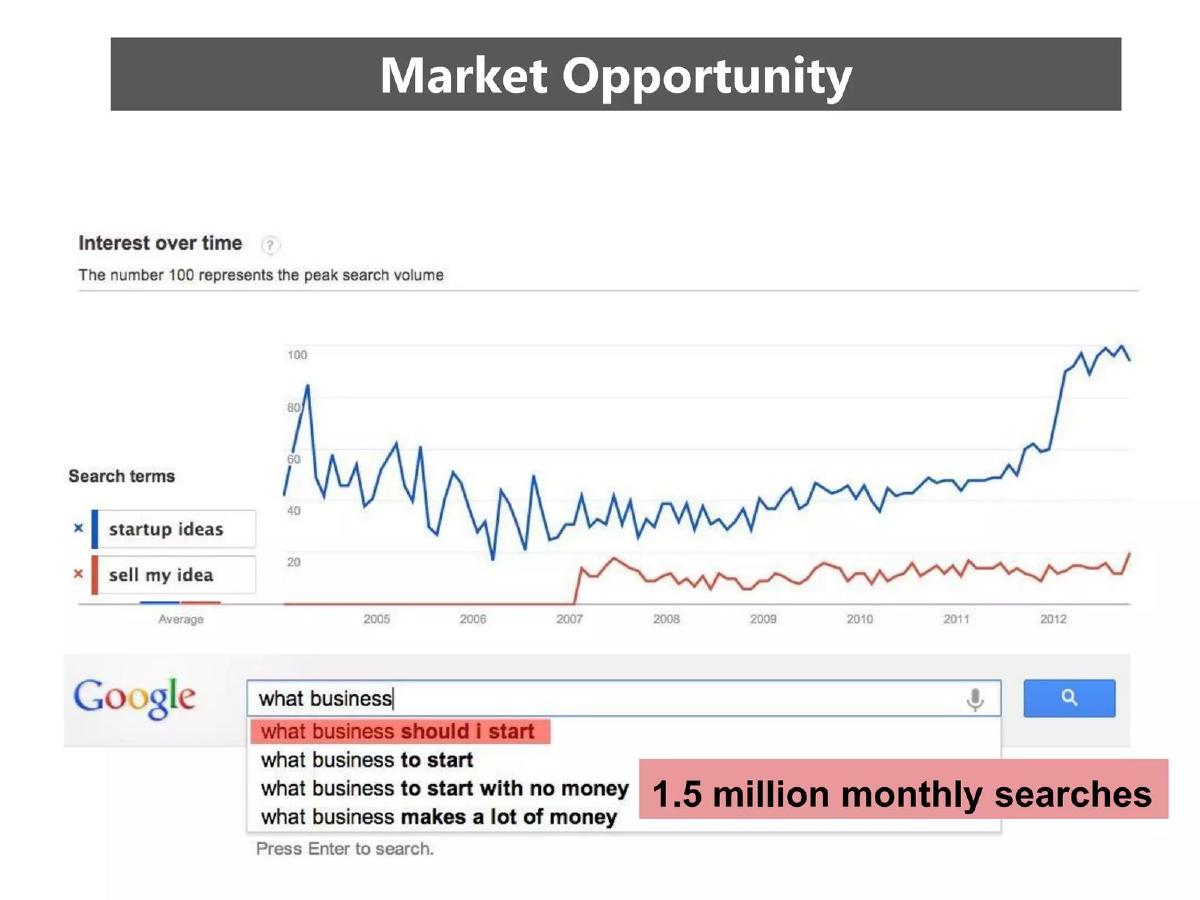
- Market opportunity is quantified using Google Trends, citing 1.5 million monthly searches for business-start terms (Slide 7).
- The roadmap sets a target of 15,000+ active users for the Beta launch phase (Slide 8).
Tangifi Pitch Deck Analysis: The Startup Weekend Winner
The Tangifi deck is a 9-slide presentation that secured the Popular Vote Award at Startup Weekend Lansing in 2012. As a competition deck, its primary goal was to communicate a vision and build excitement within a 5-minute window, rather than to survive a rigorous due diligence process from venture capitalists. It focuses heavily on the 'Idea-Maker' gap and uses the cultural language of the early 2010s to make its point.
Slide 1: Title and Credibility
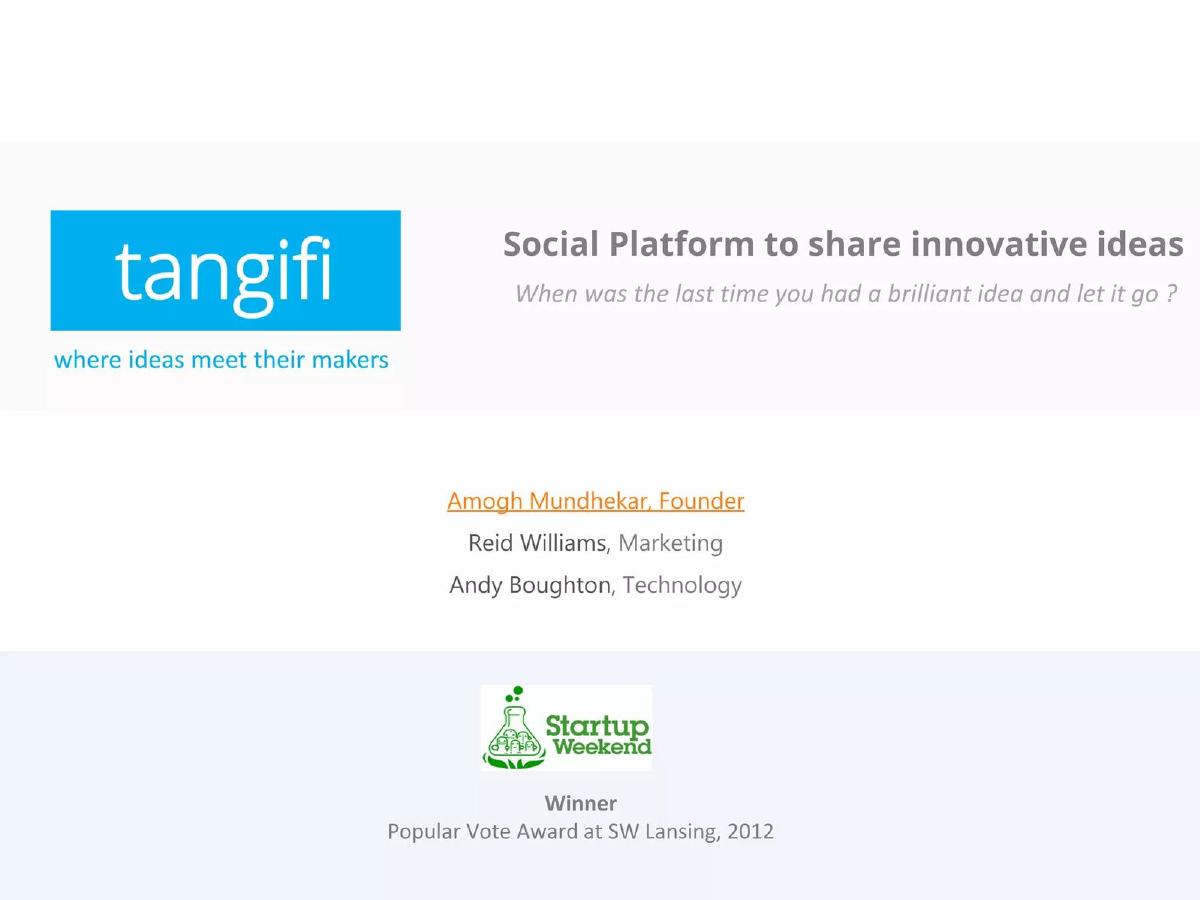
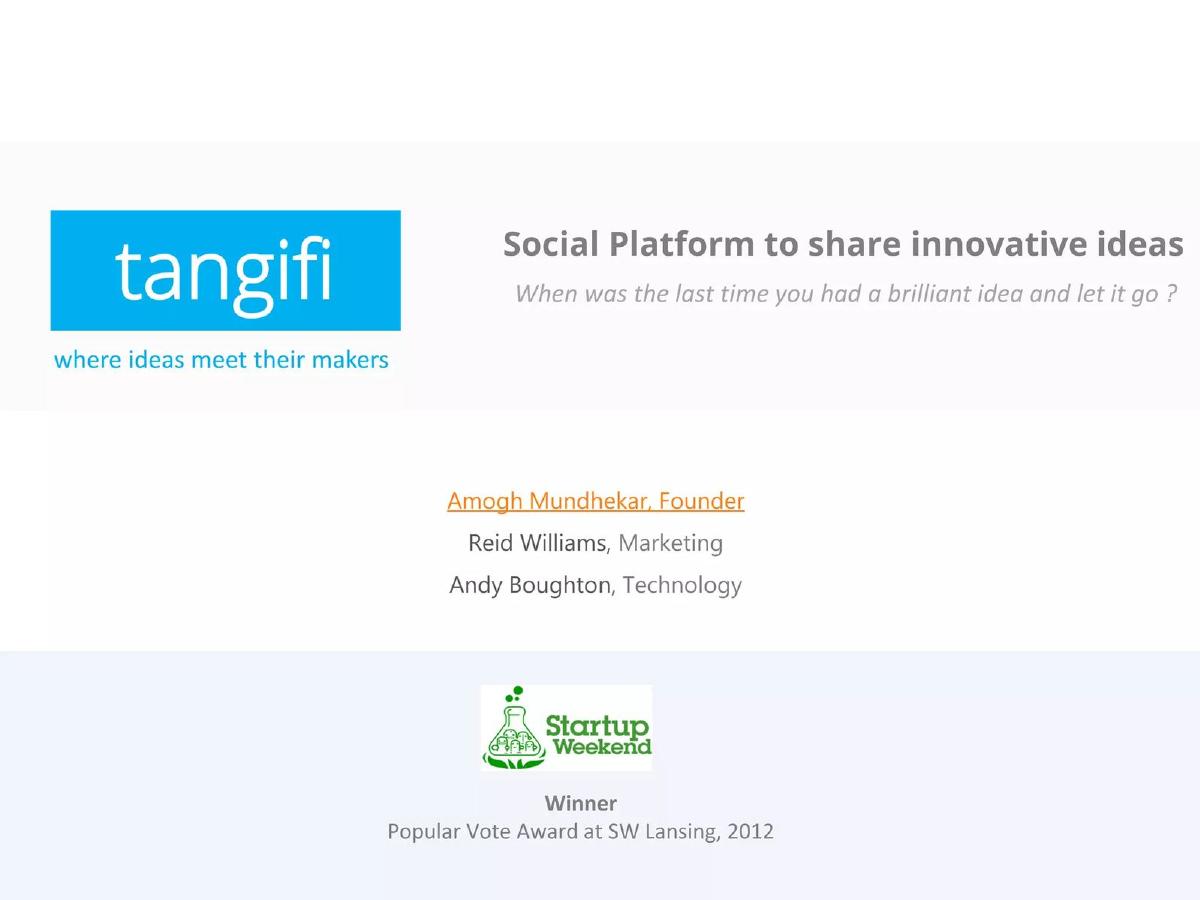
The cover slide introduces Tangifi with the tagline "where ideas meet their makers." It identifies the company as a "Social Platform to share innovative ideas." Crucially, it includes a badge for the "Startup Weekend Winner" at the bottom, which serves as immediate social proof. The team is listed as Amogh Mundhekar (Founder), Reid Williams (Marketing), and Andy Boughton (Technology).
Slide 2: The Problem (The Meme Slide)
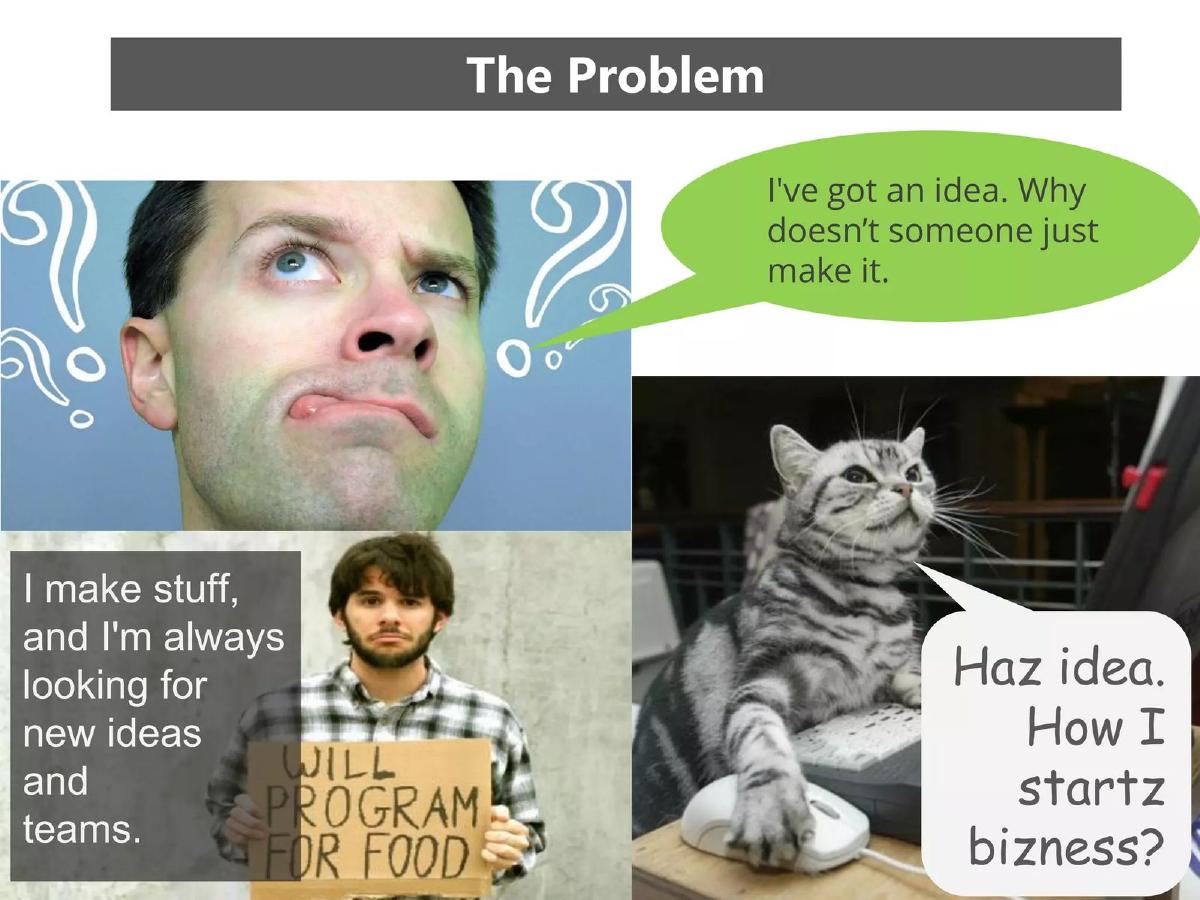
Slide 2 uses a collage of images to define the problem. It features a man wondering why someone doesn't just "make" his idea, a developer holding a "Will Program for Food" sign, and a cat meme stating "Haz idea. How I startz bizness?" While informal, this slide effectively identifies three distinct user personas: the non-technical visionary, the skill-rich but idea-poor developer, and the complete novice who needs a roadmap.
Slide 3: The Solution
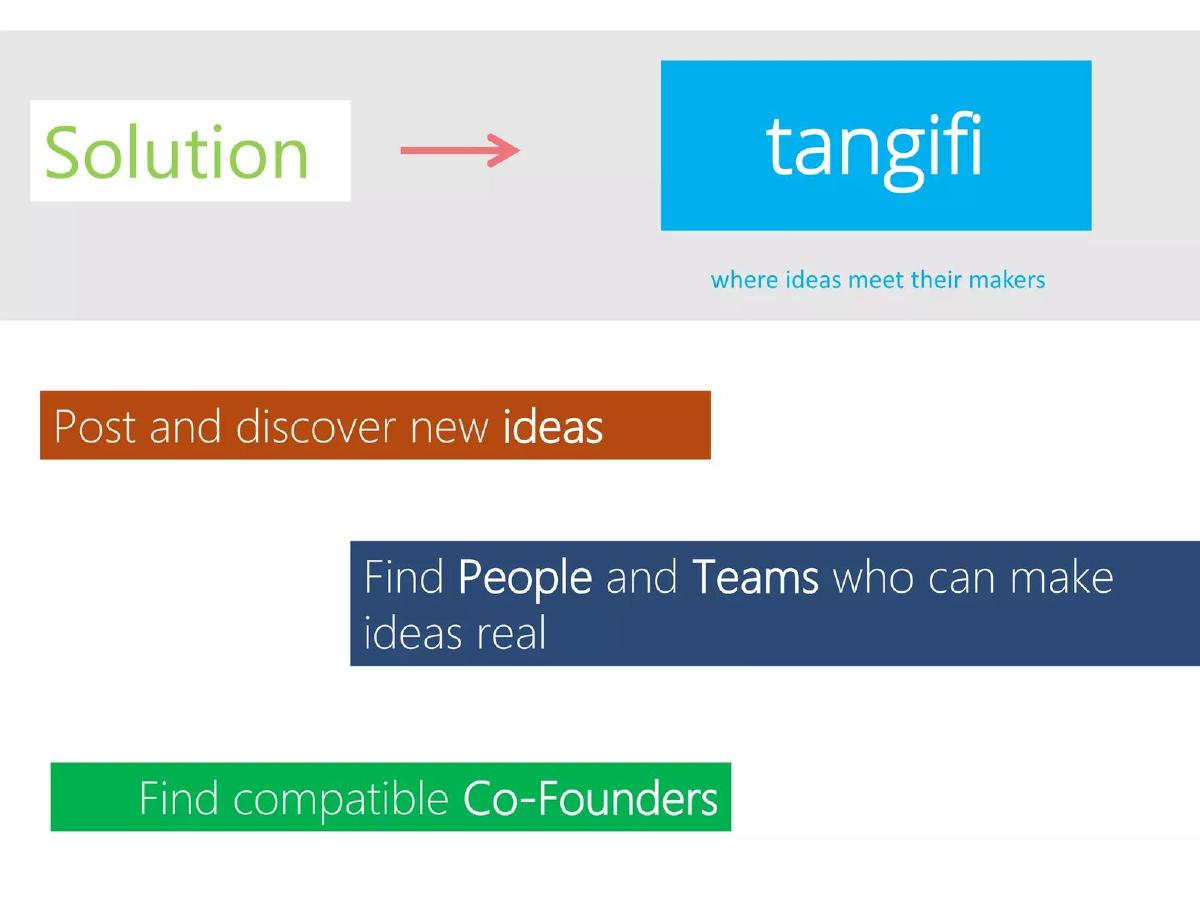
The solution slide is minimalist. It breaks the platform's value proposition into three pillars: Post and discover new ideas , Find People and Teams , and Find compatible Co-Founders . This clarifies that Tangifi is not just a message board, but a matchmaking service for the pre-seed stage of a startup's life.
Slide 4: Product Mockup
This slide displays a functional mockup of the Tangifi interface. It shows a Pinterest-style grid of project cards. Featured projects include "Custom Shoes" (with 4 votes), "Nand Airconditioner," "Virtual Keyboard," and "Inbox Mapper." The inclusion of a "-1" vote on the Inbox Mapper card suggests a community-moderated quality control system, which aligns with the "interactive voting" mentioned later in the deck.
Slide 5: Success Drivers
Under the heading "What would make Tangifi successful?", the founders list three macro factors: the proven success of crowdsourcing platforms, a "never-ending stream" of people with problems to solve, and the availability of underlying technologies like recommendation engines. This slide attempts to answer the "Why now?" question by pointing to the maturity of the social web.
Slide 6: Positioning Map
The positioning slide uses a standard four-quadrant graph. The Y-axis ranges from "Routine Projects" to "Innovative Ideas," while the X-axis ranges from "Crowdsourced Funding" to "Traditional Freelancing." Tangifi is placed in the top-right quadrant (Innovative Ideas/Traditional Freelancing). It positions itself as more creative than Freelancer.com or oDesk (now Upwork) and more execution-focused than Kickstarter.
Slide 7: Market Opportunity
To prove market size, the deck turns to Google Trends. Slide 7 shows a graph of search interest for "startup ideas" and "sell my idea" from 2005 to 2012, showing a sharp spike in the final year. A callout box claims 1.5 million monthly searches for the phrase "what business should i start." This is a classic "bottom-up" validation technique using search intent as a proxy for market demand.
Slide 8: Status & Timelines
The roadmap slide uses a series of calendar icons to show a linear progression. It marks the current state as "Alpha Product" and "Launch to startup events." The future goal is a "Beta Launch" with a target of 15,000+ active users . The slide is light on specific dates, which is common for weekend-built projects where the timeline is dependent on post-event momentum.
Slide 9: The Founder's Profile
The final slide is a "Thank You" page that doubles as a personal resume for Amogh Mundhekar. It lists his skillsets, including Machine Learning, Social Network Analysis, Python, and PHP . Interestingly, it states he is "Interested in Product Marketing/Management opportunities," which suggests the deck may have been repurposed as a portfolio piece or a recruitment tool following the Startup Weekend event.
What Works in This Deck
Persona Identification: By using images to represent the "Idea Person" and the "Maker," the founders quickly established who their customers were without using jargon. · Visual Mockups: Showing a UI (Slide 4) is always more effective than describing it. It proved the team could actually build a front-end interface. · Trend Validation: The use of Google Trends (Slide 7) provided a data-backed justification for why the platform was relevant in 2012.
What Is Missing from This Deck
Business Model: There is no mention of how Tangifi makes money. Without a revenue model, it remains a project rather than a business. · The Ask: The deck does not ask for a specific amount of money, nor does it explain what the funds would be used for. · Unit Economics: There is no discussion of Customer Acquisition Cost (CAC) or Lifetime Value (LTV), which are critical for social platforms. · Retention Strategy: While the deck mentions finding co-founders, it doesn't explain what keeps users on the platform once a team is formed (the "leaky bucket" problem of matchmaking sites).
Founder Takeaways
Founders should look at the Tangifi deck as a lesson in brevity and narrative . For a competition or a first-look meeting, you don't need 20 slides of financial tables. You need to prove that a problem exists, that you have a visual representation of the solution, and that there is a measurable trend supporting your entry into the market. However, if moving toward a Seed round, a founder must replace the memes with a clear path to monetization and a specific capital request.
Frequently asked questions
- What is the primary business model for Tangifi?
- The deck does not explicitly state a business model. There are no mentions of transaction fees, subscription tiers, or advertising revenue. Slide 5 mentions 'interactive voting and recommendation engines' as success drivers, implying a data-driven or community-curated platform, but the mechanism for monetization is entirely omitted.
- How does Tangifi differentiate itself from Kickstarter?
- According to Slide 6, Tangifi differentiates itself by moving away from 'Crowdsourced Funding' toward 'Traditional Freelancing' while maintaining a focus on 'Innovative Ideas.' While Kickstarter is for funding finished concepts, Tangifi positions itself as the place where the team is built before funding is even a consideration.
- What evidence of market demand does the deck provide?
- The deck uses Google Trends data on Slide 7 to show a significant upward trajectory in search volume for 'startup ideas' and 'sell my idea.' It specifically highlights a callout of '1.5 million monthly searches' for the query 'what business should i start' to prove a large top-of-funnel audience.
- What is the current stage of the product in this deck?
- Slide 8 indicates the company was at the 'Alpha Product' stage during the presentation. The timeline shows a progression from 'Launch to startup events' through a 'Development and expansion' phase, with a future goal of reaching 15,000 active users for a Beta launch.
- Who are the key team members listed?
- Slide 1 lists Amogh Mundhekar as Founder, Reid Williams for Marketing, and Andy Boughton for Technology. However, the final slide (Slide 9) focuses exclusively on Amogh Mundhekar, listing his skillsets in Python, PHP, and Machine Learning, and stating he is 'Interested in Product Marketing/Management opportunities.'