WeddingLovely’s 19-slide deck from 2011 is a classic example of a seed-stage pitch focused on market fragmentation and the 'concierge' model. The company identified a massive, $55.7 billion market characterized by high stress and overwhelming choices. By positioning themselves as an email-based guide, they sought to simplify the planning process for engaged couples while monetizing a network of local vendors. The deck highlights strong early traction, including a jump to nearly 60,000 monthly pageviews and a growing list of 700+ vendors. However, the business eventually closed in 2019, highli…
Key takeaways
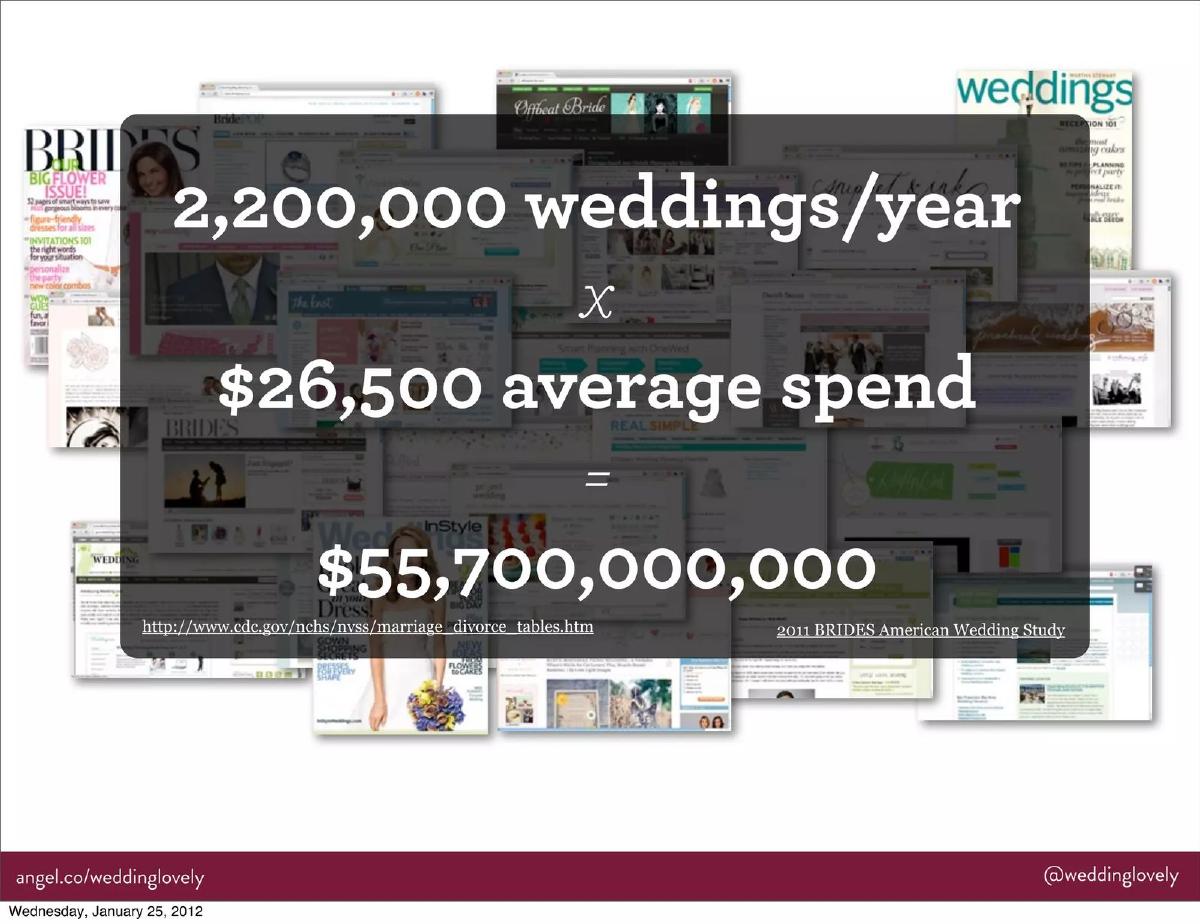
- The deck identifies a total addressable market of $55.7 billion based on 2.2 million weddings per year and a $26,500 average spend (Slide 4).
- WeddingLovely positioned itself as a 'concierge in your inbox' to solve the clutter and stress of traditional wedding sites (Slide 1 and Slide 9).
- The company utilized a multi-site network strategy, launching niche directories like WeddingVenueLove and WeddingPhotoLove (Slide 14).
- Traction was driven almost entirely by SEO, with pageviews growing from approximately 25,000 in June to nearly 60,000 by January (Slide 16).
- The monetization model relied on a freemium vendor directory, with 8% of 700+ vendors paying $25/month for upgraded accounts (Slide 17).
- The team leveraged significant social proof by highlighting participation in 500 Startups and The Designer Fund (Slide 13).
- The 'Ask' was a specific $350,000 seed investment to scale their personalized email experience (Slide 18).
- The deck lacks detailed unit economics or long-term customer acquisition cost (CAC) projections, focusing instead on top-of-funnel growth.
The Market Opportunity and the Problem of Noise
Slides 1-4: Setting the Stage
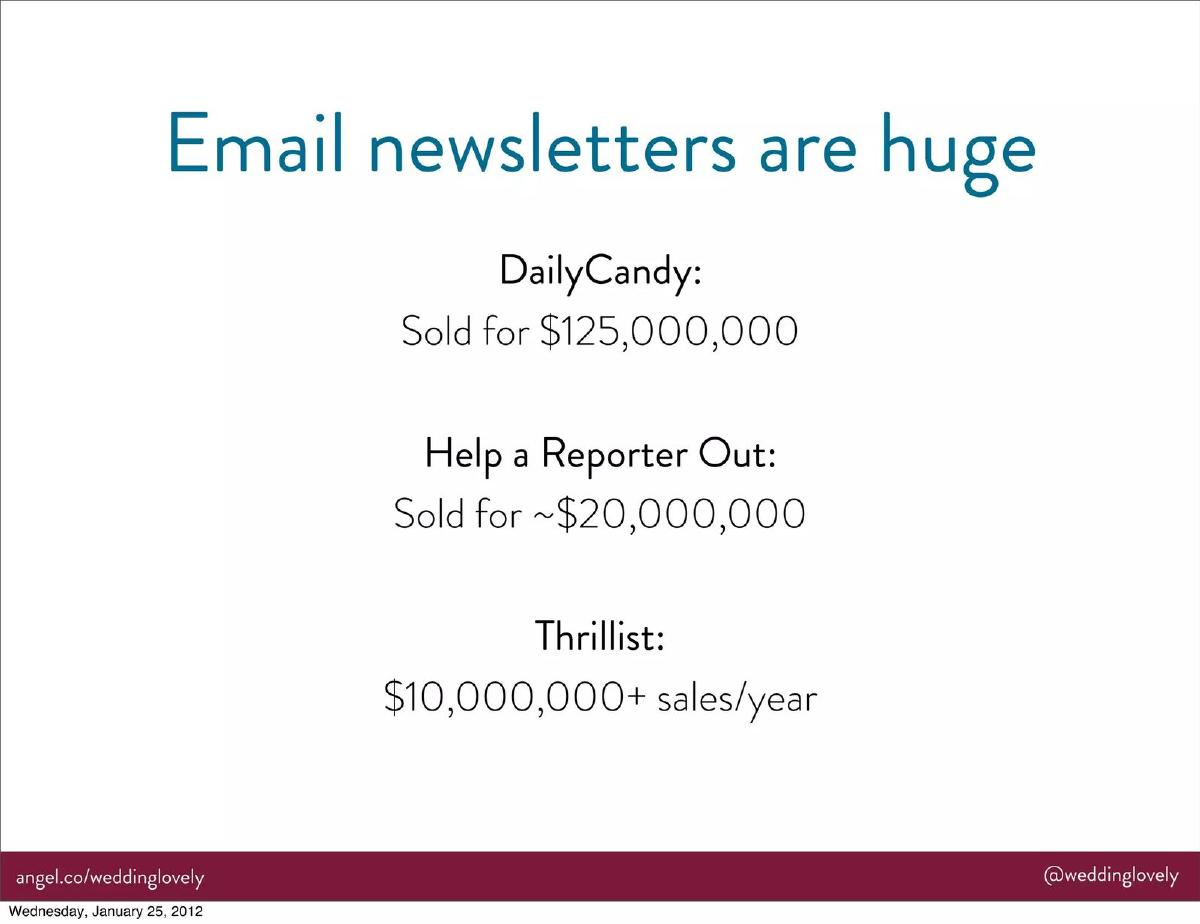
WeddingLovely opens with a clean, minimalist aesthetic. The title slide (Slide 1) introduces the tagline: "The wedding planning concierge in your inbox." This immediately signals a service-oriented, push-content model rather than a traditional search-and-browse platform. Slide 2 attempts to validate the business model by citing successful email-centric exits and revenue generators: DailyCandy (sold for $125M), Help a Reporter Out (sold for ~$20M), and Thrillist ($10M+ sales/year). This is a strategic move to show that 'newsletters' are a viable venture-scale category.
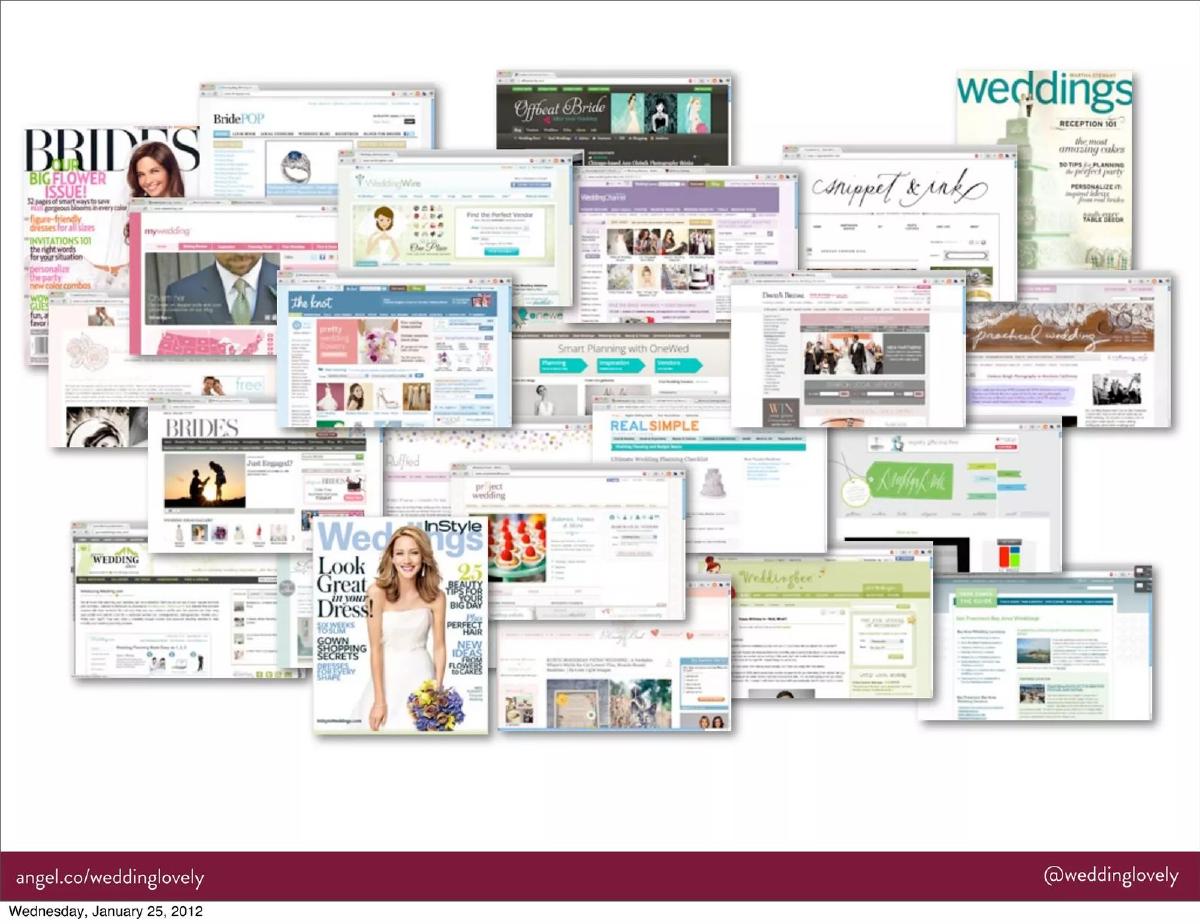
Slides 3 and 4 tackle the market size. Slide 3 is a collage of dozens of wedding magazines and websites, visually representing the 'noise' in the industry. Slide 4 provides the hard math: 2,200,000 weddings/year multiplied by a $26,500 average spend equals a $55,700,000,000 market. The sources cited are the CDC and the 2011 BRIDES American Wedding Study, providing necessary data-backed weight to the claim.
Slides 5-8: The Anti-Competitor Narrative
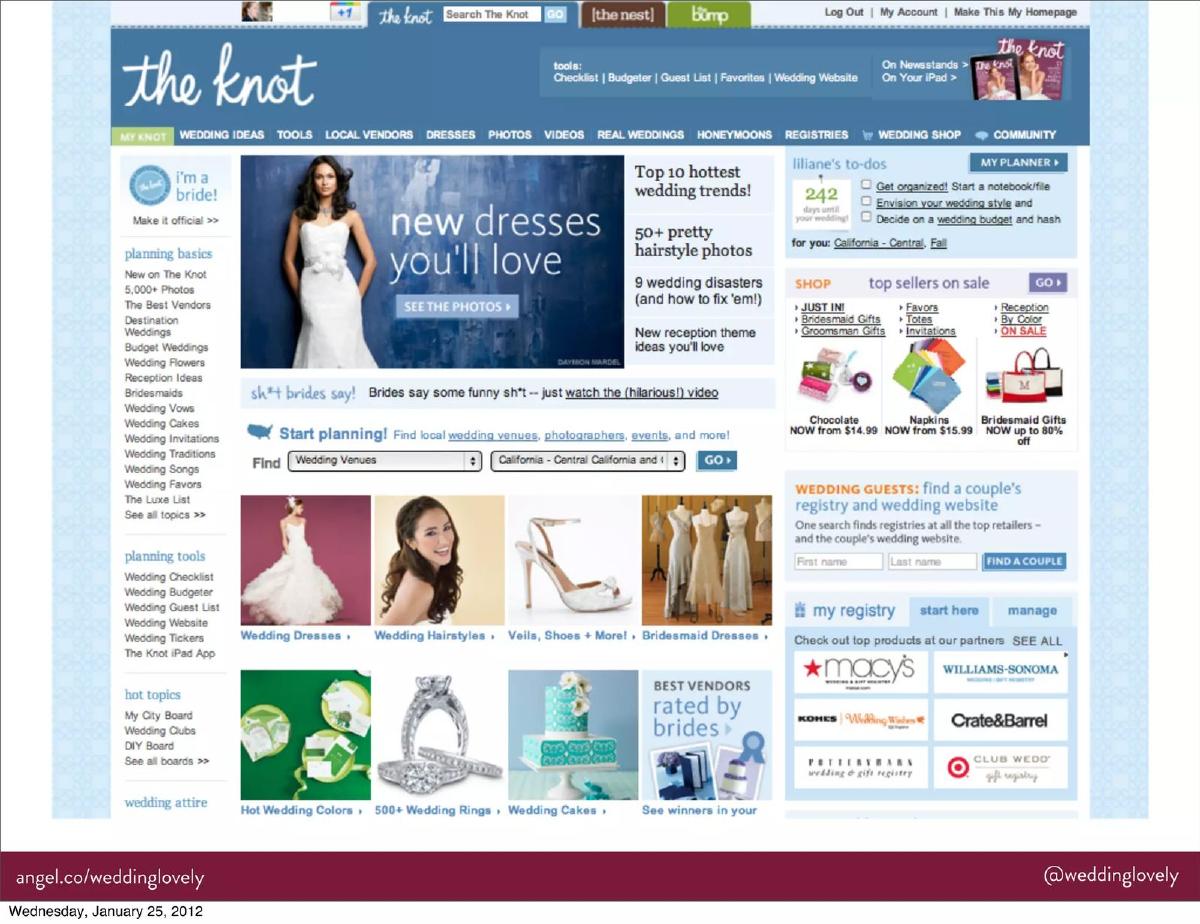
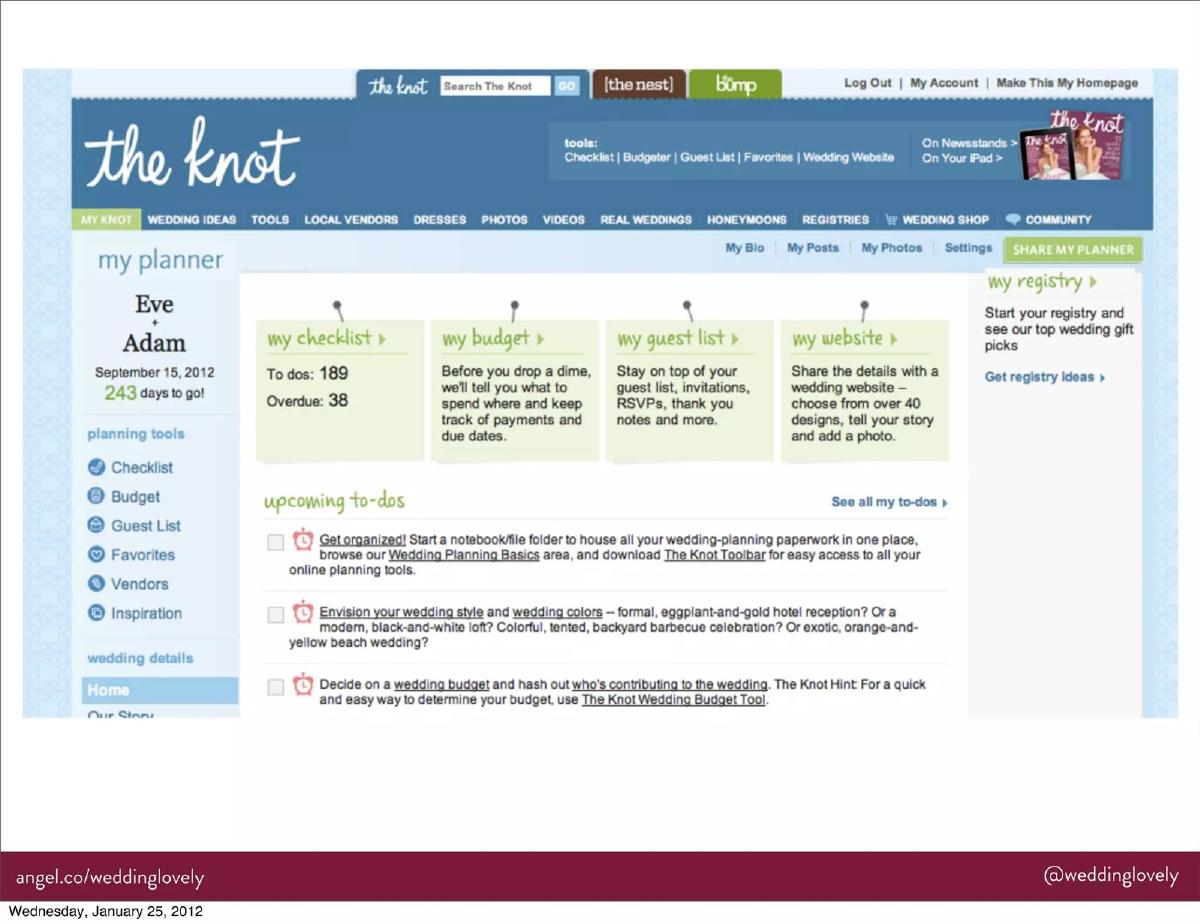
The deck takes an aggressive stance against the incumbent, The Knot. Slide 5 shows a screenshot of The Knot's homepage, which is visibly cluttered with ads, links, and widgets. Slide 6 and 7 zoom in on the user experience, highlighting a 'checklist' with 189 to-dos and 38 overdue tasks. The narrative is clear: the current solutions cause anxiety. Slide 8 is a visceral reinforcement of this point, featuring a Reuters 'Photo of the Year' showing a chaotic, stressful wedding dress sale. This section effectively builds a 'villain' (complexity) that WeddingLovely intends to 'slay' with simplicity.
The Solution: Curation and Personalization
Slides 9-12: The WeddingLovely Product
Slide 9 re-introduces the brand as a "Personalized email newsletter experience for engaged couples." Slide 10 is one of the most functional slides in the deck, showing a comprehensive 12-month timeline of wedding tasks. This demonstrates that the founders understand the domain expertise required to guide a couple from engagement to the 'Day of Congratulations!'
Slide 11 shows the landing page, which is a simple lead-capture form asking for an email address and a wedding date. This is the core of their data strategy—by knowing the wedding date, they can trigger time-relevant content. Slide 12 shows a mockup of the actual product: a clean, Gmail-integrated newsletter that tells the user exactly what to 'Start thinking about' right now. This is the 'concierge' in action.
Traction, Team, and Business Model
Slides 13-15: Social Proof and Ecosystem
Slide 13 introduces the team: Tracy Osborn (Product) and Marit Snowball (Marketing) . The slide is heavy on social proof, featuring logos for 500 Startups and The Designer Fund . The advisors listed are high-caliber: Christina Brodbeck (First UI Designer at YouTube) and Ben Blumenfeld (Design Lead at Facebook). For a design-led product, these names are significant.
Slide 14 and 15 detail the 'Milestones' and the 'Network.' WeddingLovely wasn't just one site; it was a collection of niche directories including WeddingPlannerLove, WeddingPhotoLove, WeddingVenueLove, and WeddingVideoLove . By January (the month the deck was likely finalized), they had 700+ total vendors with 8% paying for their accounts. This shows early evidence of a working B2B monetization strategy.
Slides 16-17: Growth and Revenue
Slide 16 presents a growth chart for 'WeddingLovely Network Monthly Pageviews.' The traffic is described as "booming — solely from SEO." The chart shows a steady climb from June to December, followed by a massive spike in January to nearly 60,000 pageviews . While impressive, relying 'solely on SEO' is a double-edged sword that investors would likely question regarding long-term defensibility.
Slide 17 outlines the 'Today' vs. 'Tomorrow' of the business. 'Today' is the 700+ curated vendors with 8% upgraded at $25/mo . 'Tomorrow' lists three growth levers: Commission Revenue, Affiliate Partnerships, and Advertising . This is a standard marketplace evolution, moving from subscription fees to transaction-based or volume-based revenue.
The Ask and Conclusion
Slides 18-19: The Investment
The deck concludes with a direct 'Ask' on Slide 18: Looking for $350k for their personalized email newsletter experience. This is a modest seed round by modern standards but was typical for the 2011-2012 era. Slide 19 provides contact information, including the AngelList URL, which was the primary platform for distributing this deck.
What Works in This Deck
Strong Problem/Solution Fit: The contrast between the 189-item checklist on The Knot and the simple WeddingLovely email is a powerful visual argument. · Social Proof: Being part of 500 Startups and having Facebook/YouTube design leads as advisors gives the 'design-first' claim immediate legitimacy. · Clear Niche Strategy: Breaking the directory into sub-sites (Photo, Venue, Video) likely helped their SEO strategy, which they cite as their primary growth driver. · Market Sizing: Using credible sources like the CDC to define a $55B market makes the opportunity feel grounded in reality.
What Is Missing
Unit Economics: There is no mention of Customer Acquisition Cost (CAC) or Lifetime Value (LTV). In a 'one-and-done' industry like weddings, LTV is capped, making CAC efficiency the most critical metric for survival. · Retention Data: While they show pageview growth, they don't show email open rates or click-through rates, which are the 'pulse' of a newsletter-based business. · Competitive Response: The deck assumes The Knot will remain 'cluttered' and 'stressful.' It doesn't address what happens if incumbents simplify their UI or if Pinterest (which launched around the same time) captures the 'inspiration' phase of planning. · Spend Breakdown: The $350k ask is not broken down into hiring, marketing, or product development.
What a Founder Should Copy
The 'Villain' Slide: Using a screenshot of a competitor's messy UI to highlight your own simplicity is a classic, effective move. · The Timeline Slide: Slide 10 shows deep domain expertise. It proves the founders aren't just 'tech people' but understand the actual journey of their users. · Milestone Clarity: Listing exactly when each sub-product launched (Slide 14) shows a high 'velocity of shipping,' which is a trait investors love in early-stage teams. · The 'Concierge' Framing: Positioning a product as a 'concierge' or 'assistant' rather than a 'platform' or 'tool' makes the value proposition feel more premium and helpful.
Frequently asked questions
- What was WeddingLovely's primary value proposition?
- WeddingLovely aimed to be a 'wedding planning concierge in your inbox.' Unlike traditional wedding portals that presented users with overwhelming dashboards and hundreds of tasks, WeddingLovely used a personalized email newsletter to deliver practical tips and reminders based on the couple's specific wedding date.
- How did WeddingLovely plan to make money?
- At the time of the deck, their primary revenue came from a curated vendor directory. They had over 700 vendors, with 8% paying $25 per month for upgraded accounts. Future revenue streams included commission revenue, affiliate partnerships, and traditional advertising.
- What was the competitive landscape according to the deck?
- The deck uses visual cues rather than a grid to show competition. Slides 5, 6, and 7 specifically highlight 'The Knot,' criticizing its cluttered interface and overwhelming 'to-do' lists (showing 189 tasks) to contrast with WeddingLovely's simpler, email-driven approach.
- Who were the key people involved in the startup?
- The core team consisted of Tracy Osborn (Product) and Marit Snowball (Marketing). They were supported by high-profile advisors including Christina Brodbeck (YouTube's first UI designer) and Ben Blumenfeld (Design Lead at Facebook), adding significant design credibility to the pitch.
- Why did WeddingLovely eventually close in 2019?
- While the deck doesn't state the cause of failure, the wedding industry is notoriously difficult due to the lack of customer retention—once a couple marries, they no longer need the service. This requires constant, expensive acquisition of new users, which can be difficult to sustain against larger, better-funded competitors.