WebBadge presents a vision for a more authenticated web through a system of digital badges designed to connect websites, data, and end-users. The deck, dated January 2022, identifies a core problem in the lack of easy authentication and poor interoperability across the internet. Led by Mitchell Nguyen, a former Qualcomm engineer, the company positions itself as a 'dedicated solution' in a competitive landscape of all-in-one platforms. While the deck is strong on vision and founder pedigree, it lacks specific financial projections, a defined business model, and a clear dollar amount for the fu…
Key takeaways
- The company identifies trust, transparency, and poor interoperability as the primary hurdles for modern digital products (Slide 2).
- WebBadge proposes a '3-in-1' Interoperating System (IS) focusing on digital badges, contacts, and privacy (Slide 4).
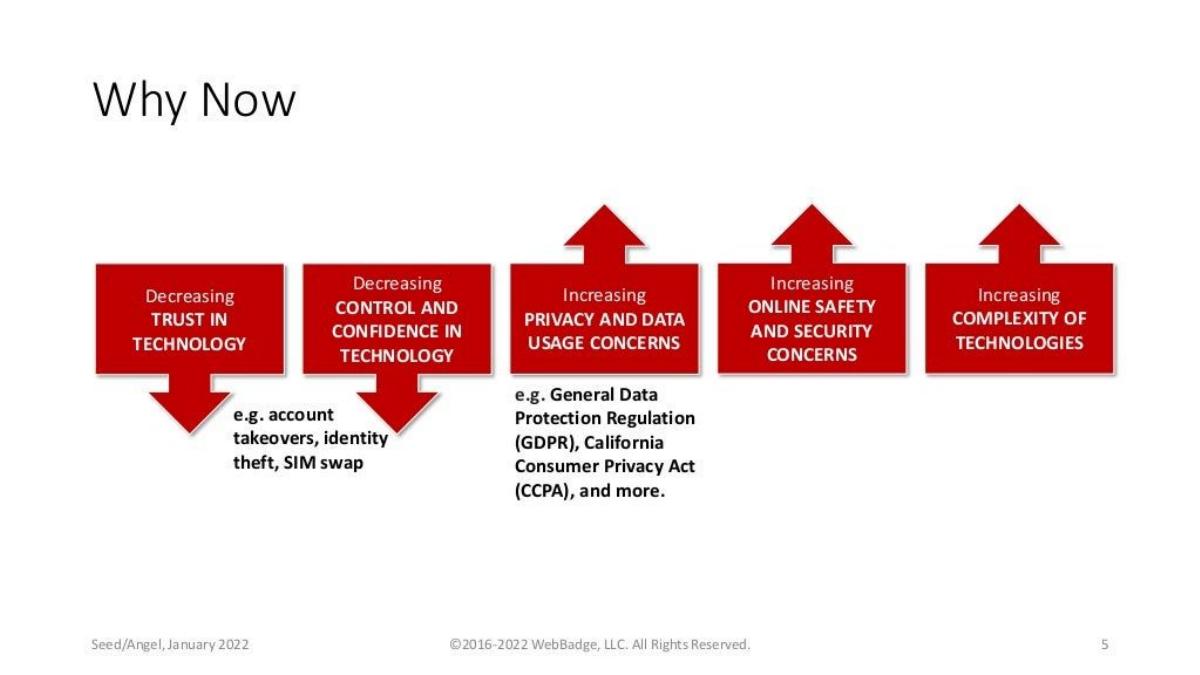
- The 'Why Now' slide points to decreasing trust in technology and increasing regulatory pressure from GDPR and CCPA (Slide 5).
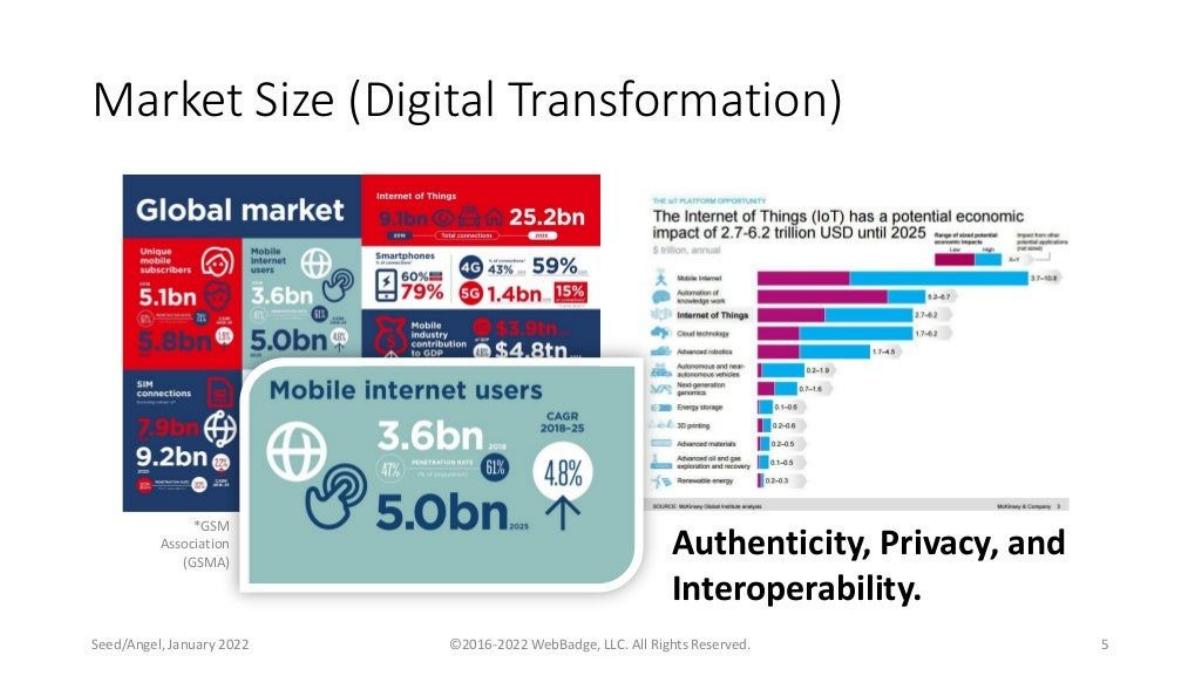
- Market sizing relies on broad digital transformation metrics, citing a potential IoT economic impact of $2.7-$6.2 trillion by 2025 (Slide 6).
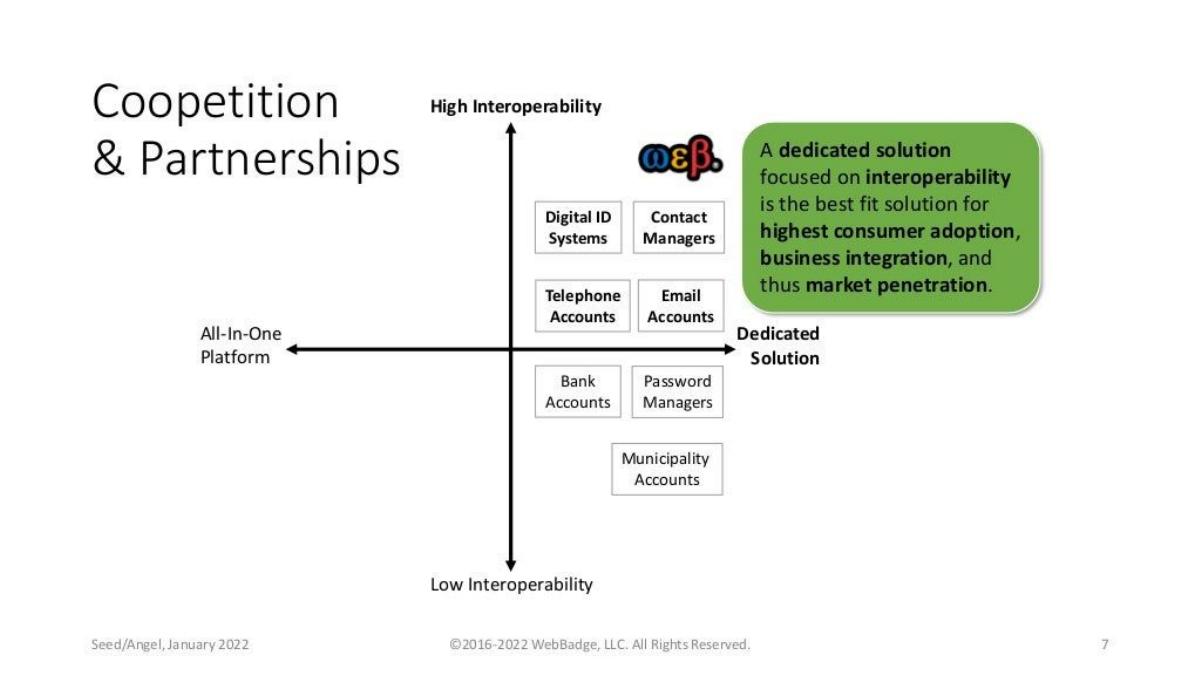
- The competitive matrix positions WebBadge as a high-interoperability, dedicated solution compared to 'All-In-One' platforms like bank or email accounts (Slide 7).
- Founder Mitchell Nguyen brings deep technical experience, including 8 years as a Senior Software Engineer at Qualcomm (Slide 8).
- The funding strategy prioritizes a gender-balanced cap table and board, though it lacks a specific capital target (Slide 9).
- The deck omits a traditional business model slide, leaving the monetization strategy for the 'B2B2C' team to define (Slide 9).
WebBadge Pitch Deck Analysis
The WebBadge pitch deck, dated January 2022, is a 9-slide presentation aimed at Seed and Angel investors. It focuses on the conceptual framework of a digital identity and authentication system. The deck is characterized by a high-level vision for 'democratizing' various aspects of the web, backed by a founder with significant technical pedigree in the wireless industry.
Slide 1: Title and Recognition
The cover slide introduces the company name, WebBadge, and its tagline: 'Authenticate for humanity.' It prominently features three awards: a 2019 Webby Award Honoree badge, a 2019 Lovie Awards shortlist mention, and a 15th Annual Davey Awards Silver Winner badge. Founder/CEO Mitchell Nguyen is listed with his location in Carlsbad, California, and a 'WIN' identification number. The inclusion of awards on the first slide serves as immediate social proof for a company that is still in its early stages.
Slide 2: The Problem/Need
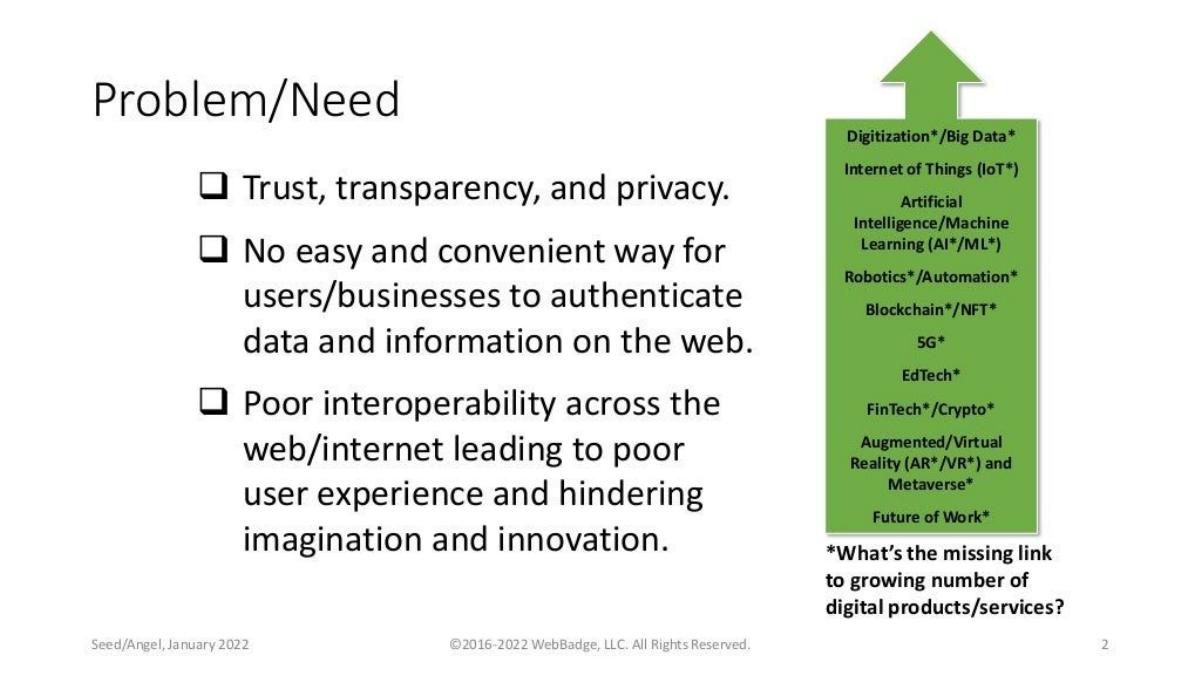
Slide 2 outlines the friction points WebBadge intends to solve. It lists three primary issues: a lack of trust, transparency, and privacy; the absence of a convenient way to authenticate data on the web; and poor interoperability that hinders innovation. To the right, a large green arrow lists various tech sectors (IoT, AI/ML, Blockchain/NFT, 5G, EdTech, Metaverse) and asks, 'What’s the missing link to growing number of digital products/services?' This slide effectively establishes that as digital complexity grows, the need for a unifying authentication layer becomes more acute.
Slide 3 & 4: The Solution and 'Pi-Principles'
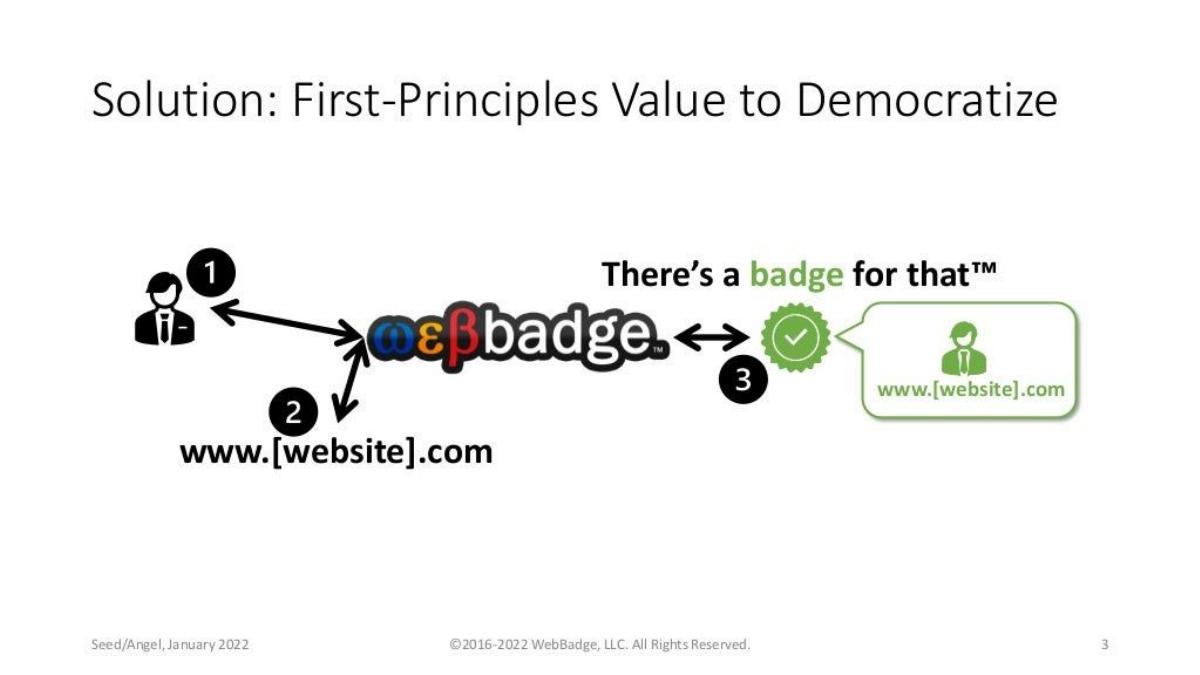
Slide 3 provides a simple workflow diagram showing a user (1) interacting with a website (2) through WebBadge, resulting in a verified 'badge' (3). The slide uses the trademarked phrase 'There’s a badge for that.' Slide 4 expands this into what the company calls an 'Interoperating System (IS).' This is visualized as a three-part pie chart consisting of 'Democratized DIGITAL BADGES,' 'Democratized CONTACTS,' and 'Democratized PRIVACY.' The text describes it as a '3-in-1 solution' to connect websites to each other and to end-users.
Slide 5: Why Now
The 'Why Now' slide uses five red arrows to show market trends. Two arrows point down, representing 'Decreasing TRUST IN TECHNOLOGY' (citing account takeovers and identity theft) and 'Decreasing CONTROL AND CONFIDENCE.' Three arrows point up, representing 'Increasing PRIVACY AND DATA USAGE CONCERNS' (citing GDPR and CCPA), 'Increasing ONLINE SAFETY AND SECURITY CONCERNS,' and 'Increasing COMPLEXITY OF TECHNOLOGIES.' This slide creates a sense of urgency by showing that regulatory and social pressures are peaking.
Slide 6: Market Size
This slide uses a collage of third-party infographics to illustrate the market opportunity. It cites the GSM Association (GSMA) regarding the growth of mobile internet users to 5.0 billion by 2025 and McKinsey Global Institute regarding the $2.7-$6.2 trillion potential economic impact of IoT. While these numbers are massive, they represent the entire digital ecosystem rather than a specific Total Addressable Market (TAM) for a badge-based authentication system. The slide concludes with the keywords: 'Authenticity, Privacy, and Interoperability.'
Slide 7: Coopetition & Partnerships
Instead of a standard competitive grid, WebBadge uses a 2x2 matrix. The Y-axis measures 'Interoperability' and the X-axis measures 'Platform Type' (All-In-One vs. Dedicated). WebBadge places itself in the top-right quadrant as a 'Dedicated Solution' with 'High Interoperability.' It positions legacy systems like 'Bank Accounts' and 'Password Managers' in the bottom-left (All-In-One, Low Interoperability). The slide argues that a dedicated solution is the 'best fit' for consumer adoption and business integration.
Slide 8: The Founder
The founder slide focuses exclusively on Mitchell Nguyen. It highlights his status as a '2nd-time Consumer Software Founder' and his 8-year tenure as a Senior Software Engineer at Qualcomm. His educational background includes a B.S. in Electrical Engineering from UCSD (2003) and business management courses from UCSD Extension. This slide is the strongest part of the deck's 'credibility' narrative, showing a founder with deep technical roots in the geographic hub of wireless technology (San Diego/Carlsbad).
Slide 9: Funding Objectives & Strategy
The final slide outlines the goals for the seed round. It mentions an openness to 'SAFE with discount' and emphasizes the importance of a 'gender balanced cap table and board.' The primary use of funds is to hire a 'B2B2C founding team' to build the alpha version and perform security/code reviews. Notably, the slide includes a link to a team page, but the deck itself does not list any other team members or advisors. There is no specific dollar amount requested on this slide.
What Works in the WebBadge Deck
Strong Founder Pedigree: The founder’s 8-year history at Qualcomm provides significant technical credibility, especially for a product focused on interoperability and systems architecture. · Clear Problem Identification: Slide 5 ('Why Now') does an excellent job of linking the product's necessity to real-world regulatory shifts like GDPR and CCPA. · Social Proof: Leading with three industry awards (Webby, Lovie, Davey) immediately suggests that the concept has been vetted by design and technology communities. · Strategic Positioning: The 'Coopetition' matrix (Slide 7) avoids the trap of saying 'we have no competitors' and instead explains how WebBadge fits into the existing ecosystem of digital IDs and contact managers.
What is Missing from the WebBadge Deck
Specific Financial Ask: The deck mentions raising a seed round but never specifies how much capital is needed. This is a critical omission that prevents investors from sizing the opportunity. · Business Model: There is no mention of how WebBadge intends to make money. Whether it is a SaaS model for businesses, a transaction-based fee for authentications, or a freemium model is left entirely to the imagination. · Traction Metrics: While the deck mentions an 'alpha version' is being built, there is no data on current users, pilot programs, or waitlist numbers. · Product Screenshots: The 'Solution' slides are highly conceptual. For a product that relies on 'badges,' seeing a mockup of the user interface or the integration on a partner website would have been beneficial. · Unit Economics: There is no discussion of Customer Acquisition Cost (CAC) or Lifetime Value (LTV), which are standard for seed-stage consumer/B2B2C pitches.
What Founders Should Copy
The 'Why Now' Logic: Using regulatory changes (GDPR/CCPA) as a tailwind is a persuasive way to show that a market is being forced to change, creating an opening for new solutions. · Founder-Market Fit: Slide 8 is a great example of how to highlight specific technical roles (e.g., 'Test Automation Development') that directly relate to the product's core value proposition (quality and security). · Values-Based Fundraising: Explicitly stating the desire for a 'gender balanced cap table' (Slide 9) is a modern approach that can help attract specific types of impact-aligned investors. · Simplified Workflow: Slide 3 uses a very simple 1-2-3 diagram to explain a complex technical process. Founders should always aim for this level of simplicity when explaining 'how it works.'
Frequently asked questions
- What is the core product of WebBadge?
- Based on Slide 4, the core product is an 'Interoperating System (IS)' that uses general-purpose digital badges to connect websites to each other and to end-users. It is described as a 3-in-1 solution covering democratized digital badges, democratized contacts, and democratized privacy. The goal is to provide a 'badge for that' to authenticate data and information across the web.
- How much money is WebBadge raising in this deck?
- The deck does not state a specific dollar amount. Slide 9 mentions they are 'Raising seed round' and are 'Open to SAFE with discount.' The funds are intended for hiring a B2B2C founding team and conducting security and code reviews to establish a quality baseline for their alpha version. The absence of a specific 'Ask' figure is a notable omission for a seed deck.
- What is the founder's background?
- Founder and CEO Mitchell Nguyen is a second-time consumer software founder with over 15 years of experience in mobile and wireless technologies. Most notably, he spent 8 years at Qualcomm as a Senior Software Engineer focused on product integration and test automation. He holds a B.S. in Electrical Engineering from UCSD, specializing in Computer Design (Slide 8).
- Who are WebBadge's competitors according to the deck?
- Slide 7 uses a 'Coopetition & Partnerships' matrix to categorize other players. It lists Digital ID Systems and Contact Managers as high-interoperability peers, while Telephone and Email accounts are mid-range. Bank accounts, Password Managers, and Municipality accounts are positioned as 'All-In-One' platforms with lower interoperability. WebBadge claims to be the 'best fit' because it is a dedicated solution for interoperability.
- What market opportunity does the company target?
- The company targets the broad 'Digital Transformation' market. Slide 6 cites GSM Association data showing mobile internet users growing from 3.6 billion in 2018 to 5.0 billion by 2025. It also references McKinsey Global Institute analysis regarding the Internet of Things (IoT), which could have an economic impact of up to $6.2 trillion by 2025.