The Weeks Best deck from 2009 addresses the burgeoning problem of digital information overload, citing a $650 billion drag on the U.S. economy. The company proposed a curation model where 'expert producers' use the MyWire platform to filter content into free weekly email updates or RSS feeds for consumers. The business model relies on a revenue-sharing system between the platform and these producers, projecting that a typical title could reach $293,018 in annualized revenue by Year 5 with 98,088 email subscribers. While the deck provides a strong macro-economic justification for curation and…
Key takeaways
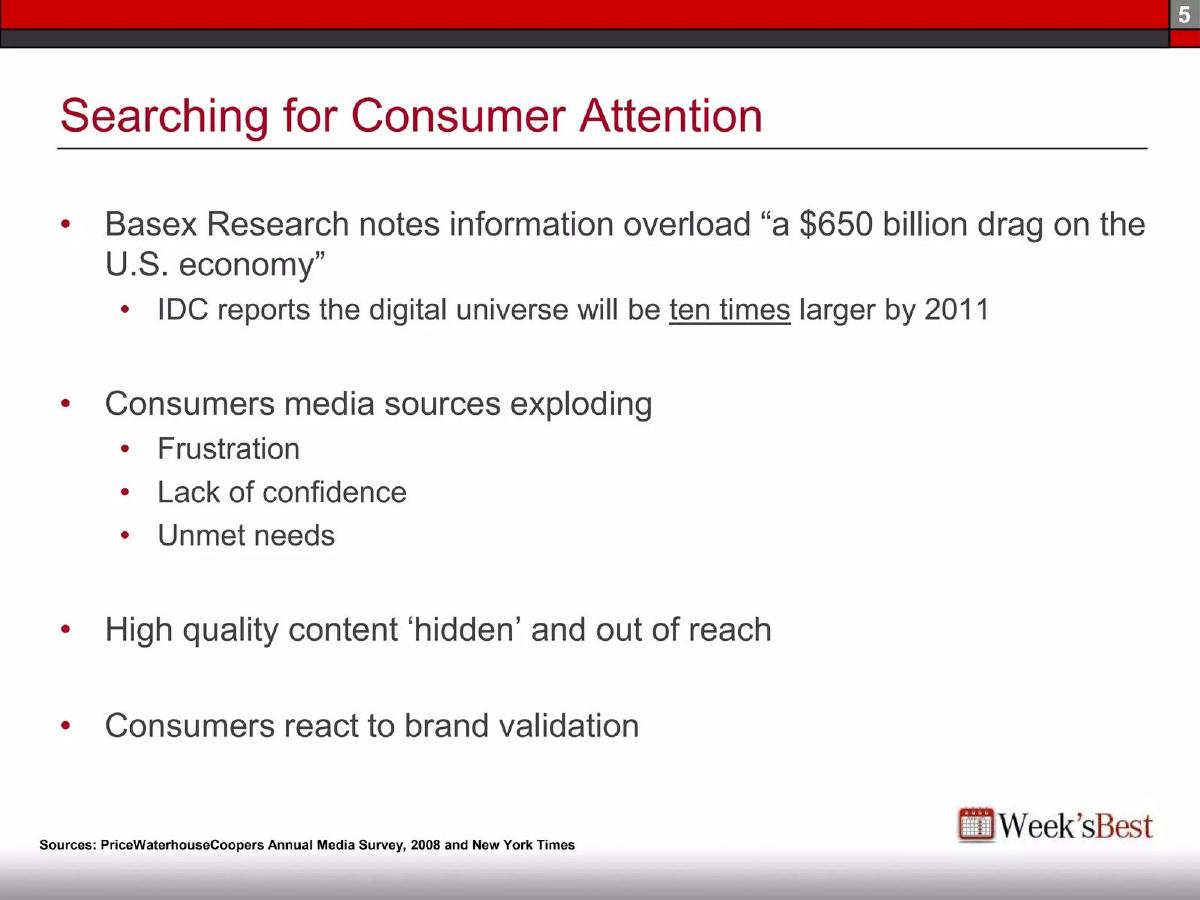
- The problem is defined as 'information overload,' which Basex Research estimated as a $650 billion drag on the U.S. economy (Slide 5).
- IDC data cited on Slide 5 predicted the digital universe would be ten times larger by 2011, necessitating better filtering tools.
- The solution involves 'expert producers' selecting content from a topic 'in-box' to create branded weekly updates (Slide 3).
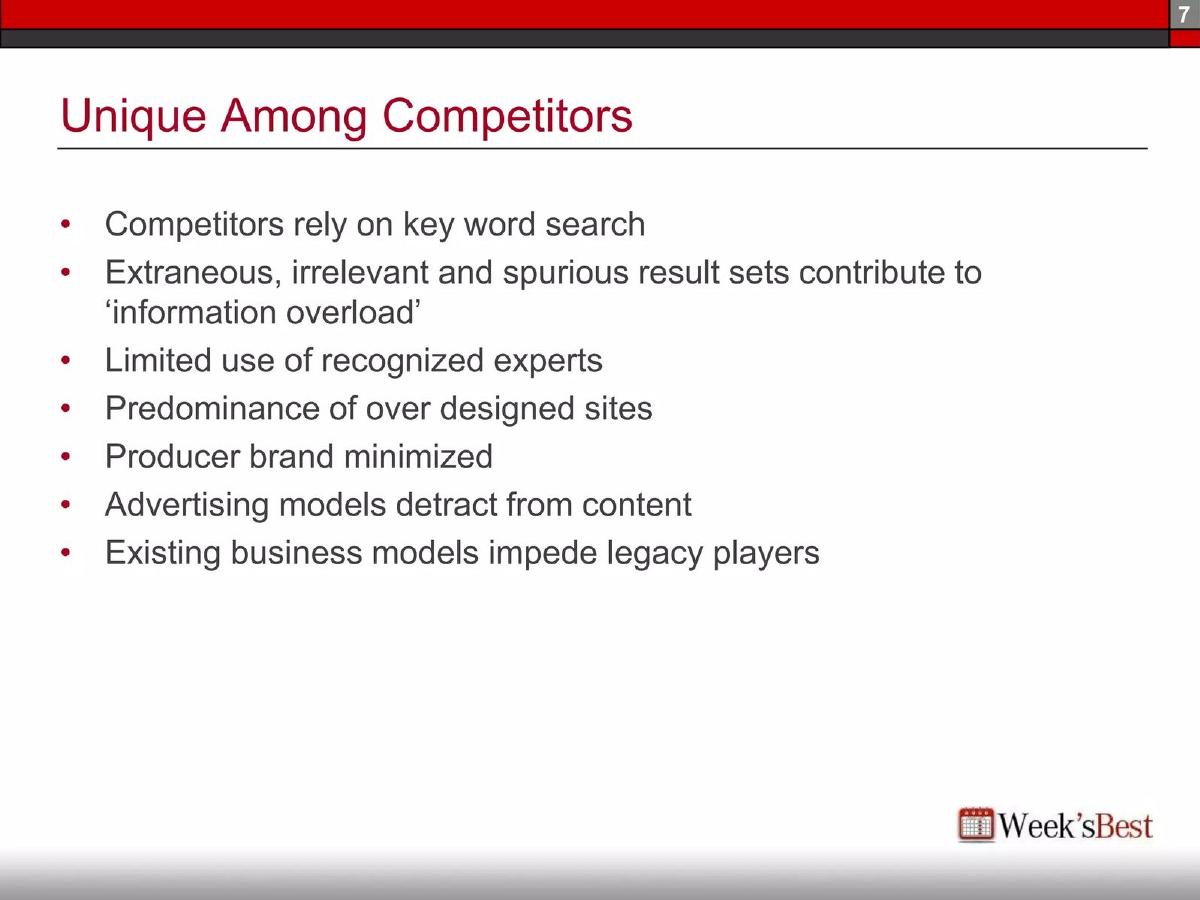
- The company positions itself against keyword search competitors, arguing that result sets are often 'extraneous, irrelevant and spurious' (Slide 7).
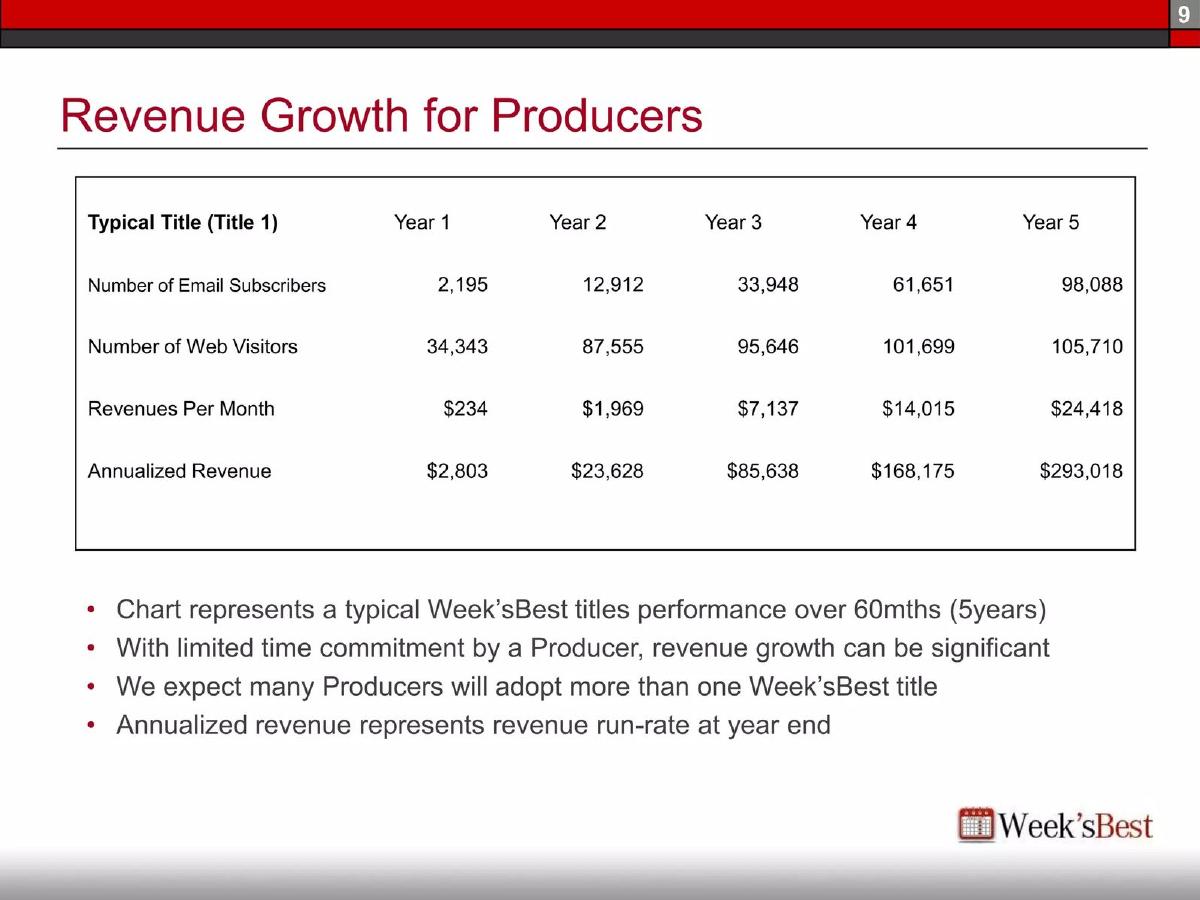
- Financial projections for a single 'typical title' estimate growth from $2,803 in Year 1 to $293,018 in Year 5 (Slide 9).
- The MyWire platform provides a web-based interface for editorial workflow, revenue allocation, and content distribution (Slide 11).
- Founder Michael Cairns brings significant industry weight, with over 25 years of experience at firms like Macmillan, Inc. and Wolters Kluwer Health (Slide 13).
- The company is identified as a division of MyWire, Inc., based in Redwood Shores, CA (Slide 15).
Executive Summary: The Curation Pivot
The Weeks Best deck, dated 2009, represents a specific moment in the evolution of the web. As the 'digital universe' began its exponential expansion, the founders identified that search engines—then heavily reliant on simple keyword matching—were failing to provide quality. Their solution was a return to human editors, rebranded as 'Expert Producers,' powered by a proprietary publishing stack called MyWire. This teardown explores a deck that is heavy on macro-economic justification and founder pedigree but light on the specific mechanics of the 'Ask.'
Slide 1: Title and Tagline
The cover slide introduces the brand Week'sBest with a calendar icon. The tagline, 'The best content from the web in free weekly updates,' immediately establishes the product as a curation service. It positions the value proposition around quality ('the best') and frequency ('weekly').
Slide 3: An Antidote to Irrelevant Information
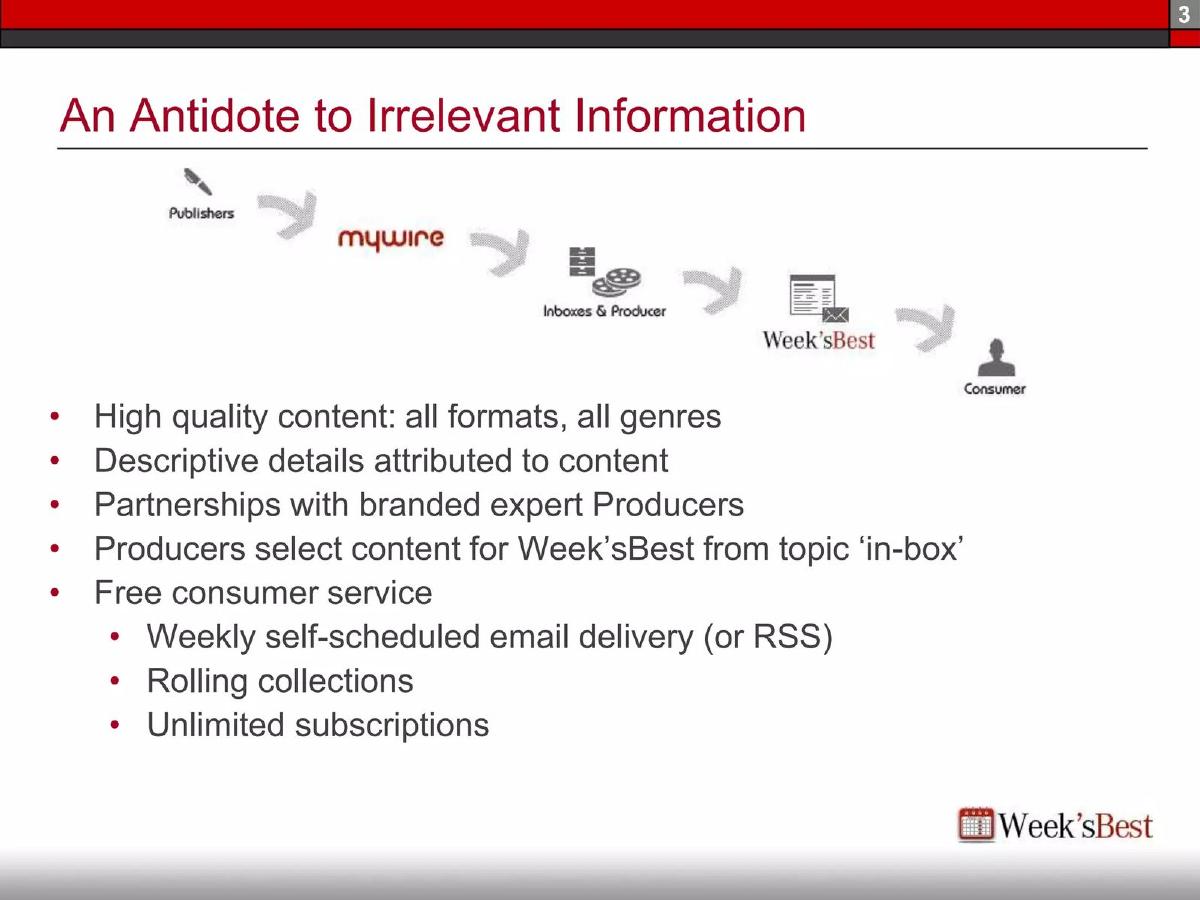
Slide 3 outlines the workflow of the service. It shows a linear progression from Publishers to mywire , then to Inboxes & Producer , through Week'sBest , and finally to the Consumer . Key features listed include:
High quality content in all formats and genres. · Partnerships with branded expert Producers. · Producers selecting content from a topic 'in-box.' · Free consumer service with self-scheduled email or RSS delivery.
This slide is crucial because it defines the company as a platform/intermediary rather than a direct content creator.
Slide 5: Searching for Consumer Attention
This is the 'Problem' slide, and it uses heavy-hitting third-party data to create urgency. It quotes Basex Research stating that information overload is a "$650 billion drag on the U.S. economy." It also cites IDC , predicting the digital universe would be ten times larger by 2011 . The slide argues that consumers are experiencing frustration and a lack of confidence, and that they 'react to brand validation,' which justifies the use of expert curators.
Slide 7: Unique Among Competitors
Instead of a standard 2x2 matrix or a checklist, Slide 7 lists qualitative disadvantages of competitors. The company claims competitors rely too much on keyword search , leading to 'extraneous, irrelevant and spurious result sets.' Other criticisms include over-designed sites, minimized producer brands, and advertising models that detract from content. This slide sets the stage for a 'cleaner,' more authoritative user experience.
Slide 9: Revenue Growth for Producers
Slide 9 provides a financial model for a 'Typical Title.' It projects a 5-year growth trajectory:
Year 1: 2,195 subscribers, 34,343 web visitors, $234 monthly revenue, $2,803 annualized revenue. · Year 3: 33,948 subscribers, 95,646 web visitors, $7,137 monthly revenue, $85,638 annualized revenue. · Year 5: 98,088 subscribers, 105,710 web visitors, $24,418 monthly revenue, $293,018 annualized revenue.
The slide notes that annualized revenue represents the run-rate at year-end and suggests that Producers will likely adopt more than one title to increase earnings.
Slide 11: MyWire Publishing and Distribution Platform
This slide focuses on the technology. It lists the 'Toolset to create a multimedia publication' and an 'Editorial work-flow solution.' A screenshot of the interface shows a 'My Inbox' feature where a producer can see various news items (e.g., 'Chelsea beats Everton,' 'Ronaldo refuses to commit to United') and select them for processing. The distribution side mentions a Revenue allocation system and Financial management , indicating the platform handles the monetization and payouts for the curators.
Slide 13: Introduction - Michael Cairns
The 'Team' slide is focused entirely on Michael Cairns . It lists his 25+ years of experience as a publishing and media executive, including management roles at Macmillan, Inc. , Wolters Kluwer Health , and Reed Elsevier . His skills include business and corporate strategy, operations management, and software development. The slide also lists his MBA from Georgetown and his presence on boards like the Association of American Publishers. This slide is designed to provide maximum institutional credibility.
Slide 15: Contact Information
The final slide identifies Week'sBest as a division of MyWire, Inc. , located at 275 Shoreline Drive, Suite 100, Redwood Shores, CA. It provides a phone number and the company logo. Notably, there is no 'Ask' or 'Funding Required' information on this closing slide or any of the preceding slides provided.
What Works in This Deck
Strong Macro Justification: The use of the $650 billion 'information overload' figure from Basex Research (Slide 5) gives the pitch a sense of economic importance. It moves the conversation from 'we have a cool newsletter' to 'we are solving a systemic economic drag.'
Clear Product Interface: Slide 11 shows the actual backend. For a platform play, seeing the 'In-box' and the 'Process' buttons helps investors understand exactly how the 'Expert Producer' interacts with the software. It proves the technology isn't just a concept.
Founder-Market Fit: Michael Cairns' resume (Slide 13) is perfectly aligned with the product. Having an executive from Macmillan and Reed Elsevier suggests the company has the industry connections necessary to secure the 'branded expert Producers' mentioned on Slide 3.
What Is Missing From This Deck
The Financial Ask: There is no slide indicating how much money the company is raising, at what valuation, or what the milestones will be. Without this, it functions more as a partnership deck than a pure investment pitch.
Unit Economics: While Slide 9 shows revenue growth, it doesn't explain the costs . We see the revenue per month for a producer, but we don't see the Customer Acquisition Cost (CAC) for the subscribers or the platform's take-rate. It is unclear if the $293k in Year 5 is the Producer's share or the total revenue.
Specific Competitors: Slide 7 mentions 'Competitors' generally but doesn't name them. In 2009, players like RSS readers (Google Reader), early social curation (Digg, Delicious), and emerging newsletters were the real threats. By staying generic, the deck avoids addressing how it will beat specific, well-funded incumbents.
What a Founder Should Copy
The 'Typical Unit' Projection: Slide 9 is a great way to show scalability. Instead of trying to project the entire company's revenue (which is often unbelievable), they projected the revenue of a single title . This allows an investor to do the math: 'If they can launch 100 titles, the business looks like X.'
Problem Validation: The way Slide 5 links consumer 'frustration' to a specific dollar amount of economic loss is a masterclass in framing. Founders should always look for research that quantifies the cost of the problem they are solving.
Visual Workflow: The chevron-style diagram on Slide 3 is an effective way to explain a multi-sided marketplace. It clearly shows the value chain from publisher to consumer, making a complex ecosystem easy to digest in seconds.
Frequently asked questions
- What is the core value proposition of Weeks Best?
- Weeks Best aims to be an 'antidote to irrelevant information.' It uses human experts to curate high-quality content across all formats and genres, delivering it to consumers via self-scheduled email or RSS. The goal is to replace the frustration of keyword searches with brand-validated, expert-selected content collections.
- How does the company intend to make money?
- According to Slide 11, the MyWire platform includes a 'Revenue allocation system' and 'Financial management.' Slide 9 shows revenue projections tied to the number of email subscribers and web visitors for specific titles, suggesting a model driven by advertising or subscription fees shared between the platform and the content producers.
- What is the 'MyWire' platform mentioned in the deck?
- MyWire is the underlying publishing and distribution infrastructure. It provides producers with a toolset to create multimedia publications, an editorial workflow solution, and a web-based interface to manage content from an 'in-box' to a final distributed product.
- Who is the target user for this platform?
- The deck identifies two primary users: 'Producers' (branded experts who curate the content) and 'Consumers' (individuals looking for high-quality, filtered information). Producers are expected to adopt multiple titles to increase their revenue run-rate over time.
- What market data does the deck use to justify the business?
- The deck relies on 2008-2009 era data from PriceWaterhouseCoopers, the New York Times, Basex Research, and IDC. It highlights the explosion of the 'digital universe' and the resulting consumer frustration and lack of confidence in uncurated search results.