WeightPlate presents a hardware-enabled solution to a specific healthcare challenge: elderly malnutrition. The deck identifies a significant market in the Netherlands, citing that over 30% of the elderly population suffers from malnutrition (Slide 4). The product uses integrated sensors to track food weight and transmit data to caregivers via a mobile app (Slide 10). While the team is composed of Master's students in Medical Biology, giving them academic credibility, the deck reveals a heavy reliance on external partners for both manufacturing and software development (Slide 11). Financially,…
Key takeaways
- The company identifies a specific pain point: over 30% of elderly people in the Netherlands suffer from malnutrition (Slide 4).
- The solution is a 'SmartPlate' featuring integrated weight sensors and Wi-Fi connectivity to provide real-time feedback to an app (Slide 10).
- The market size is tiered from 100 million elderly in Europe down to 30,000 potential users through their first interested customer, Pantein (Slide 8).
- The business model relies on outsourcing, with third parties handling both plate production and software development (Slide 11).
- The founders are all Master's students in Medical Biology, Science, Management & Innovation (Slide 2).
- Financial projections show a target EBIT of approximately €120,000 by July 2020 (Slide 12).
- The funding ask is split into two phases: €150,000 for the first six months and €100,000 for the second six months (Slide 13).
- The founders are personally committing €2,000 each to the startup funding (Slide 13).
Executive Summary and Team Composition
Slide 1: Title Slide
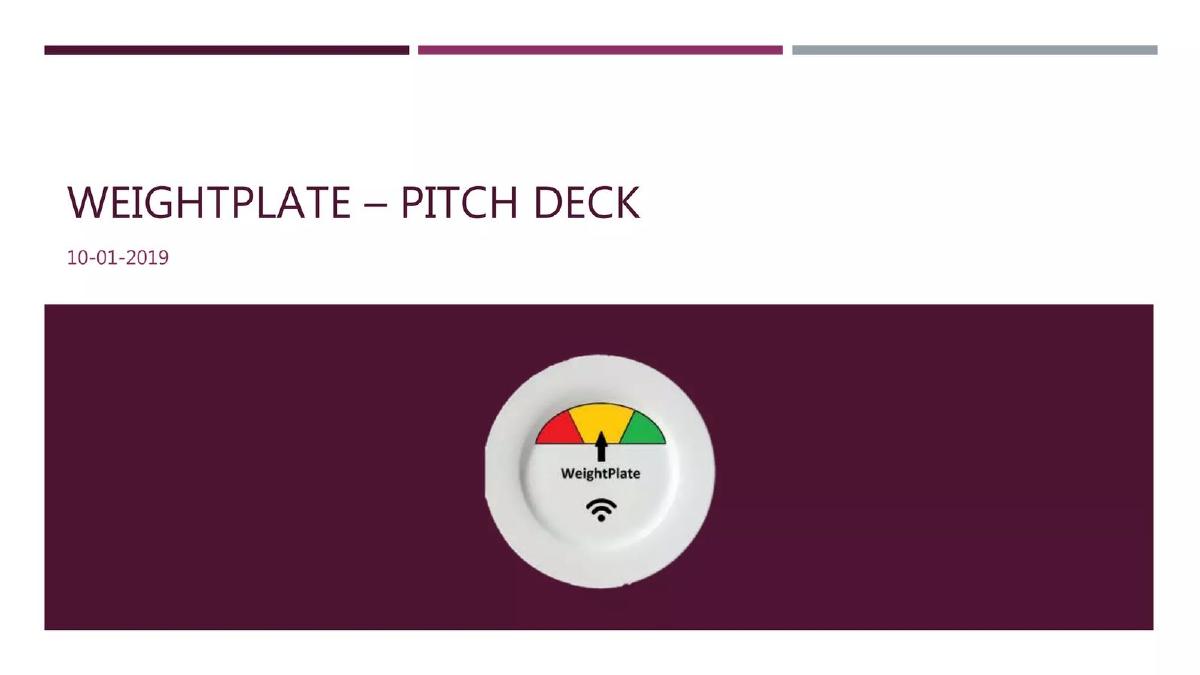
The deck opens with a minimalist title slide dated 10-01-2019. It features the company name, WeightPlate, and a graphic of a plate with a gauge showing red, yellow, and green zones, indicating a monitoring function. A Wi-Fi symbol is also present, signaling the IoT nature of the product.
Slide 2: Team
The team consists of three founders, all born between 1994 and 1995. Koen Jakobs (CFO/COO), Maikel van Berlo (CTO), and Alex van Kraaij (CEO) are all listed as Master's students in Medical Biology, Science, Management & Innovation. This suggests a strong academic background in the relevant medical field but highlights a lack of prior executive or industrial experience. Their contact information, including Gmail addresses and phone numbers, is provided.
The Problem and Market Opportunity
Slide 3: Company Purpose
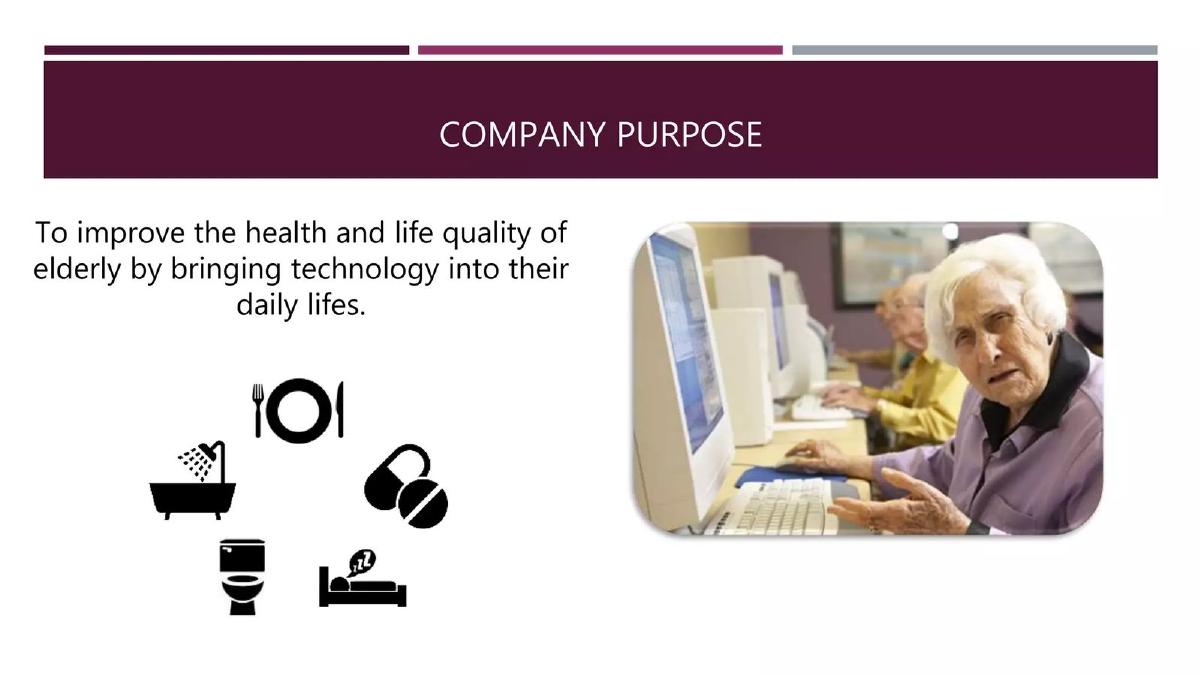
The stated purpose is to improve the health and life quality of the elderly by integrating technology into their daily lives. Icons represent various daily activities: eating, bathing, medication, sleeping, and using the restroom. The slide includes a photo of an elderly woman appearing confused by a computer, perhaps illustrating the need for more intuitive, 'invisible' technology like a smart plate.
Slide 4: Problem - The Malnutrition Epidemic
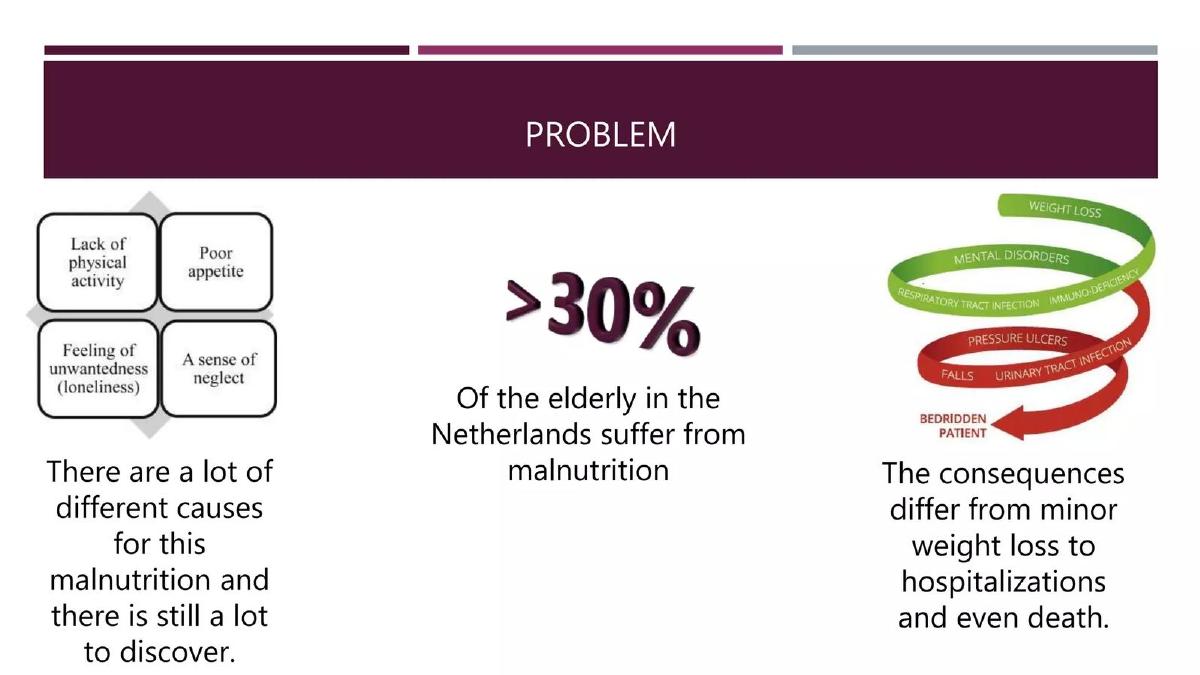
This slide quantifies the problem, stating that over 30% of the elderly in the Netherlands suffer from malnutrition. It lists causes such as lack of physical activity, poor appetite, loneliness, and neglect. A spiral graphic illustrates the downward health trajectory caused by malnutrition, leading from weight loss to mental disorders, respiratory infections, pressure ulcers, falls, and eventually death or hospitalization.
Slide 5: Problem - Monitoring Challenges
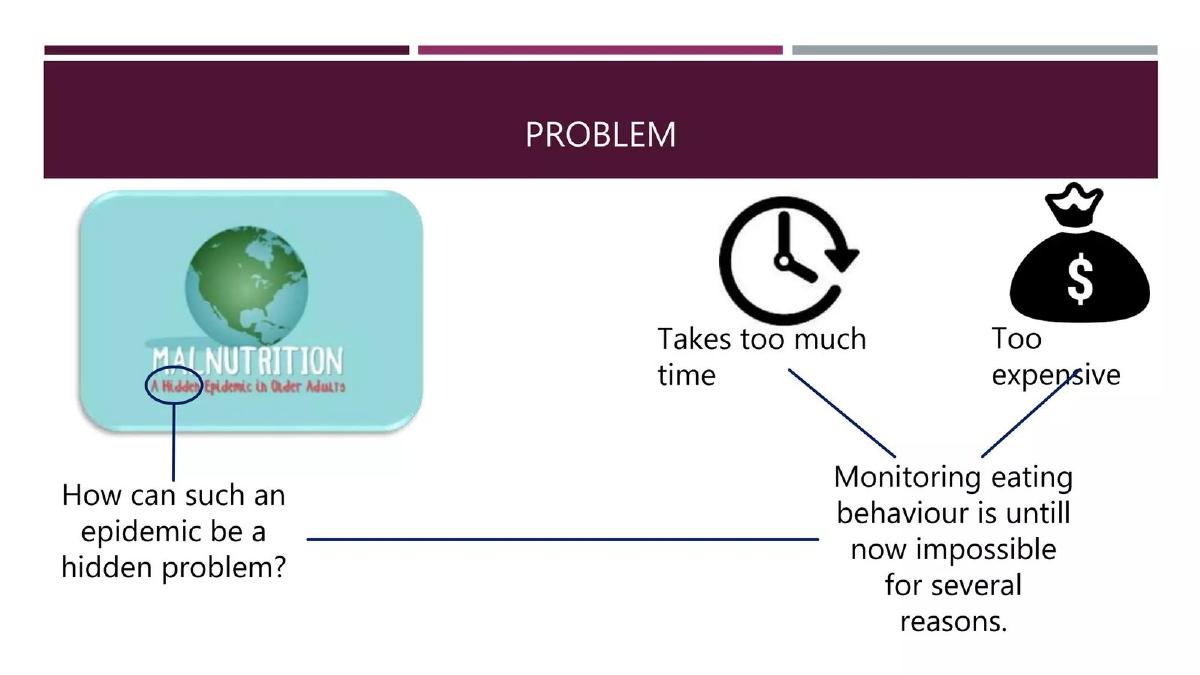
The deck asks, "How can such an epidemic be a hidden problem?" It identifies two main barriers to current monitoring: it takes too much time and is too expensive. The implication is that manual tracking by caregivers is inefficient and cost-prohibitive, creating a market gap for an automated solution.
The Solution and Product Details
Slide 6: Solution
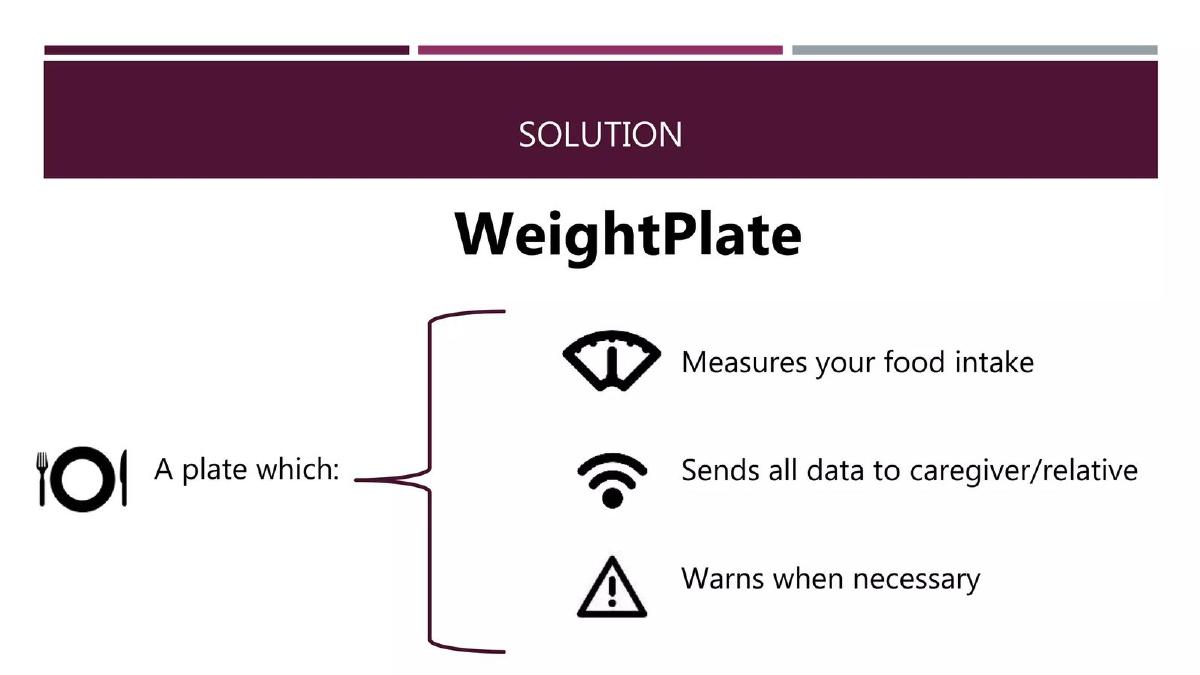
The solution is defined as a plate that measures food intake, sends data to a caregiver or relative, and warns when necessary. This slide uses simple icons to convey the core value proposition: measurement, connectivity, and alerting.
Slide 7: Why Now
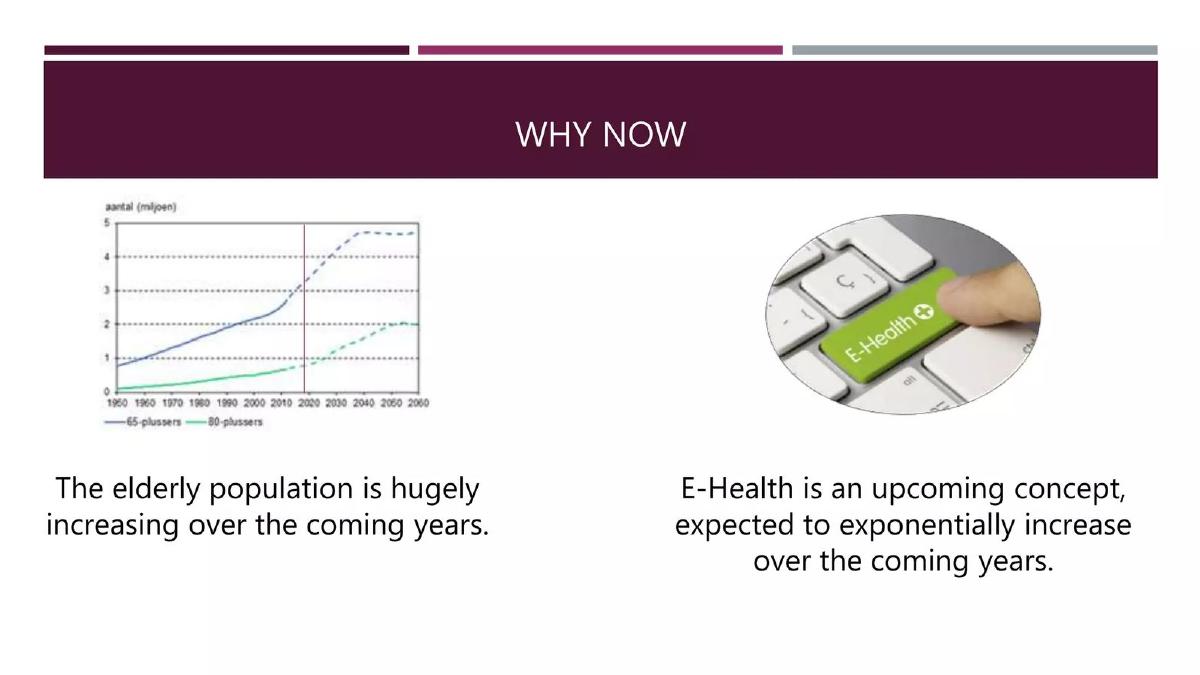
The 'Why Now' slide points to two macro trends: a 'hugely increasing' elderly population (supported by a demographic chart projecting growth through 2060) and the rise of E-Health as an 'upcoming concept' expected to increase exponentially.
Slide 8: Market Size
The market is presented as an inverted pyramid. The Total Addressable Market (TAM) is ~100,000,000 elderly in Europe. The Serviceable Addressable Market (SAM) is ~3,300,000 elderly in the Netherlands. The Serviceable Obtainable Market (SOM) is narrowed down to ~280,000 elderly receiving home care in the Netherlands, with a specific target of ~30,000 users via 'Pantein,' identified as their first interested customer.
Slide 9: Competition
The competition slide uses a matrix to compare WeightPlate against 'Ordinary' plates, 'SNAQ', and 'SmartPlate'. Key differentiators noted are that WeightPlate has 'SmartScales imbedded in the plate' and focuses specifically on the elderly market with real-time feedback. The slide also includes a SWOT-style analysis of threats (existing patents, competitors' funding) and opportunities (focus on real-time feedback and pricing strategy).
Slide 10: Product Technical Overview
This slide provides a cross-section diagram of the plate. It shows a 'double bottom' where the 'SmartScales' (weight sensor + Wi-Fi) are installed. It illustrates food items (potatoes, meat, broccoli) on the plate and an arrow pointing to a smartphone, indicating 'Realtime feedback on the WeightPlate App.'
Business Model and Financials
Slide 11: Business Model
The business model is a flow chart showing the ecosystem. WeightPlate sits at the center, interacting with three customer segments: Informal Care, Home Care Organizations, and Hospitals. The model is heavily reliant on outsourcing: a 'Plate producer' handles manufacturing and logistics, while a 'Software developer' handles development and maintenance. WeightPlate appears to act as the orchestrator, collecting payments from customers and paying the producers/developers.
Slide 12: Financial Projections
Two charts are presented. The first shows 'Gross profit per customer type,' with Home Care Organizations projected to be the largest driver of profit, reaching nearly €100,000 by July 2020. The second chart shows 'Net income (EBIT),' projecting a move from negative territory in late 2019 to a profit of approximately €120,000 by July 2020. The timeline is very aggressive, showing a steep hockey-stick growth curve over just 12 months.
Slide 13: Financials - The Ask
The startup expenses are detailed in a table. Fixed costs total €130,000, with the bulk (€100,000) allocated to software development. Monthly operating costs are estimated at €4,857, primarily for salaries. The founders state they will each invest €2,000. The total funding need is identified as €250,000: €150,000 for the first six months and €100,000 for the following six months.
Slide 14: Contact
The deck concludes by repeating the team slide, providing the founders' photos, titles, and contact details once more.
What Works and What is Missing
What Works
Clear Problem Identification: The deck does an excellent job of quantifying the malnutrition crisis in the Netherlands (Slide 4) and explaining why current solutions fail (Slide 5). · Specific Target Customer: Identifying 'Pantein' as an interested customer with 30,000 potential users (Slide 8) provides immediate credibility and a clear path to initial traction. · Simple Product Explanation: The diagram on Slide 10 makes the hardware-software interaction easy to understand for non-technical investors.
What is Missing
Manufacturing Strategy: While the deck mentions a 'Plate producer' (Slide 11), it lacks detail on who this partner is, the cost of goods sold (COGS), or how they will manage quality control for a medical-grade device. · Regulatory Path: For a device intended for hospitals and home care to monitor health, there is no mention of CE marking or medical device certifications required in the EU. · Software Ownership: The business model shows software development is entirely outsourced (Slide 11). For a tech startup, not having in-house technical talent for their core product is a significant risk. · Unit Economics: The deck lacks a breakdown of the price per plate versus the cost to produce and maintain the service.
What a Founder Should Copy
The Market Funnel: The market size slide (Slide 8) is a textbook example of how to move from a massive global number to a realistic, actionable target. · The 'Why Now' Slide: Using demographic trends and the rise of a specific sector (E-Health) to create urgency is a strong tactic (Slide 7). · Founder Commitment: Explicitly stating that the founders are putting their own money in—even if the amount is small (€2,000 each)—shows 'skin in the game' (Slide 13).
Frequently asked questions
- What is the core technology behind WeightPlate?
- According to slide 10, the technology consists of 'SmartScales'—a combination of weight sensors and Wi-Fi modules—embedded within a double-bottomed plate. This hardware communicates with a dedicated WeightPlate App to provide real-time feedback on food consumption to caregivers or relatives.
- Who are the primary target customers for this product?
- Slide 11 outlines a three-pronged customer base: Informal Care (relatives), Home Care Organizations, and Hospitals. Slide 8 specifically identifies 'Pantein' as their first interested customer, representing a segment of approximately 30,000 elderly individuals receiving home care in the Netherlands.
- What are the main financial requirements for the first year?
- Slide 13 details a total requirement of €250,000 for the first year. This includes €150,000 for the 'start-up phase' (first six months) and €100,000 for the 'first live period' (second six months). Fixed costs include €100,000 for software development and €10,000 for patenting.
- How does the company plan to handle manufacturing?
- WeightPlate does not plan to manufacture the hardware in-house. Slide 11 shows a business model where a third-party 'Plate producer' handles manufacturing and logistics, while a 'Software developer' handles the creation and maintenance of the digital platform.
- What competitive advantages does WeightPlate claim?
- On slide 9, the company compares itself to 'Ordinary' plates, 'SNAQ', and 'SmartPlate'. It claims differentiation by embedding scales directly into the plate (unlike SNAQ) and specifically targeting the elderly market with real-time feedback (unlike the existing SmartPlate brand).