Well Dot's 2020 Series A deck is a masterclass in product-centric storytelling, focusing heavily on the user experience and the underlying AI engine. Rather than leading with dense financial tables or market sizing, the company prioritizes the 'how' of their solution: a personalized, consumer-grade platform designed to drive health engagement for employees. By drawing direct parallels to consumer giants like Netflix and Amazon, Well Dot positions itself as a modern alternative to legacy healthcare interfaces. The deck successfully raised $40M by emphasizing a 'clinically-robust' approach back…
Key takeaways
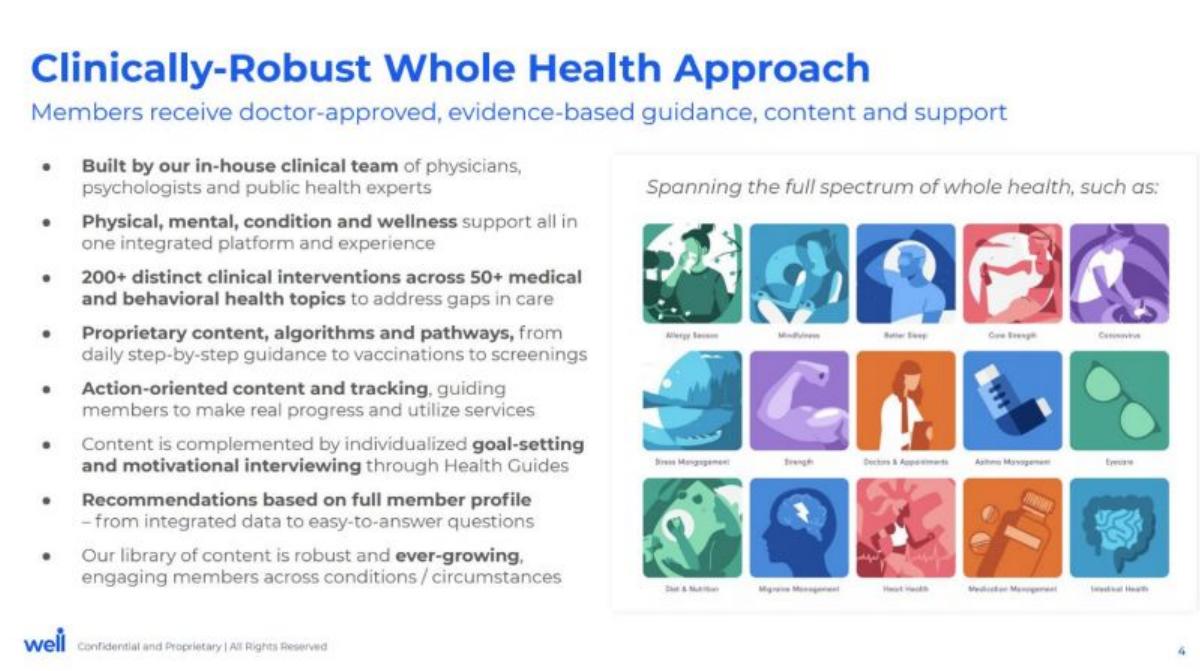
- The platform claims to offer 200+ distinct clinical interventions across 50+ medical and behavioral health topics (Slide 4).
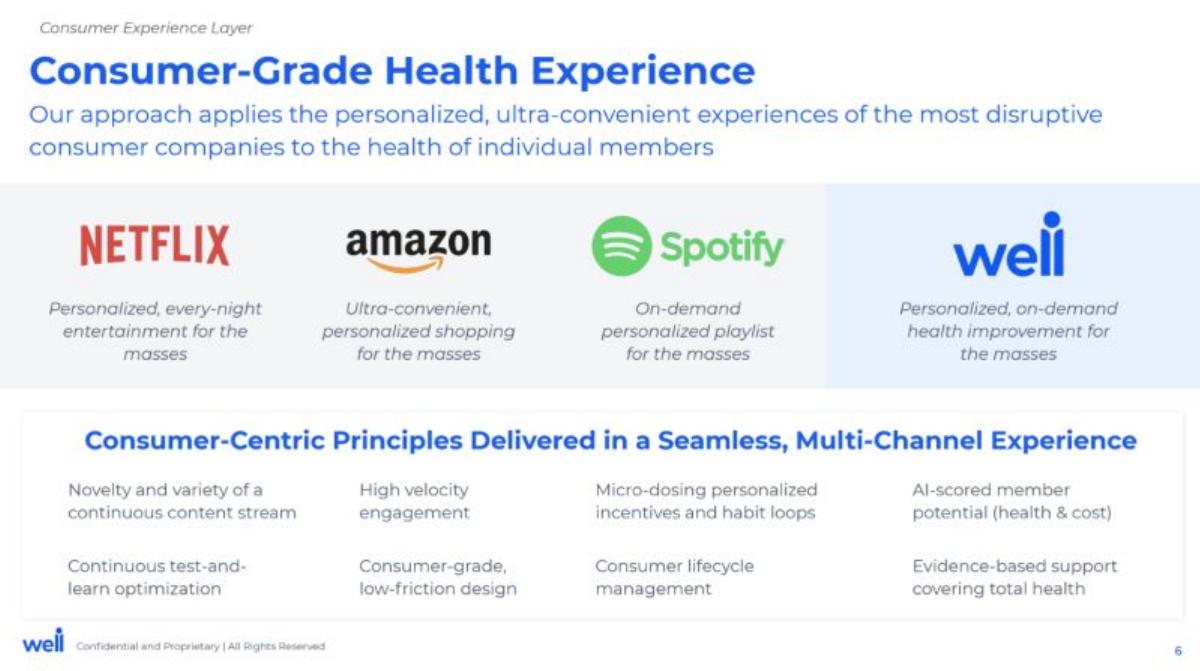
- Well Dot positions its user experience against consumer giants Netflix, Amazon, and Spotify to emphasize its 'consumer-grade' design (Slide 6).
- The 'AI Health Engine' is described as a four-step closed feedback loop: Ingest Data, Perform Assessments, Orchestrate Engagement, and Deliver with Personalized Incentives (Slide 8).
- A detailed member persona, 'Mia', is used to illustrate a potential 12-month cost savings opportunity of over $6,000 (Slide 9).
- The deck identifies four key ROI drivers: preemptive engagement, targeted utilization, sustaining proven programs, and 'swimming upstream' to untouched health impacts (Slide 10).
- There is no team slide included in this 12-slide presentation, omitting founder backgrounds and clinical leadership names.
- The presentation lacks a specific 'Ask' slide detailing the amount of capital sought or the intended use of funds.
- No competitive analysis or market size (TAM/SAM/SOM) data is presented in the deck.
Well Dot: The Product-First Series A Narrative
Well Dot’s 2020 Series A deck is a 12-slide presentation that leans heavily into the user experience and the technology stack. In an industry often bogged down by regulatory jargon and complex billing cycles, Well Dot chooses to present itself as a sleek, consumer-facing application. The goal is clear: convince investors that the secret to lowering healthcare costs is not through better insurance math, but through better user engagement.
The Vision and Product Identity (Slides 1-2)
Slide 1 sets a minimalist tone with three core pillars: Re-imagining engagement, Improving health, and Reducing cost. This is a standard 'triple aim' approach in healthcare, but the phrasing 're-imagining engagement' signals that the company views the interface as the primary problem to be solved.
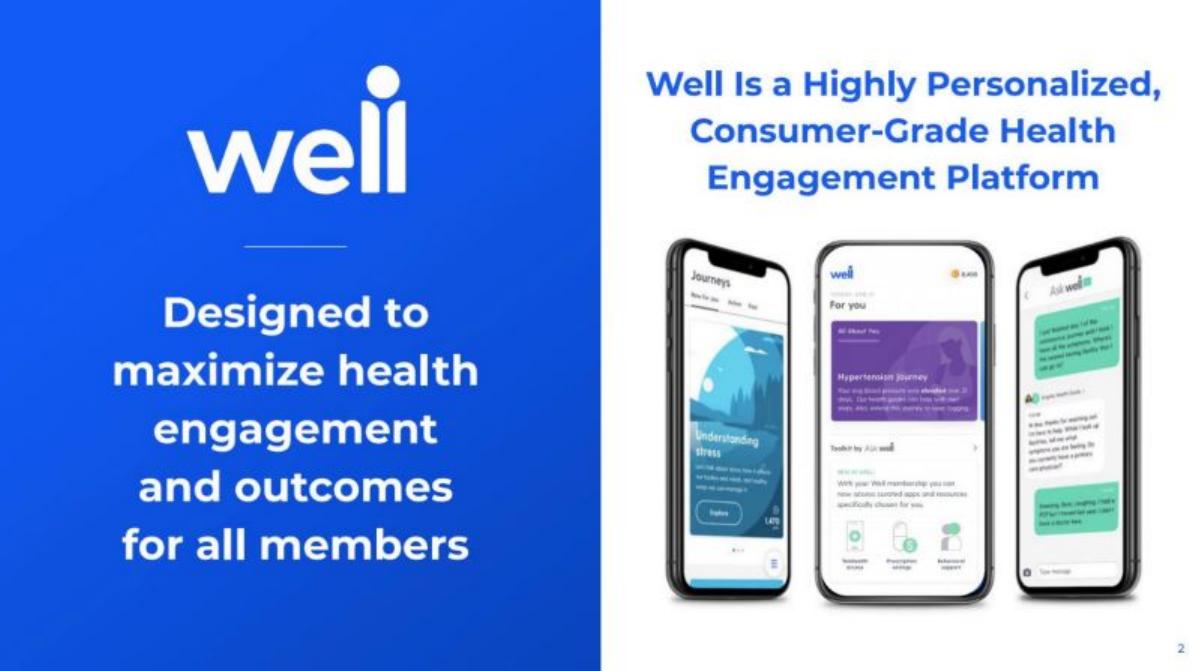
Slide 2 introduces the platform visually. By showing the app on three mobile devices, Well Dot immediately establishes itself as a mobile-first, 'consumer-grade' solution. The headline explicitly calls it a 'Highly Personalized, Consumer-Grade Health Engagement Platform.' This is a strategic move to distance the company from the clunky, web-portal experiences typical of traditional health plans.
Value Proposition and Clinical Breadth (Slides 3-4)
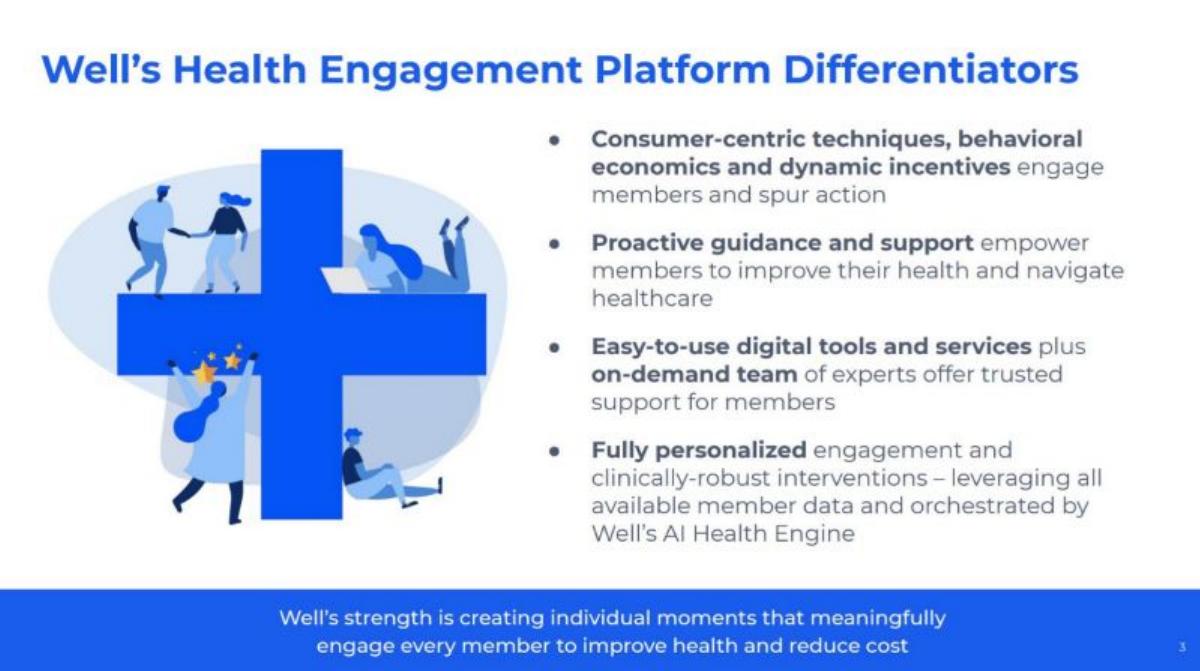
Slide 3 lists the platform differentiators. It mentions 'behavioral economics' and 'dynamic incentives,' which are buzzwords for a platform that uses rewards to change user behavior. Crucially, it introduces the 'AI Health Engine' as the orchestrator of these interventions. The graphic on the left—a large blue plus sign populated by diverse characters—reinforces the idea of 'whole health' rather than just sick care.
Slide 4 is the 'Clinical' slide. To avoid being seen as just another wellness app, Well Dot emphasizes that their guidance is 'doctor-approved' and 'evidence-based.' They quantify their reach: 200+ distinct clinical interventions across 50+ medical and behavioral health topics. The grid of icons on the right illustrates the variety of these topics, ranging from 'Allergy Season' and 'Mindfulness' to 'Migraine Management' and 'Intestinal Health.' This slide is intended to prove that the platform has the depth to handle serious clinical needs.
The Technology Stack and User Experience (Slides 5-7)
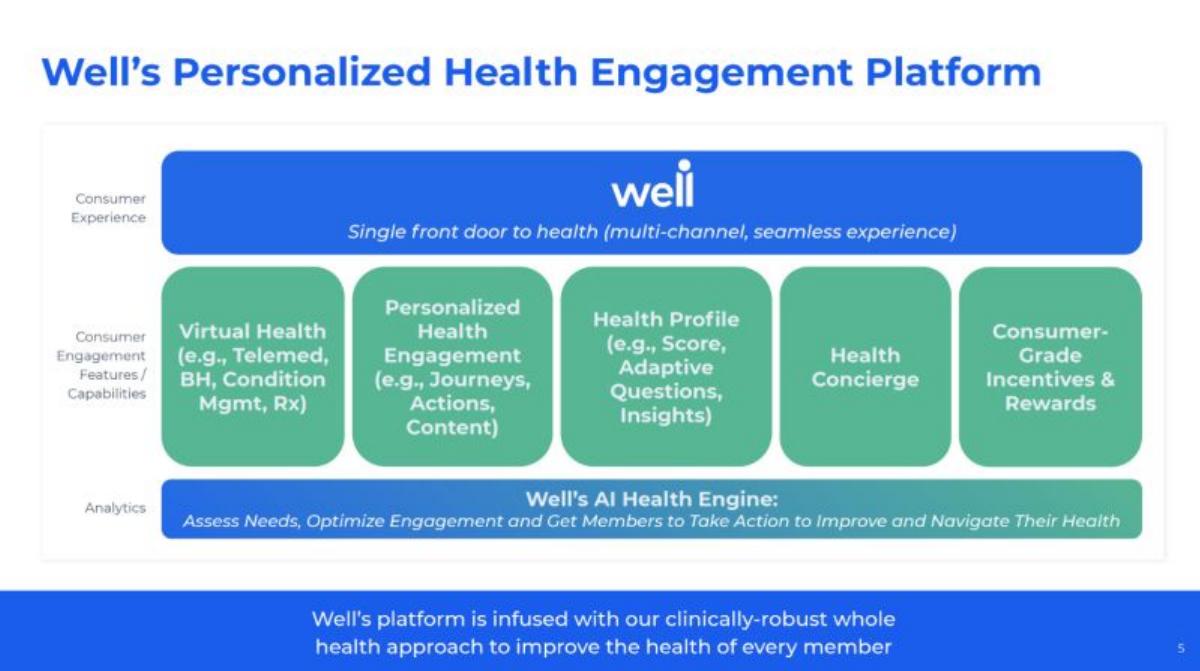
Slide 5 provides a high-level architecture of the platform. It shows a three-layer stack: the Consumer Experience (the 'single front door'), the Consumer Engagement Features (Virtual Health, Health Profile, Concierge, etc.), and the Analytics layer (the AI Health Engine). This visualization helps investors understand how the disparate parts of the business—telehealth, data, and rewards—fit into one cohesive product.
Slide 6 is perhaps the most aggressive slide in the deck. It places the Well Dot logo alongside Netflix, Amazon, and Spotify. The text claims Well Dot applies the 'personalized, ultra-convenient experiences' of these giants to individual health. This is a bold comparison, suggesting that Well Dot can achieve the same level of daily stickiness as a streaming service or an e-commerce platform. The bottom half of the slide lists 'Consumer-Centric Principles' like 'micro-dosing personalized incentives' and 'habit loops.'
Slide 7 dives deeper into the 'Vertical Capabilities.' It explains that the 'Health Concierge' is an on-demand team of 'Well Guides and nurses' who offer human-delivered coaching via chat and phone. This confirms that the platform is not purely automated; there is a service component that supports the technology.
The AI Engine and Member Journey (Slides 8-9)
Slide 8 explains the 'AI Health Engine' as a circular process. It starts with ingesting data (EHRs, engagement data), moves to performing assessments (scoring members), orchestrates engagement (finding the right action at the right time), and delivers incentives. The phrase 'test-and-learn experimentation' suggests a machine learning approach that improves as more members use the platform.
Slide 9 brings the entire deck together with a persona-based case study. We follow 'Mia,' a 46-year-old female. The slide maps her journey from data ingestion to a '21-day nutrition journey' and a telehealth visit. The most important figure on this slide is the '12-Month Cost Savings Opportunity: >$6K.' This provides a concrete, albeit illustrative, example of how engagement translates into the financial outcomes promised on Slide 1.
ROI Drivers and Mission (Slides 10-11)
Slide 10 outlines the 'Key ROI Drivers' for employers. It focuses on four areas: preemptive engagement (targeting high-cost members before they get expensive), targeted utilization (routing to optimal providers), sustaining programs (reducing drop-off), and 'swimming upstream' (addressing health impacts typically left untouched). This is the 'business' slide, explaining why an employer would pay for this service.
Slide 11 concludes with the mission statement: 'To be the world’s most effective partner in the advancement of our members’ health.' It is a standard closing slide that returns to the minimalist blue branding of the opening.
What Works in the Well Dot Deck
Visual Consistency: The deck uses a professional, cohesive color palette and high-quality illustrations. It looks like a product that a consumer would actually want to use, which reinforces their 'consumer-grade' claim.
Clear Architecture: Slide 5 is excellent for explaining a complex business model. By separating the 'front door' from the 'analytics engine,' the founders make it easy for investors to categorize the company’s various functions.
Persona-Based Proof: The use of 'Mia' on Slide 9 makes the abstract AI engine feel real. It shows exactly how the technology interacts with a human being to produce a financial result.
What is Missing from the Well Dot Deck
The Team: There is no team slide. For a Series A raising $40M, the pedigree of the founders and the clinical leadership is usually a primary selling point. Its absence here is highly unusual for a standalone deck.
Market Size and Competition: The deck does not mention the Total Addressable Market (TAM) or how Well Dot compares to competitors like Livongo, Omada, or Castlight Health. Investors are left to guess how large the opportunity is and how Well Dot wins against incumbents.
Financials and The Ask: There are no historical growth metrics, revenue figures, or projections. Furthermore, there is no slide stating how much money they are raising or how they plan to spend it. This suggests the deck was a 'teaser' or a visual aid for a conversation where these details were handled elsewhere.
Lessons for Founders
Use Consumer Analogies Wisely: Comparing yourself to Netflix or Amazon (Slide 6) is a high-risk, high-reward move. It sets a very high bar for your UX. If you use this tactic, your product screenshots must actually look as good as the companies you are citing.
Quantify the 'How': Well Dot doesn't just say they have AI; they show a four-step loop (Slide 8) and a member journey (Slide 9). Founders should aim to visualize their 'black box' technology so it feels tangible to non-technical investors.
Focus on the End User: Even though the employer pays the bill, Well Dot spends 90% of the deck talking about the employee (the member). This reflects a growing trend in B2B2C: if the end-user doesn't love the product, the enterprise buyer won't see the ROI.
Conclusion: Well Dot’s deck is a polished, product-centric narrative that successfully raised $40M by focusing on the 'engagement gap' in healthcare. While it lacks the structural components of a comprehensive pitch, its focus on design, AI-driven personalization, and clinical depth provided a compelling vision of the future of employee benefits.
Frequently asked questions
- What is the primary value proposition of Well Dot according to the deck?
- Well Dot defines its value proposition as a highly personalized, consumer-grade health engagement platform designed to maximize health outcomes while reducing costs for employers. As stated on Slide 2 and Slide 3, the platform uses behavioral economics, AI-driven guidance, and dynamic incentives to spur member action and improve health navigation.
- How does Well Dot justify its clinical efficacy?
- On Slide 4, the company highlights a 'Clinically-Robust Whole Health Approach.' They claim the platform is built by an in-house clinical team of physicians and psychologists, featuring over 200 distinct clinical interventions. The content is described as doctor-approved and evidence-based, covering a spectrum from mindfulness and sleep to chronic condition management like hypertension and asthma.
- What role does AI play in the Well Dot platform?
- AI is the core 'Analytics Layer' of the platform. According to Slide 8, the AI Health Engine continuously builds member profiles by ingesting data, scoring members based on engagement opportunities, and orchestrating personalized incentives. This 'test-and-learn' experimentation is intended to find the specific 'engagement hook' for each individual user.
- How does the deck demonstrate ROI for employers?
- The deck uses a combination of a persona-based case study and strategic pillars. Slide 9 shows a member experience resulting in over $6,000 in cost savings. Slide 10 then outlines the 'Key ROI Drivers,' which include identifying high-cost members preemptively and routing them to optimal providers and sites of care to prevent cost leakage.
- Is this a complete pitch deck for a Series A round?
- While this deck successfully raised $40M, it is structurally incomplete by traditional standards. It lacks a team slide, a competition slide, financial projections, and a clear funding ask. It functions more as a product and vision overview, likely supplemented by a data room or a detailed verbal pitch regarding the business's unit economics and leadership.