The Wellinks deck from 2016 is a focused presentation on 'Cinch,' a smart strap designed for orthopedics and prosthetics. The company identifies a clear medical need—scoliosis monitoring—and proposes a hardware-plus-software solution that connects physical braces to a mobile app via Bluetooth. The deck is notable for its specific pricing model ($250 per device) and its clear short-term go-to-market strategy through partnerships with brace manufacturers. While the provided slides lack a formal team overview or financial projections, they effectively communicate a modular product vision that ex…
Key takeaways
- The primary product is Cinch, a smart strap for orthopedics and prosthetics (Slide 3).
- The initial medical focus is scoliosis, illustrated by X-ray imagery (Slide 2).
- Connectivity is achieved via Bluetooth, allowing patients and parents to view progress on a mobile app (Slide 4).
- Wellinks provides a dashboard for data analysis, featuring patient profiles like 'Amanda Benson' (Slide 5).
- The short-term market strategy relies on partnering with brace makers for distribution (Slide 6).
- Pricing is explicitly stated at $250 per device (Slide 6).
- The company claims to be in active contract negotiations with brace manufacturers (Slide 6).
- The long-term vision is a modular 'Orthotics Platform' capable of monitoring multiple conditions (Slide 7).
Wellinks Pitch Deck Analysis
The 2016 Wellinks pitch deck is a product-centric presentation that focuses on the intersection of wearable hardware and medical orthopedics. At a time when 'Internet of Things' (IoT) was a dominant investment theme, Wellinks sought to apply this connectivity to the relatively stagnant field of medical bracing. The deck is structured to move from a specific medical problem to a hardware solution, and finally to a scalable platform vision.
Slide 1: Title Slide
The cover slide introduces the company name, Wellinks, with the tagline 'Motivating Health.' It identifies Ellen Su as the CEO and notes the presentation was given at a 'Health Conference 2016' on March 4, 2016. The branding is clean, utilizing a medical green and grey color palette that establishes a professional, healthcare-oriented tone immediately.
Slide 2: The Problem - Scoliosis
Slide 2 uses a stark X-ray image of a curved spine to identify the initial target condition: Scoliosis. By leading with a clinical image, the deck anchors the technology in a real-world medical necessity. There is no text on this slide other than the heading, which forces the audience to focus on the severity of the condition being addressed.
Slide 3: Product Introduction - Cinch
This slide introduces 'Cinch,' described as a 'Smart Strap for Orthopedics and Prosthetics.' The slide uses three circular icons to illustrate the components: the physical strap hardware, the Bluetooth connectivity to a smartphone, and the data visualization on a laptop. This effectively communicates that Wellinks is not just a hardware company, but a full-stack data solution.
Slide 4: The Ecosystem
Slide 4 details the interaction between the 'Smart Brace with Cinch' and the 'Mobile App for Patients.' It highlights two key functional points: wireless Bluetooth connectivity and the ability for both patients and parents to view progress. This is a critical distinction, as it acknowledges the 'payer/user' dynamic in pediatric care, where parents are the primary stakeholders in treatment compliance.
Slide 5: Data Visualization and Dashboard
This slide showcases the user interface (UI) for the Wellinks platform. It features a patient profile for 'Amanda Benson' and displays various metrics such as 'Prescribed Hours' (16 Hrs/Day) and 'Total Hours On.' The dashboard uses bar charts and line graphs to track compliance over time. The inclusion of a 'Patient List' on the sidebar suggests that this interface is also designed for clinicians to manage multiple patients simultaneously.
Slide 6: Market and Distribution Strategy
Slide 6 is the most business-heavy slide in the deck. It outlines the 'short-term' market focus on 'Brace Makers.' Key data points include:
Distribution: Through brace makers. · Customers: Parents and brace makers. · Partners: 3-4 potential partners identified. · Pricing: $250 per device.
The slide also notes that the company is 'in contract negotiations for sales with brace manufacturers currently,' which provides a sense of traction and urgency.
Slide 7: The Orthotics Platform Vision
The final slide in this selection expands the vision from a scoliosis tool to a comprehensive 'Wellinks Orthotics Platform.' It emphasizes three pillars: a modular attachment system for different braces, standardized communication across devices, and a flexible, secure database to analyze data from 'many types of conditions.' This slide is intended to show investors that the addressable market is much larger than just scoliosis patients.
What Works in the Wellinks Deck
Specific Pricing: Many early-stage decks avoid naming a price point. Wellinks is explicit about their $250 per device target, which allows investors to quickly model potential revenue based on market size estimates.
Clear Distribution Path: By targeting brace manufacturers rather than trying to sell directly to every orthopedic clinic, Wellinks demonstrates an understanding of how to achieve 'wider distribution' (as stated on Slide 6) with a lean team.
Modular Design: The emphasis on a 'modular attachment system' (Slide 7) is a strong technical value proposition. It suggests that the company doesn't need to reinvent its hardware for every new medical application, which lowers future R&D costs and speeds up time-to-market for new indications.
What is Missing from the Wellinks Deck
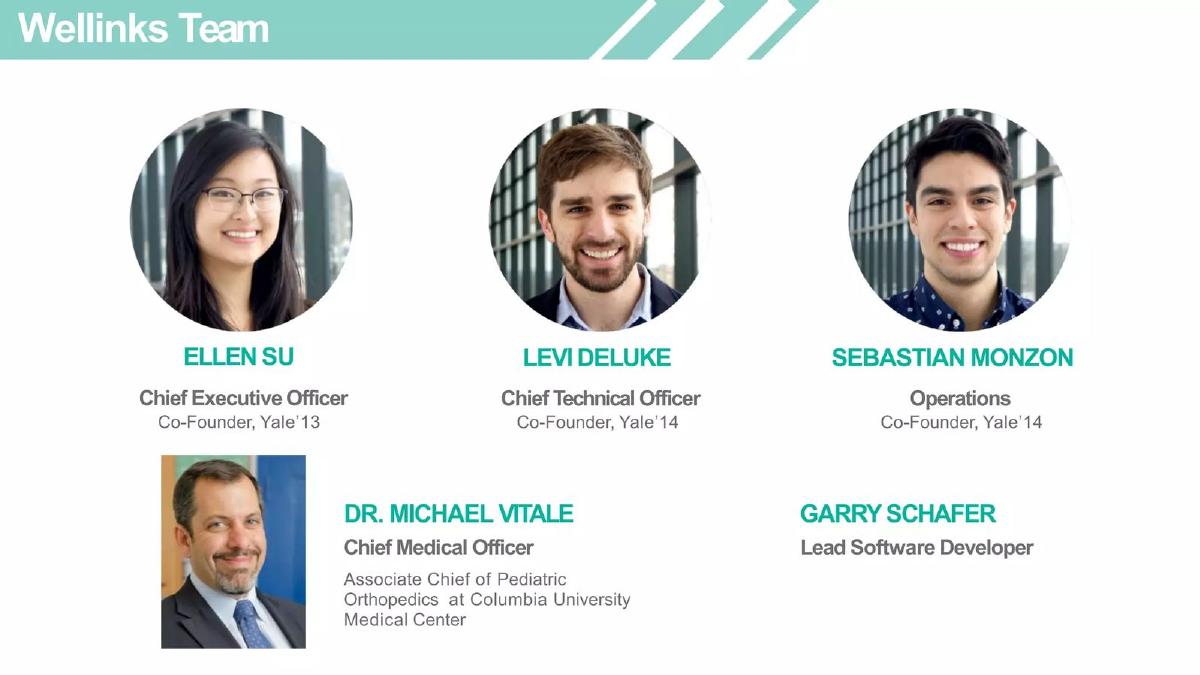
The Team: While Ellen Su is mentioned on the cover, there is no dedicated team slide in this selection. In med-tech, the clinical and engineering pedigree of the founders is often as important as the technology itself.
Clinical Validation: There is no mention of clinical trials, pilot studies, or data proving that using Cinch actually improves patient outcomes or compliance rates. For a medical device, this is a significant hurdle.
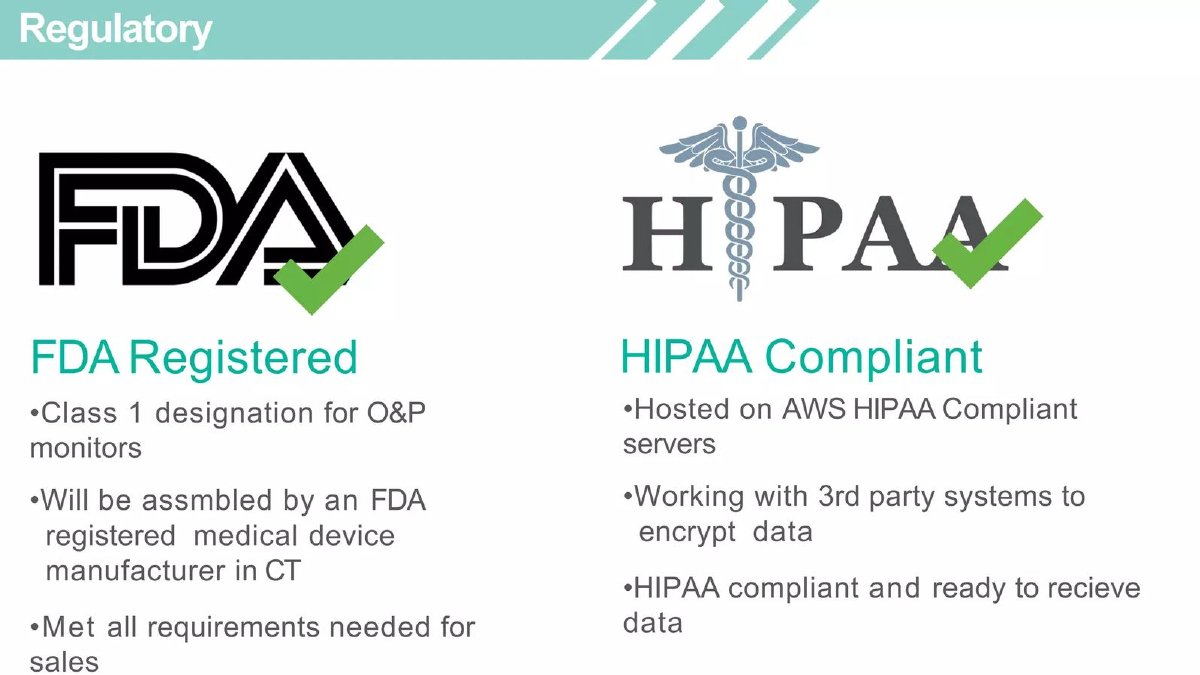
Regulatory Strategy: The deck does not address FDA clearance or other regulatory requirements. Investors in 2016 would have needed to know if this was considered a Class I or Class II medical device and what the path to legal sale looked like.
Competition: The deck operates in a vacuum, failing to mention other compliance-monitoring technologies or traditional methods (like thermal sensors) used to track brace wear time.
Founder Takeaways
Focus on the 'Parent' as a Stakeholder: If your product is for children or adolescents, your UI and your pitch must account for the parent. Wellinks does this well on Slide 4, acknowledging that the data is for both the patient and the guardian.
Bridge the Physical and Digital: Wellinks uses simple iconography (Slide 3 and 7) to show how a physical object (a brace) becomes a data point. This is a great way to explain complex IoT systems to non-technical investors.
Define Short-term vs. Long-term: By labeling Slide 6 as 'Market (short-term),' the founders signal that they have a focused starting point but aren't limited by it. This prevents the 'platform' vision from feeling too unfocused or 'boiling the ocean.'
Frequently asked questions
- What is the core technology behind Wellinks?
- The core technology is the 'Cinch' smart strap. It is a modular hardware attachment designed to fit onto various orthopedic braces. It uses Bluetooth to transmit data to a smartphone app, which then syncs with a web-based dashboard for long-term data analysis and monitoring by patients, parents, and presumably healthcare providers.
- How does Wellinks plan to make money?
- According to slide 6, the company has a clear B2B2C pricing model. They charge $250 per device. Their primary customers are listed as parents and brace makers, with the distribution strategy focused on partnering directly with companies that manufacture scoliosis braces to achieve wider market penetration.
- Who is the target end-user for the Wellinks app?
- Slide 4 specifies that the mobile app is for patients and parents. This suggests a focus on pediatric or adolescent care, which aligns with the scoliosis focus, as that condition is frequently diagnosed and treated with bracing during growth spurts in younger patients.
- What is the scope of the Wellinks platform?
- While the deck starts with a focus on scoliosis, slide 7 reveals a broader ambition. The 'Wellinks Orthotics Platform' is designed to be modular, with a standardized communication protocol and a secure database capable of analyzing data from many different types of orthopedic conditions beyond just spinal curvature.
- What critical investor information is missing from this deck?
- The provided slides are missing several standard components of a venture pitch: a team slide (though the CEO is named on the cover), a detailed competitive analysis, financial projections, a clear 'Ask' (how much money they are raising), and specific clinical validation or regulatory (FDA) status.