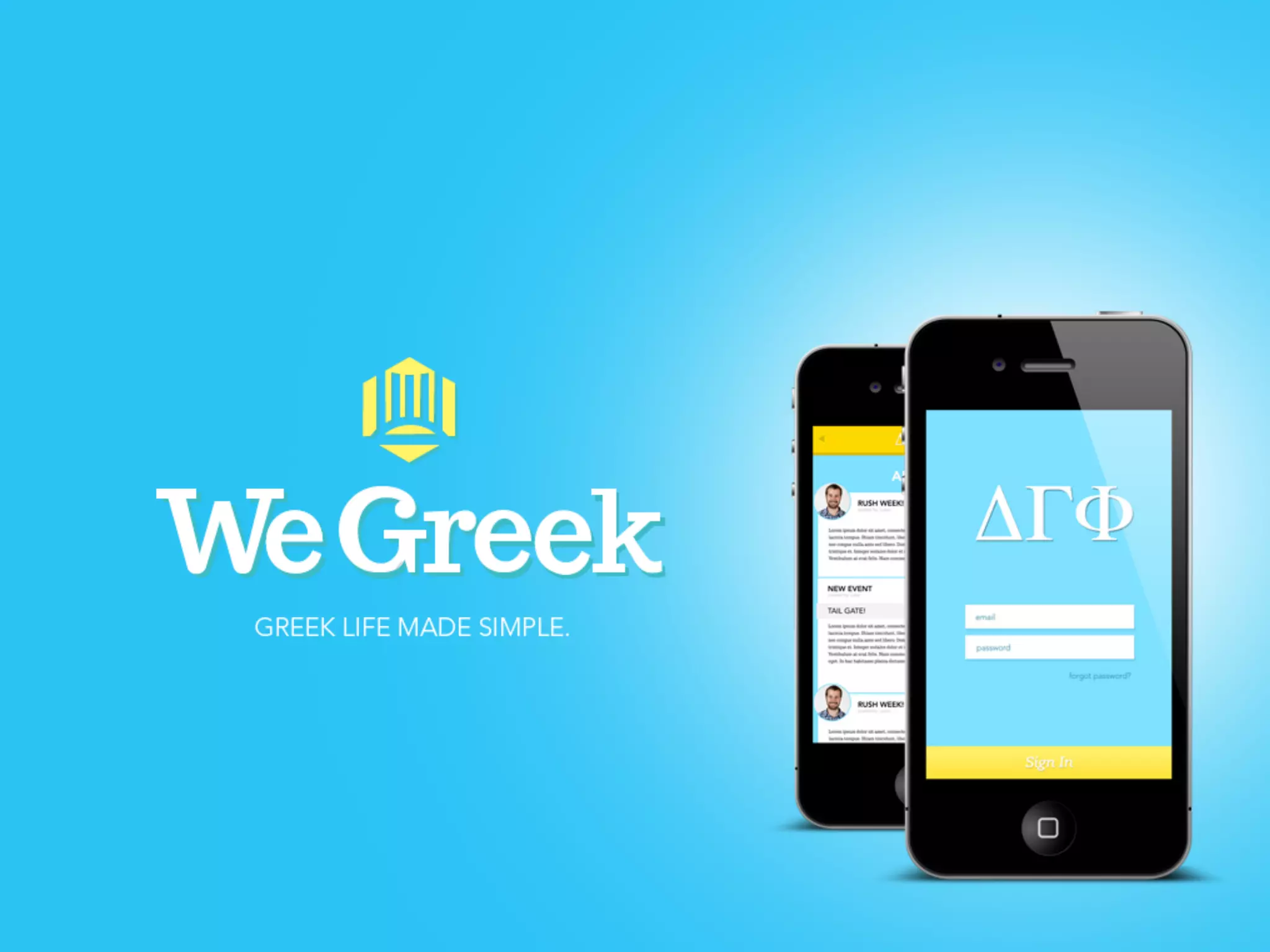
WeGreek is a mobile-first management platform designed exclusively for the fraternity and sorority market. The deck outlines a clear value proposition: consolidating all Greek life activities into a single, custom-branded mobile application. Their business model is straightforward, charging $15 per member per semester, which is deducted directly from existing member dues. The deck highlights significant early interest, listing 14 specific Greek organizations that have signed with an intent to purchase. While the deck provides a clear roadmap for customer acquisition—scaling from a 10-chapter…
Key takeaways
- The product is positioned as a custom-branded, all-in-one management tool for Greek organizations (Slide 2).
- Revenue is generated through a flat fee of $15 per member per semester, integrated into existing dues (Slide 3).
- First-year revenue projections show a growth trajectory from $0 in December to over $60,000 by June (Slide 3).
- The company lists 14 Greek organizations, including Sigma Nu and Delta Zeta, as having signed letters of intent (Slide 4).
- The customer acquisition strategy relies on leveraging pre-existing connections and pushing for national-level adoption (Slide 5).
- The growth roadmap targets a launch of 'Version 1' in January with 15 chapters, scaling to 40 chapters by June (Slide 5).
- The deck omits a team slide, providing only a generic 'founders' email address for contact (Slide 6).
- There is no mention of the total addressable market (TAM) or specific competitive advantages over existing tools like GroupMe or Facebook Groups.
Slide-by-Slide Teardown
Slide 1: Title and Branding
The cover slide introduces the company name, WeGreek, accompanied by the tagline 'Greek Life Made Simple.' The visual focus is on a mobile device showing a custom-branded login screen for a specific sorority (Delta Gamma Phi). This immediately establishes the product as a mobile-first, white-label solution for the fraternity and sorority market. The branding is clean, utilizing a bright blue and yellow color palette that feels collegiate.
Slide 2: Value Proposition
Slide 2 defines the target market and core offering. It states the product is 'Exclusively for Fraternities and Sororities' and emphasizes two key selling points: 'Custom Branded' and 'All Activities in One Place.' Below the text, five icons represent the functional pillars of the app: communications, checklists, calendaring, time tracking, and data reporting. This slide effectively communicates the 'what' and 'who,' though it remains at a very high level regarding the 'how.'
Slide 3: Revenue Model
This slide provides a clear, transparent look at the unit economics. The price point is set at '$15 per member per semester.' Crucially, it notes that this fee 'comes out of member dues,' which addresses a common hurdle in the student market: the difficulty of getting individuals to pay for software. By positioning it as a B2B2C play where the chapter pays from its existing budget, WeGreek lowers the friction for adoption. The slide also includes a 'First Year Revenues' bar chart, showing a jump from $0 in December to approximately $45,000 in January, growing steadily to over $60,000 by June. This suggests a seasonal sales cycle aligned with the academic calendar.
Slide 4: Traction
The traction slide is the strongest evidence of product-market fit in the deck. It lists 14 Greek organizations that have 'signed with intent to purchase.' The list is divided by gender, showing 8 fraternities (Sigma Tau Gamma, Sigma Nu, Phi Sigma Kappa, Kappa Sigma, Phi Lambda Chi, Phi Gamma Delta, Pi Kappa Alpha, and Sigma Phi Epsilon) and 6 sororities (Sigma Sigma Sigma, Sigma Kappa, Phi Sigma Kappa—noted again, likely a different chapter or error—Delta Zeta, Alpha Sigma Tau, and Alpha Sigma Alpha). Using specific organization names rather than vague numbers adds significant credibility.
Slide 5: Customer Acquisition
Slide 5 details the go-to-market strategy and growth projections. The strategy involves three steps: leveraging existing connections, campus-to-campus viral growth, and national-level sales. The chart tracks chapter growth, starting with a 10-chapter beta period from October to December. The 'Launch Version 1' occurs in January with 15 chapters, with a projected growth of 5 chapters per month, ending at 40 chapters in June. This is a linear, conservative growth projection that feels achievable for a small team.
Slide 6: Contact and Final Visual
The final slide provides a close-up of the mobile interface on a white iPhone, reinforcing the 'custom branded' message with the Delta Gamma Phi logo. The only call to action is a black banner containing the email address 'founders@wegreekapp.com.' There is no specific 'ask' slide in this sequence, meaning the amount of capital being raised and the intended use of funds are not disclosed.
What Works
Clear Monetization: The revenue model is unambiguous. By tying the cost to existing member dues, the founders show they understand the financial structure of their target customers. Investors can easily calculate the potential revenue of a single campus based on the number of Greek members.
Specific Traction: Listing the actual names of fraternities and sororities that have signed LOIs (Letters of Intent) is much more powerful than saying 'we have 14 interested groups.' It allows an investor to verify the claim and demonstrates that the founders have successfully navigated the initial sales process.
Niche Focus: The deck does not try to be a general 'campus management' tool. It leans heavily into the specific terminology and branding of Greek life, which suggests a deep understanding of the user base's unique needs, such as tracking service hours or managing chapter-specific events.
What is Missing
The Team: This is the most glaring omission. In early-stage investing, the team is often more important than the idea. There is no information on who the founders are, their background in Greek life, or their technical capabilities to build and maintain the platform.
Competitive Landscape: Greek organizations already use tools to communicate (GroupMe, Slack, Facebook Groups) and manage finances (GreekBill, OmegaFi). The deck fails to explain why a chapter would switch from these free or established tools to a paid, custom-branded app.
Market Size (TAM): While the revenue per member is clear, the deck does not quantify the total number of fraternity and sorority members in the US. Without this, it is difficult for an investor to determine if this is a venture-scale opportunity or a lifestyle business.
The 'Ask': A pitch deck is a tool to raise money. This deck does not state how much money is being sought, what valuation is being targeted, or what milestones the funding will help the company reach.
Founder's Playbook: What to Copy
The 'Dues-Based' Revenue Strategy: If you are building for the student market, follow WeGreek's lead by finding a way to integrate your cost into existing budgets (like student activity fees or organization dues) rather than asking individual students to pull out their credit cards.
Visualizing the Roadmap: Slide 5 does a great job of combining a timeline with specific chapter count goals. It shows a clear transition from 'Beta' to 'Version 1' to 'Scale,' which helps investors visualize the company's progress over the next nine months.
White-Label Mockups: If your value proposition is 'custom branding,' show it. By putting a specific sorority's Greek letters on the phone screen in the first and last slides, WeGreek makes the abstract concept of 'customization' feel tangible and immediate.
Frequently asked questions
- What is the specific pricing model for WeGreek?
- According to Slide 3, WeGreek charges $15 per member per semester. The deck specifies that this cost 'comes out of member dues,' suggesting the platform is sold to the chapter leadership as a budget line item rather than an additional out-of-pocket expense for individual students.
- How does WeGreek plan to scale its user base?
- Slide 5 outlines a three-pronged strategy: leveraging pre-existing personal connections, spreading from campus to campus, and pursuing adoption at the national organization level. The timeline shows a transition from a 10-chapter beta in Q4 to a 40-chapter footprint by the following June.
- What evidence of market demand does the deck provide?
- Slide 4, titled 'Traction,' lists 14 specific Greek organizations that have 'signed with intent to purchase.' These include eight fraternities (such as Sigma Tau Gamma and Pi Kappa Alpha) and six sororities (such as Sigma Kappa and Alpha Sigma Alpha).
- What features does the application actually offer?
- Slide 2 uses five icons to represent the platform's functionality: announcements (megaphone), task management (clipboard), scheduling (calendar), time tracking (stopwatch), and analytics (growth chart). However, the deck does not provide detailed screenshots of these features in action.
- Who is behind WeGreek?
- The provided slides do not include a team or 'About Us' slide. The only contact information is a generic email address, founders@wegreekapp.com, shown on Slide 6. This is a significant omission for a seed-stage pitch deck where founder-market fit is a primary evaluation criteria.