Pet Savvy is a community-driven platform designed to bring transparency to the veterinary care market. The deck outlines a problem where pet owners face unpredictable and expensive vet costs, leading to financial stress. The proposed solution is an app where users share detailed reviews, including costs and symptoms, to help others prepare for expenses. The business model relies on a $5/month subscription fee and advertising, targeting a $5.1 billion TAM based on 85 million U.S. pet-owning households. While the deck provides extensive market research and Lean Canvas iterations, it lacks a for…
Key takeaways
- The company identifies a lack of transparency in veterinary prices as the core problem, citing that costs are often more expensive than expected (Slide 5).
- Pet Savvy positions itself as a 'Niche Player' in the community-driven service/care quadrant, distinguishing itself from professional-driven platforms like Airvet or PetDesk (Slide 11).
- The Total Addressable Market (TAM) is calculated at $5.1 billion, based on 85 million pet-owning households paying a $5/month subscription (Slide 14).
- The Serviceable Obtainable Market (SOM) is estimated at $600,000 in three years, assuming 10,000 subscribed users and $100,000 in advertising revenue (Slide 14).
- The product roadmap includes a 12-month timeline, with a product launch scheduled for months 8-10 and a plan to bring on a technical founder in the first 3 months (Slide 20).
- Early concept validation involved a Google Form survey where 6 out of 10 participants shared their vet visit experiences, meeting the team's 60% response rate goal (Slide 62).
- The revenue model is described as a 'Marketplace' with a B2C relationship structure, though specific marketplace mechanics are not detailed (Slide 47).
- The deck includes multiple iterations of a 'Molecule' diagram and 'Lean Canvas,' showing the evolution of the business concept from September to November 2020 (Slides 26-35).
Executive Summary
Pet Savvy is a design-led startup attempting to solve the chronic lack of price transparency in the veterinary industry. The deck, dated November 2020, presents a community-driven solution where pet owners crowdsource cost data to help one another prepare for medical expenses. While the deck excels at documenting the iterative process of business modeling—showing multiple versions of their Lean Canvas and 'Molecule' diagrams—it functions more as a project roadmap than a high-stakes investor pitch. It lacks a clear funding request and detailed unit economics, focusing instead on user sentiment and market size calculations.
Slide 1: Title Slide
The deck opens with the company name, PET SAVVY , and the tagline: "Savings in your wallet, Transparency in your vet cost." It is dated November 14th, 2020, and attributed to 'Common Ground,' which appears to be the incubator or program context for the project.
Slides 3-5: The Problem and Persona
Slide 3 introduces a persona, Parker Jay, and her cat, Mr. Pickles. This narrative approach is used to humanize the problem. Slide 5 explicitly defines the PROBLEM in three pillars: vet costs are always more expensive than expected, there is a lack of transparency in veterinary prices, and the current system does not prepare pet owners for these expenses. The visual metaphor of money with wings is used to represent the unpredictable nature of these costs.
Slide 8: The Solution
Slide 8 introduces the product through a user journey. Parker realizes something is wrong with Mr. Pickles, enters Pet Savvy to compare prices based on symptoms, and leaves feeling "more relieved with knowing what to expect." The solution is positioned as a tool for emotional and financial preparation.
Slide 11: Competitive Research
The team uses a standard 2x2 matrix to map the landscape. The axes are Service/Care vs. Platform and Community-driven vs. Profession-driven. Pet Savvy is placed in the top-left quadrant as a "Niche Player," contrasting with professional platforms like Airvet and PetDesk , and general community platforms like Reddit and Facebook . This positioning suggests they aim to be the 'Yelp' of vet pricing.
Slide 14: Market Size
The market analysis on Slide 14 is aggressive but structured. The TAM is cited as $5.1 billion, calculated by multiplying 85 million pet-owning households by a $5/month subscription fee. The SAM (Serviceable Addressable Market) focuses on Millennials (27% of pet owners), arriving at $140 million by assuming a 10% subscription rate. The SOM (Serviceable Obtainable Market) is estimated at $600,000, based on 100,000 users with 10,000 of them subscribing.
Slide 17: Next Step for MVP
This slide outlines the hypothesis-driven approach of the founders. They believe pet owners are willing to share cost data and that structured cost ranges will prepare them. The success metric for their next test is 70% of participants answering that they "feel more prepared" after seeing the data.
Slide 20: Timeline
The 12-month roadmap is divided into five stages. Notably, in months 2-3, the team plans to "Bring on another founder to focus on technical development," which indicates that the current founding team is likely non-technical. Product launch is slated for months 8-10, with market expansion and investment in new channels occurring at the 12-month mark.
Slide 23: Next Steps
A simplified four-step plan: 01 Finalizing the revenue model, 02 Building the product prototype, 03 Defining branding, and 04 Getting ready for the pitch day. This reinforces that the deck was created for a specific program or pitch competition.
Slides 26-35: Iterative Business Modeling
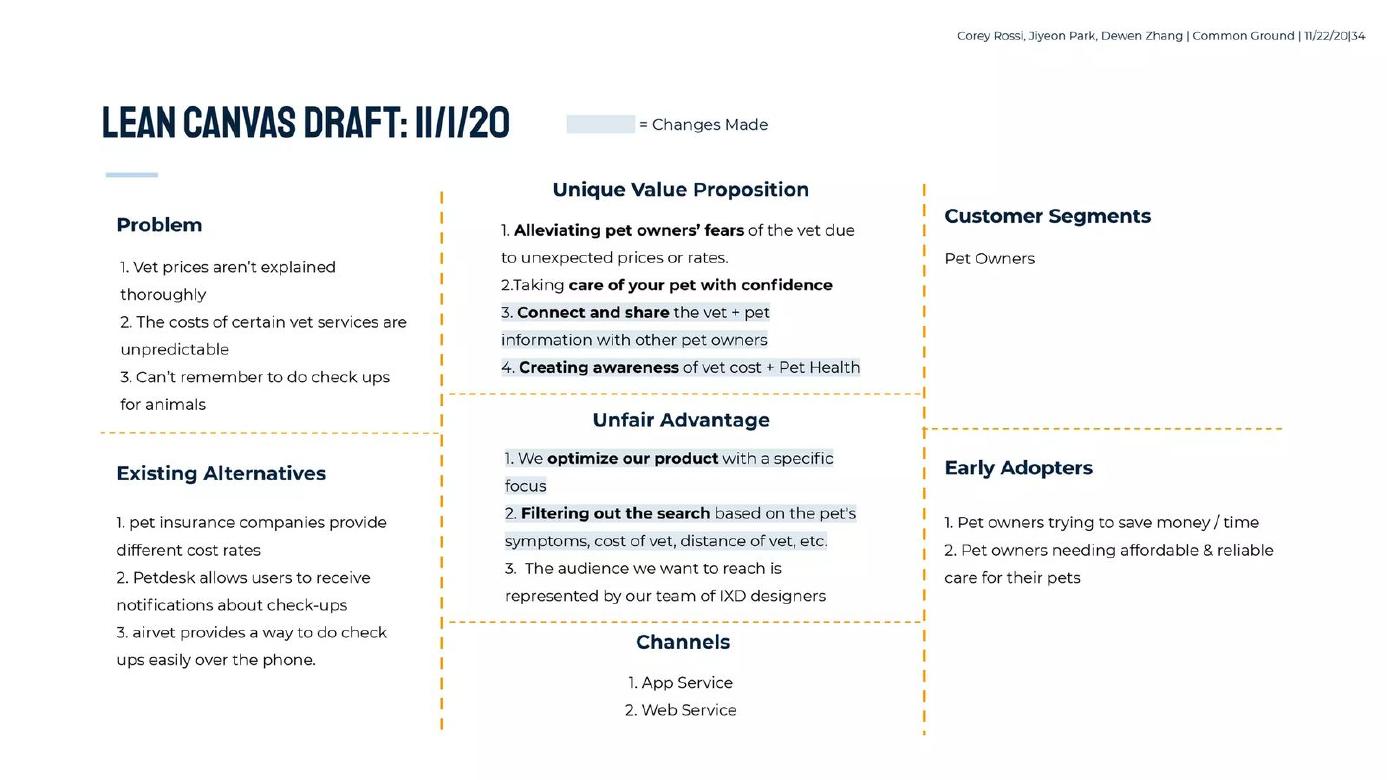
These slides show the evolution of the business concept. Slide 26 shows an early 'Molecule' from September 2020 focusing on people looking to adopt pets. By Slide 29 (November 2020), the focus shifted to "Current Pet owners" and the "Lack of transparency in veterinary prices." Slides 32 and 35 show the Lean Canvas progress. The November 8th version (Slide 35) lists the Unfair Advantage as a specific focus on symptoms and a team of "IXD designers" (Interaction Designers).
Slides 38-44: Cost Structure and Market Research References
Slide 38 provides a "Works Cited" for their cost structure, including links to Glassdoor for engineer salaries and WeWork for rent. Slide 41 and 44 provide alternative market size views, citing a $20 billion U.S. veterinary care market in 2019 with a 5% growth rate. They narrow the initial target market to the Bay Area, valued at $531 million.
Slide 47: Business Structure
This slide categorizes the business into four quadrants: Structure (In Progress), Revenue Model (Marketplace), Relationships (B2C), and Delivery Channels (Online). The mention of a "Marketplace" suggests they may eventually facilitate payments or bookings, though the primary focus remains on information transparency.
Slides 50-53: Expanded Competitive Landscape
Slide 50 provides a much denser view of the competition, including CareCredit , ASPCA Insurance , and PetCareRx . Slide 53 separates these into "Community-driven services" (Yelp, Google Maps) and "Community-driven platforms" (Facebook, Reddit, GoPetie).
Slides 56-62: MVP Validation
The team defines their MVP hypothesis on Slide 56. Slide 59 details the experiment: using a Google Form to collect vet visit data. Slide 62 shows the results: 6 out of 10 people shared their experiences, which the team views as a success, validating that "community-members are motivated enough to create reviews."
Slide 65: Landing Page and Team
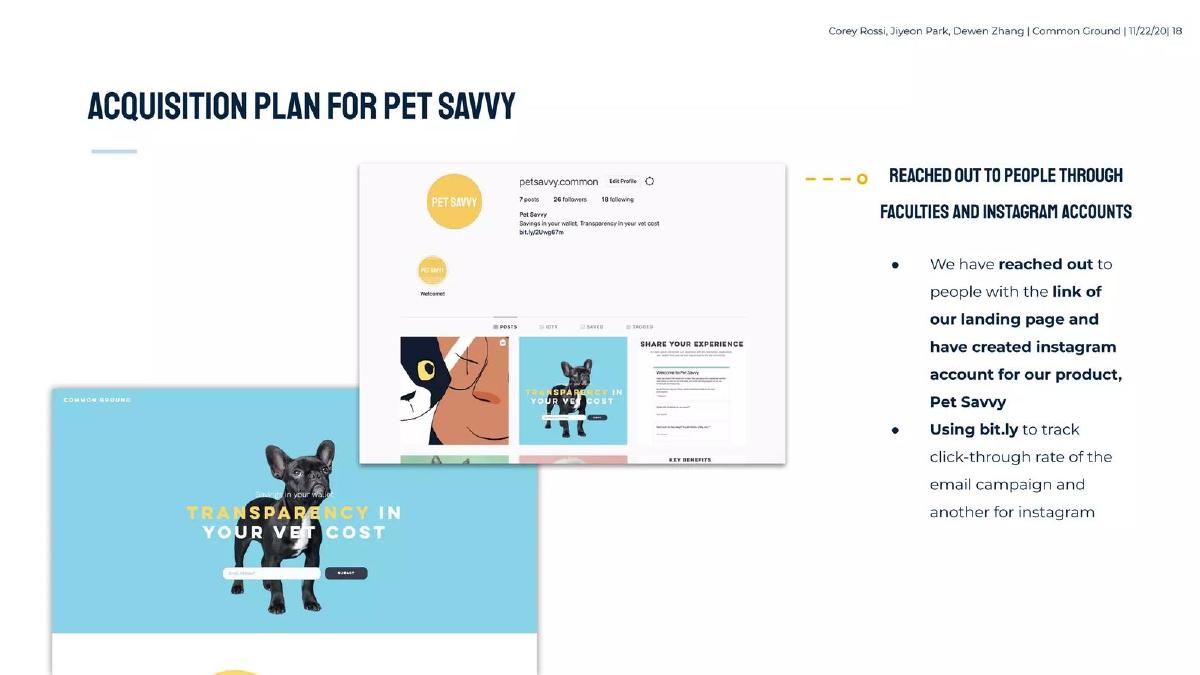
This slide shows a mockup of the Pet Savvy landing page. It features the team: Jiyeon Park , Corey Rossi , and Dewen Zhang . The mission is stated as providing opportunities for people to gain skills and knowledge to empower companionships. The page includes a sign-up form and key benefits: taking care of pets with confidence, knowing the right treatment, and understanding vet visits.
Slide 68: Market Research Reference
The final slide is a comprehensive list of references, including articles from the AVMA, Healthline, and ABC News regarding unnecessary vet treatments and the lack of price knowledge among veterinarians themselves. This provides a strong evidentiary basis for the problem they are solving.
What Pet Savvy Does Well
The Pet Savvy deck is an excellent example of evidence-based entrepreneurship . The founders do not just claim there is a problem; they document their research process, cite their sources, and show the results of their early validation tests. The use of the Lean Canvas and Molecule diagrams shows a disciplined approach to refining their value proposition. By identifying as a "Niche Player" in the community space, they avoid the trap of trying to compete directly with massive incumbents like PetMD, instead focusing on a specific, underserved pain point: price transparency.
What Is Missing from the Deck
From a fundraising perspective, the deck is incomplete. The most glaring omission is a Funding Ask . There is no mention of how much capital the team needs to execute the 12-month roadmap or what milestones that capital will achieve. Additionally, the Team Slide is weak; while it lists the founders, it provides no professional background, education, or proof of their ability to build a marketplace. The Technical Gap is also a concern, as the timeline explicitly mentions the need to find a technical founder, which is a significant risk for investors. Finally, the Revenue Model is speculative, with no data on customer acquisition costs (CAC) or projected churn for the $5/month subscription.
What Founders Should Copy
Founders should emulate the transparency of research shown in this deck. Including a "Works Cited" slide for market size and cost assumptions builds immediate credibility with analytical investors. The MVP Validation slides (59-62) are also a masterclass in how to test a concept with zero budget. By using Google Forms to prove that users will contribute data, the team moved from "we think" to "we know." This type of low-fidelity validation is often more convincing to early-stage investors than a polished prototype with no users.
Final Verdict
Pet Savvy presents a compelling case for a specific market inefficiency. However, the deck feels more like a student project or an incubator submission than a professional seed-round pitch. To move to the next level, the founders need to secure technical talent, define their capital requirements, and provide a more robust financial model that justifies the $5/month subscription in a world where free community platforms (Reddit, Facebook) already exist.
Frequently asked questions
- What is the core product of Pet Savvy?
- Pet Savvy is a community-driven mobile application that allows pet owners to share and compare veterinary costs. Users can filter reviews by symptoms, specific procedures, and distance to vet offices. The goal is to provide price transparency so owners know what to expect before visiting a clinic, thereby reducing financial anxiety and improving access to proper pet care.
- How does the company plan to generate revenue?
- The deck outlines a dual revenue stream: a $5 per month subscription fee for users and additional income from advertising. Slide 14 estimates that with 10,000 subscribed users and $100,000 in advertising, the company could reach $700,000 in annual revenue within three years. Slide 47 also categorizes the revenue model as a 'Marketplace,' though specific transaction fees are not mentioned.
- Who are the competitors in this space?
- The deck identifies several competitors across different quadrants. Professional-driven platforms include Airvet, PetDesk, and Ask.vet. Community-driven alternatives include Reddit and Facebook groups. Pet Savvy distinguishes itself by focusing specifically on crowdsourced cost data and symptom-based filtering, positioning itself as a 'Niche Player' compared to broader platforms like PetMD or Pet Connect (Slide 11).
- What is the current stage of the product?
- As of the deck's date in late 2020, the product was in the MVP (Minimum Viable Product) research and validation phase. The team used Google Forms to test if users were willing to share cost data and if that data helped others feel prepared. The timeline on Slide 20 indicates they planned to build a prototype and soft launch within 4-5 months.
- What is missing from the Pet Savvy pitch deck?
- The deck lacks several critical components for a professional fundraise. There is no 'Ask' slide detailing how much money is being raised or how it will be used. It also omits detailed financial projections (P&L), a cap table, and a deep dive into the technical architecture. Furthermore, the team slide on the landing page (Slide 65) lacks professional bios or previous experience details.