The 2014 WeeGo pitch deck presents a crowdfunding model designed to de-risk the concert promotion industry in China and Singapore. By allowing fans to vote for artists and pre-purchase tickets, the platform provides promoters with the 'Who, Where, and Price' data necessary to avoid deficits. The deck is notable for its granular budget breakdown—requesting a modest 10,716 SGD for its first year—and its focus on social media data crawling from Weibo to identify target regions. While the financial projections are aggressive, jumping from 57,000 SGD to 1.9 million SGD in revenue within three year…
Key takeaways
- The platform addresses the 'Huge Cost' and 'Limited Information' problems that lead to deficits for concert promoters (Slide 3).
- WeeGo utilizes a two-step process: gathering fan votes followed by a crowdfunding project to trigger concert booking (Slide 4).
- The executive team consists of six members, including a CEO, CDO, CTO, CDO (Data), CMO, and CIO, primarily with backgrounds in Information Systems and Engineering (Slide 8).
- The initial annual budget is extremely lean at 10,716 SGD, with significant portions allocated to Weibo advertising and platform outsourcing (Slide 9).
- Marketing strategy leverages existing Chinese fan bases on QQ, Tieba, and Weibo, with future plans to target Singaporean labels like Sony and Music Forest (Slide 10).
- Revenue assumptions are built on capturing 10% of concert-goers and taking a 10% commission on payments (Slide 12).
- Financial projections suggest a profit of 1.1 million SGD by 2017 under a scenario including spin-off product sales (Slide 13).
- The rollout plan is data-driven, using crawled Weibo data from 1,000 performances to identify Zhejiang, Jiangsu, and Shandong as key growth areas (Slide 14).
Introduction: Solving the Promoter's Dilemma
The WeeGo pitch deck, dated 2014 and originating from Singapore, targets the high-risk world of concert promotion in Greater China. The central thesis is that the traditional concert model is inefficient because promoters lack real-time data on fan demand, leading to frequent financial deficits. WeeGo proposes a crowdfunding layer to validate demand before capital is committed.
Slides 1-2: Title and Structure
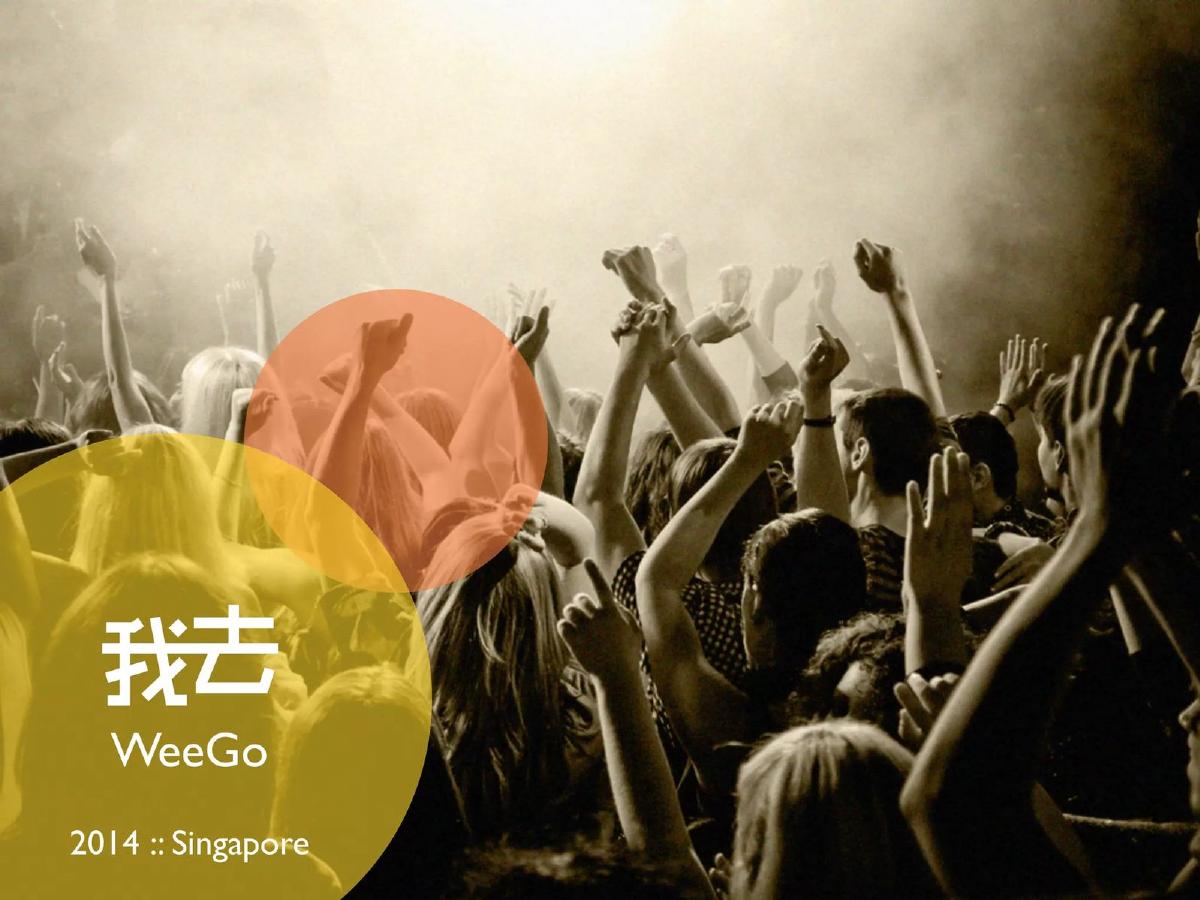
The deck opens with a high-energy cover slide featuring a concert crowd, establishing the sector immediately. Slide 2 provides a standard Table of Contents, outlining a logical flow: Market Need, Product, Market Response, Team, Budget, and Financials. The branding uses a yellow and orange palette that feels accessible and energetic, consistent with a fan-facing platform.
Slides 3-4: Defining the Market Need and Solution
Slide 3 identifies the core problem: "Huge Cost" and "Limited Information." It argues that concert promoters and record labels take significant financial risks because they don't know who will attend, where they are located, or what price they are willing to pay. The slide concludes that "Inefficient Market Feedback leads to High Risk."
Slide 4 introduces the WeeGo workflow. It is a linear process: Fans vote for an artist, a crowdfunding project is created once enough votes are gathered, and then the project either hits the sale target (concert is on) or misses it (full refund). This is a classic 'Kickstarter for concerts' model, designed to move the financial risk from the promoter to the validated demand of the crowd.
Slide 5: Product and Technology
This slide shows a mockup of the platform. It features a concert page for an artist (Phillip Phillips is pictured) with a clear progress bar. The data points shown include the number of people who have pre-ordered (3,633), the days remaining (10), and the price (140 Yuan). The interface is simple, focusing entirely on the conversion metric—the "Pre-order Now" button.
Slides 6-7: Market Response and Validation
Slide 6 attempts to show traction through "Fan Leaders" in a VIP group chat. The screenshots (in Chinese) show fans discussing features and expressing interest in joining the team. While this provides qualitative evidence of engagement, it lacks the quantitative punch of user growth metrics.
Slide 7 features a quote from a concert promoter: "Collaboration is possible as long as you could show us the money." This is a sobering reminder of the industry's bottom line. It validates the WeeGo model—if the platform can aggregate the funds, the supply side (promoters) will follow.
Slide 8: The Executive Team
The team slide lists six executives. Yolanda Zhang (CEO) and Jimmy Feng (Data) both hold degrees in Information Systems, with Feng having a double degree in Finance. The technical side is covered by Ellery Jiao and Meng Kaizhi, both mobile and web developers. Liu Zenan handles design, and Anna Qiu manages marketing. The team appears to be a group of recent graduates or young professionals with strong technical backgrounds, though the deck does not list specific past companies or successful exits.
Slide 9: The Budget Breakdown
This is one of the most detailed budget slides seen in a seed-stage deck. It lists expenses totaling exactly 10,716 SGD for the current year. Key allocations include:
Domain names (5-qu.com, 57concert.com, 57play.com): 108 SGD · Web hosting (Ali Yun and AWS): 708 SGD · Marketing (Weibo ads and small events): 4,400 SGD · Outsourced development: 3,000 SGD · Legal/Registration in China: 1,000 SGD
The extremely low budget suggests this deck was intended for a very small initial seed round or a grant application, as 10,000 SGD is insufficient for a six-person executive team to draw salaries.
Slides 10-11: Marketing and Requirement
Slide 10 identifies the current focus on Chinese platforms: QQ and Tieba for fan bases, and Weibo for social marketing. It also lists future targets in Singapore, specifically naming record labels like Sony, Music Forest, and LWS Music Entertainment. Slide 11 (not fully detailed in the provided text but part of the sequence) continues the financial narrative.
Slides 12-13: Financial Projections
Slide 12 breaks down the revenue assumptions. Based on data from people.cn , they estimate:
47.59% of fans accept a price point of 60-199 SGD. · WeeGo aims to capture 10% of the 28,000 users who attend concerts. · Revenue is calculated at a 10% cut of ticket payments. · A secondary revenue stream, "Spin-offs," assumes a 5% margin on merchandise.
Slide 13 presents two scenarios. Scenario 1 (Crowdfunding only) projects profit growing from 46,000 SGD in Year 1 to 857,000 SGD in Year 3. Scenario 2 (including spin-offs) is more aggressive, reaching 1.113 million SGD in profit by Year 3. The jump in costs from 11,000 SGD to 853,000 SGD over three years indicates a plan for massive scaling of human resources and marketing.
Slide 14: RollOut Plan
The final slide shows a data-driven approach to expansion. By crawling Weibo data for 1,000 performances, the team identified that while Guangzhou, Beijing, and Shanghai are the top markets, the regions of Zhejiang, Jiangsu, and Shandong represent the next most active tiers. This demonstrates a sophisticated use of data to guide geographic prioritization.
What Works in This Deck
Specific Problem/Solution Fit: The deck does an excellent job of identifying a specific pain point for promoters (financial risk) and offering a specific mechanism (crowdfunding) to solve it. The quote on Slide 7 perfectly encapsulates the industry's skepticism and what it would take to overcome it.
Granular Budgeting: While the total amount is low, the transparency of the budget on Slide 9 is refreshing. It shows the founders have actually priced out their domains, hosting, and initial marketing spend, which builds trust in their operational competence.
Data-Driven Strategy: Using Weibo data to map out the rollout plan (Slide 14) shows that the team isn't just guessing where to go next. They are using the very social signals their platform relies on to make business decisions.
What Is Missing
The Ask: The deck lacks a clear investment slide. While it shows a budget of 10,716 SGD, it doesn't explicitly state how much they are raising, at what valuation, or what the milestones for the next round will be. A budget is not an 'Ask.'
Unit Economics: While they mention a 10% cut, there is no discussion of Customer Acquisition Cost (CAC) vs. Lifetime Value (LTV). In a crowded social market like China, the cost to acquire a fan could easily exceed the 10% commission on a single ticket.
Competitive Landscape: There is no mention of existing crowdfunding platforms or ticketing giants (like Damai in China) that could easily integrate these features. Investors need to know why a startup can win against incumbents with deeper pockets.
Founder's Takeaway
Founders should look at the WeeGo deck as a model for logical flow and market validation . The way they bridge the gap between fan desire and promoter risk is a masterclass in identifying a two-sided marketplace's friction points. However, the deck also serves as a warning: a technical team without deep industry connections may struggle to move beyond the 'small event' stage. If you are building in a legacy industry like music, your team slide needs to show more than just the ability to code; it needs to show the ability to close deals with the labels and promoters mentioned on Slide 10.
Frequently asked questions
- What is the core business model of WeeGo?
- WeeGo operates as a crowdfunding intermediary for live music. Fans vote for their favorite artists to signal demand. Once enough interest is gathered, a crowdfunding campaign is launched. If the sales target is met, the concert proceeds; if not, fans receive a full refund. The company generates revenue by taking a 10% commission on ticket sales and a 5% margin on spin-off merchandise.
- How does WeeGo plan to acquire users in the Chinese market?
- The deck outlines a digital-first strategy focusing on established social platforms. They target existing fan communities on QQ and Tieba, while using Weibo for active social media marketing. Slide 14 highlights that their expansion strategy is based on crawling Weibo data to identify regions with the highest concentration of active concert-goers outside of Tier 1 cities.
- What are the primary expenses listed in the budget?
- For the initial year, the budget is focused on infrastructure and marketing. Major line items include 2,400 SGD for Weibo advertising, 2,000 SGD for small concert events, and 3,000 SGD for outsourced platform development (web and mobile). The total year-one budget is remarkably low at 10,716 SGD, suggesting a bootstrap or very early seed approach.
- Who are the key members of the WeeGo leadership team?
- The team is led by CEO Yolanda Zhang, supported by a technical and design-heavy executive suite including Liu Zenan (Design), Ellery Jiao (Technology), Jimmy Feng (Data), Anna Qiu (Marketing), and Meng Kaizhi (Information). The team profiles emphasize technical skills like iOS/Web development and data analysis rather than deep music industry experience.
- What are the projected financial outcomes for the company?
- WeeGo projects rapid growth over a three-year period. Starting from a revenue of 57,000 SGD in 2014, they expect to reach 1.96 million SGD by late 2017. This growth is predicated on expanding from simple crowdfunding into 'spin-off products' (merchandise), which they estimate could add nearly 300,000 SGD in additional annual profit by the third year.