Wealthsimple’s 2014 seed deck is unique because it functions as both a pitch and a post-mortem on its own success. Raising $2M in just 2.5 weeks from 15 investors, the company utilized a 'herd mentality' strategy, securing a high-profile lead investor (Joe Canavan) to trigger FOMO among others. The deck highlights a massive $1.3T Canadian market opportunity, specifically targeting the 'light advice' gap between high-fee full-service advisors and no-advice self-directed platforms. While the deck is light on proprietary technology details—even explicitly redacting the 'Client Acquisition' slide…
Key takeaways
- The round was closed in 2.5 weeks from 15 different investors (Slide 3).
- The company secured Joe Canavan, a former CEO of Assante, as a lead investor to provide high-level industry validation (Slide 6).
- Wealthsimple identified a $1.3T market gap in Canada between $1T in full-service and $0.3T in self-directed assets (Slide 15).
- The business model is based on charging 35-50 bps on assets for accounts ranging from $5,000 to millions (Slide 13).
- The deck uses Wealthfront's growth from $0 to $1B in two years as a primary US case example for their model (Slide 16).
- The team slide emphasizes past exits and roles at major firms like McKinsey, Ancestry, and Amazon (Slide 17).
- The 'Client Acquisition' strategy was explicitly redacted from the public version of the deck (Slide 19).
- Founder Mike Katchen recommends that founders invest their own money into the round to signal commitment (Slide 21).
The Meta-Pitch: A Deck About a Deck
The Wealthsimple seed deck is an unusual artifact in the world of fundraising. It is not just a pitch for a FinTech startup; it is a presentation delivered after the fact, explaining how they raised $2M in two weeks. This gives us a rare look at both the materials used to raise the money and the founder's strategic mindset during the process. The deck is 24 slides long and leans heavily on the 'pedigree' of the founders and advisors to overcome the inherent trust hurdles of a new financial institution.
The Strategy and 'Table Stakes' (Slides 1-4)
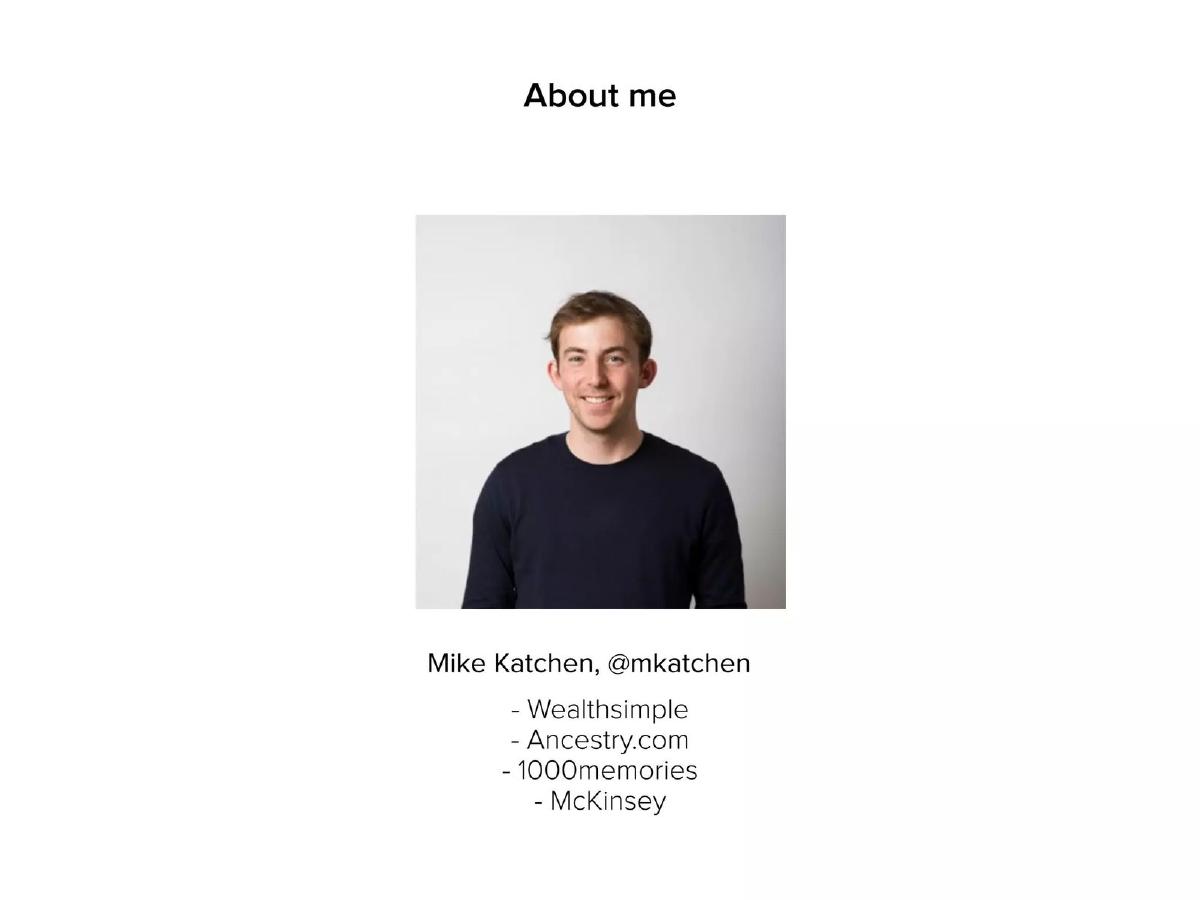
The deck opens with a bold claim: "How Wealthsimple raised $2MM in 2 weeks" (Slide 1). This sets a tone of confidence. Founder Mike Katchen introduces himself on Slide 2, highlighting a resume that includes McKinsey, Ancestry.com, and 1000memories. This is a classic 'signal' slide designed to show that the founder has been vetted by elite institutions before the pitch even begins.
On Slide 4, Katchen defines the 'Table Stakes' for a seed round as a "Good idea (in a massive market)" and a "Killer team." This framing suggests that the rest of the deck is simply proving these two points. It moves the conversation away from risky technical details and toward the inevitability of the team's success.
The Lead Investor and the Herd (Slides 5-8)
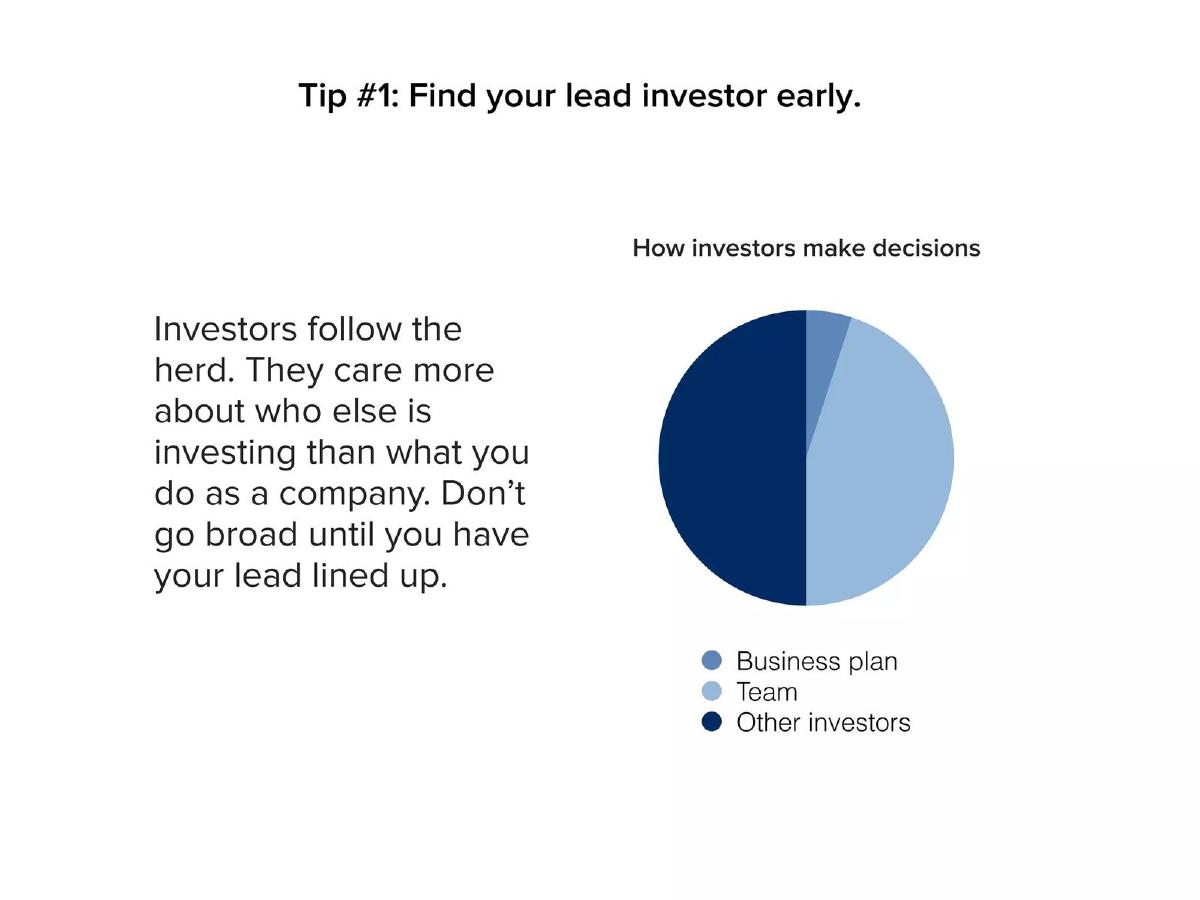
One of the most honest sections of this deck is the discussion of investor psychology. Slide 5 features a pie chart titled "How investors make decisions," where the largest slice is "Other investors." Katchen argues that investors follow the herd and care more about who else is in the round than the business plan itself.
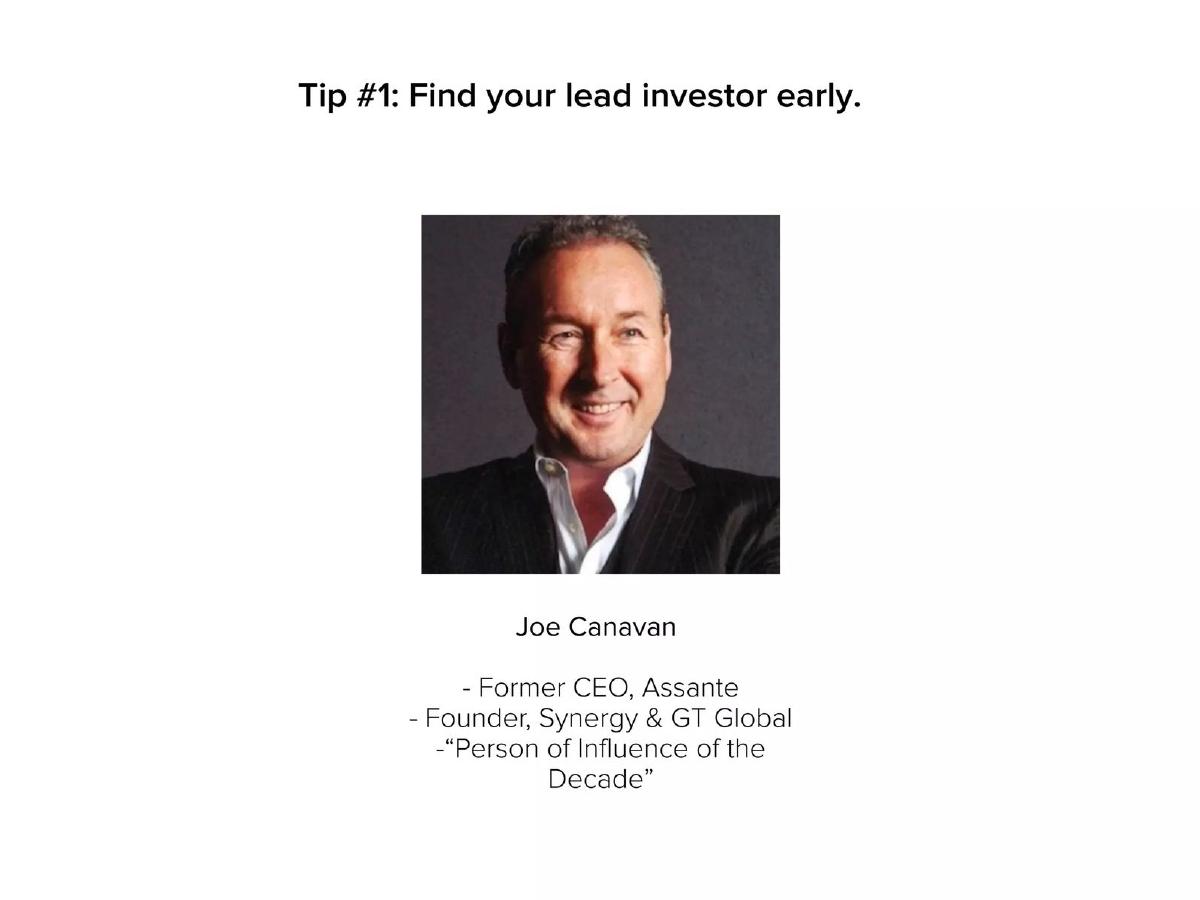
To solve this, Wealthsimple secured Joe Canavan (Slide 6). By landing a former CEO of a major wealth management firm (Assante), they gained instant credibility in the Canadian finance sector. This allowed them to tap into a pool of wealthy individuals who wanted to invest in tech but weren't 'active tech angels' (Slide 7). In fact, Slide 8 reveals that 64% of their investors came from Finance , while only 36% came from Tech. This is a vital lesson for founders: your capital doesn't always have to come from traditional VCs if your industry expertise is strong enough.
The Product and Market Gap (Slides 9-15)
The actual 'pitch' portion of the deck begins on Slide 10. The mission is stated simply: "Smart investing made simple." Slide 12 provides a historical context, placing 'Online solutions' as the natural 2010s successor to Mutual Funds (1980s), Discount Brokerages (1990s), and ETFs (2000s). This positions Wealthsimple as an evolutionary certainty rather than a radical experiment.
The business model (Slide 13) is clear: charge 35-50 bps on assets . They target young professionals with accounts from $5,000 to millions. The product interface (Slide 14) shows a clean, mobile-responsive dashboard, emphasizing the "Simple Experience" and "Wealth Concierge" support.
The 'Killer Slide' in this deck is Slide 15, "The Canadian market opportunity." It visualizes a $1.3T market. It shows $1T locked in 'Full-service' (high fees) and $0.3T in 'Self-directed' (no advice). Wealthsimple claims the middle ground: "Low fees, Low minimums, 'Light' advice." This clearly identifies the 'enemy' (high-fee banks) and the 'underserved' (millennials with some savings but not enough for a private banker).
Validation and Team Pedigree (Slides 16-18)
Because Wealthsimple was new, they used Wealthfront as a US case example (Slide 16). Showing Wealthfront's growth from $0 to $1B in two years provided a blueprint for what was possible in Canada. This 'copy-paste' validation is a common and effective tactic for startups in non-US markets.
The Team slide (Slide 17) is an exercise in name-dropping. It lists 10 people, many with "1000memories, YC alumni" or "McKinsey" in their bios. Even the CTO is listed as "pending," but his previous success with Genius Scan (15MM downloads) is used to bolster the slide. The Advisors slide (Slide 18) is equally heavy-hitting, featuring the Former Dean of Rotman Business School and the CEO of Ceridian . For a seed-stage company, this level of advisory talent is exceptional and likely did the heavy lifting in the 2.5-week raise.
The Missing Pieces and Fundraising Tips (Slides 19-24)
Slide 19 is a glaring omission. Titled "CLIENT ACQUISITION," it simply says, "Not sharing at this time... sorry." While this was likely done for the public version of the deck to protect trade secrets, it leaves a massive question mark for any analyst. How exactly do they plan to win users away from the big banks? At seed stage, the 'how' of acquisition is often more important than the 'what' of the product.
The deck concludes with tactical advice: Set a deadline (Slide 20) and Put some money in yourself (Slide 21). Katchen notes that investing in your own round signals that you are a "responsible steward of capital." The final slides provide a recap and resources, cementing the deck's purpose as an educational tool for other founders.
What Works
The Market Gap Visualization: Slide 15 is a perfect example of how to show a market opportunity. It doesn't just show a big number; it shows where the money is currently sitting and why it is poorly served. · Social Proof: By securing Joe Canavan and a roster of high-profile advisors (Slide 18), Wealthsimple removed the 'trust' barrier that kills most early FinTech startups. · US Comparables: Using Wealthfront (Slide 16) as a benchmark helped investors understand the potential scale and the specific 'light advice' category without needing a long explanation. · Speed and Momentum: The deck emphasizes the 2-week timeline, which creates a sense of scarcity and high demand for the shares.
What is Missing
Client Acquisition Strategy: Slide 19 is a total blank. Without knowing the cost of customer acquisition (CAC) vs. the lifetime value (LTV) of a 35bps fee, the business model is purely theoretical. · Financial Projections: There are no slides showing expected Assets Under Management (AUM) growth or a path to profitability. · Use of Funds: The deck does not specify how the $2M will be spent (e.g., hiring, marketing, regulatory licensing). · Regulatory Roadmap: In a highly regulated market like Canadian finance, the deck omits any mention of the legal hurdles or licenses required to operate as an investment manager.
What a Founder Should Copy
The 'Pedigree' Slide: If you have a team with exits or experience at top-tier firms, make it the centerpiece of your deck. Wealthsimple proved that a strong team can raise money even while redacting their marketing strategy. · The Market 'Bridge' Logic: Position your startup as the middle ground between two existing, flawed extremes (Slide 15). It makes your solution feel like common sense. · The Lead Investor Strategy: Don't pitch everyone at once. Focus on one 'anchor' investor whose name carries weight in your specific industry, then use that name to close the rest of the round quickly. · Historical Context: Use a 'Decade by Decade' transformation slide (Slide 12) to show that your startup is part of a larger, unstoppable macro trend.
Frequently asked questions
- How much did Wealthsimple raise with this deck?
- Wealthsimple raised $2M in its seed round in May 2014. According to Slide 3, the process was exceptionally fast, taking only 2.5 weeks to secure commitments from 15 different investors. This speed was attributed to securing a high-profile lead investor early in the process to create momentum.
- What was the core market gap Wealthsimple identified?
- As shown on Slide 15, Wealthsimple targeted a gap in the $1.3T Canadian investment market. They identified that 'Full-service' options had high fees and minimums, while 'Self-directed' options offered no advice. Wealthsimple positioned itself in the middle, offering 'light advice' with low fees and low minimums.
- Who was the lead investor and why did they matter?
- The lead investor was Joe Canavan, the former CEO of Assante and founder of Synergy & GT Global. Slide 6 describes him as a 'Person of Influence of the Decade.' His involvement was critical because it provided the 'smart money' validation needed to convince non-tech investors to join the round.
- What is missing from the Wealthsimple seed deck?
- The deck is notably missing a detailed 'Client Acquisition' strategy, which is explicitly blocked out on Slide 19 with the text 'Not sharing at this time... sorry.' It also lacks detailed financial projections or a specific breakdown of how the $2M would be spent, focusing instead on the team and market opportunity.
- What business model did Wealthsimple propose in 2014?
- According to Slide 13, the business model was to act as an online investment manager charging 35-50 basis points (bps) on assets under management. They targeted young professionals and serviced accounts starting as low as $5,000, which was significantly lower than traditional full-service wealth management firms.