Reklaim’s August 2021 corporate presentation outlines a strategic pivot from its former identity, Killi, to a platform focused on 'democratizing data.' The company positions itself as a solution to the $245B US data market's disruption by privacy regulations like GDPR and CCPA. The deck emphasizes significant scale, claiming 320 million profiles under management, with 120 million 'reclaimed' by users who actively interact with the product. By integrating with 14 major distribution platforms—including LiveRamp, T-Mobile, and Magnite—Reklaim aims to provide compliant, first-party data to brands…
Key takeaways
- The company rebranded from Killi to Reklaim to better align with its mission of helping consumers 'reclaim' and control their data (Slide 1).
- Reklaim targets a $245 billion US data industry that currently provides $0 in compensation to the consumers whose data is harvested (Slide 5).
- The platform has achieved significant scale, growing from 10,000 profiles in Q1-2020 to 320,000,000 profiles by Q2-2021 (Slide 7).
- A 'Reklaimed' account is defined as one that has had a 1x1 interaction with the company or been active in the product within the last 30 days (Slide 7).
- The company has secured 14 platform integrations for data distribution, including partnerships with Xandr, PubMatic, and MediaMath (Slide 9).
- Reklaim holds a 12-month international contract with Nielsen to supply consented data for TV measurement panels (Slide 11).
- Insiders maintain a high level of skin in the game, owning 45% of the company as of August 2021 (Slide 13).
- The deck omits specific revenue figures, burn rate, and a breakdown of the leadership team in the provided slides.
Executive Summary: The Pivot to Consented Data
Reklaim’s August 2021 deck is a classic example of a 'market shift' narrative. By rebranding from Killi, the company signaled a move away from being just another data app to becoming a foundational infrastructure for the privacy-first era. The deck focuses heavily on two things: the regulatory inevitability of their model and the massive scale they have already achieved. With 320 million profiles, they are positioning themselves as a scale player that can compete with traditional, unconsented data brokers.
Slide 1: Title and Rebranding
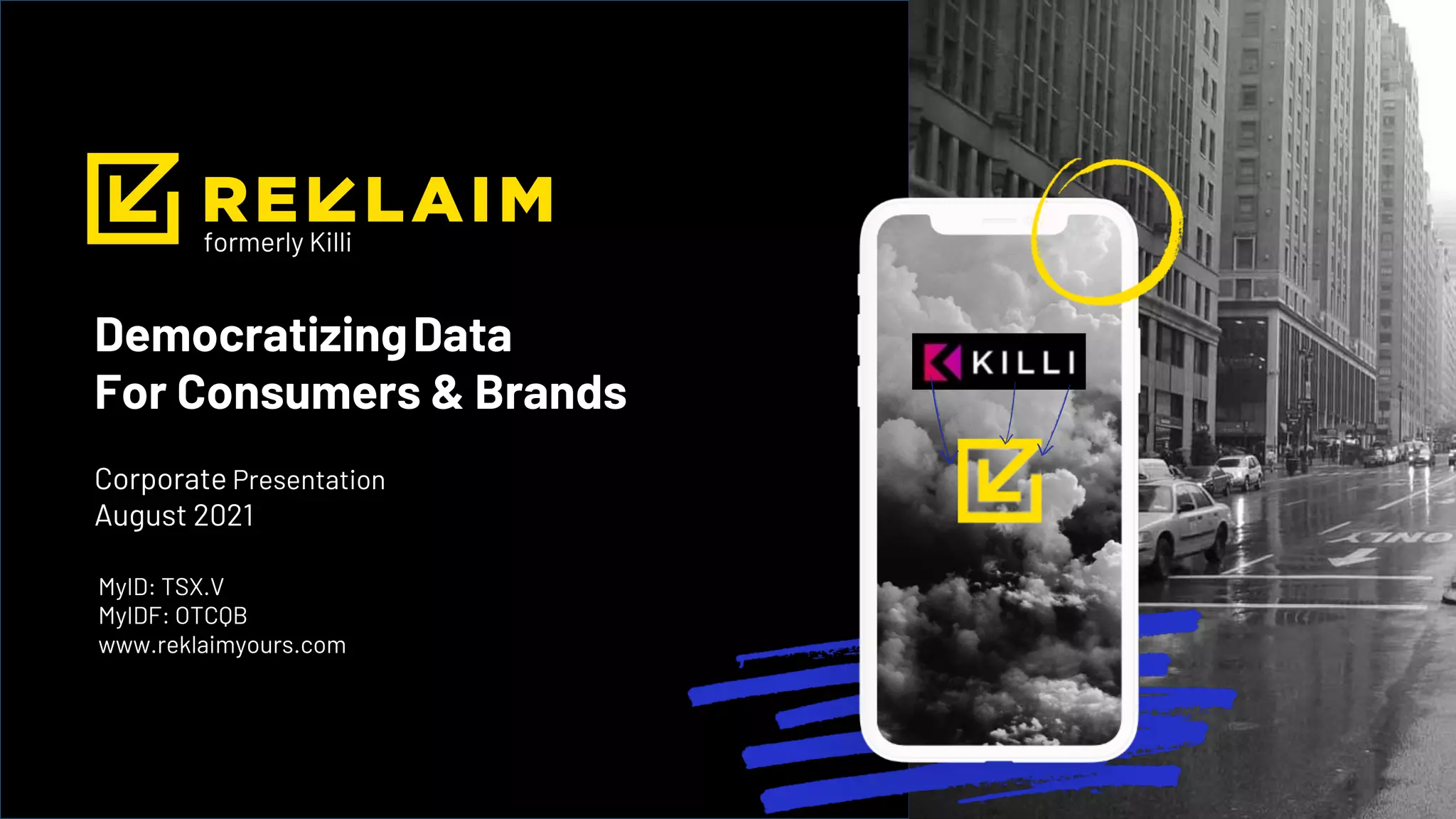
The cover slide introduces the new brand, Reklaim , with the subtitle 'formerly Killi.' The tagline 'Democratizing Data For Consumers & Brands' establishes a dual-sided marketplace. Crucially, the slide includes public market tickers (TSX.V: MyID and OTCQB: MyIDF), indicating that this is a corporate presentation for a publicly traded entity rather than a seed-stage startup. The date is listed as August 2021.
Slide 3: The Mission Statement
This slide provides the 'What' and 'Where.' Headquartered in New York with a Toronto office, Reklaim describes itself as a company capitalizing on the 'dramatic shift in the data and privacy space.' The text explains the mechanism: consumers sign up to view their data profiles and share specific pieces of data with brands in exchange for a 'weekly dividend.' The slide makes a bold claim: 'Reklaim is the only company in the world allowing consumers to view and take back control of their data.'
Slide 5: Market Disruption and Regulatory Tailwinds
Reklaim frames the $245B US data industry as a legacy system built on 'harvesting and exploiting consumer data' with zero compensation for the user. They cite a figure of $6,000/year/profile generated by the industry. The slide lists specific regulations—GDPR, CCPA, CPRA, and international laws in Brazil and India—as 'roadblocks' for competitors that will force a 'regulated disruptive migration' toward Reklaim’s consented data model. A flywheel diagram links Scale (320m profiles), Distribution (14 platforms), and Unique Data (1:1 consumer content) to revenue growth.
Slide 7: Explosive Scale and Growth Metrics
This is the 'traction' slide. It shows a timeline from Q1-2020 to Q2-2021. The growth in 'Number of Profiles' is staggering: starting at 10,000 in Q1-2020 and reaching 320,000,000 by Q2-2021. The slide also tracks 'Platform Integrations,' which grew from 2 to 14 in the same period. A critical footnote defines a 'Reklaimed' account as one with a 1x1 interaction or activity in the last 30 days, noting that 120 million of the 320 million profiles meet this higher engagement standard.
Slide 9: Integrated Platforms
Slide 9 visualizes the 'Distribution' arm of the business. It lists logos for 12 'Sample' partners, including LiveRamp, T-Mobile, Xandr, and PubMatic . The text reinforces that Reklaim is integrated with 14 of the top platforms that facilitate data purchase. This slide is intended to prove that Reklaim isn't just collecting data; they have the 'pipes' to sell it to the world's largest advertisers.
Slide 11: Data Company Partnerships
While Slide 9 focused on ad-tech platforms, Slide 11 focuses on data companies. It highlights a specific 'International 12-month contract' with Nielsen to supply consented data for TV measurement panels. It also mentions Digicenter . The slide argues that these companies need Reklaim's data to 'offset exposure to cookie and mobile ID' loss, positioning Reklaim as the solution to the 'cookie-less future.'
Slide 13: Reasons to Invest
The final slide in the provided set summarizes the investment thesis. It reiterates the $245B market size and the shift driven by 'Big Tech' and government action. It highlights the 'foundation for growing and recurring sales' through 320 million profiles and 14 platforms. Key new information includes the mention of 'Fortune 500 customers' and the fact that 'Insiders own 45%.' The slide claims revenue is trending higher each quarter, though it does not provide the actual revenue numbers.
What Reklaim Does Well
Regulatory Alignment: The deck does an excellent job of positioning Reklaim not just as a 'nice to have,' but as an inevitability. By listing specific laws (GDPR, CCPA), they make the problem feel urgent and the solution feel legally mandated.
Scale as a Moat: In the data business, volume is everything. Showing a jump from 10k to 320m profiles in 18 months is a powerful signal of market fit or, at the very least, highly effective acquisition and ingestion strategies.
Defining Active Users: Many startups hide behind 'total registered users.' Reklaim’s distinction between 'Profiles Under Management' (320m) and 'Reklaimed' accounts (120m) adds a layer of transparency that builds trust with sophisticated investors.
What Is Missing from the Deck
Financial Specifics: Despite being a public company presentation, the provided slides contain no P&L data. We see that revenue is 'trending higher,' but we don't know if that means $100k or $10M. There is no mention of Gross Margin or EBITDA.
Unit Economics: The deck mentions a 'weekly dividend' for consumers. A crucial missing piece is the cost of these dividends versus the revenue generated per profile. If the payout to the consumer is higher than the data's sale price, the model isn't sustainable.
The Team: There is no team slide in the provided selection. For a company undergoing a major rebrand and pivot, understanding the pedigree of the leadership—especially their experience in ad-tech and data privacy—is essential.
Competitive Landscape: The deck implies Reklaim is the 'only company in the world' doing this. While they may be unique in their specific 'reclaim' mechanism, they compete with every other first-party data provider and 'clean room' solution. A competitive matrix is missing.
Founder's Playbook: What to Copy
The 'Market Shift' Narrative: If your startup benefits from a change in law or a tectonic shift in how Big Tech operates (like the death of the cookie), make that the 'villain' of your story. Reklaim successfully frames the status quo as 'exploitative' and 'dying,' making their solution the only logical path forward.
Visualizing the Ecosystem: Slide 9 and Slide 11 are excellent. Instead of just saying 'we have partners,' they show exactly where they sit in the value chain. Founders should use logo clouds not just for social proof, but to explain their product's distribution and utility.
Clear Definitions: If you use a non-standard metric (like 'Reklaimed accounts'), define it clearly on the slide. It prevents investors from feeling like you are 'fluffing' the numbers and shows you have a deep understanding of your own user funnel.
Skin in the Game: If your team owns a significant portion of the company, say so. The 'Insiders own 45%' bullet point on Slide 13 is a strong closing argument for investor alignment.
Frequently asked questions
- What is Reklaim's core value proposition for consumers?
- According to Slide 3, Reklaim allows consumers to view their online data profiles for the first time and take back control. Consumers can choose to share specific data points with brands in exchange for compensation via a 'weekly dividend,' effectively turning their personal information into a financial asset.
- How does Reklaim define its 'Scale' metric?
- On Slide 7, Reklaim reports 320 million profiles under management. However, they distinguish between total profiles and 'Reklaimed' accounts. A Reklaimed account (totaling 120 million) requires a 1x1 interaction or activity within the last 30 days, providing a more rigorous engagement metric than simple profile harvesting.
- Which regulatory shifts is Reklaim capitalizing on?
- Slide 5 identifies several key regulatory 'roadblocks' that serve as tailwinds for Reklaim's consented data model. These include GDPR in Europe, CCPA/CPRA in the USA, and similar laws in Canada (CPPA), Brazil, India, and South Africa, all of which force companies to move away from unconsented data.
- Who are Reklaim's primary distribution partners?
- Slide 9 lists 14 integrated platforms that facilitate the purchase and distribution of Reklaim's data. Notable partners include LiveRamp, Lotame, T-Mobile, Neustar, Adsquare, Xandr, Viant, Retargetly, Magnite, MediaMath, Tru Optik, and PubMatic.
- What is the ownership structure of Reklaim?
- Slide 13 notes that insiders own 45% of the company. This high percentage of insider ownership is typically presented to investors as a sign of confidence and alignment between the management team and shareholders, particularly for a company listed on the TSX.V and OTCQB.