DAS (Drone Automation and Services) presents a highly ambitious vision to build a comprehensive military drone ecosystem for the Indian Armed Forces. The deck outlines a four-stage development timeline spanning 2020 to 2026, moving from micro-drones with swarm capabilities to large, supersonic stealth aircraft. Seeking approximately ₹5.50 Crore ($730K) in seed funding, the team aims to deliver 30 prototypes across micro, small, and medium segments within 6-8 months. While the roadmap is expansive, the deck lacks critical details on current technical progress, specific team expertise, and comp…
Key takeaways
- The company identifies eight systemic problems in India's current AI and drone programs, including lack of funding and manufacturing infrastructure (Slide 3).
- The technical solution proposes using VTOL and Tiltrotor capabilities alongside GAN algorithms for autonomous optimization (Slide 4).
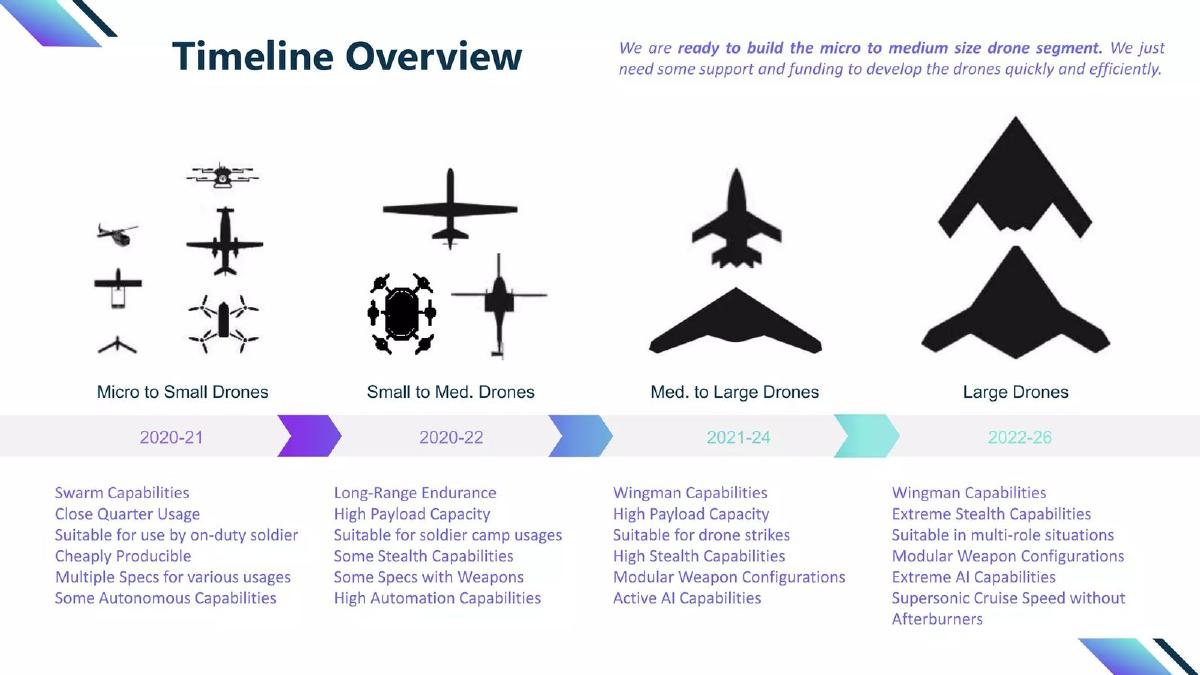
- A multi-year roadmap targets the development of large drones with supersonic cruise speeds by 2022-2026 (Slide 5).
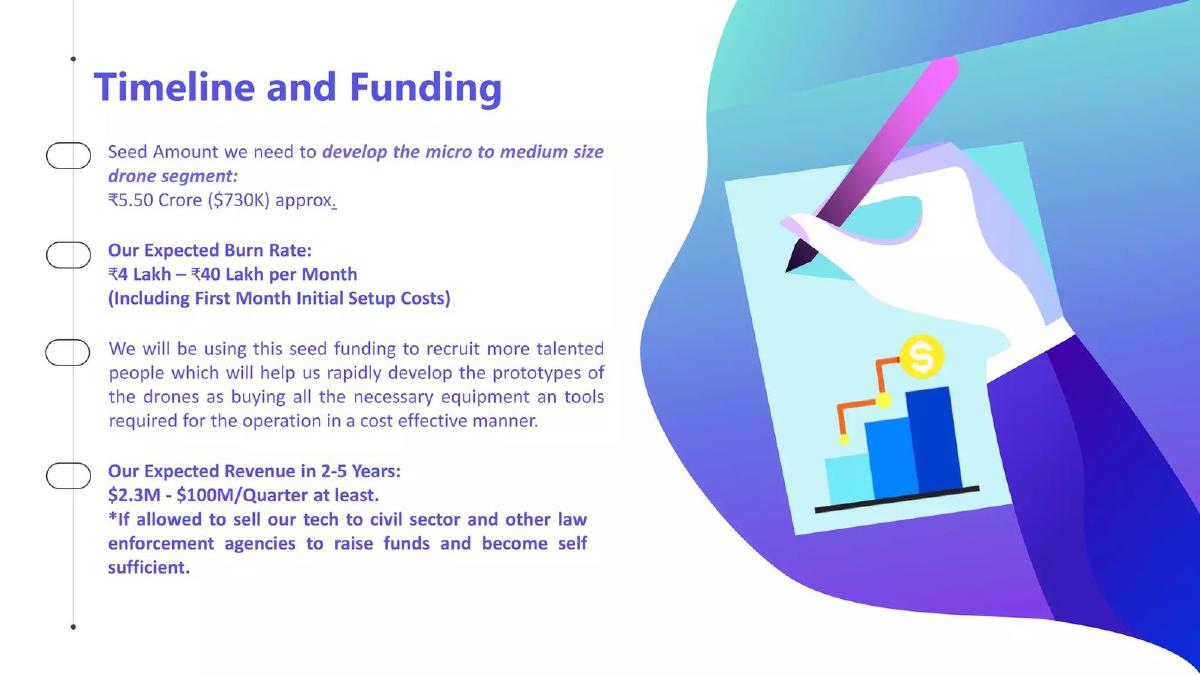
- The seed funding ask is exactly ₹5.50 Crore, which the deck approximates as $730K (Slide 6).
- Monthly burn rate is projected to fluctuate significantly between ₹4 Lakh and ₹40 Lakh (Slide 6).
- Revenue projections are highly speculative, ranging from $2.3M to $100M per quarter within 2-5 years (Slide 6).
- The team promises to deliver 10 micro, 10 small, and 10 medium drones within an 8-month window following funding (Slide 7).
- The deck lists three individuals—Hemant Sarthak, Manan Garg, and Sunny Kaushik—but provides no professional background or titles for them (Slide 9).
Executive Summary and Vision
Slide 1: Title Slide
The deck opens with the company name 'DAS,' which stands for Drone Automation and Services. The visual features a stylized illustration of a city being monitored by drones, with a hand holding a tablet displaying a tactical map. The imagery suggests a focus on urban surveillance and military coordination.
Slide 2: Who are We?
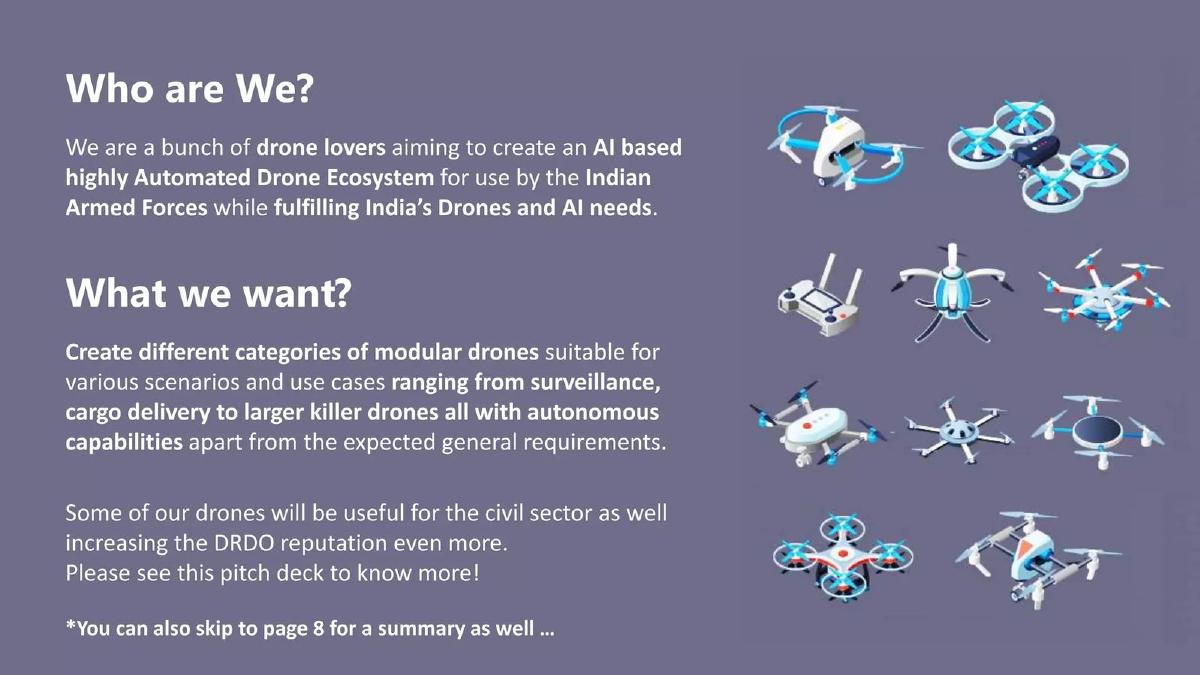
The company describes itself as a 'bunch of drone lovers' aiming to create an AI-based highly automated drone ecosystem for the Indian Armed Forces. The slide lists their goals: creating modular drones for surveillance, cargo delivery, and 'killer drones.' It mentions that some drones will be useful for the civil sector, which they claim will increase the reputation of the DRDO. A collection of 11 isometric drone icons is displayed on the right, showing various form factors from quadcopters to fixed-wing hybrids.
Problem and Solution
Slide 3: India’s AI & Drone Program Problems
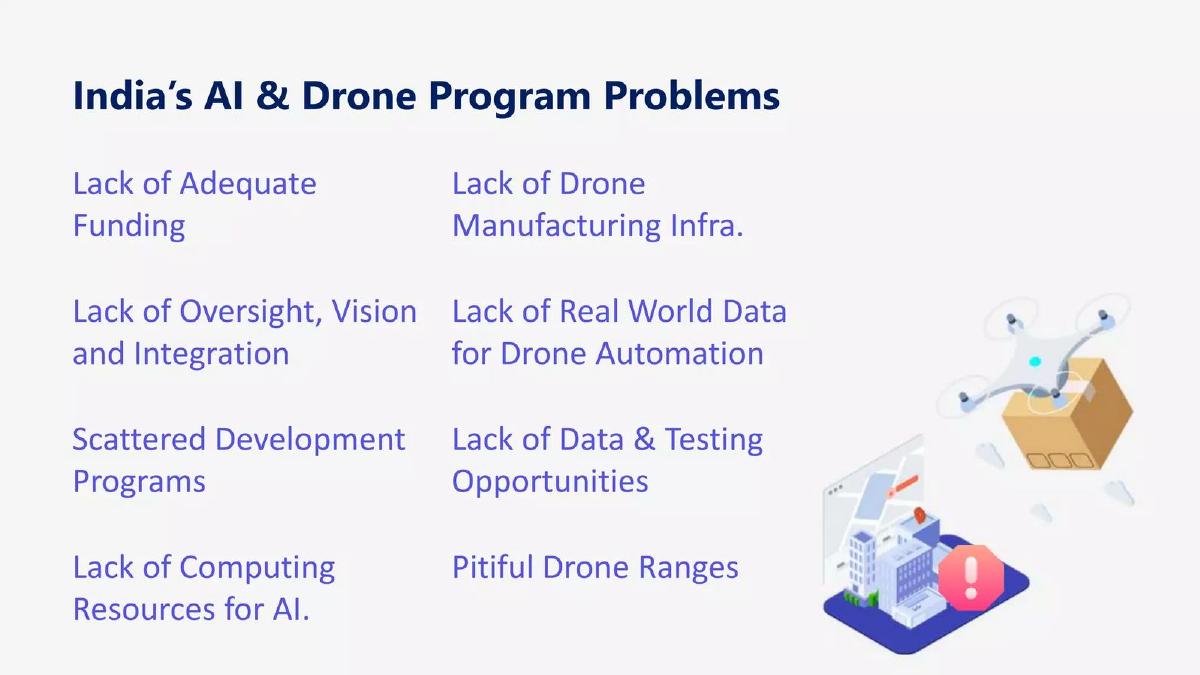
DAS identifies eight core issues currently facing the Indian drone landscape. These include a lack of adequate funding, manufacturing infrastructure, oversight, and computing resources for AI. They also cite 'scattered development programs,' a lack of real-world data for automation, limited testing opportunities, and 'pitiful drone ranges.' This slide sets the stage for their intervention as a unifying solution.
Slide 4: Our Solutions
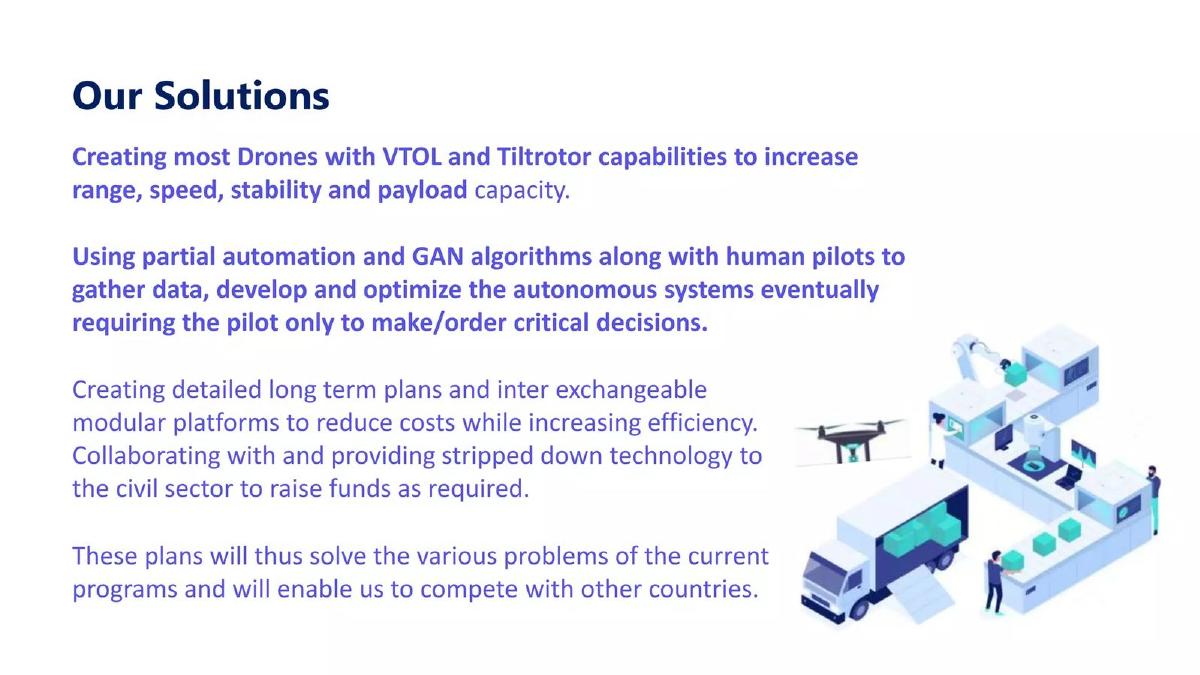
The proposed solution involves four pillars. First, using VTOL (Vertical Take-Off and Landing) and Tiltrotor capabilities to improve range and payload. Second, employing partial automation and GAN (Generative Adversarial Network) algorithms to optimize autonomous systems, eventually reducing the pilot's role to only making critical decisions. Third, creating interchangeable modular platforms to reduce costs. Fourth, collaborating with the civil sector to raise funds by providing 'stripped down' versions of their technology.
Roadmap and Financials
Slide 5: Timeline Overview
This slide presents a linear progression of drone development. The 'Micro to Small' segment (2020-21) focuses on swarm capabilities. The 'Small to Med.' segment (2020-22) targets long-range endurance and high automation. The 'Med. to Large' segment (2021-24) introduces wingman capabilities and drone strikes. Finally, the 'Large Drones' segment (2022-26) aims for extreme stealth and supersonic cruise speeds. The slide includes a note stating they are currently 'ready to build the micro to medium size drone segment' and only require funding.
Slide 6: Timeline and Funding
The financial ask is detailed here. DAS seeks a seed amount of ₹5.50 Crore (approx. $730K). The expected burn rate is listed as a wide range: ₹4 Lakh to ₹40 Lakh per month. The revenue projection for the 2-5 year mark is even broader, spanning from $2.3M to $100M per quarter. The slide clarifies that the funding will be used for recruitment and purchasing equipment to develop prototypes.
Slide 7: What we need? / What you will get?
This slide reiterates the funding request of ₹5.50 Crore and a timeline of 6-8 months. In exchange, the company promises to deliver 10 micro, 10 small, and 10 medium drones. They also promise a '100% Made in India' ecosystem, stealth technologies for small objects, and a self-funded program after the initial investment, assuming they can sell to the civil sector.
Summary and Contact
Slide 8: Summarizing
The summary slide reinforces the goal of making India a leader in Defense AI. It lists the capability priorities for their initial drone segments, including swarm capabilities, high payload, and modular weapon configurations. It concludes with a note that other detailed steps and data could not be shown due to 'space constraints' and invites a meeting for further discussion.
Slide 9: Thank You
The final slide provides contact information for three individuals: Hemant Sarthak, Manan Garg, and Sunny Kaushik. Each entry includes a phone number and a Gmail address. No titles, company roles, or professional affiliations are provided for any of the named individuals.
What Works
Clear Market Focus: The deck identifies a specific customer (Indian Armed Forces) and a clear secondary market (civil sector), aligning with national 'Made in India' initiatives. · Ambitious Roadmap: The progression from micro-drones to supersonic stealth aircraft provides a long-term vision that could appeal to strategic defense investors. · Specific Funding Ask: The deck does not hedge on the amount needed, stating exactly ₹5.50 Crore for the initial phase.
What is Missing
Team Credentials: This is the most significant omission. Developing supersonic stealth drones and GAN-based AI requires world-class engineering talent. The deck provides names but no resumes, past successes, or technical qualifications. · Technical Validation: There are no photos of existing prototypes, flight test data, or screenshots of the AI ecosystem. The use of generic icons and illustrations suggests the project is in the very early ideation stage. · Competitive Analysis: The deck mentions 'competing with other countries' but does not name specific competitors or explain how DAS technology is superior to existing global or domestic solutions. · Regulatory and Legal Strategy: Defense contracting is highly regulated. The deck mentions the DRDO but does not clarify the company's legal relationship with government bodies or its status regarding defense manufacturing licenses. · Unit Economics: While a total funding amount and a broad revenue range are provided, there is no information on the manufacturing cost per unit or the expected sale price to the military.
Founder Takeaways
Avoid generic descriptions: Describing a team as a 'bunch of drone lovers' (Slide 2) undermines the seriousness required for a defense contract. Founders should lead with their technical expertise and professional pedigree.
Tighten financial ranges: A revenue projection ranging from $2.3M to $100M (Slide 6) is too broad to be useful. It suggests the founders have not yet modeled their market penetration or pricing strategy with any precision.
Show, don't just tell: When claiming to be 'ready to build' (Slide 5), founders should include evidence of existing work, such as CAD designs, bench test results, or software architecture diagrams. Relying on stock illustrations for a high-tech pitch creates a credibility gap.
Address the 'Space Constraints' excuse: Stating that data was omitted due to 'space constraints' (Slide 8) is a tactical error. A pitch deck is exactly where that data belongs; if it is too complex for a slide, it should be referenced as an available appendix or data room.
Frequently asked questions
- What is the primary product DAS is developing?
- DAS aims to create a modular, AI-based automated drone ecosystem. According to slide 2, this includes categories ranging from surveillance and cargo delivery to 'killer drones' with autonomous capabilities. The technology is intended primarily for the Indian Armed Forces, with secondary applications for the civil sector to increase the reputation of the DRDO (Defense Research and Development Organisation).
- How much funding is DAS seeking and what is the intended use?
- The company is seeking a seed investment of ₹5.50 Crore, approximately $730,000. As stated on slide 6, this capital is intended for recruiting talent and purchasing the equipment and tools necessary to develop prototypes for the micro to medium size drone segments. They aim to deliver 30 drones total across these three size categories within 6-8 months.
- What are the specific technical capabilities mentioned in the roadmap?
- The roadmap on slide 5 details a progression of capabilities. Early-stage drones (2020-21) focus on swarm capabilities and close-quarter usage. Mid-stage drones (2021-24) add wingman capabilities and stealth. The final stage (2022-26) targets 'Large Drones' featuring extreme stealth, modular weapon configurations, and supersonic cruise speeds without the use of afterburners.
- What are the projected financial outcomes for the company?
- The financial projections on slide 6 are extremely broad. DAS expects a monthly burn rate between ₹4 Lakh and ₹40 Lakh. Revenue projections for the 2-5 year horizon range from $2.3 million to $100 million per quarter. The deck notes that reaching these figures depends on being allowed to sell technology to the civil sector and other law enforcement agencies.
- Who is the team behind DAS?
- The team is introduced on slide 9 as Hemant Sarthak, Manan Garg, and Sunny Kaushik. However, the deck provides no information regarding their professional experience, educational backgrounds, or specific roles within the company. They describe themselves on slide 2 simply as a 'bunch of drone lovers' aiming to fulfill India's AI needs.