The DAS pitch deck is a brief, early-stage presentation for a drone delivery startup aiming to automate logistics using AI and VTOL (Vertical Take-Off and Landing) technology. The company identifies six core problems in the current delivery landscape, including congestion and a lack of infrastructure, and proposes a solution involving 'greedy learning algorithms' and hybrid human-pilot training. While the deck includes a specific funding ask of $730K (approximately ₹5.50 Crore) and ambitious revenue projections reaching up to $100M per quarter within five years, it lacks critical components s…
Key takeaways
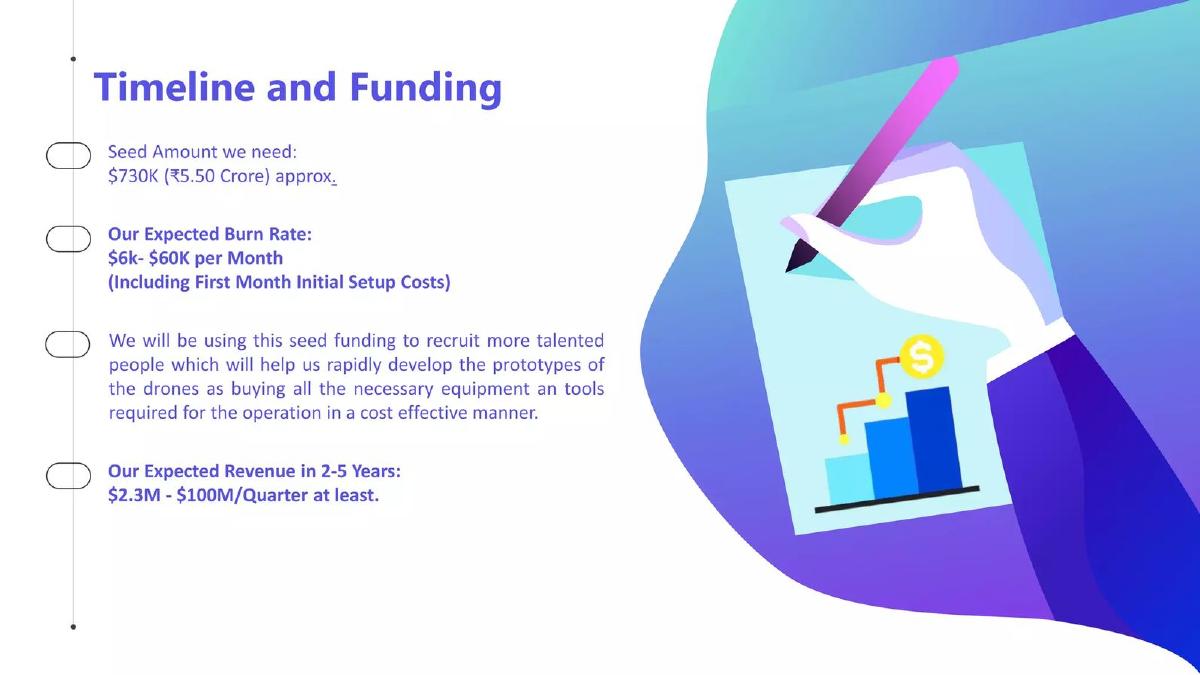
- The company is seeking a seed investment of $730K (₹5.50 Crore) to recruit talent and develop drone prototypes (Slide 6).
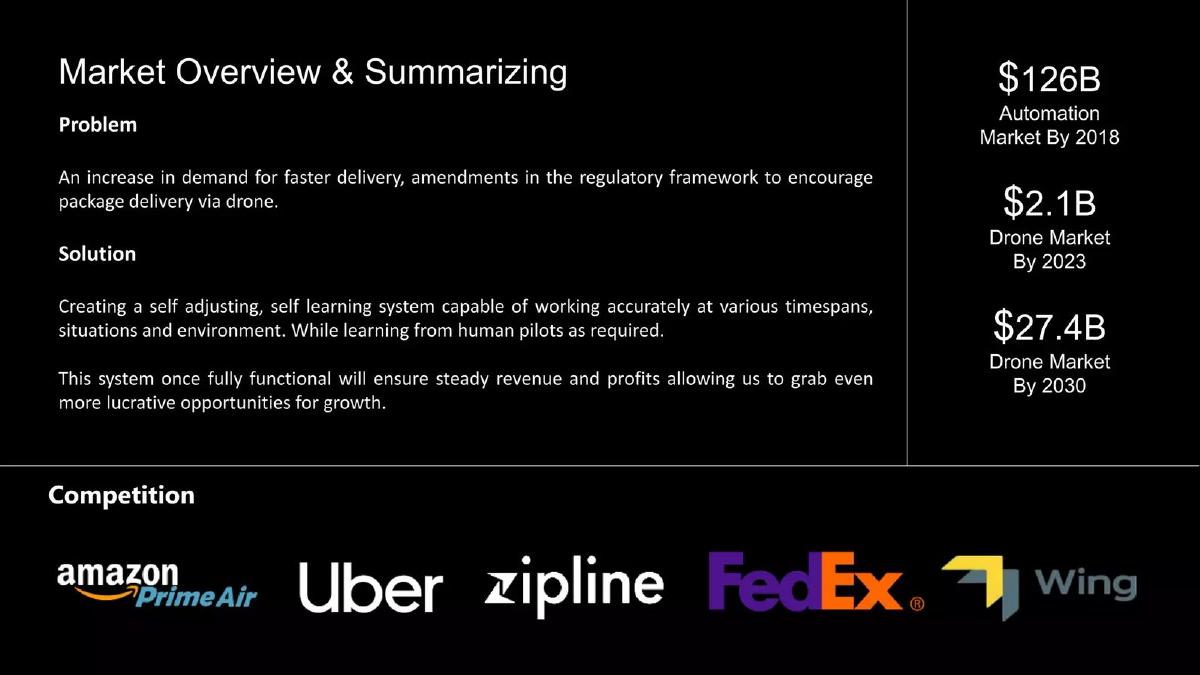
- DAS identifies a massive market opportunity, citing a $126B automation market as of 2018 and a projected $27.4B drone market by 2030 (Slide 5).
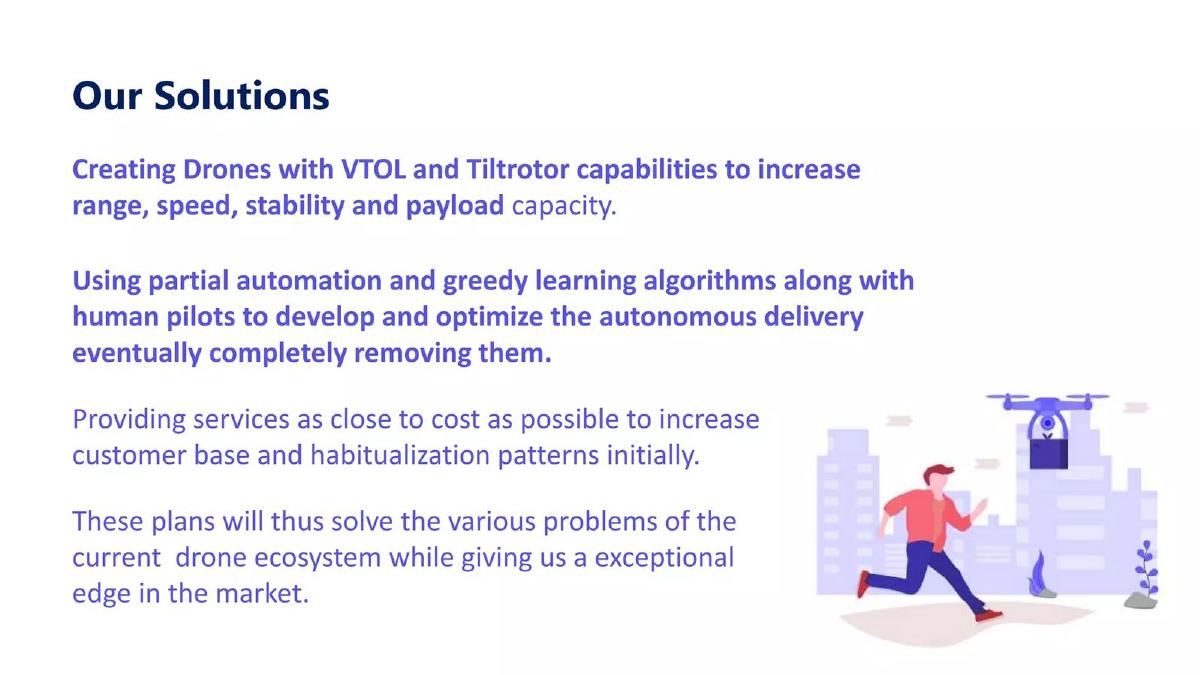
- The technical strategy involves using VTOL and Tiltrotor capabilities to improve drone range, speed, and payload capacity (Slide 4).
- Automation will be achieved through a transition phase where 'greedy learning algorithms' learn from human pilots before removing them entirely (Slide 4).
- Revenue projections are highly aggressive, ranging from $2.3M to $100M per quarter within a 2-5 year window (Slide 6).
- The deck lists major global players like Amazon Prime Air, Uber, Zipline, FedEx, and Wing as competition but does not explain how it will compete (Slide 5).
- There is a total absence of a team slide, meaning the founders' qualifications and technical expertise are not disclosed to the investor.
- Operational costs are estimated with a wide burn rate margin of $6k to $60k per month, including initial setup (Slide 6).
Executive Summary: A Vision for Autonomous Logistics
The DAS (Drone Automation and Services) pitch deck is a 7-slide presentation that outlines a high-level vision for the future of package delivery. The company positions itself as a group of 'drone lovers' aiming to solve the last-mile delivery problem through AI-driven automation and specialized hardware. While the deck identifies clear pain points in the logistics industry, it remains largely conceptual, lacking the granular data and team validation typically required for a $730K seed round.
Slide 1: Title Slide
The deck opens with the company name, 'DAS,' and the full descriptor, 'Drone Automation and Services.' The visual features a generic illustration of a city with drones and a hand holding a mobile device showing a map. This slide establishes the sector—drone logistics—but does not offer a unique brand identity or a compelling hook.
Slide 2: Who are We? and What we want?
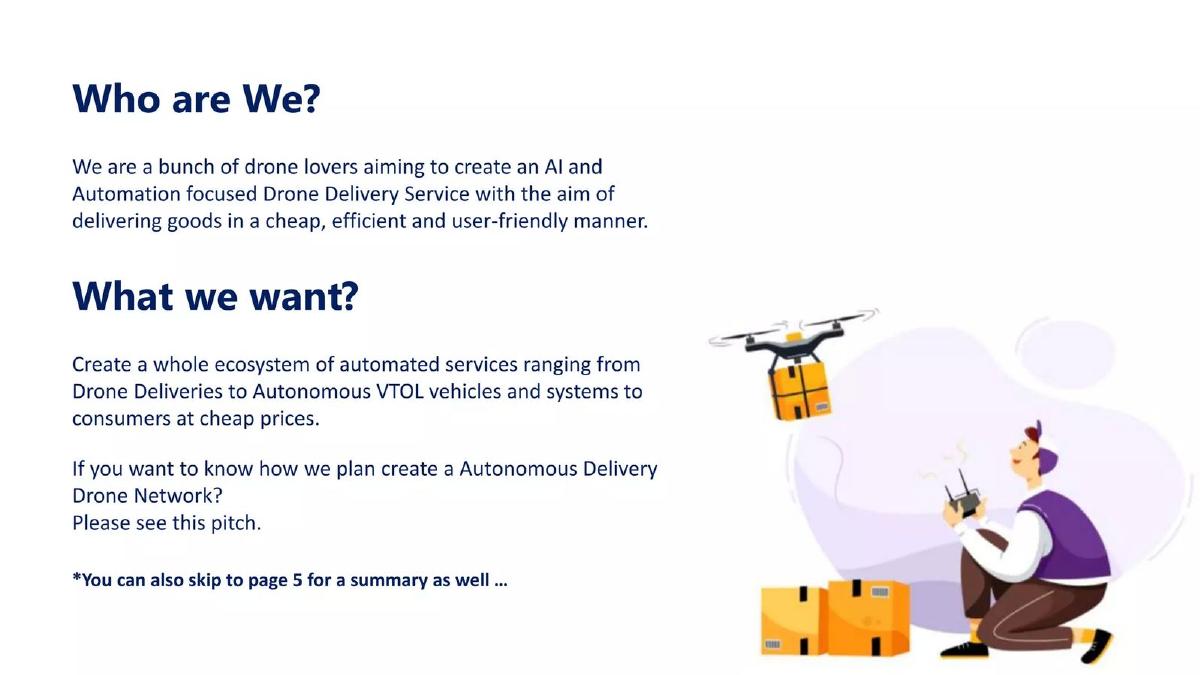
This slide serves as the mission statement. The founders describe themselves as a 'bunch of drone lovers' aiming to create an 'AI and Automation focused Drone Delivery Service.' Their stated goal is to deliver goods in a 'cheap, efficient and user-friendly manner.' They also mention an ambition to create an ecosystem ranging from drone deliveries to 'Autonomous VTOL vehicles.' Notably, the slide includes a footnote suggesting the reader can skip to page 5 for a summary, which is an unusual inclusion for a professional pitch deck, as it may encourage investors to bypass the core problem/solution narrative.
Slide 3: The Problems
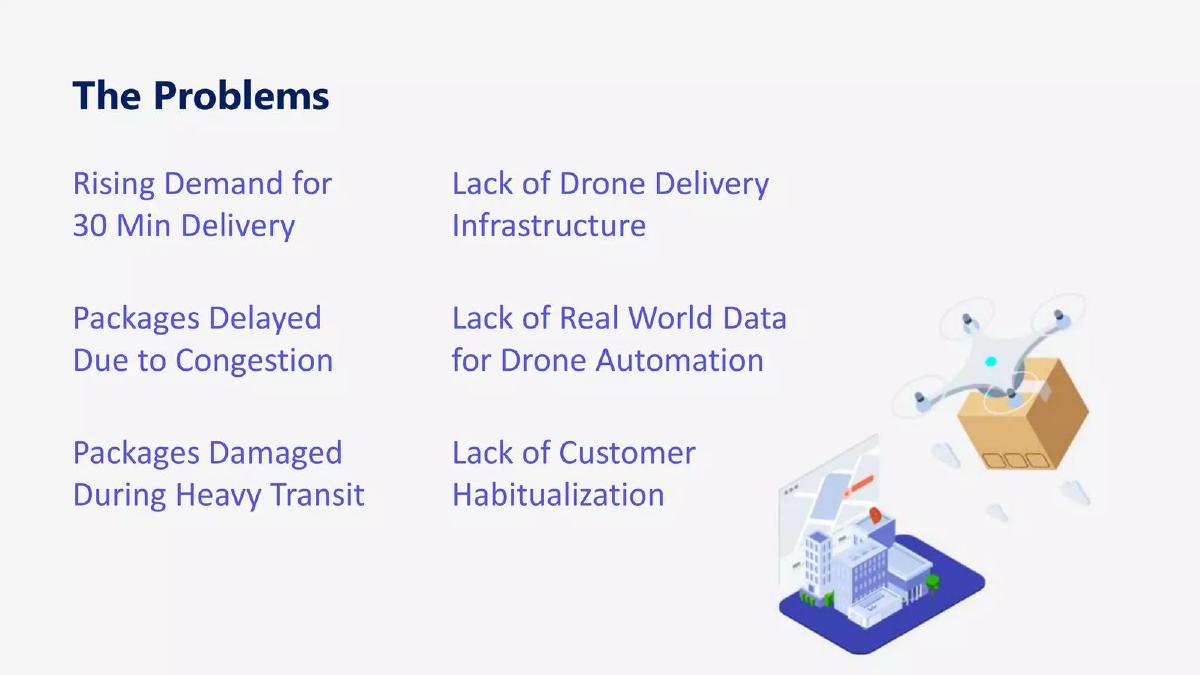
Rising Demand for 30 Min Delivery · Packages Delayed Due to Congestion · Packages Damaged During Heavy Transit · Lack of Drone Delivery Infrastructure · Lack of Real World Data for Drone Automation · Lack of Customer Habitualization
This slide effectively categorizes the hurdles facing the industry, though it does not provide data to quantify these issues (e.g., the cost of damaged packages or specific congestion statistics).
Slide 4: Our Solutions
The solution slide outlines a three-pronged approach. First, the hardware: creating drones with 'VTOL and Tiltrotor capabilities' to improve range and payload. Second, the software: using 'partial automation and greedy learning algorithms' alongside human pilots to optimize the system. Third, the market strategy: providing services 'as close to cost as possible' to build a customer base. The mention of 'greedy learning algorithms' is a specific technical detail, but the deck does not explain why this specific algorithmic approach is superior to other machine learning models currently used in autonomous flight.
Slide 5: Market Overview & Summarizing
This slide attempts to validate the market size and identify competitors. It cites three figures: a '$126B Automation Market By 2018,' a '$2.1B Drone Market By 2023,' and a '$27.4B Drone Market By 2030.' The use of a 2018 figure suggests the deck may be dated or using older research. The competition section lists heavyweights: Amazon Prime Air, Uber, Zipline, FedEx, and Wing. By listing these companies without a 'Why Us' comparison, the deck highlights the significant uphill battle DAS faces against trillion-dollar companies and established unicorns.
Slide 6: Timeline and Funding
The 'Ask' is clearly defined here. DAS is seeking a 'Seed Amount' of '$730K (₹5.50 Crore) approx.' The expected burn rate is listed as '$6k- $60k per Month,' a ten-fold variance that suggests a lack of precise financial planning. The funds are intended for recruitment and prototype development. The most striking figure on this slide is the 'Expected Revenue in 2-5 Years,' which is cited as '$2.3M - $100M/Quarter at least.' A quarterly revenue target of $100M for a seed-stage startup within five years is an exceptionally aggressive projection that would require massive scale and market share.
Slide 7: Contact Information
The final slide provides a 'Thank You' and contact details for 'Manan Garg,' including a Gmail address. The use of a personal Gmail account rather than a corporate domain name is a common red flag in professional fundraising, as it may signal a lack of formal business infrastructure.
What Works in This Deck
Specific Funding Ask: Unlike many early-stage decks that vaguely ask for 'investment,' DAS provides a specific dollar amount ($730K) and its equivalent in Indian Rupees (₹5.50 Crore), giving investors a clear starting point for negotiations.
Hardware Specification: By identifying VTOL and Tiltrotor technology as their hardware focus, the company narrows its technical scope, which is more helpful than simply saying they will 'build drones.'
Problem Identification: The six points on Slide 3 cover the primary logistical and behavioral barriers to drone adoption, showing that the founders have thought through the 'why' of the business.
What is Missing
The Team Slide: This is the most significant omission. In a seed-stage startup, investors are primarily betting on the founders. Without knowing the technical or business backgrounds of Manan Garg and the rest of the 'bunch of drone lovers,' it is impossible to assess the execution risk.
Regulatory Strategy: Drone delivery is one of the most heavily regulated industries in the world. The deck mentions 'amendments in the regulatory framework' on Slide 5 but does not explain how DAS will navigate FAA (or equivalent) certifications, air traffic management, or safety protocols.
Unit Economics: The deck claims they will provide services 'as close to cost as possible,' but provides no data on what that cost is. Investors need to see the cost per delivery versus traditional methods to understand the path to profitability.
Traction or IP: There is no mention of existing patents, proprietary algorithms, or pilot programs. Without evidence of 'Real World Data' (which they admit is lacking in the industry on Slide 3), the pitch remains purely theoretical.
Founder's Guide: What to Copy and What to Avoid
Copy the clear problem categorization: Grouping problems into logical buckets (Infrastructure, Data, Habitualization) helps an investor understand the multi-dimensional nature of the challenge.
Avoid the 'Skip to Summary' note: Never tell an investor to skip parts of your deck. If a slide isn't worth reading, it shouldn't be in the deck. Every slide should be essential to the narrative.
Avoid unrealistic revenue ranges: A revenue projection with a floor of $2.3M and a ceiling of $100M per quarter is too wide to be meaningful. It suggests the founders haven't modeled their growth based on specific unit sales or market penetration targets.
Avoid generic illustrations: The use of stock vector art throughout the deck makes the company look like a school project rather than a high-tech startup. Founders should use actual photos of their prototypes, team, or specific technical diagrams to build credibility.
Final Analysis
The DAS pitch deck is a 'pre-seed' or 'concept' deck that successfully identifies a massive market opportunity but fails to provide the evidence required to secure significant funding. The $730K ask is relatively modest for a hardware-heavy startup, yet the lack of a team slide and the presence of highly speculative revenue projections make it a difficult sell for institutional investors. To improve, the founders must provide proof of technical capability and a much more granular financial model that accounts for the high costs and regulatory hurdles of the autonomous aviation industry.
Frequently asked questions
- What is the specific technology DAS is developing?
- According to Slide 4, DAS is focused on creating drones with Vertical Take-Off and Landing (VTOL) and Tiltrotor capabilities. Their software approach involves 'greedy learning algorithms' and partial automation that utilizes human pilots to train the system, with the ultimate goal of achieving full autonomy in package delivery.
- How much funding is DAS seeking and what is the intended use?
- As stated on Slide 6, the company is asking for a seed round of approximately $730K (₹5.50 Crore). The funds are earmarked for recruiting 'talented people' and developing drone prototypes, as well as purchasing the necessary equipment and tools for operations.
- Who does DAS consider to be their primary competition?
- Slide 5 identifies several major industry incumbents and specialists as competitors: Amazon Prime Air, Uber, Zipline, FedEx, and Wing (Alphabet). However, the deck does not provide a feature-by-feature comparison or a specific strategy for how a seed-stage startup will displace these well-funded entities.
- What are the projected financial outcomes for the company?
- The financial projections on Slide 6 are extremely broad. The company expects to reach a revenue milestone of between $2.3M and $100M per quarter within 2 to 5 years. They also estimate a monthly burn rate ranging from $6,000 to $60,000, which includes the initial setup costs.
- What critical information is missing from this pitch deck?
- The deck omits several standard fundraising requirements. Most notably, there is no Team slide to verify founder expertise. It also lacks a Go-To-Market strategy, a detailed breakdown of unit economics, regulatory compliance plans (crucial for drones), and any evidence of existing traction or intellectual property.