Relief's 2021 Seed deck is a masterclass in identifying a massive, underserved market—the 1 in 3 Americans with accounts in collections—and positioning a technology-first solution against a 'shady' incumbent industry. The deck effectively uses a 16-slide structure to highlight a $2.78 trillion total addressable market and a simple revenue model: a 10% service fee on successful settlements. While the deck leans heavily on market size and the moral failings of competitors, it provides a clear roadmap for customer acquisition through unique partnerships with debt holders like Bloom Acquisitions.…
Key takeaways
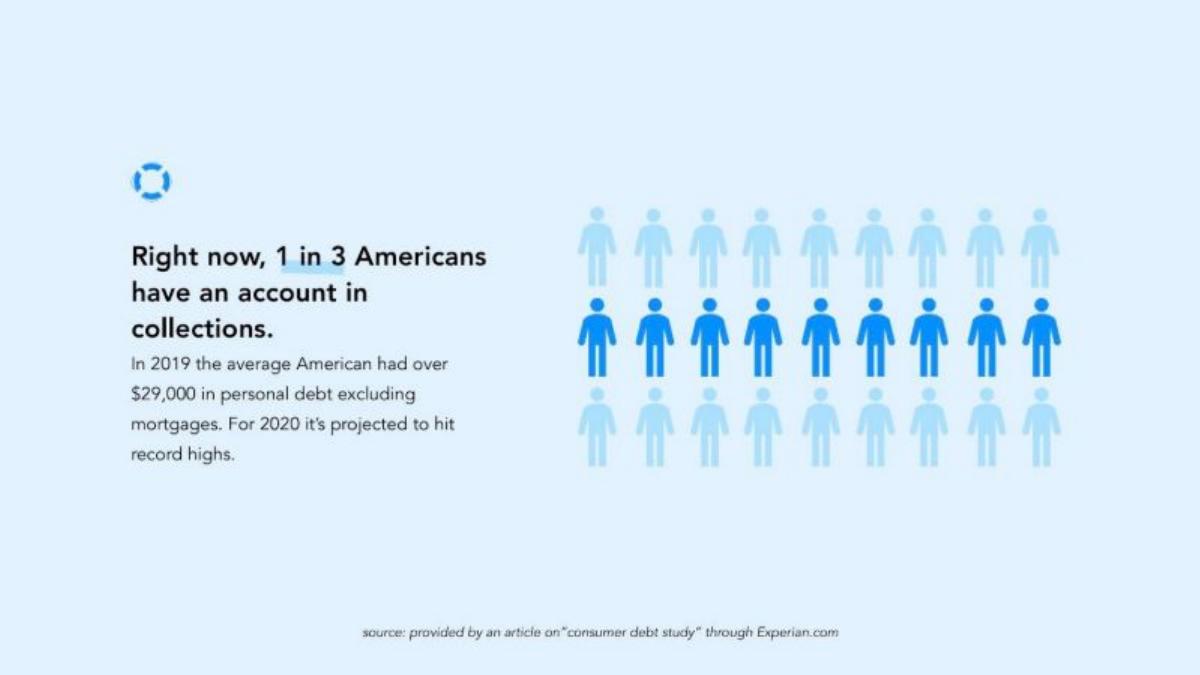
- The deck identifies a massive problem: 1 in 3 Americans have an account in collections, and the average personal debt excluding mortgages was over $29,000 in 2019 (Slide 2).
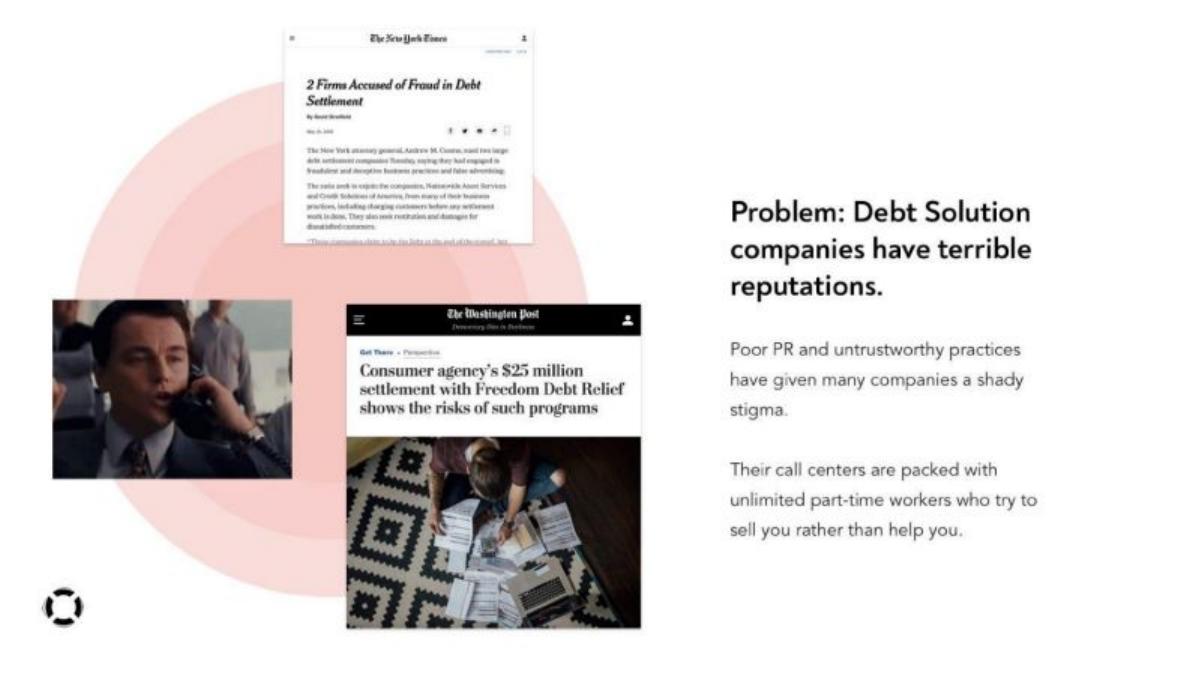
- Relief positions itself against 'shady' incumbents, citing news headlines about fraud and $25 million settlements in the debt relief industry (Slide 4).
- The business model is straightforward: Relief charges a 10% service fee to the creditor upon a successful settlement, averaging $749 per person based on 2019 data (Slide 12).
- Market opportunity is segmented into a $2.78 trillion TAM, a $695 billion SAM (debt expected to default), and a $6.7 billion debt settlement market (Slide 8).
- Go-to-market strategy relies on a partnership with Bloom Acquisitions, providing immediate access to 2.5 million debt holders (Slide 11).
- The product vision extends beyond settlement into a 'gateway' for debt consolidation, credit monitoring, and personal lending (Slide 10).
- The ask was for $1.7 million via a convertible note to reach profitability within 12 months (Slide 15).
- The team slide highlights 20+ years of experience and includes legal and compliance experts from ReedSmith, addressing the high regulatory risk of the industry (Slide 14).
Relief Pitch Deck Teardown: Disrupting the Debt Settlement Industry
Relief entered the fintech space in 2021 with a clear mission: to fix a broken, often predatory debt settlement industry. Their seed deck, which helped secure $2 million, focuses on the sheer scale of American consumer debt and the lack of transparent options for those in financial distress. By positioning themselves as the 'honest way' to get out of debt, Relief leveraged a technology-first approach to a problem traditionally handled by high-pressure call centers.
Slide 1: The Hook
The cover slide introduces Relief with a simple tagline: "Making debt relief easier, more transparent, and accessible for everyone." The visual includes app mockups showing a user-friendly interface with prompts like "How much can you afford this month?" and "You're not alone." This immediately sets a tone of empathy and simplicity, contrasting with the complex and stressful nature of debt.
Slides 2-4: The Problem
Slide 2 presents a staggering statistic: 1 in 3 Americans have an account in collections. It notes that in 2019, the average American had over $29,000 in personal debt (excluding mortgages), a figure projected to hit record highs. By starting with the macro-economic reality, Relief establishes the inevitability of their market.
Slide 3 focuses on the emotional and cognitive burden of debt. It uses photos of stressed individuals with thought bubbles asking, "How am I going to pay for all of this??" and "Can I go to jail for this?" This slide identifies the core customer pain point: being overwhelmed and uninformed about their options.
Slide 4 takes a direct shot at the competition. It features headlines from The New York Times and The Washington Post about fraud and $25 million settlements in the debt relief industry. It explicitly labels existing debt solution companies as having "terrible reputations" and "shady stigmas," driven by call centers that "try to sell you rather than help you." This creates a 'villain' in the narrative that Relief is designed to defeat.
Slide 5: The Solution
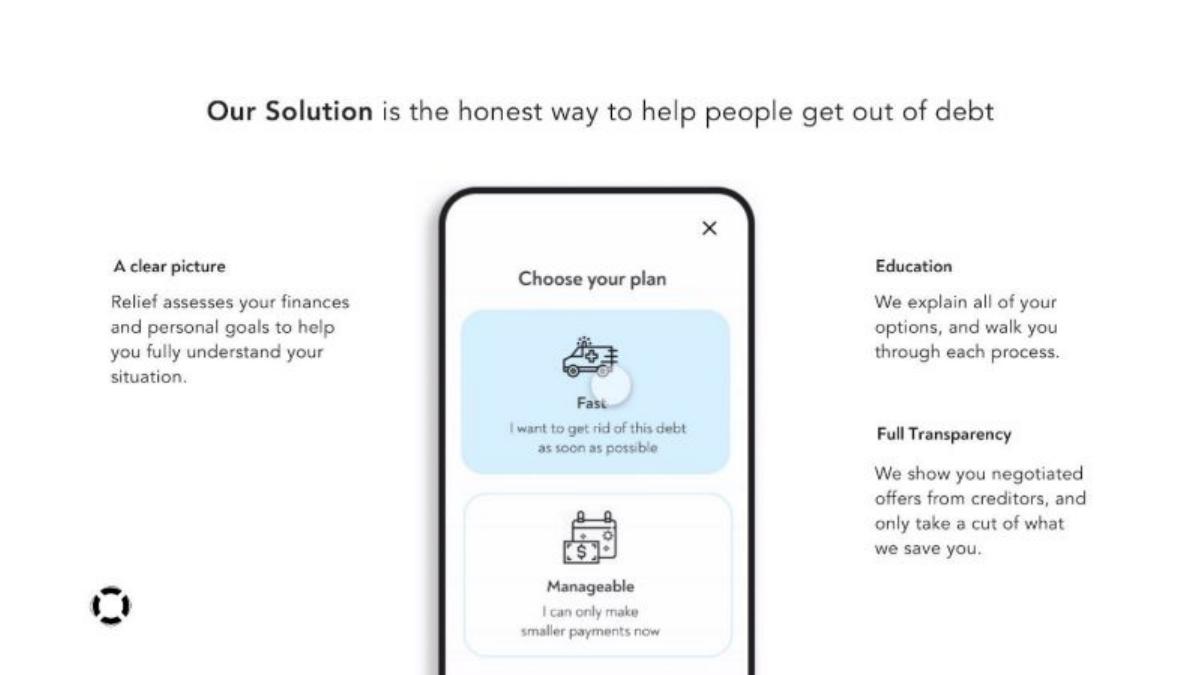
Relief presents itself as the "honest way to help people get out of debt." The slide breaks the solution into four pillars: a clear picture (assessing finances), education (explaining options), full transparency (showing negotiated offers), and a success-based model (only taking a cut of savings). The app mockup shows a choice between "Fast" (getting rid of debt ASAP) and "Manageable" (smaller payments) plans, emphasizing user control.
Slide 6: Competitive Landscape
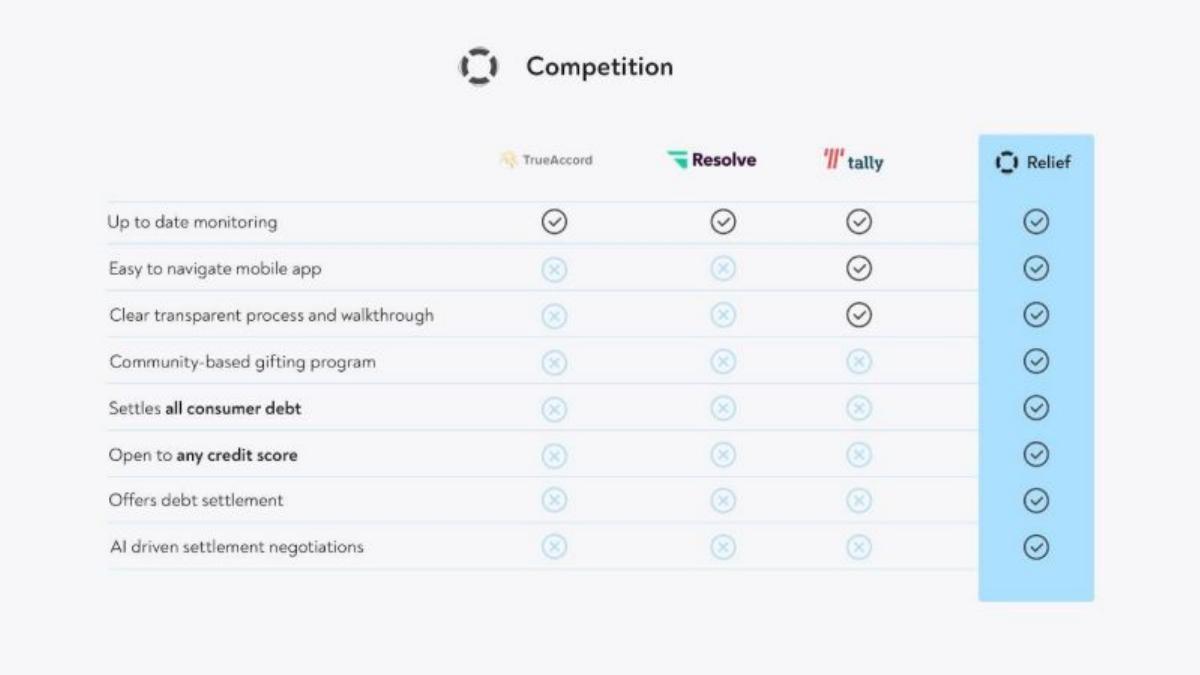
The competition matrix compares Relief against TrueAccord, Resolve, and Tally. Relief checks every box, including "AI driven settlement negotiations," "Settles all consumer debt," and a "Community-based gifting program." Notably, it marks competitors as lacking an "easy to navigate mobile app" or a "clear transparent process," reinforcing the themes from the problem slides.
Slide 7: The 'X for Y' Comparison
Relief aligns itself with successful fintech disruptors. It shows Robinhood (Brokerage), Earnin (Payday Loans), and Credit Karma (Credit Monitoring) alongside Relief (Debt Solutions). The text states, "Relief will revolutionize debt the way these apps have for their industry." This is a classic pitch deck tactic to help investors visualize the potential for a massive exit by association with known unicorns.
Slide 8: Market Opportunity
This slide uses a nested circle diagram to visualize the market. The Total Addressable Market (TAM) is listed as $2.78 trillion (US consumer debt minus mortgages, auto, and HELOC). The Serviceable Addressable Market (SAM) is $695 billion (debt expected to default). The current debt settlement market is valued at $6.7 billion . By showing the gap between the current market and the SAM, Relief suggests a massive opportunity to capture users who are currently unserved by traditional settlement firms.
Slide 9: How it Works
The user journey is mapped out in a six-step process: create a profile, assess goals, view options, review a payment plan, pay into an escrow account, and finally, Relief negotiates and settles with creditors. This flow clarifies that Relief isn't just a software tool but a full-service intermediary that manages the financial transaction through escrow.
Slide 10: Long Term Vision
Relief signals that it doesn't intend to stay only in debt settlement. The "Long term vision" slide positions the app as a "gateway for other services in personal finance," including debt consolidation, credit score monitoring, loan refinancing, and personal lending. This expands the potential Lifetime Value (LTV) of a customer beyond a single settlement event.
Slide 11: Go-to-Market Strategy
This is one of the strongest slides in the deck. Relief claims a "Beta User Reach" of 5.2 million people. This is broken down into 2.5 million debt holders from a partnership with Bloom Acquisitions and a 2.7 million combined mailing list from Alley and Colors Worldwide. Having a pre-defined acquisition channel for millions of users significantly de-risks the investment for a Seed round.
Slide 12: Business Model
The revenue model is transparent and simple. Based on 2019 data, the average settlement amount per person is $7,492 . Relief charges a 10% service fee to the creditor upon successful settlement, resulting in an average fee of $749 . This 'no-win, no-fee' structure for the user (paid by the creditor/savings) is a compelling value proposition.
Slide 13: Projected Revenue
A growth chart shows projected revenue from FY2021 through EOY 2024. While the Y-axis goes up to $400m , the specific data points for 2022 and 2023 are roughly $25m and $85m respectively. The slide notes these revenues are based on the SAM of $695 billion.
Slide 14: The Team
The team slide lists eight individuals, led by CEO Jason Saltzman. It emphasizes "20+ years of debt and development experience." Crucially for a fintech startup in a regulated space, it includes two members from ReedSmith focused on "Legal & Compliance." This addresses the inevitable investor concern regarding the regulatory hurdles of debt negotiation.
Slide 15: The Ask
The final substantive slide lists the ask: 1.7 million via a convertible note round . The funds are intended to support the company for 12 months and reach profitability. The contact email provided is Jason@relief.app.
What Relief Does Well
Clear Villain: The deck does an excellent job of painting the existing industry as predatory and outdated, making Relief's 'honest' approach feel like a necessary correction. · Quantifiable GTM: Instead of vague marketing plans, they cite specific partnerships (Bloom Acquisitions) and exact numbers of reachable users (5.2M). · Simple Unit Economics: The 10% fee model is easy to understand and provides a clear path to calculating revenue per user.
What is Missing
Unit Economics (CAC/LTV): While they show the average fee ($749), they do not provide an estimated Cost Per Acquisition (CAC). Given the competitive nature of fintech, this is a significant omission. · Regulatory Detail: While they have legal experts on the team, the deck doesn't explain how they navigate the complex state-by-state licensing required for debt settlement. · AI Proof: The deck claims "AI driven settlement negotiations" but provides no detail on how this technology works or if it has been tested against human negotiators.
Founder Takeaway: Copy the 'Market Gap' Logic
Founders should study Slide 8. Many decks fail because they only show a massive TAM that feels unreachable. Relief shows the TAM ($2.78T), but then narrows it down to a realistic SAM ($695B) and compares it to the tiny sliver of the market currently being served ($6.7B). This visually demonstrates that the current industry is failing to capture 99% of the potential market, creating a compelling 'why now' for investors. If you can show that your competitors are only scratching the surface of a problem, your startup becomes a play on market expansion rather than just market share theft.
Frequently asked questions
- What is Relief's primary value proposition?
- Relief automates the negotiation of credit card debt. Unlike traditional debt settlement firms that rely on manual call centers and have reputations for predatory practices, Relief uses AI-driven negotiations to settle outstanding balances for users. The deck emphasizes transparency, education, and a 'success-only' fee structure where they only take a cut of what they save the user.
- How does Relief plan to acquire customers?
- The deck outlines a multi-channel strategy. Their primary advantage is a partnership with Bloom Acquisitions, giving them access to 2.5 million debt holders for their pilot program. Additionally, they leverage a combined mailing list of 2.7 million through partners Alley and Colors Worldwide, alongside digital media campaigns and influencer content.
- What is the revenue model for Relief?
- Relief operates on a performance-based fee. According to slide 12, they charge a 10% service fee to the creditor upon a successful settlement. Based on 2019 averages, they estimate an average settlement amount of $7,492 per person, resulting in an average fee of $749 per successful case.
- Who are Relief's main competitors according to the deck?
- Slide 6 compares Relief to TrueAccord, Resolve, and Tally. Relief claims to differentiate itself by offering AI-driven settlement negotiations, being open to any credit score, and settling 'all consumer debt,' whereas competitors are marked as lacking these specific features or a 'community-based gifting program.'
- What was the financial ask in this pitch deck?
- Relief sought $1.7 million through a convertible note round. The stated purpose of this capital was to support the company through 12 months of operations and reach profitability. The catalogue facts indicate they eventually closed $2M for this Seed round in 2021.