Wayflyer’s Series A deck presents a compelling case for revenue-based financing by identifying a specific pain point: the working capital gap in e-commerce. The deck moves quickly from problem to proof, utilizing a mix of high-level strategy and granular operational data. Key strengths include the emphasis on '1st party data' for underwriting and the speed of their decision-making process—generating offers within one hour. While the deck uses some placeholders for specific customer counts and financial figures in this public version, the structure highlights a global ambition, supported by a…
Key takeaways
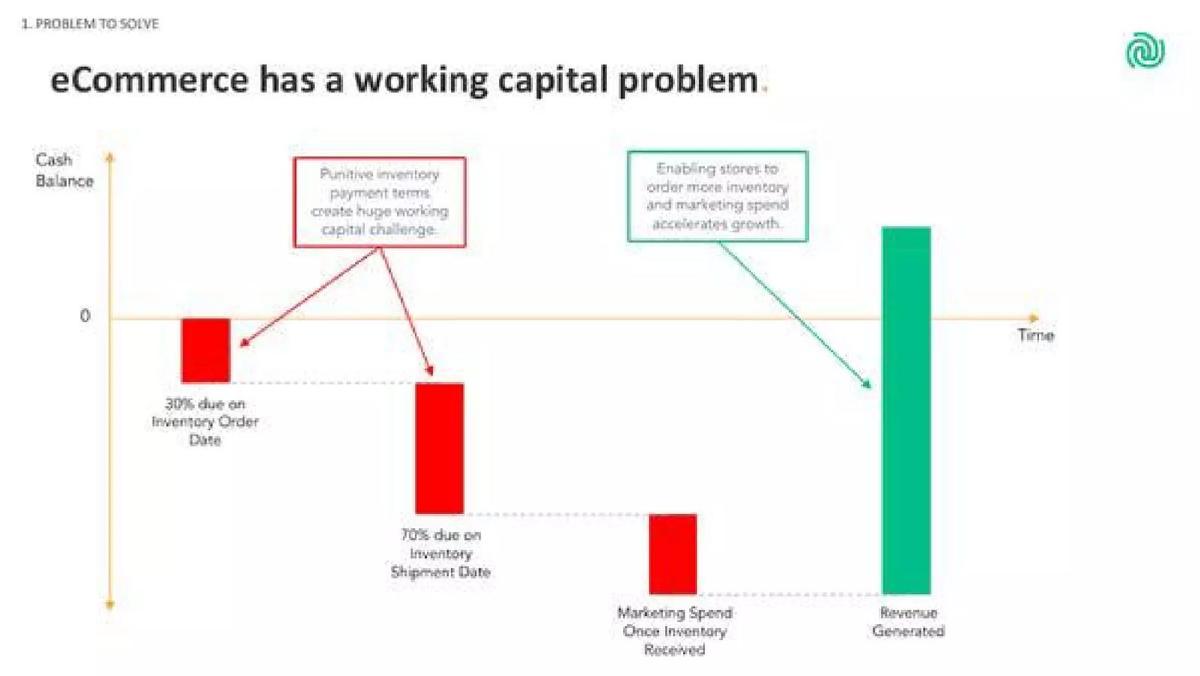
- The deck identifies a specific working capital problem where inventory and marketing costs precede revenue, creating a cash flow trough (Slide 4).
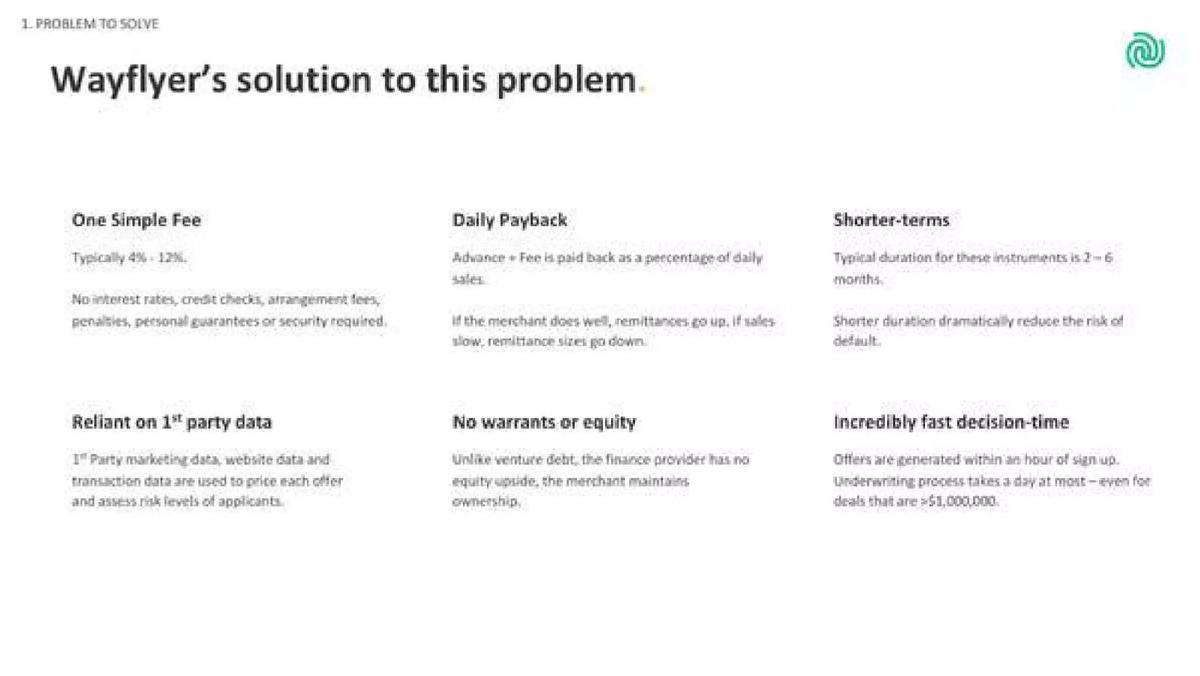
- Wayflyer differentiates itself from traditional equity and debt by offering a 'One Simple Fee' typically between 4% and 12% (Slide 6).
- Speed is a core value proposition, with underwriting taking 'a day at most' even for deals exceeding $1,000,000 (Slide 6).
- The company leverages 1st party marketing and website data to price offers, reducing reliance on traditional credit checks (Slide 6).
- Growth is demonstrated through a graph showing 'Signed Deals' and 'Fees Charged' increasing monthly from June 2020 to January 2021 (Slide 11).
- The deck highlights a global footprint with a network of offices across North America, Europe, and Australia to enable 24-hour support (Slide 10).
- Strategic partnerships are a primary growth lever, specifically citing 'Won' status with WooCommerce and Adobe Commerce Cloud (Slide 18).
- The user experience is designed for extreme efficiency, claiming a merchant can connect their account in just 1 minute (Slide 16).
Introduction: The Fintech Bridge for E-commerce
Wayflyer’s Series A pitch deck is a masterclass in identifying a systemic market inefficiency and presenting a scalable, data-driven solution. Founded in Dublin, Ireland, Wayflyer addresses the 'working capital problem' that plagues fast-growing e-commerce brands. The deck, dated around 2019-2021, outlines how the company uses real-time data to provide non-dilutive funding. With over $889 million raised to date according to catalogue facts, this deck represents the foundational logic that convinced top-tier investors of the platform's potential.
Section 1: The Problem and Solution
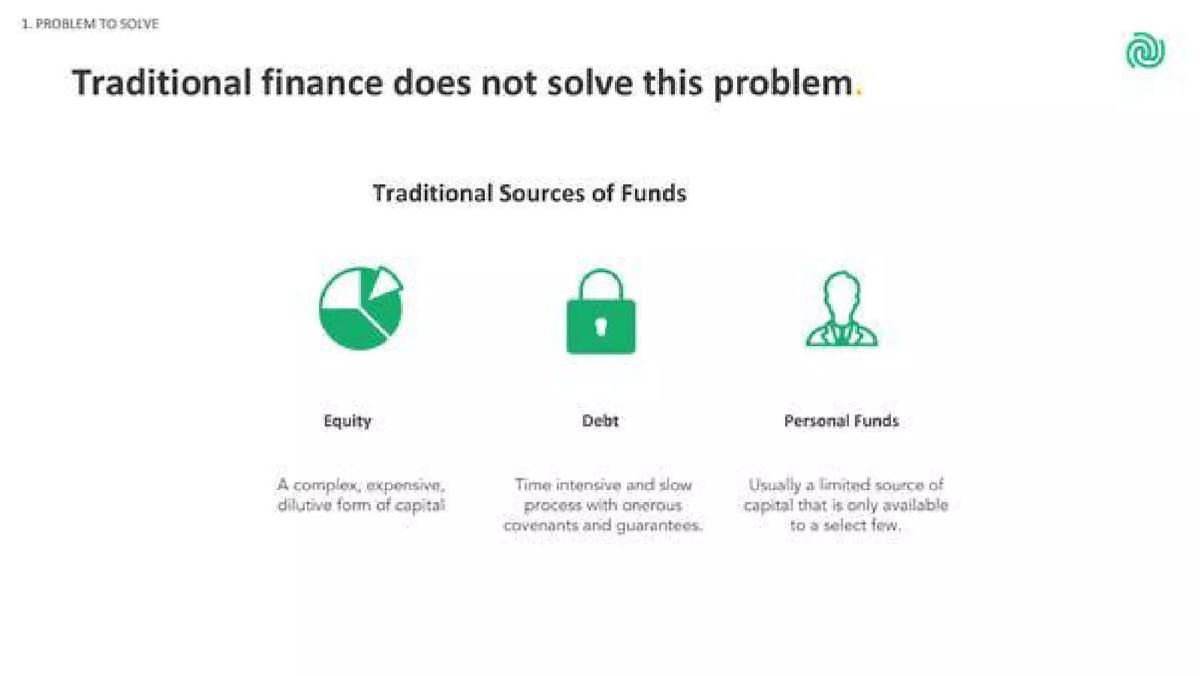
Slides 3-6 establish the narrative. Slide 4 is particularly effective, using a simple bar chart to visualize the 'working capital problem.' It shows red bars for inventory orders and marketing spend occurring well before the green bar of revenue generation. This 'trough' is the specific gap Wayflyer fills. Slide 5 dismisses traditional finance—Equity (too expensive/dilutive), Debt (too slow/onerous), and Personal Funds (too limited)—setting the stage for a new category.
Slide 6 introduces the Wayflyer solution with six key pillars. The most notable are the 'One Simple Fee' (4-12%) and the 'Daily Payback' model. By tying repayment to a percentage of daily sales, Wayflyer aligns its success with the merchant's. The mention of 'No warrants or equity' directly appeals to founders who want to maintain ownership while scaling.
Section 2: The Team and Global Reach
Slides 8-10 focus on the 'Story So Far.' Slide 8 introduces the leadership, led by CEO Aidan Corbett (formerly of McKinsey and Conjura) and CFO Jack Pierse (formerly of PwC). The team slide is strong because it highlights specific domain expertise in sales, engineering, and legal from established firms like Oracle and BAE Systems. Slide 9 is a 'logo cloud' of their investors' portfolios, including N26, Revolut, and Stripe, which serves as a powerful proxy for credibility. Slide 10 uses a world map to show offices in North America, Europe, and Australia, emphasizing that this is a global play, not a local one.
Section 3: Traction and Social Proof
Slides 11-13 provide the 'proof of work.' Slide 11 contains a growth chart for 'Monthly Sales KPIs.' While the specific customer count is redacted as 'xxx' in this version, the trend line for 'Fees charged' and 'Signed Deals' shows aggressive, consistent month-over-month growth from June 2020 to January 2021. The slide also notes a 'Negligible default level,' which is the most critical metric for any lending business.
Slide 12 and 13 focus on the customers. Slide 13 provides three specific case studies: Tommi Skin (8x revenue growth), Bow Wow Labs (2x revenue growth), and Geologie (10x revenue growth). These testimonials aren't just fluff; they specifically mention 'not diluting ownership' and 'flexible' cycles, reinforcing the core value propositions mentioned earlier in the deck.
Section 4: Product and Go-To-Market
Slides 15-18 detail the 'how.' Slide 16 is a vital operational slide. It breaks down the user experience into a timeline: 1 minute to connect a merchant account, 2 minutes for marketing accounts, and 15 minutes to generate an offer. This speed is Wayflyer’s 'unfair advantage' over traditional banks. The slide lists integrations with Stripe, Shopify, Facebook, and Google, showing the breadth of their data ingestion capabilities.
Slide 18 outlines the partnership strategy. It lists WooCommerce and Adobe Commerce Cloud as 'Won' partners. For WooCommerce, Wayflyer claims to be the 'only extension for Merchant Finance in the Store.' This indicates a highly defensible customer acquisition channel that doesn't rely solely on expensive direct marketing.
Section 5: Financials and Conclusion
Slides 20-21 wrap up the presentation. Slide 20 is a 'Recent monthly cashflow summary' table. In this version, the cells are blank, but the row headers—'Operating Cash Burn,' 'Increase in First Loss Pool,' and 'Outstanding Balance at SPVs'—reveal the sophisticated way Wayflyer manages its capital. They aren't just lending off their balance sheet; they are using Special Purpose Vehicles (SPVs), a standard practice for mature fintechs. The deck ends on Slide 21 with the tagline: 'Wayflyer. Where eCommerce takes off.'
What Works in This Deck
Clear Problem Visualization: Slide 4 makes the abstract concept of 'working capital' immediately understandable to any investor, regardless of their familiarity with e-commerce logistics. · Speed as a Feature: By quantifying the onboarding process in minutes (Slide 16), Wayflyer turns a boring operational detail into a competitive moat. · Alignment of Interests: The deck repeatedly emphasizes that they only get paid when the merchant makes a sale, which builds trust. · Strategic Partnerships: Highlighting 'Won' status with platforms like Adobe and WooCommerce proves that the business has a low-cost way to acquire customers at scale.
What Is Missing
Unit Economics: While the deck mentions a 4-12% fee, it does not explicitly detail the Customer Acquisition Cost (CAC) vs. the Lifetime Value (LTV) of a merchant. · Competitive Landscape: There is no slide addressing competitors like Clearco (formerly Clearbanc) or Shopify Capital. In a crowded fintech space, explaining why Wayflyer wins against these giants is a missed opportunity. · The Ask: The deck is labeled 'Series A Presentation,' but it does not state the specific dollar amount being raised or the intended use of funds. This is common in 'leaked' or public versions of decks but is a critical component of a real pitch.
What a Founder Should Copy
The 'Traditional vs. Us' Slide: Slide 5 is a perfect template for any founder disrupting an incumbent industry. It categorizes the flaws of existing solutions into three clear buckets. · Data-Backed Underwriting: If your startup uses API integrations to make decisions, use a slide like Slide 16 to show exactly which logos you connect to and how fast the result is. · Case Study Structure: Slide 13 is excellent. It combines a logo, a headshot, a specific growth metric (e.g., 10x), and a quote that addresses a specific pain point (e.g., 'The bank turned us away'). · Global Ambition: Even if you are small, showing a map of where you can operate (Slide 10) signals to Series A investors that you are thinking about a billion-dollar outcome, not just a local success.
Frequently asked questions
- What is Wayflyer's core business model?
- Wayflyer operates a revenue-based financing platform specifically for e-commerce brands. They provide upfront capital for inventory and marketing in exchange for a single fee (4-12%) and a percentage of daily sales. This allows brands to scale without giving up equity or taking on traditional bank debt with personal guarantees.
- How does Wayflyer handle underwriting and risk?
- Unlike traditional banks, Wayflyer uses 1st party data. They connect directly to a merchant's store (e.g., Shopify, Magento) and marketing accounts (e.g., Facebook, Google) to assess performance in real-time. This allows them to generate offers within an hour and complete full underwriting in less than 24 hours.
- What are the typical terms for a Wayflyer advance?
- According to slide 6, the fee is typically between 4% and 12%. The duration of the instrument is short, usually between 2 and 6 months. Repayment is flexible, scaling up or down based on the merchant's daily sales volume, which reduces the risk of default during slow periods.
- How does Wayflyer acquire new customers?
- Their go-to-market strategy relies heavily on direct outbound efforts and strategic partnerships. Slide 18 highlights 'Won' partnerships with major e-commerce platforms like WooCommerce and Adobe Commerce Cloud (Magento), where Wayflyer acts as the exclusive or preferred merchant finance extension within those ecosystems.
- What evidence of scale does the deck provide?
- The deck shows consistent month-on-month growth in both signed deals and fees charged from mid-2020 through early 2021. It also notes that the US, UK, and Australia contribute over 95% of revenue and that the technology stack is designed to launch in new markets within 1-3 months.