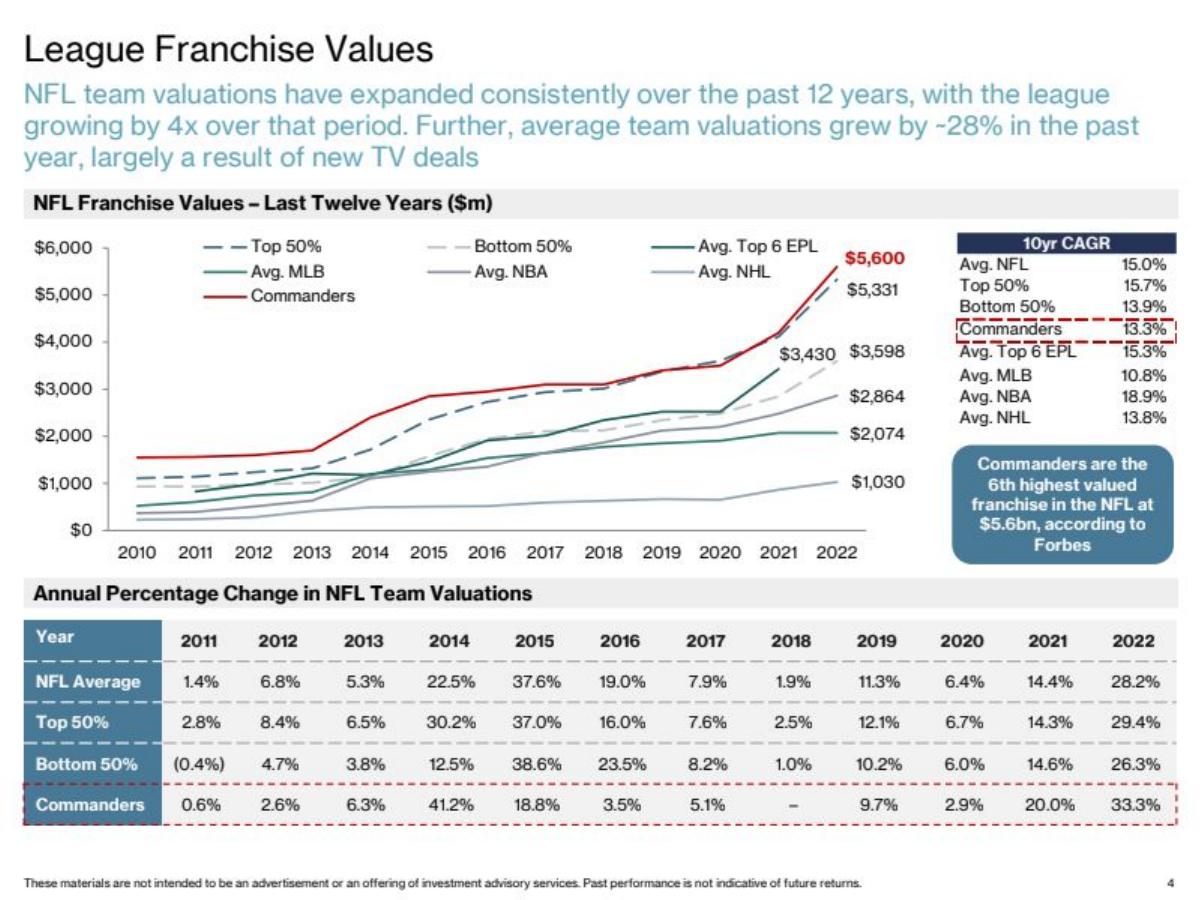
The Washington Commanders acquisition deck, used by Josh Harris to secure the $6.05 billion purchase in 2023, is a sophisticated financial document that treats a professional sports team as a distressed value-add real estate and media play. Rather than focusing on on-field performance, the deck highlights a massive disconnect between the team's historical #1 ranking in local revenue (2008) and its 2022 slide to #22. The thesis is simple: the brand was suppressed by 'toxic workplace' allegations and poor management, creating a 'coiled spring' effect for new ownership. With $725 million in esti…
Key takeaways
- The deck identifies a specific 'Owner Fallout' period from 2015-2022 as the primary cause for the team's revenue decline (Slide 7).
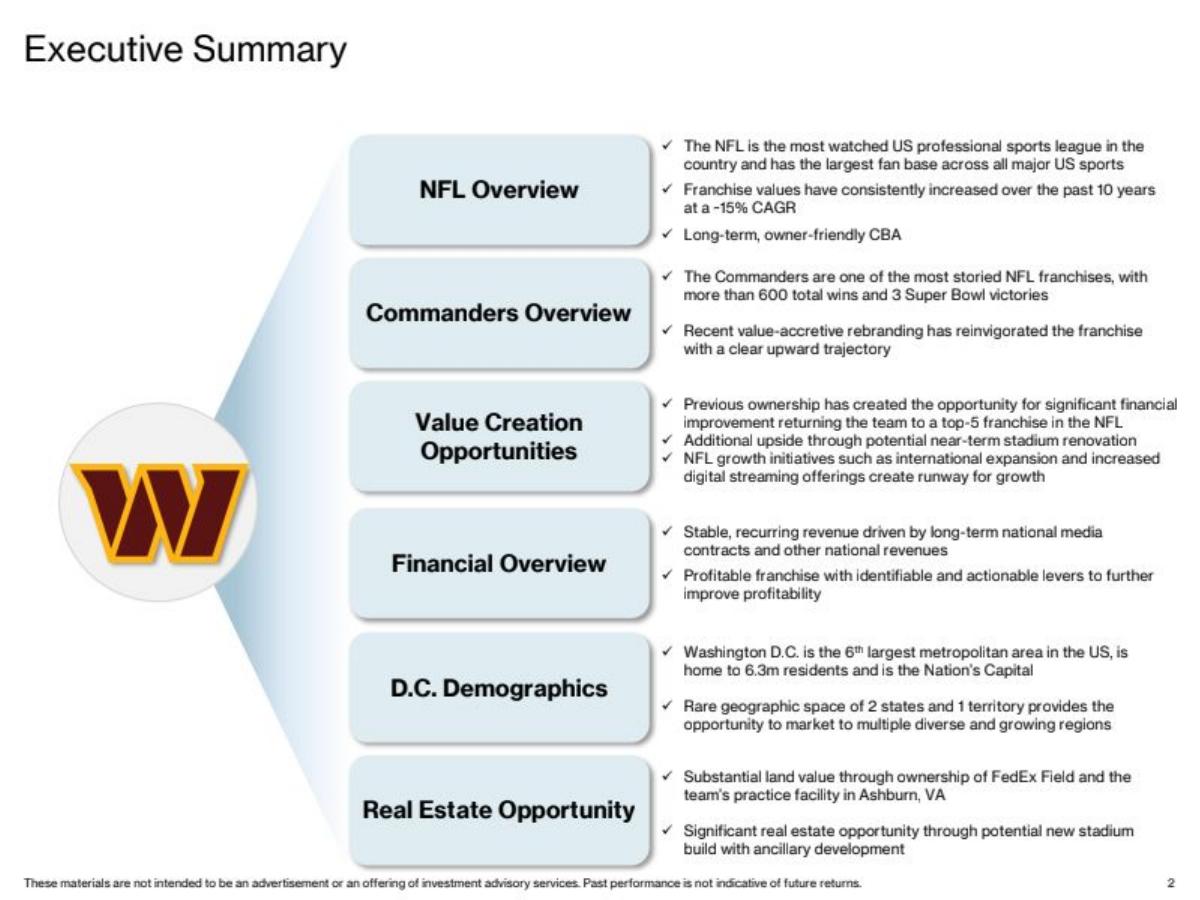
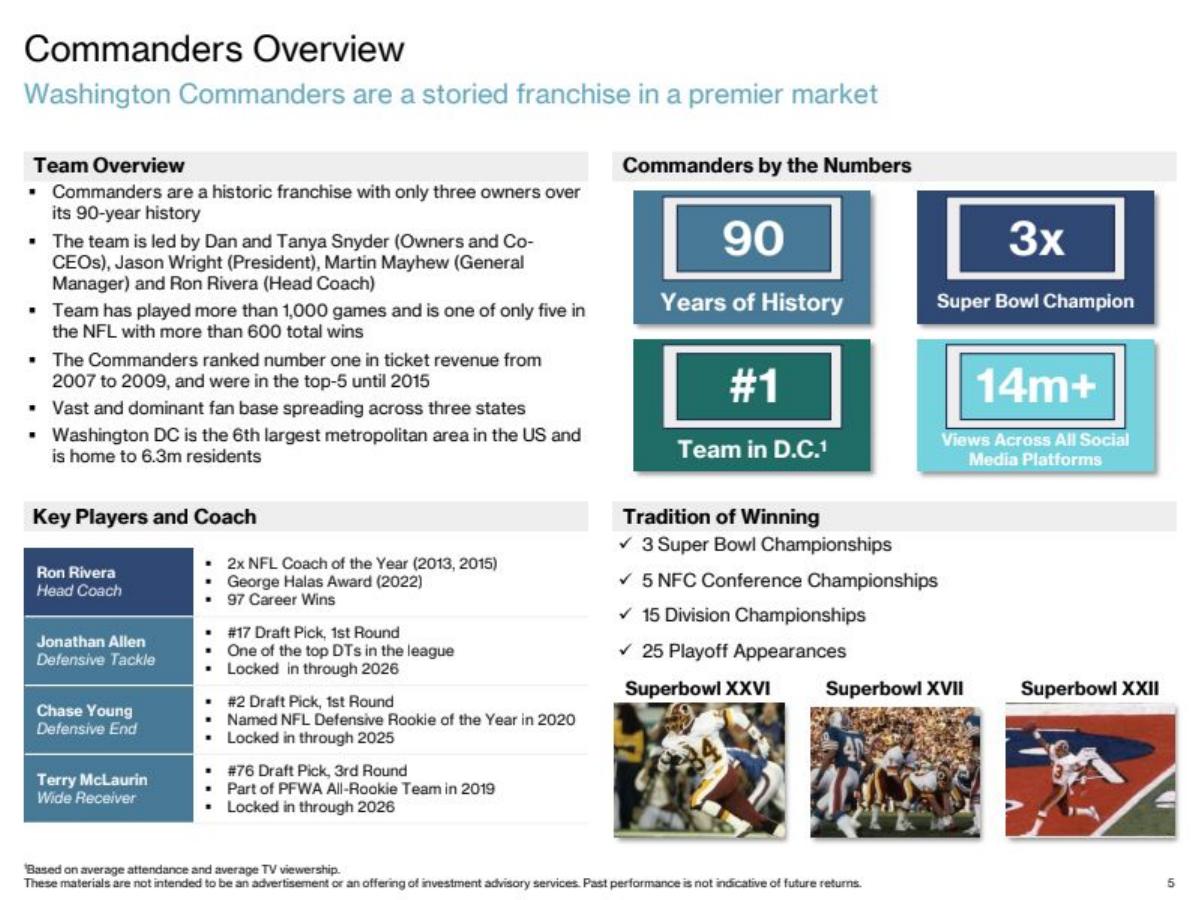
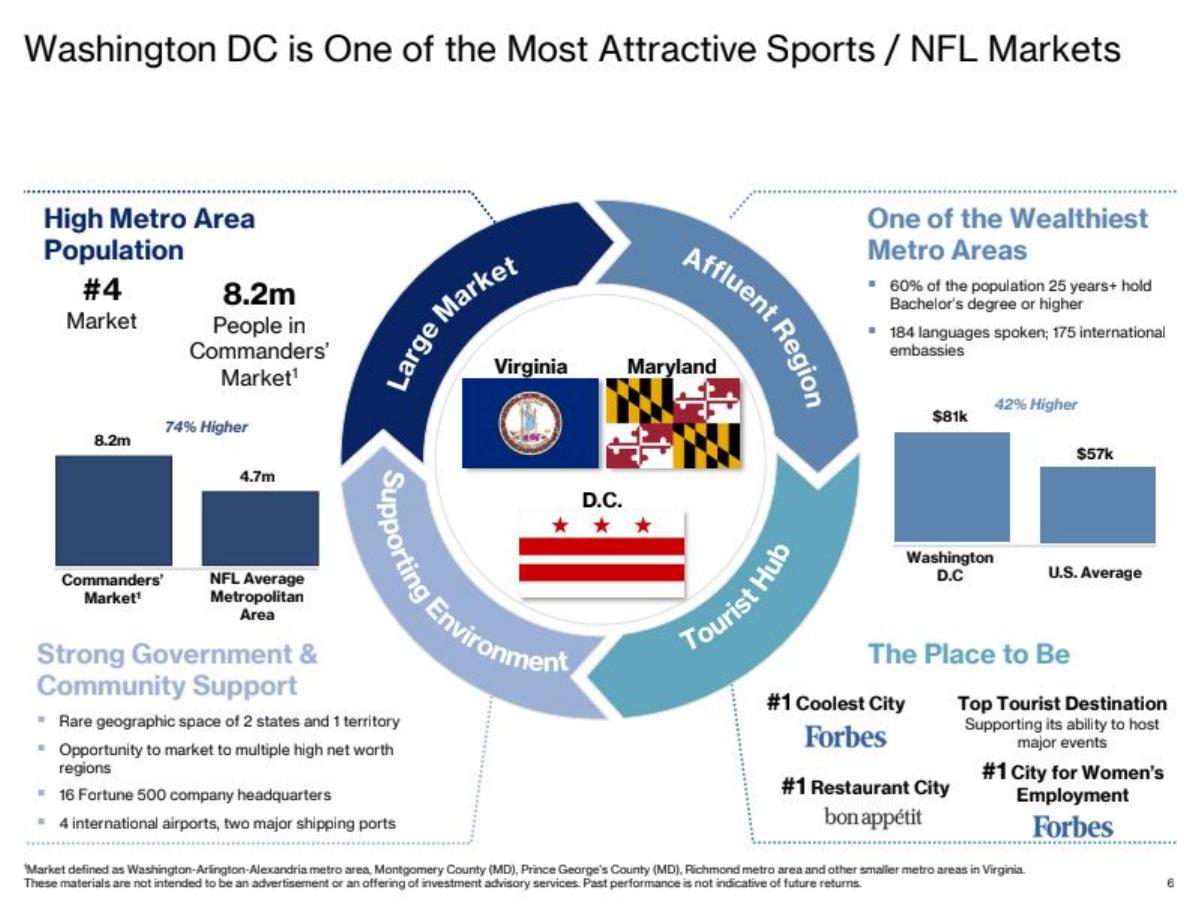
- Washington DC is highlighted as the 6th largest metropolitan area in the US, home to 6.3m residents, providing a massive untapped market (Slide 5).
- The franchise's local revenue ranking plummeted from #1 in 2008 to #22 in 2022, representing a $65m delta in gross gate revenue alone (Slide 9).
- Real estate is a core pillar of the valuation, with 160 acres at the practice facility and 227 developable acres at FedEx Field valued at ~$725m (Slide 15).
- A two-phase growth plan projects 'Brand Revival' through 2031, followed by a 'New Stadium' phase to drive top-5 league revenue (Slide 7).
- National revenue provides a massive safety net, accounting for 67% of total revenue and backed by $12.25bn in annual NFL media contracts (Slide 11, 19).
- The investment group plans $231m in total stadium renovations and maintenance to extend the life of FedEx Field (Slide 13).
- The exit strategy assumes a 10-year hold with a projected sale price of $15.4bn to $19.8bn based on a 40x-45x EBITDA multiple (Slide 23).
Introduction: The $6 Billion Turnaround
The acquisition of the Washington Commanders for $6.05 billion in 2023 was a landmark moment in sports finance. This deck, dated March 2023, was the primary tool used by Josh Harris and his investment group to recruit limited partners. It is not a typical startup pitch; it is a sophisticated private equity memorandum that frames a professional sports team as a distressed asset with a massive real estate kicker.
Slide 1-3: The Macro Case for the NFL
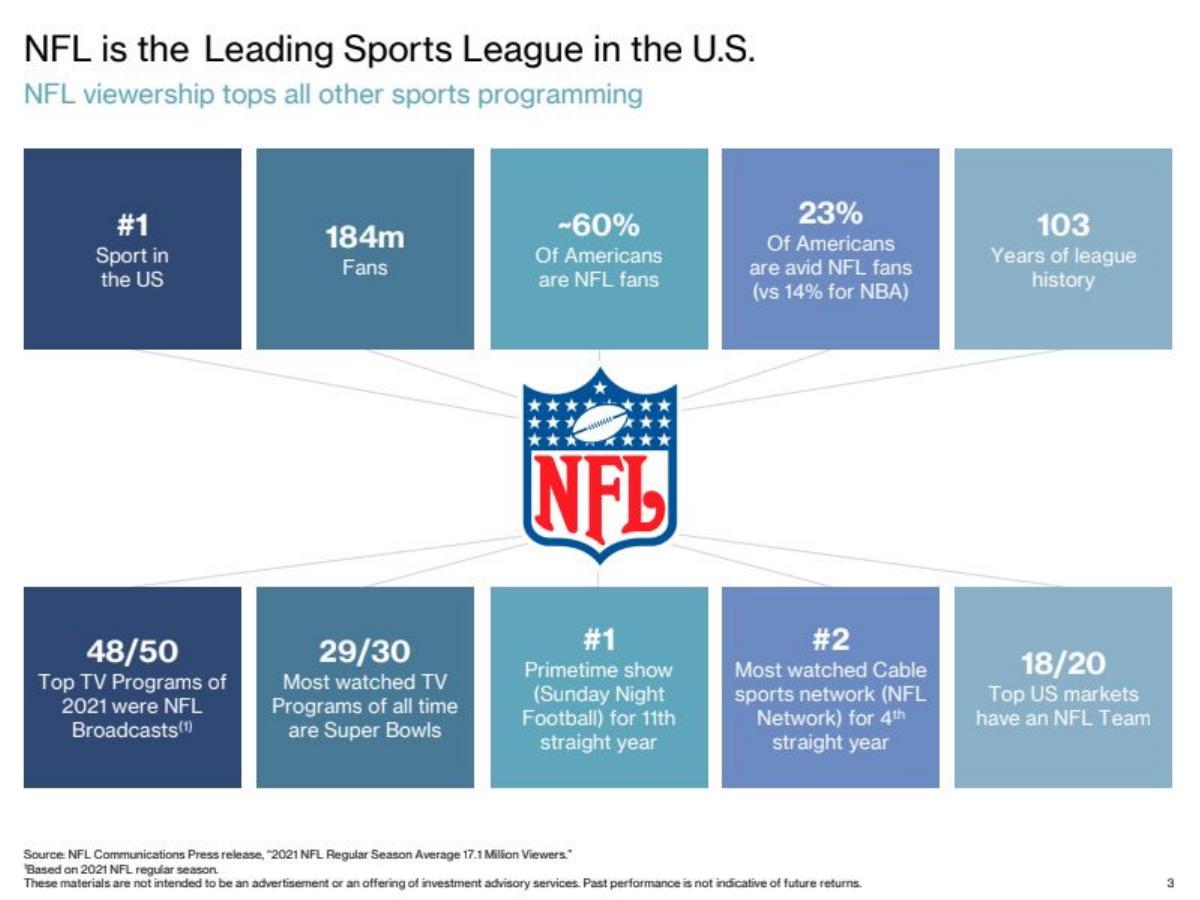
The deck begins by establishing the NFL as the 'Leading Sports League in the U.S.' Slide 3 is a data-heavy wall of proof: 184 million fans, 48 of the top 50 TV programs in 2021, and a 103-year history. By starting here, the founders are not selling a team; they are selling an entry point into a monopoly that dominates American media consumption. They note that 23% of Americans are 'avid' NFL fans, nearly double the NBA's 14%.
Slide 5: The Commanders Overview
Slide 5 introduces the asset. It highlights that the team is one of only five in the NFL with more than 600 total wins and has a 90-year history. Crucially, it identifies Washington DC as the 6th largest metropolitan area in the US with 6.3 million residents. This slide sets the stage for the 'Premier Market' argument—the demand is there, even if the current product is failing.
Slide 7-9: The 'Owner Fallout' Thesis
This is the heart of the deck. Slide 7 creates a timeline of 'Historical' vs. 'Projections.' It explicitly labels the 2015-2022 period as '(Owner Fallout).' It shows the team's local revenue ranking falling from #1 to #22. Slide 9 provides the granular data: Gross Gate Revenue dropped from $120m in 2008 to $55m in 2022. The deck argues that this $65m 'delta' is entirely recoverable under new management. This is a classic 'coiled spring' investment thesis.
Slide 11: Revenue Composition
Slide 11 breaks down the revenue profile. National Revenue (media rights) makes up 67% of the total. This is the 'downside protection.' Even if the team is terrible on the field and fans stay home, the NFL's massive media deals with ESPN, FOX, CBS, NBC, and Amazon ensure a stable, recurring floor. Local sponsors and gate revenue are the 'upside' levers the new owners intend to pull.
Slide 13-15: The Real Estate Play
The deck shifts from sports to infrastructure. Slide 13 outlines a $231m renovation plan for FedEx Field, including $43m for 'Direct Revenue Generating Improvements' like loge boxes and suite upgrades. Slide 15 is perhaps the most important for valuation: it values the 160-acre practice facility and the 227 developable acres at FedEx Field at a combined ~$725m. This provides a hard asset floor to the $6bn purchase price.
Slide 17-19: Key Assumptions and Modeling
Slide 17 summarizes the plan: near-term renovations followed by a new stadium by 2031. Slide 19 details the 'Base Case' vs. 'Upside Case.' The Base Case assumes gate revenue CAGR of 8.5% and suite revenue CAGR of 11.3%. It also notes that player costs are forecasted at 48% of total league revenue, providing a predictable expense structure due to the NFL's collective bargaining agreement.
Slide 21-23: The Exit and Returns
Slide 21 shows the ROI on specific renovations, projecting a 22.4% ROI on $43.2m of construction costs. Slide 23 delivers the 'Ask' and the 'Outcome.' It projects a 10-year hold with an exit in 2033. At a 45x EBITDA multiple, the sale price is projected at $17.3bn (Base) to $19.8bn (Upside), delivering a 3.1x to 3.8x MOIC. This slide justifies the $6bn entry price by showing the massive terminal value of an NFL franchise.
Slide 27-33: Appendix and Historical Context
The appendix provides the 'defensive' data. Slide 27 addresses league-wide risks like CTE and gambling. Slide 31 shows the dramatic decline in attendance, which bottomed out at 65.8% of capacity in 2021. Slide 33 shows sponsorship revenue declining 4% annually since 2013. These slides are intended to show how much 'room' there is to grow by simply returning to league averages.
Slide 41-43: The HBSE Track Record
The deck concludes with a 'Bet on the Jockey' section. Slide 41 shows the growth of Harris Blitzer Sports & Entertainment (HBSE) since 2011. Slide 43 is the final proof point: it shows the Philadelphia 76ers' gate revenue per game growing from $0.59m to $1.82m under Harris's ownership, moving from #27 to #5 in the NBA. The message is clear: 'We have done this before, and we will do it again.'
What Works in This Deck
1. The 'Mean Reversion' Narrative: The deck successfully argues that the Commanders aren't a bad business; they are a great business with a temporary 'ownership tax.' By quantifying the revenue gap between 2008 and 2022, they make the upside feel inevitable rather than speculative.
2. Downside Protection: By highlighting that 67% of revenue is guaranteed by national media contracts, the deck de-risks the investment for conservative LPs. It frames the NFL as a 'safe' asset class with venture-like upside.
3. Real Estate Integration: Treating the land as a separate value-add component ($725m) allows the investors to justify a record-breaking purchase price. It turns a sports team into a diversified portfolio of media, entertainment, and real estate.
What Is Missing
1. Political/Regulatory Risk: While the deck mentions a new stadium by 2031, it glosses over the extreme difficulty of securing public funding or land rights in the DC/Maryland/Virginia area. There is no 'Plan B' if a new stadium isn't built.
2. On-Field Strategy: For a sports team, there is remarkably little about the actual football. There is no mention of scouting, draft strategy, or how they intend to win games, which is the primary driver of the 'Brand Revival' they promise.
3. Detailed Debt Structure: The deck mentions a 'debt ceiling' of $1bn for NFL teams, but it doesn't detail the specific leverage being used for this $6.05bn acquisition, which is a critical component of the IRR calculation.
What a Founder Should Copy
1. The 'Delta' Analysis: If your business is underperforming compared to its history or its peers, use a slide like Slide 9 . Show the 'lost' revenue and explain exactly why it's gone and how you will get it back. It turns a negative into a clear opportunity.
2. Comparable Track Record: Slide 43 is a perfect example of how to use a previous success to validate a current pitch. Don't just say you are a good operator; show a chart of a previous asset where you moved the needle from #27 to #5.
3. Layered Value: Don't just sell one product. The Commanders sold a media asset, a local entertainment business, and a real estate development project all in one deck. If your startup has multiple value levers, present them as independent pillars that support a higher valuation.
Frequently asked questions
- What is the primary investment thesis of the Commanders deck?
- The thesis is 'mean reversion' through management change. The deck argues that the Commanders are a premier asset in a top-tier market (DC) that has been artificially suppressed by bad ownership. By removing the 'toxic' element and investing in basic fan experience (renovations), the new owners believe they can return the team to its historical position as a top-5 revenue generator in the NFL.
- How much of the valuation is tied to real estate?
- Significant value is placed on land. Slide 15 estimates the combined land value of the practice facility and FedEx Field at approximately $725 million. The deck even calculates an 'effective team price' of $5.1 billion after applying a $500 million credit for land value against the Forbes valuation, making the purchase price look more attractive to investors.
- What are the projected financial returns for investors?
- The deck projects a Pre-Tax IRR of 12.2% to 13.8% in the Base Case, and 14.3% to 15.9% in the Upside Case over a 10-year hold. This results in a projected MOIC (Multiple on Invested Capital) of 2.7x to 3.8x. These returns are predicated on an exit EBITDA multiple of 40x to 45x in the year 2033.
- How does the deck address the risks of the NFL as a league?
- Slide 27 addresses 'Considerations' like Concussions/CTE and declining youth participation. It dismisses these risks, stating that go-forward legal risks for CTE are 'very low' and that youth participation trends are 'not severe.' Instead, it focuses on 'Value Creation Levers' like legalized sports gambling, international expansion, and the entry of institutional capital into the league.
- Why is the 76ers' performance included in an NFL deck?
- This is a 'bet on the jockey' move. Josh Harris and HBSE use the final slides (41-43) to demonstrate their operational excellence. By showing how they took the Philadelphia 76ers from #27 in ticket sales to #5, they provide a proven blueprint for the exact turnaround they are proposing for the Commanders.