Warybee is a personal safety startup that developed a discreet wearable device designed to trigger emergency alerts via a smartphone connection. The pitch deck emphasizes the product's 'perfect disguise,' suggesting it can be integrated into jewelry or accessories to remain hidden from assailants. While the deck effectively communicates the core problem—safety concerns for women, children, and the elderly—and showcases a robust technical team with backgrounds in robotics and industrial design, it lacks critical financial data. There are no mentions of unit economics, manufacturing costs, curr…
Key takeaways
- The product uses Bluetooth Low Energy (BLE) to connect a wearable trigger to a smartphone for SOS signals (Slide 3).
- Warybee targets four specific segments: women, the elderly, children, and shoppers in mall parking bays (Slide 2).
- A 'Community Alert' feature aims to notify other nearby Warybee users to facilitate swift action during an emergency (Slide 4).
- The hardware is designed for concealment, with the deck suggesting integration into necklaces and bracelets (Slide 5).
- The team includes a robotics lecturer, an industrial designer with 9+ years of experience, and a UX designer who spoke at Google I/O (Slide 9).
- Competitive analysis divides the market into software-only apps, traditional hardware like ADT, and new wearable players like Cuff and Zazzi (Slide 7).
- The deck identifies two primary exit paths: 'Smart Accessories' partnerships with brands like Tiffany & Co. or 'Home Security' integration with firms like G4S (Slide 8).
- Battery life is stated to require replacement only 'once every few months,' indicating a non-rechargeable or high-efficiency power model (Slide 4).
Slide-by-Slide Teardown
Slide 1: Title Slide
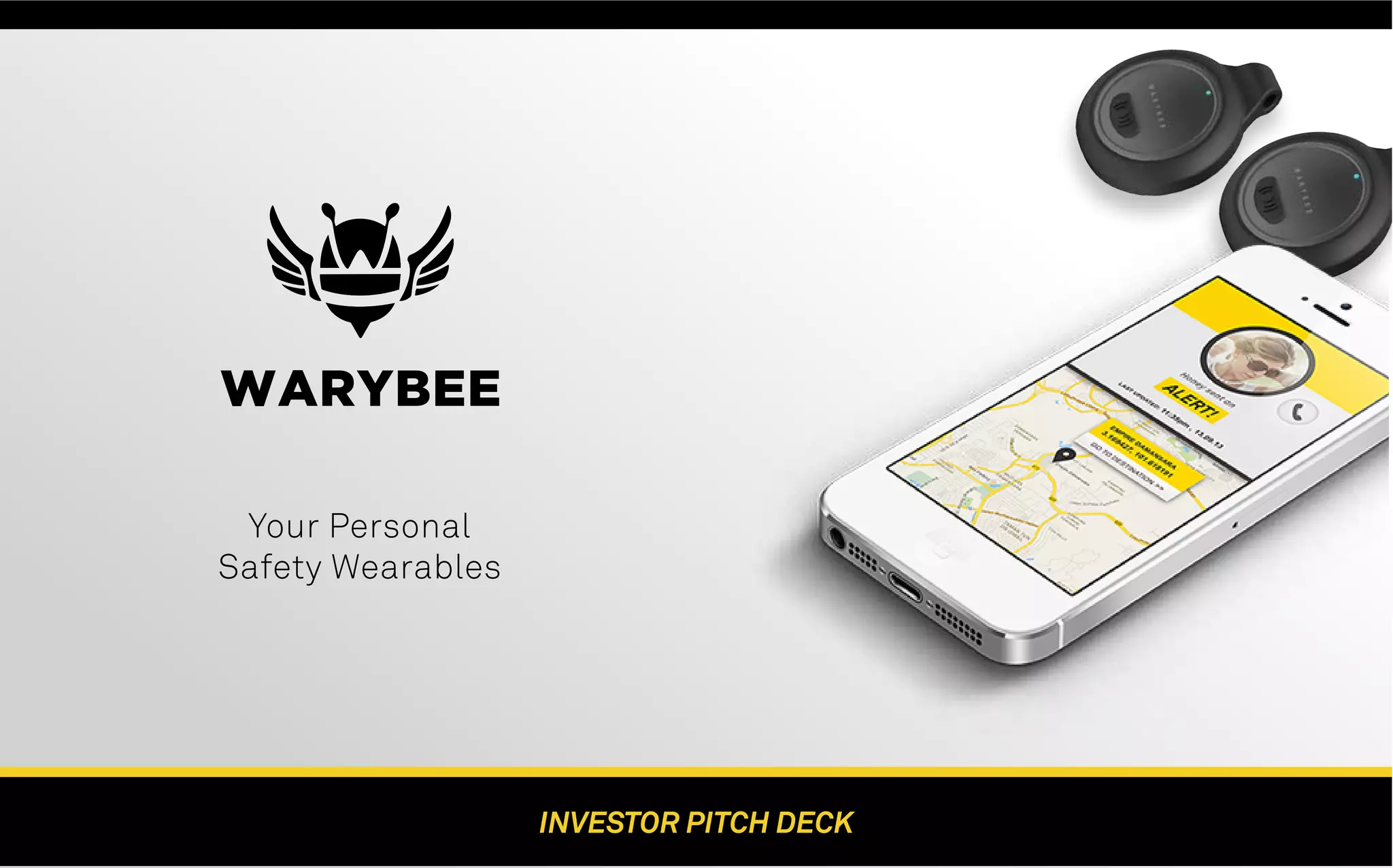
The title slide introduces the Warybee logo—a winged insect motif—and the tagline 'Your Personal Safety Wearables.' It features a high-quality product render of the device alongside a smartphone displaying a map and an 'ALERT!' notification. The visual establishes the product as a hardware-software hybrid immediately.
Slide 2: Core Problems
Warybee identifies four distinct user personas. For women, the problem is feeling 'threatened and unsafe' during commutes. For the elderly, existing solutions are 'bulky and too obvious.' For children, the issue is parental supervision gaps. Finally, it notes that shopping mall parking bays are 'prime locations for petty crime.' This slide effectively broadens the TAM (Total Addressable Market) by showing the device's versatility across different demographics.
Slide 3: What is Warybee?
This slide defines the technical nature of the product. It is an 'intelligent wearable device' using Bluetooth Low Energy (BLE) to connect to a smartphone. The core value proposition is the ability to 'trigger an immediate distress call.' It specifies that the alert conveys three data points to security contacts: current location, contact number, and a profile photo.
Slide 4: Main Function
The deck breaks down the features into six categories: Panic Button, Community Alert, Private Location Sharing, LED Notification, Long Battery Life, and SMS Mode. The 'Community Alert' is a notable differentiator, claiming to notify other Warybee users nearby. The 'SMS Mode' ensures functionality even when data connections are weak. The slide also mentions that batteries only need replacement 'once every few months,' which is a critical detail for wearable maintenance.
Slide 5: Core Feature - The Perfect Disguise
This slide focuses on concealment. It argues that an assailant will not be able to identify the device because it is 'cleverly concealed.' The imagery shows the device integrated into necklaces and bracelets, suggesting a lifestyle/fashion angle rather than a purely utilitarian medical-alert look.
Slide 6: Product Design and Development
This slide provides an exploded view of the hardware components, showing the casing, internal circuitry, and sealing rings. Below the technical diagram are various form factors, including a clip-on version and colorful wristbands. This demonstrates that the hardware design is mature enough for multiple aesthetic variations.
Slide 7: Other Players and Solution
The competitive landscape is well-organized. It categorizes rivals into 'Software' (Life360, Bsafe), 'Traditional Hardware' (Philips Lifeline, ADT), and 'New Players' (Cuff, Zazzi, Silent Beacon). By placing themselves against both legacy giants and modern startups, Warybee acknowledges the crowded nature of the safety market.
Slide 8: Potential Exit
The deck outlines two exit strategies. The first is 'Smart Accessories,' targeting partnerships with jewelry conglomerates like Tiffany & Co., Pandora, and Chow Tai Fook. The second is 'Home Security Ecosystem Integration,' listing giants like ADT, G4S, and Securitas. This slide is intended to show investors that there is a clear path to liquidity through acquisition by established players in adjacent industries.
Slide 9: Core Team Members
The team slide presents six members with strong technical credentials. Ray and Bernie bring 10 years of IT and software experience each. Yap Wen Juin adds robotics expertise, while Sharma handles firmware. Kelvin (Industrial Design) and Taylor (UX Design) round out the product development side. The team appears highly capable of building the product, though the slide lacks information on their business or sales leadership.
Slide 10: Contact Slide
The final slide repeats the branding and provides a direct email and phone number for Ray Teng. It serves as a standard call to action for interested investors.
What Warybee Does Well
Clear Problem Identification: The deck does an excellent job of segmenting the market. By identifying specific pain points for the elderly (discretion) and women (commuter safety), they move beyond a generic 'safety' pitch into specific use cases. Hardware Maturity: The inclusion of an exploded view of the device and multiple form factors (Slide 6) suggests that the team has moved past the conceptual stage and has a functional prototype or DFM (Design for Manufacturing) plan. Competitive Awareness: Slide 7 shows a sophisticated understanding of the market. They aren't just competing with other buttons; they are competing with apps and legacy home security firms. This helps investors understand where Warybee fits in the broader safety ecosystem.
What is Missing from the Warybee Deck
Business Model and Pricing: There is no mention of how Warybee makes money. Is it a one-time hardware sale? Is there a monthly subscription for the monitoring service or the community alert feature? Without this, the 'Investor Pitch' is incomplete. Traction and Validation: The deck contains zero metrics regarding user testing, pre-orders, or pilot programs. Investors need to see that people actually want to wear this device. Unit Economics: For a hardware startup, the cost to build (COGS) versus the retail price is vital. The deck omits these figures entirely. The Ask: The most glaring omission is the lack of a funding slide. There is no mention of how much money is being raised, what the valuation is, or how the funds will be allocated (e.g., manufacturing, marketing, or R&D).
What You Should Copy from This Deck
The 'Potential Exit' Strategy: Many founders forget to show investors how they will get their money back. Slide 8 is a great example of how to map out potential acquirers across different industries (Fashion vs. Security). Visualizing the 'Disguise': If your product relies on being discreet, don't just say it—show it. Slide 5 effectively uses lifestyle photography to demonstrate how the technology blends into everyday life. Functional Breakdown: Slide 4 uses a clean grid to explain six complex features without overwhelming the reader with text. This is a highly readable way to present a product's 'Main Functions.'
Final Thoughts
Warybee has a compelling product vision and a team that looks capable of executing the technical requirements of a wearable device. However, as an 'Investor Pitch Deck,' it falls short on the business side. It reads more like a product brochure than a financial proposal. To successfully raise capital, the founders would need to supplement these slides with a rigorous breakdown of their go-to-market strategy, manufacturing costs, and a clear explanation of their revenue model.
Frequently asked questions
- What is the primary function of the Warybee device?
- The primary function is a 'Panic Button' that sends an SOS signal and location details to a pre-established list of security contacts. It connects to a smartphone via Bluetooth Low Energy and can also trigger a 'Community Alert' to notify other Warybee users in the immediate vicinity, as detailed on slide 4.
- Who are the target customers for this wearable?
- Slide 2 identifies four core groups: women who feel unsafe commuting, elderly individuals who find current solutions too bulky, parents who cannot watch children at all times, and shoppers concerned about petty crime in retail mall parking bays.
- How does Warybee differentiate itself from other safety apps?
- Unlike software-only solutions like Life360 or Circle of 6, Warybee provides a physical trigger that is 'cleverly concealed' as jewelry or accessories. Slide 5 emphasizes that an assailant will not be able to identify the device, allowing the user to trigger an alert discreetly without reaching for a phone.
- What technical expertise does the founding team possess?
- The team is engineering-heavy. According to slide 9, it includes Ray (10 years in IT at IBM/Ericsson), Yap Wen Juin (University lecturer in Robotics), Sharma (electronic design and firmware), and Kelvin (industrial designer with 9+ years experience). This suggests strong internal capabilities for hardware prototyping and manufacturing.
- What information is missing from the Warybee pitch deck?
- The deck is missing all financial and operational metrics. There is no slide covering the business model (pricing), unit economics (COGS), current traction (pre-orders or users), or the specific amount of capital being raised. It functions more as a product and vision deck than a complete investment proposal.