WaitForSales is an early-stage concept designed to bridge the gap between price-sensitive consumers and e-commerce retailers. The deck outlines a B2B2C model where online stores integrate a 'WaitForSales' button on product pages, allowing users to receive push notifications on mobile and smartwatches when specific items drop in price. While the deck provides a clear walkthrough of the user experience—from button click to mobile app notification—it is heavily reliant on hypothetical funnel metrics and lacks a concrete business model or team slide. The presentation positions the company in the…
Key takeaways
- The product relies on a native button integration on third-party e-commerce websites to capture user intent (Slide 4).
- The user journey requires a multi-step conversion process including Facebook login and a mobile app download to receive notifications (Slides 5 and 6).
- Notifications are designed for cross-device delivery, specifically targeting smartphones and smartwatches (Slide 8).
- Market size is based on 2015 projections, estimating global e-commerce sales at $1.7 trillion (Slide 10).
- The company claims to support all e-commerce engines with customized solutions for retailers (Slide 11).
- Current progress is limited to market research, a financial plan, and a prototype of the web and mobile applications (Slide 12).
- The success of the model depends on aggressive funnel assumptions, including a 50% click rate on the 'WaitForSales' button (Slide 13).
- The deck lacks a dedicated team slide, revenue model, or specific funding ask in the provided 13 slides.
Introduction and Problem Statement
Slide 1: Title Slide
The deck opens with a simple title slide featuring the company name, WaitForSales , in a stylized red script. The background uses a light beige gradient with icons representing currency, discount tags, and shopping carts. A 'Keep Calm and Do More Sales' graphic is positioned in the top right corner, setting a retail-centric tone for the presentation.
Slide 2: The Problem
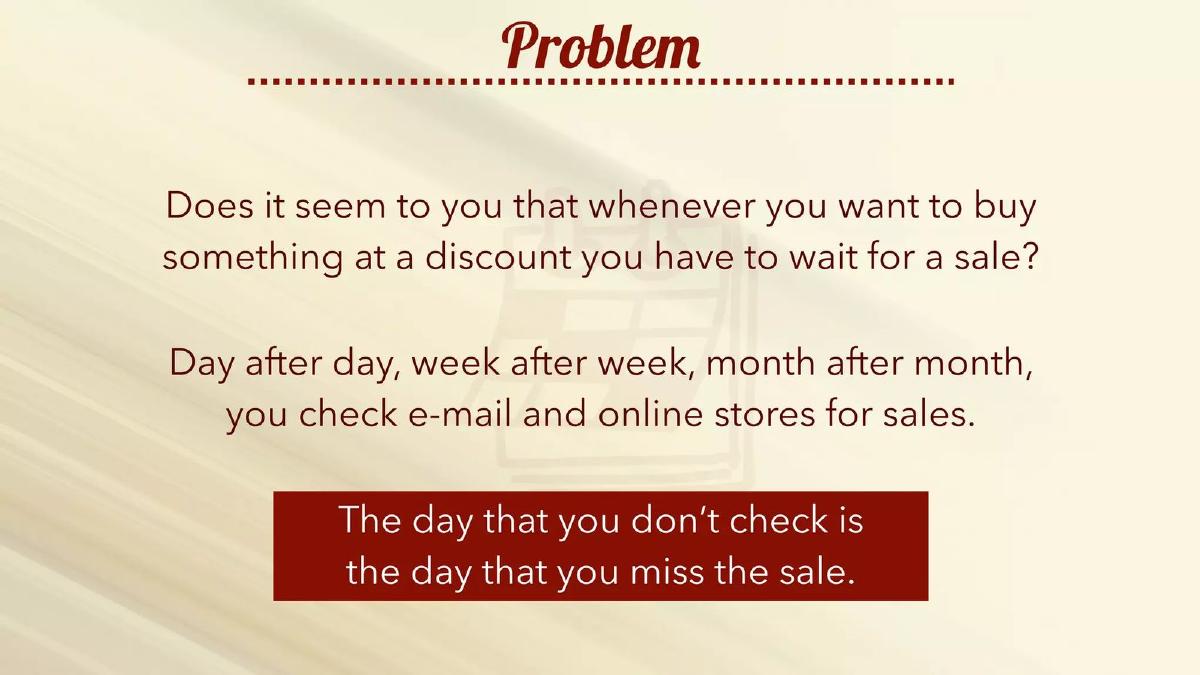
The problem slide addresses the consumer pain point of missing discounts. It asks, 'Does it seem to you that whenever you want to buy something at a discount you have to wait for a sale?' The slide highlights the inefficiency of manual checking, stating that users check emails and stores 'day after day' and 'week after week.' The core tension is summarized in the red box: 'The day that you don't check is the day that you miss the sale.'
Value Proposition and Integration
Slide 3: Benefits For All
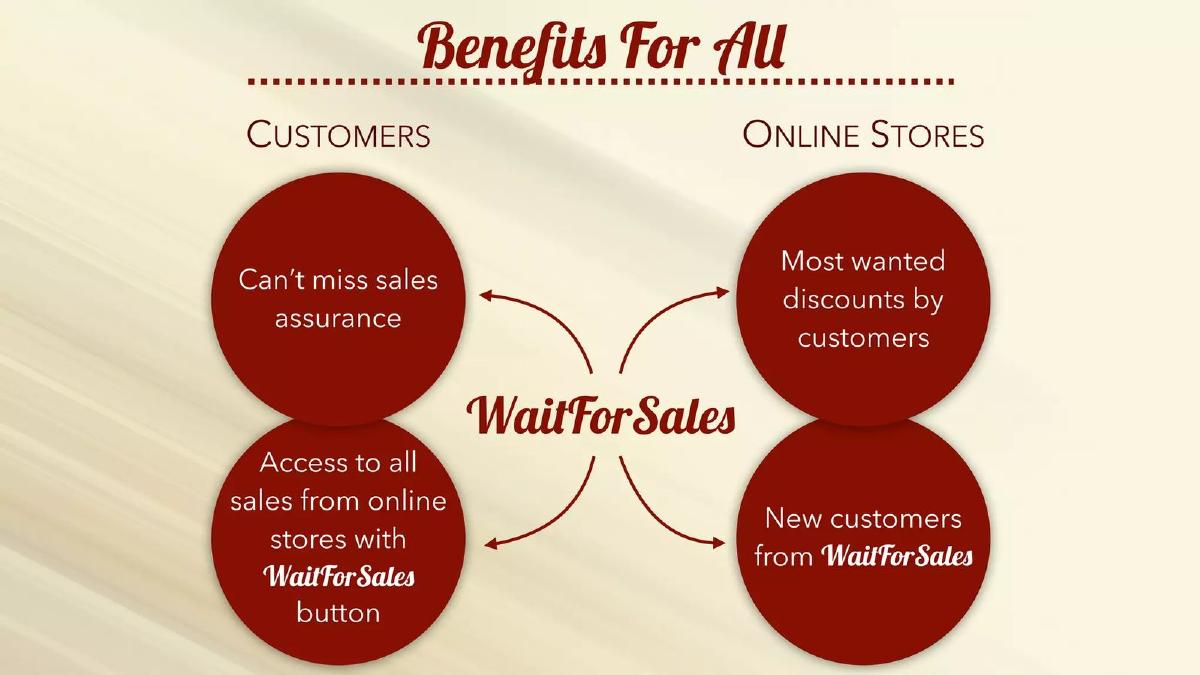
This slide attempts to show a two-sided marketplace benefit. For Customers , the benefits are 'Can't miss sales assurance' and 'Access to all sales from online stores with WaitForSales button.' For Online Stores , the value lies in identifying 'Most wanted discounts by customers' and acquiring 'New customers from WaitForSales.' This suggests a data-play where stores can see which specific items users are waiting to buy.
Slide 4: Easy For Online Stores
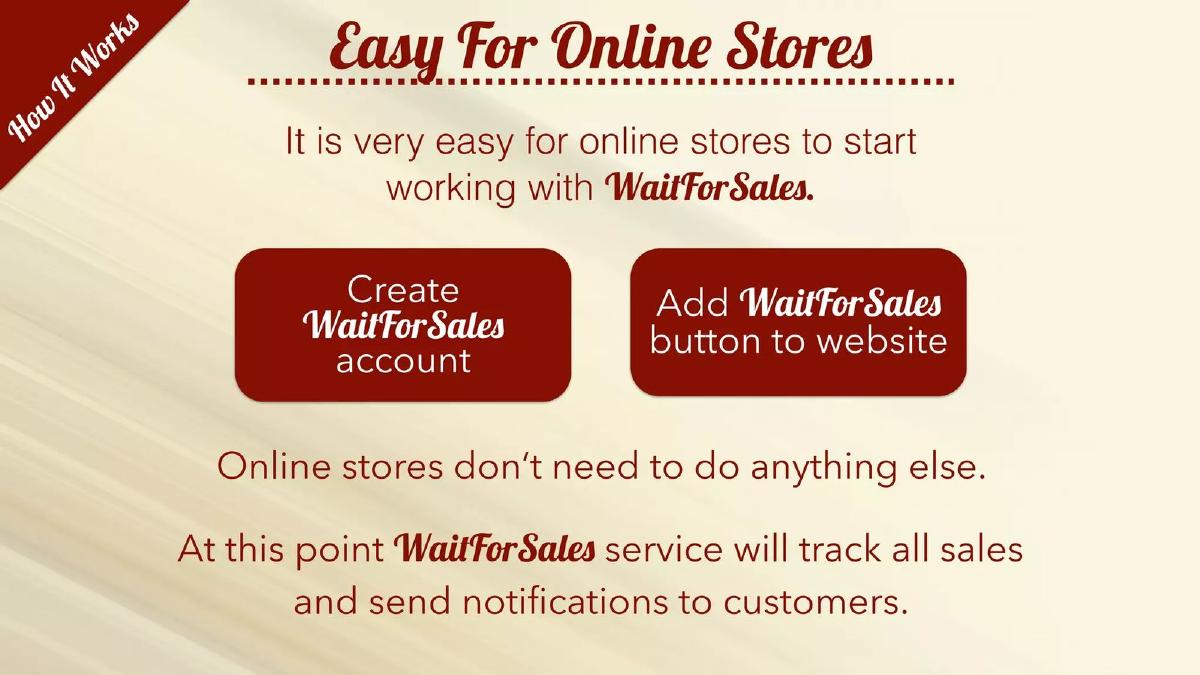
The deck emphasizes low friction for retailers. It claims stores only need to 'Create WaitForSales account' and 'Add WaitForSales button to website.' The slide asserts that 'Online stores don't need to do anything else,' as the service will automatically track sales and notify customers once the button is live.
User Experience and Product Walkthrough
Slide 5: Login For The First Time
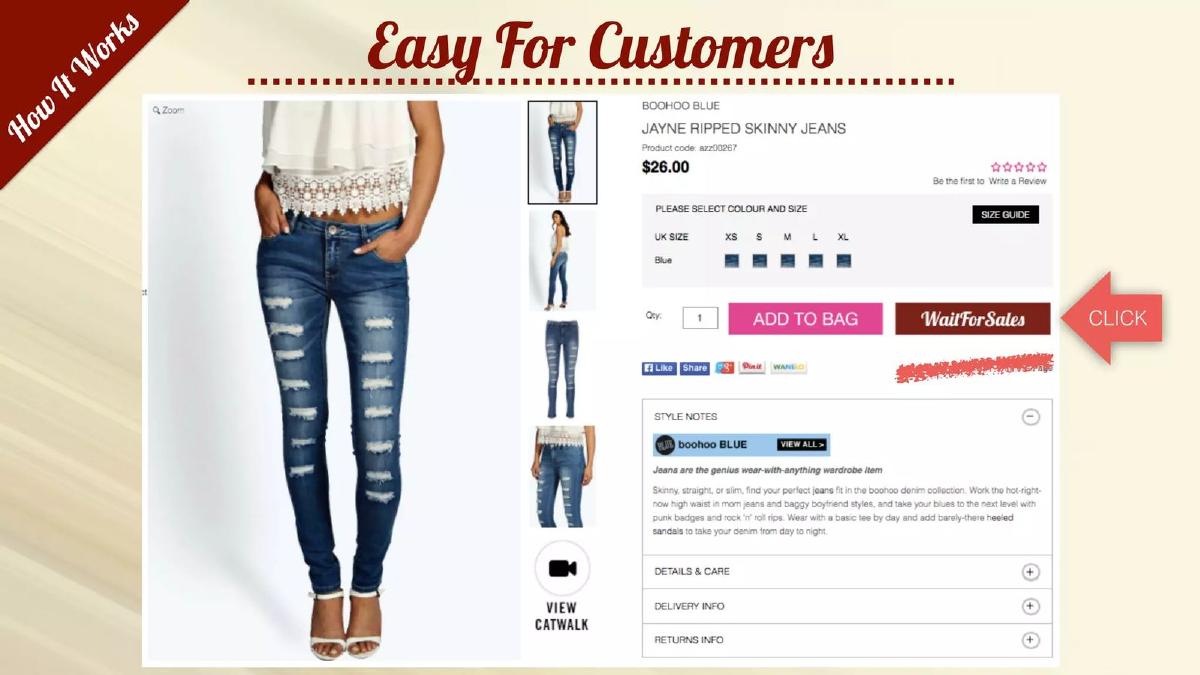
This slide provides a mockup of the user interface. When a user clicks the button on a product page (in this case, for 'Jayne Ripped Skinny Jeans' priced at $26.00), a pop-up appears. The user is prompted to 'Log in with Facebook' or use a WaitForSales account to receive the notification.
Slide 6: Download Mobile App For The First Time
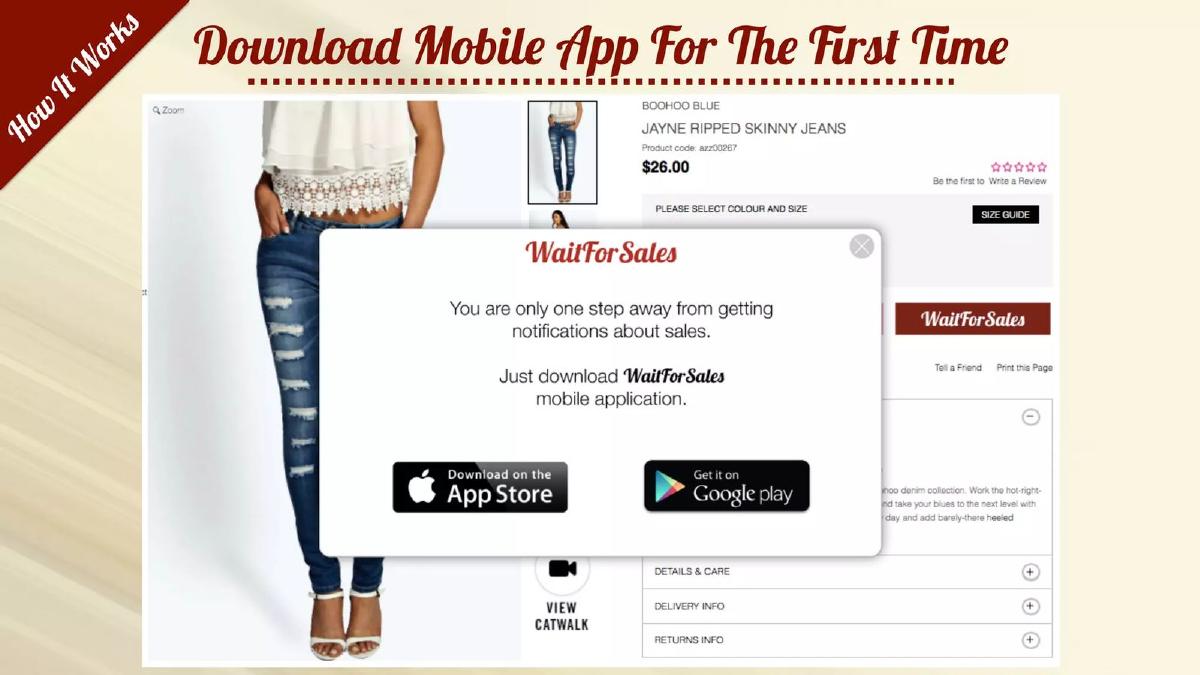
Following the login, the user is directed to download the mobile application. The slide shows a call to action with 'Download on the App Store' and 'Get it on Google Play' buttons. This indicates that the service is not web-based for notifications but requires a native app installation to function.
Slide 7: Voila! Waiting For Sales
This slide shows the 'after' state of the product page. The original 'WaitForSales' button has changed to a green 'WaitingForSales' status button, confirming to the user that the item is now being tracked.
Slide 8: Receive a Notification
The product's delivery mechanism is shown here. It features mockups of an iPhone lock screen, an Apple Watch, and an iPhone home screen. The notification reads: 'Hi Jessica, JAYNE RIPPED SKINNY JEANS is now on sale with 20% discount at price $20.' This confirms the cross-device nature of the alerts.
Slide 9: Use Mobile Application
The mobile app interface is displayed, showing two primary functions: 'Watch for sales you are interested in' (a list of tracked items) and 'Hunt for hot sales' (a grid of general discounts). The mockups show items from retailers like Boohoo, Fab, and Gap, though it is not stated if these are active partners or just placeholders.
Market and Traction
Slide 10: Market Size
The deck uses 2015-era data to justify the opportunity. It quotes a Statista report stating global e-commerce sales will reach 1.7 trillion US dollars in 2015 . A bar chart projects growth up to $2.356 trillion by 2018. Additionally, it notes that Alexa has detected 66,834 e-commerce websites, defining the total addressable market of potential integrations.
Slide 11: Why WaitForSales?
This slide attempts to differentiate the company by stating it 'focuses on sales and discounts only' and 'supports all e-commerce engines.' It claims to have 'customized solutions,' suggesting the integration is flexible enough for various tech stacks.
Slide 12: Current Status
E-commerce market research · Roadmap and financial plan for the next year · Initial negotiations with online stores · API for web and mobile applications · Prototype of web and mobile applications · Design of buttons, web and mobile applications
This list confirms the company is in the pre-revenue, pre-launch phase.
Slide 13: Terms of Success
The final slide in the set is a funnel projection. It acknowledges that they 'need to make sure that our assumptions regarding the funnel are valid.' The projected funnel is:
Online store page visits: 100% · WFS button clicks: 50% · Authorization: 40% · Mobile application installation: 20%
These are highly optimistic figures, as a 50% click-through rate on a secondary page element is rarely achieved in standard e-commerce environments.
What Works / What is Missing
What Works
The deck is very effective at explaining the user journey . By using a specific product (the jeans) and walking through every screen from the store page to the Apple Watch notification, the founders leave no ambiguity about how the product functions. The visual layout is consistent, and the 'Benefits For All' slide clearly articulates the value proposition for both sides of the market.
What is Missing
The most glaring omission is the Team Slide . There is no information regarding who is building this or why they have the technical or retail expertise to succeed. Furthermore, the Business Model is not explained; it is unclear if the company plans to charge stores a subscription fee, take a commission on sales (affiliate model), or sell the consumer intent data. Finally, the Ask is missing—investors do not know how much money is being raised or what the specific milestones for that capital would be.
Founder Takeaways
Validate your funnel with real data: The assumptions on Slide 13 are the weakest point of the deck. Claiming a 50% CTR on a button is a 'red flag' for experienced investors. Founders should use early beta data or industry benchmarks to ground these numbers in reality. Focus on the integration hurdle: Convincing 66,000 stores to add a custom button is a massive sales challenge. The deck mentions 'initial negotiations' but lacks a 'Go-to-Market' strategy that explains how they will achieve scale without a massive sales force. Update your market data: Using 2015 projections in a pitch suggests the deck is dated. Founders must ensure their market size figures are current to demonstrate they are active in the present market landscape.
Frequently asked questions
- What is the core product of WaitForSales?
- The core product is a notification service triggered by a button integrated into online store product pages. When a user clicks the button, they are prompted to log in and download a mobile app. The service then tracks the price of that specific item and sends a push notification to the user's phone or smartwatch once a discount is applied.
- How does the company plan to acquire users?
- The acquisition strategy is B2B2C. By convincing online stores to add the 'WaitForSales' button to their websites, the company gains access to the store's existing traffic. According to Slide 13, they assume 50% of page visitors will click the button, leading to a 20% total conversion rate for mobile app installations.
- What stage of development is WaitForSales in?
- Based on Slide 12, the company is in the pre-seed or prototype stage. They have completed market research, designed the API, and built a prototype. However, they are still in 'initial negotiations' with online stores and have not yet launched a live integration or proven their funnel assumptions.
- What are the primary risks identified in the deck?
- The primary risk is the validity of their conversion funnel. Slide 13 explicitly states they 'need to make sure that our assumptions regarding the funnel are valid.' Their projected 50% click-through rate and 40% authorization rate are exceptionally high for third-party web elements, representing a significant execution risk.
- What information is missing from the pitch deck?
- The provided slides omit several critical fundraising components: a team slide (founders' backgrounds), a clear revenue model (how they make money from the stores or users), a competitive analysis, and a specific financial 'ask' detailing how much capital they are seeking and how it will be spent.