Wagestream’s 12-slide Series C deck is a masterclass in narrative-driven fundraising, positioning the company as a social impact leader in the Earned Wage Access (EWA) space. By framing the problem as a £5.6 billion 'poverty premium' paid by frontline workers, the deck shifts the conversation from simple payroll tech to a moral and economic necessity. The deck relies heavily on high-level vision and engagement metrics, such as a 60% employee adoption rate, to justify its expansion into a 'super-app' covering assets, payments, deposits, credit, and insurance. While it lacks granular financial…
Key takeaways
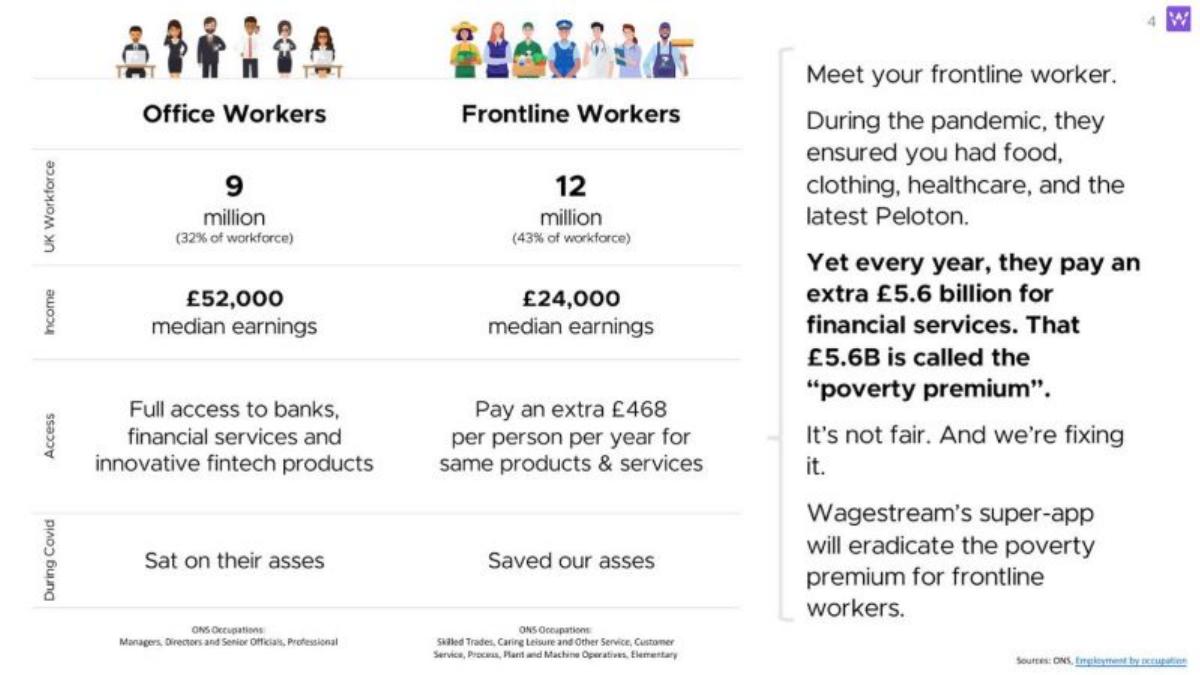
- Wagestream identifies a £5.6 billion 'poverty premium' where frontline workers pay an extra £468 per year for the same financial services as office workers (Slide 4).
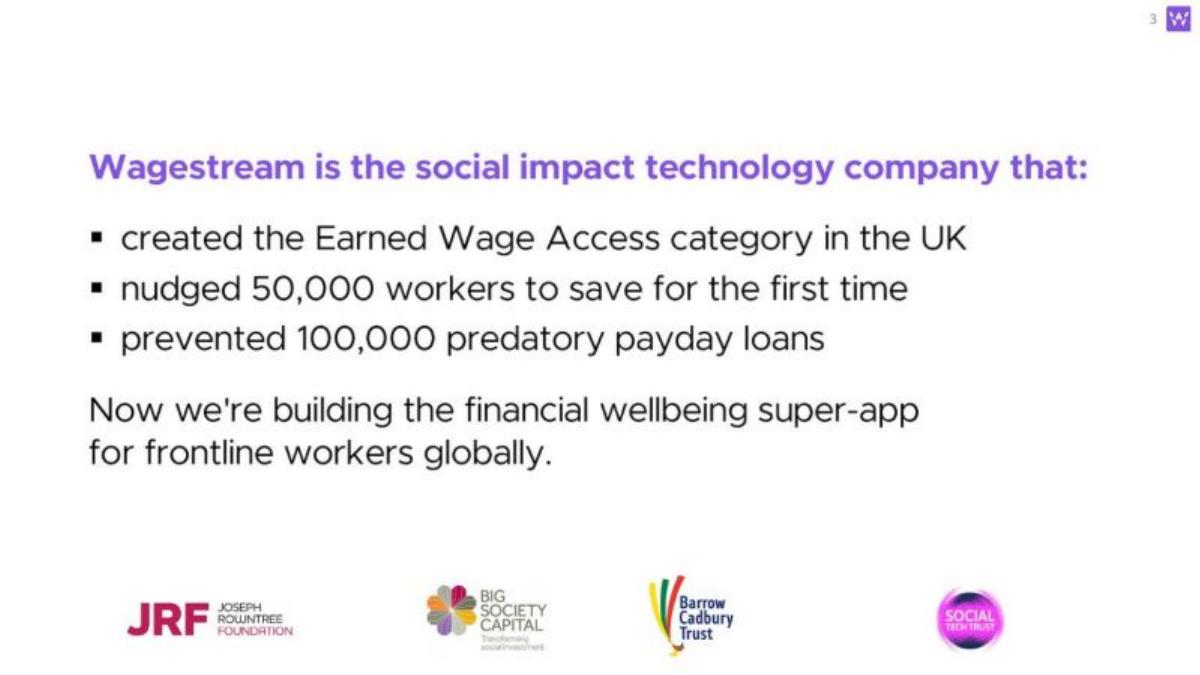
- The company claims to have prevented 100,000 predatory payday loans and nudged 50,000 workers to save for the first time (Slide 3).
- The business model relies on a dual revenue stream: a £1.75 transaction fee for employees and a monthly SaaS fee for employers (Slide 7).
- Wagestream reports a 60% employee adoption rate, significantly higher than the 33% of its nearest unnamed competitor (Slide 9).
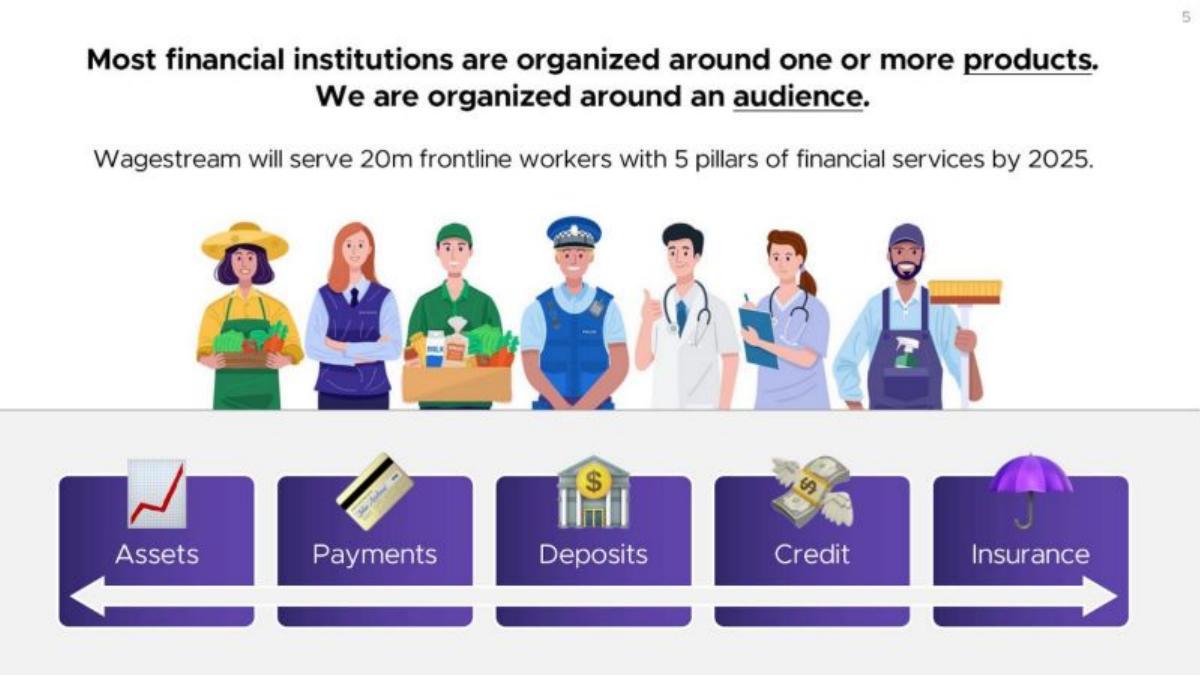
- The product roadmap aims to serve 20 million frontline workers across five pillars: Assets, Payments, Deposits, Credit, and Insurance by 2025 (Slide 5).
- The deck highlights a 'MAU:download ratio' of 54%, suggesting high retention and utility compared to other fintech apps (Slide 9).
- Social proof is established through testimonials from major UK employers including Toolstation, Bupa, and the NHS (Slide 10).
- The fundraising history shows a progression from a £1.5M Seed in 2018 to a £20M Series B in 2020, totaling £40M in equity before this round (Slide 11).
Wagestream Series C Teardown: The Social Impact Narrative
Wagestream’s Series C deck, dated December 2021, is a concise 12-slide presentation that prioritizes mission and high-level engagement over granular financial data. At this stage, the company had already raised £40M in equity and was positioning itself to move beyond Earned Wage Access (EWA) into a comprehensive financial 'super-app' for frontline workers. The deck is notable for its aggressive social impact framing, contrasting the 'poverty premium' of the working class against the financial ease of the 'office worker' class.
Slides 1-3: The Mission and Impact
Slide 1 serves as a standard title page, identifying the company as 'The financial wellbeing app for frontline workers.' Slide 2 is a simple transition slide for 'Vision & Mission.' The narrative begins in earnest on Slide 3, which defines Wagestream as a 'social impact technology company.' This slide lists three major achievements: creating the EWA category in the UK, nudging 50,000 workers to save, and preventing 100,000 predatory payday loans. By leading with these figures, Wagestream establishes its 'Social Tech' credentials, supported by logos from the Joseph Rowntree Foundation and Big Society Capital at the bottom of the slide.
Slide 4: Defining the Poverty Premium
Slide 4 is the emotional and logical core of the deck. It uses a side-by-side comparison of 'Office Workers' and 'Frontline Workers.' It notes that while office workers (9 million people) have a median income of £52,000 and full access to banks, frontline workers (12 million people) earn a median of £24,000 and pay an extra £468 per year for the same services. The slide uses provocative language, stating that while office workers 'Sat on their asses' during Covid, frontline workers 'Saved our asses.' This framing justifies the existence of the product as a matter of fairness, not just convenience.
Slide 5: The Super-App Vision
Slide 5 transitions from the problem to the long-term solution. Wagestream argues that most financial institutions are organized around products, whereas they are organized around an 'audience.' The slide introduces the '5 pillars of financial services' they intend to offer by 2025: Assets, Payments, Deposits, Credit, and Insurance. This is a classic Series C move: showing how a successful niche product (EWA) can expand into a massive, multi-vertical platform to justify a higher valuation.
Slides 6-8: Product and Business Model
Slide 6 is a transition, and Slide 7 explains the mechanics of the platform. Wagestream connects to enterprise ERP, WFM, Payroll, and HRIS data to make real-time pay data available to users. The business model is clearly stated: a £1.75 transaction fee for employees and a monthly SaaS fee for employers. Slide 8 provides a 'before and after' look at the product features. It contrasts the 'Assets' of an office worker (stock apps) with a frontline worker's assets (worked-but-not-yet-paid shifts). It also highlights the 'Human Coach' feature launched in 2021, emphasizing that their solution includes a human element to financial health.
Slide 9: Engagement Metrics
Slide 9 uses data to prove product-market fit. It presents three charts comparing Wagestream to unnamed competitors. The 'Employee Adoption' chart shows Wagestream at 60%, nearly double the 33% of the next competitor. The 'MAU:download ratio' is 54%, and the 'DAU:MAU ratio' is 38%. These metrics are intended to show that once the app is deployed within an enterprise, employees use it frequently and consistently, which is a key indicator of long-term value in the fintech space.
Slide 10: Social Proof and B2B Value
Slide 10 addresses the 'Why now?' and 'Why for employers?' questions. It features six testimonials from HR and Payroll directors at major organizations like Toolstation, Bupa, and the NHS. The quotes highlight benefits such as increased overtime, better shift fill rates, and improved talent retention. This slide proves that Wagestream isn't just a benefit for the employee; it solves critical operational problems for the employer, such as reducing 'agency spend' (temporary staff costs).
Slide 11: Fundraising History
Slide 11 provides a timeline of the company’s growth. It shows a steady cadence of funding: a £1.5M Seed in April 2018, a £15M Series A in May 2019, and a £20M Series B in June 2020. The inclusion of the £25M 'Debt Warehouse' from Shawbrook Bank is crucial, as it demonstrates the company's ability to secure the capital necessary to fund the actual wage advances without diluting equity excessively. The slide lists heavy-hitting investors like Northzone, Balderton, and QED, signaling to Series C investors that the company has already passed rigorous institutional due diligence.
What Wagestream Does Well
Class-Leading Narrative: The deck does an exceptional job of framing a fintech product as a social crusade. By using the term 'poverty premium' and contrasting the Covid-era experiences of different worker classes, they create a sense of urgency and moral clarity that is often missing from B2B SaaS decks.
Clear Monetization: Many 'social impact' companies struggle to explain how they make money without exploiting their users. Wagestream’s Slide 7 is refreshingly transparent about the £1.75 transaction fee and the employer SaaS fee, showing a balanced revenue model.
Enterprise Validation: Including the NHS and Bupa as clients (Slide 10) is a massive signal of reliability. These are highly regulated, complex organizations; if Wagestream can integrate with their payroll systems, they can integrate anywhere.
What is Missing from the Wagestream Deck
The Management Team: There is no team slide. In a Series C deck, investors expect to see the 'bench strength'—not just the founders, but the experienced VPs of Engineering, Sales, and Finance who will scale the company to the next level.
Financial Granularity: While the deck shows engagement ratios, it omits absolute numbers for Revenue (ARR), Gross Margins, and Customer Acquisition Cost (CAC). For a Series C round, these are typically non-negotiable requirements.
The 'Ask': The deck ends abruptly after the fundraising history. There is no slide detailing how much capital is being sought for the Series C, nor is there a breakdown of how that capital will be allocated (e.g., geographic expansion, R&D for the new 'pillars,' or marketing).
Competitive Landscape: Slide 9 compares Wagestream to others, but the competitors are anonymized. A more detailed competitive matrix would help investors understand how Wagestream defends its 60% adoption rate against emerging EWA rivals.
Founder Takeaways: What to Copy
Use 'Audience' as a Moat: Founders should copy Slide 5’s approach to positioning. Instead of saying 'we are a payroll tool,' Wagestream says 'we are the only ones serving this specific audience.' This allows them to claim future territory in insurance and credit that a simple payroll tool couldn't touch.
Quantify the 'Unfairness': If your startup addresses an inequality, quantify it exactly like Slide 4. The '£468 per person per year' figure is a 'sticky' metric that an investor can easily remember and repeat to their investment committee.
Dual-Sided Social Proof: Don't just show that users like the product; show that the people paying for it (the employers) see a bottom-line benefit. Slide 10’s focus on 'shift fill rates' and 'agency spend' proves that Wagestream is a 'must-have' operational tool, not just a 'nice-to-have' employee perk.
Frequently asked questions
- What is the 'poverty premium' mentioned in the deck?
- According to Slide 4, the poverty premium refers to the extra £5.6 billion frontline workers pay annually for financial services. Wagestream calculates this as an additional £468 per person per year compared to office workers, who have better access to innovative fintech and traditional banking products. The deck positions Wagestream's 'super-app' as the tool to eradicate this premium.
- How does Wagestream generate revenue?
- Slide 7 outlines a B2B2C revenue model. The company charges employees a flat transaction fee of £1.75 for accessing their earned wages. Simultaneously, the employer pays a monthly SaaS fee to provide the service to their workforce. This model allows the company to monetize both the enterprise relationship and the individual user's utility.
- What are the key engagement metrics Wagestream uses to prove traction?
- On Slide 9, Wagestream focuses on three core ratios: Employee Adoption (60%), MAU to download ratio (54%), and DAU to MAU ratio (38%). By comparing these figures against a dozen unnamed competitors, Wagestream argues that its platform achieves higher engagement because it is built around 'financial wellbeing' rather than just a single financial product.
- Which investors have previously backed Wagestream?
- Slide 11 provides a fundraising timeline. Notable equity investors include Lead Edge Capital, QED Investors, Village Global, Northzone, Balderton Capital, and LocalGlobe. The company also secured a £25M debt warehouse from Shawbrook Bank in April 2019, indicating a need for significant capital to facilitate wage advances.
- What is missing from this Series C pitch deck?
- The deck is surprisingly light on traditional Series C requirements. It lacks a team slide, detailed financial statements (P&L, Burn, Runway), and a specific 'Ask' slide detailing how much they are raising and how it will be spent. It also omits a detailed competitive landscape, opting instead for anonymized bar charts to show relative performance.