Wadja presented a 15-slide deck in 2012 seeking $650,000 to scale a hybrid social discovery and messaging platform. The company aimed to solve the 'creepiness' of social discovery apps by focusing on verified mobile numbers and leveraging a global SMS network. At the time of the deck, they claimed 6 million registered users and 1,000 daily sign-ups. Their business model was heavily reliant on micro-revenues from SMS traffic—$0.05 per user message and $0.10 per brand message—projecting $50 million in revenue by Year 5. While the deck provides clear competitive positioning against giants like B…
Key takeaways
- The company sought a $650,000 investment in 2012 to expand its US sales team and Cyprus development office (Slide 14).
- Wadja claimed a significant existing user base of 6 million registered users with 1,000 new sign-ups daily (Slide 12).
- The business model targeted an ARPU of $1.68, driven by charging $0.05 per user SMS and $0.10 per brand SMS (Slide 11).
- Market validation relied on the projection of 8.7 trillion SMS messages being sent globally by 2015 (Slide 7).
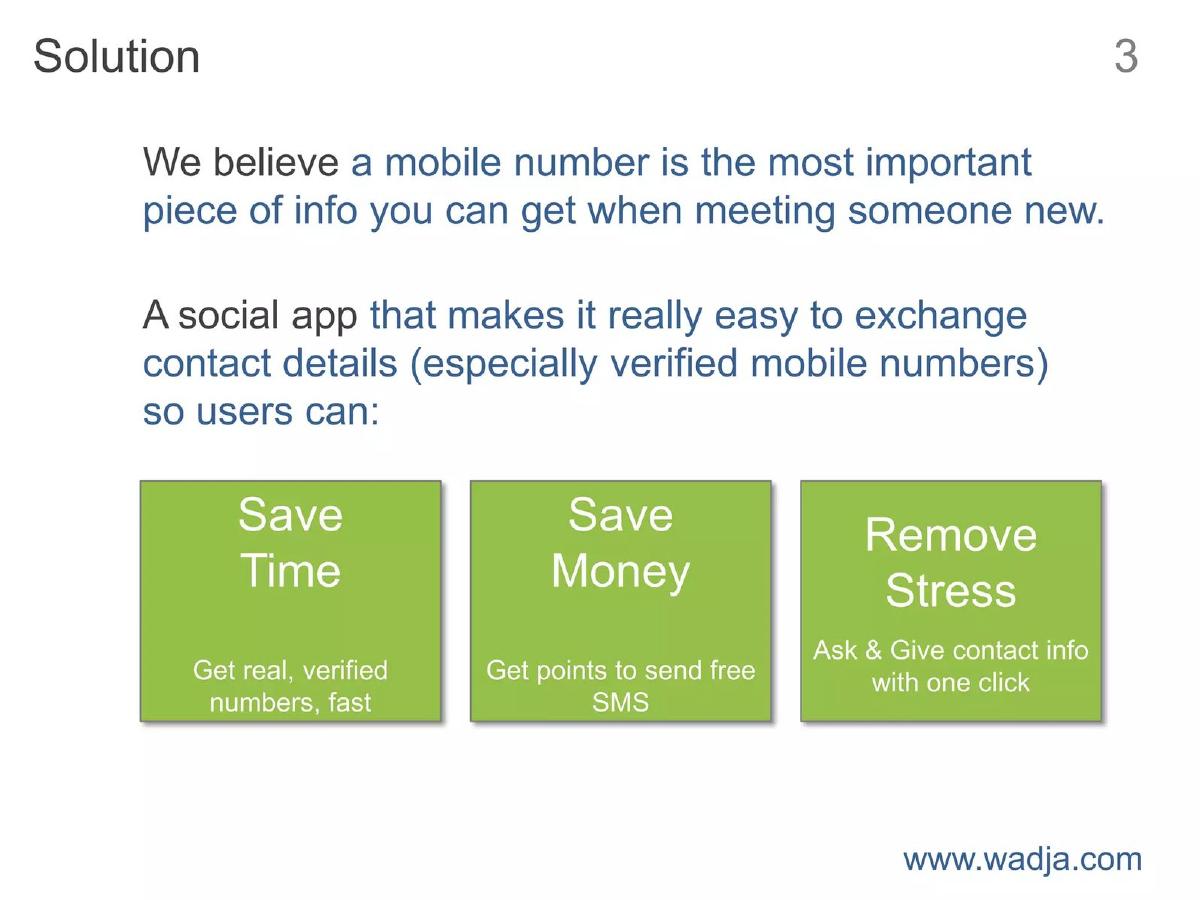
- The product featured an 'Ask & Give' mechanic for contact details, aiming to reduce the stress of meeting new people (Slide 3).
- Competitive positioning placed Wadja between casual relationships (Twitter/Badoo) and intimate ones (Match.com), focusing on 'People You Want to Know' (Slide 10).
- The team consisted of 5 people who had worked together for over 5 years, totaling 20+ years of web experience (Slide 6).
- Growth strategy relied on 'viral' SMS signatures (via www.wadja.com) and email notifications through SendGrid (Slide 12).
Wadja Pitch Deck Analysis
The Wadja pitch deck is a 15-slide document that serves as a time capsule for the mobile messaging industry circa 2012. It attempts to merge the high-growth world of social discovery with the established revenue streams of the global SMS market. At its core, Wadja was a platform for meeting new people and exchanging verified contact information, primarily mobile numbers.
Slide 1: Title Slide
The deck opens with a simple logo and the tagline: "The easy way to exchange contact details." It includes the company URL, which is a standard and professional way to start a presentation. The branding is clean, using a blue and white color palette that was common for social startups of that era.
Slide 2: The Problem
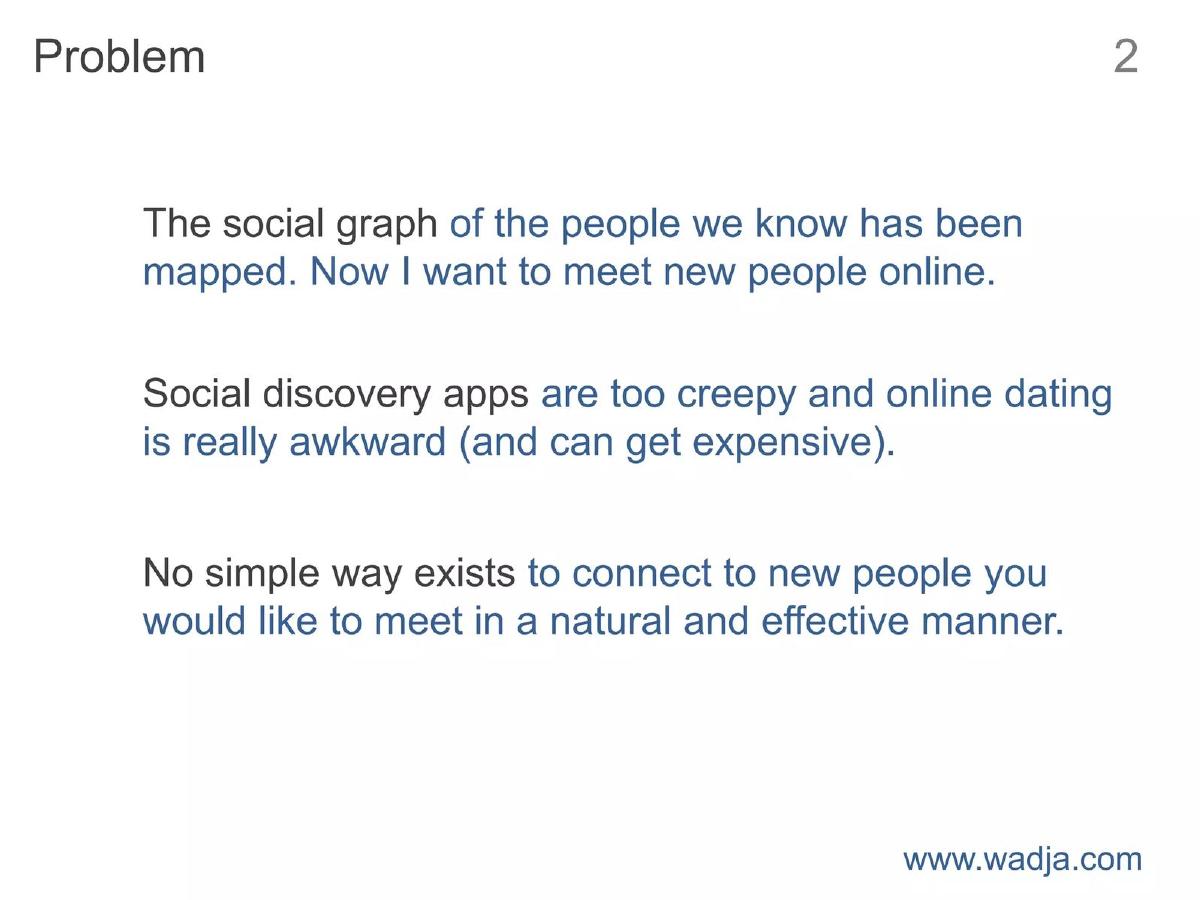
Wadja identifies three pain points: the social graph for existing friends is already mapped (Facebook), social discovery apps are "creepy," and online dating is "awkward" and "expensive." The slide argues that no simple way exists to connect with new people in a natural manner. This is a classic "gap in the market" argument, though it lacks specific data to back up the claim that users found other apps creepy.
Slide 3: The Solution
The solution is presented as a social app that makes exchanging verified mobile numbers easy. They list three value drivers: Save Time (verified numbers), Save Money (points for free SMS), and Remove Stress (one-click contact exchange). The mention of "points to send free SMS" suggests a gamified or loyalty-based approach to messaging costs.
Slide 4: About the Ecosystem
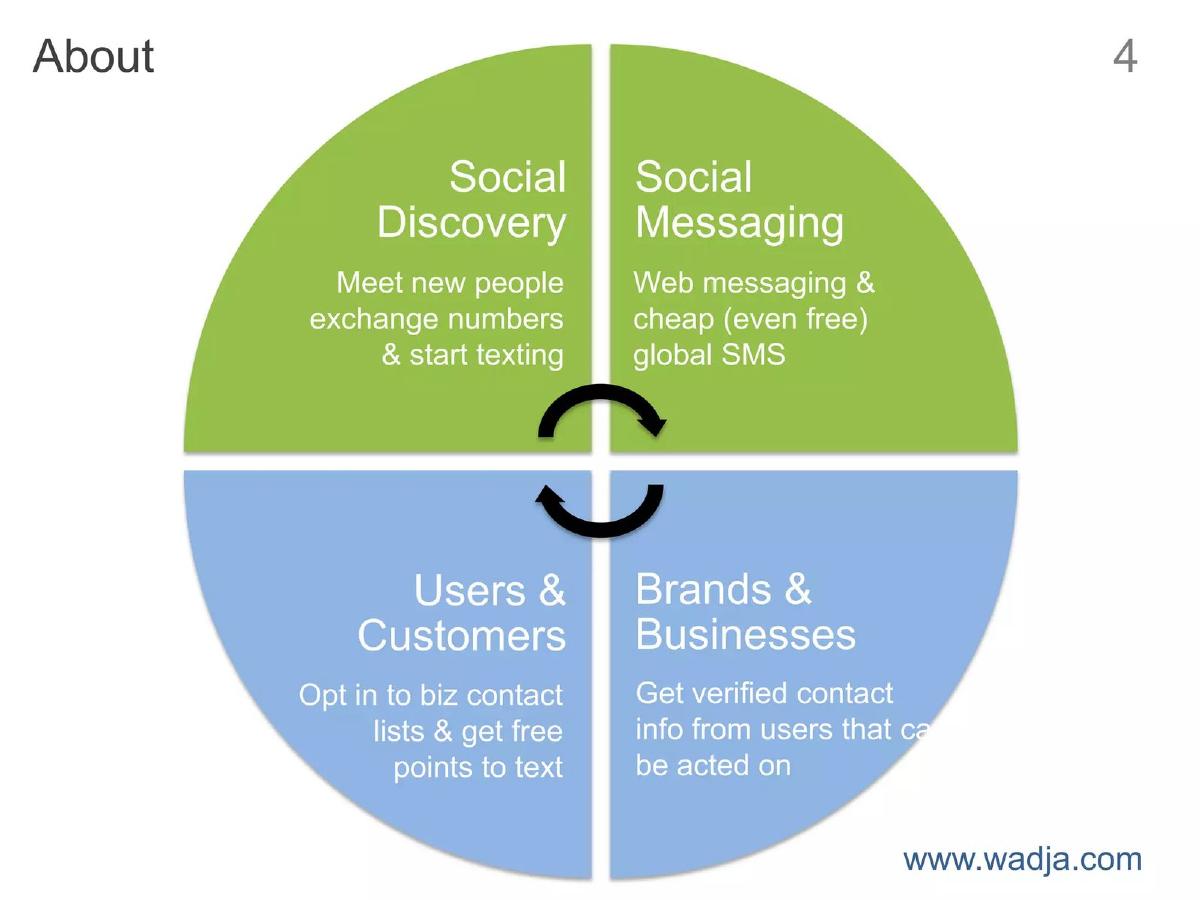
This slide uses a four-quadrant circle to explain the platform's dynamics. It connects Social Discovery (meeting people) and Social Messaging (global SMS) with two user groups: Users/Customers (who opt-in to lists for points) and Brands/Businesses (who get verified contact info). This indicates a B2B2C model where user data and messaging traffic are the primary assets.
Slide 5: Product Interface
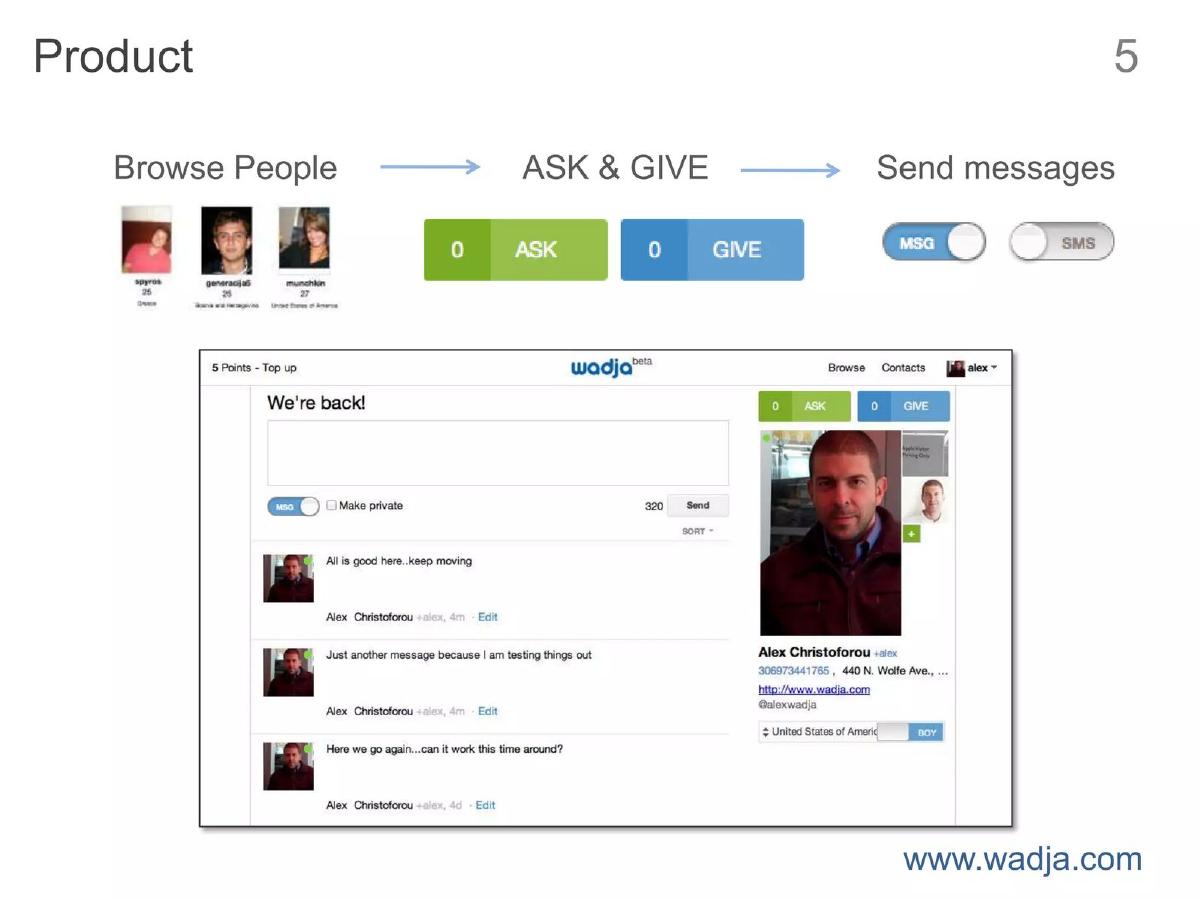
Slide 5 provides a screenshot of the "Wadja beta" interface. It shows a web-based dashboard where users can browse profiles, "Ask" for or "Give" contact info, and send messages. The UI appears dated by modern standards, resembling a forum or early social network feed, but it clearly demonstrates the core functionality of the "Ask & Give" mechanic.
Slide 6: The Team
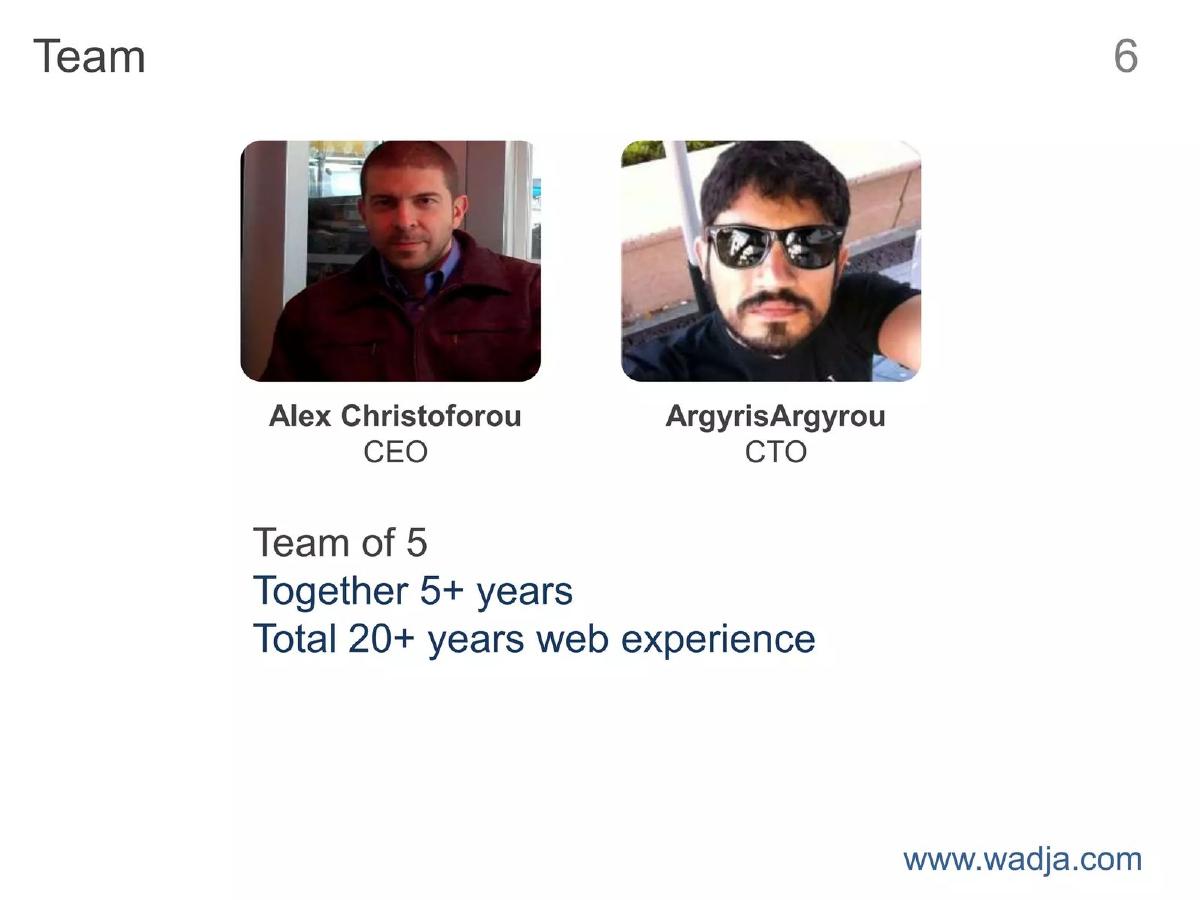
The team slide features CEO Alex Christoforou and CTO Argyris Argyrou. It notes a total team of five people who have worked together for over five years, boasting a combined 20+ years of web experience. While it lacks specific past company names or successful exits, the emphasis on longevity and technical experience is a positive signal for investors.
Slide 7: Market Validation
Wadja uses three large figures to validate the market: a $4 Billion online dating market, 8.7 Trillion SMS messages projected for 2015, and a 9% Decline in carrier SMS revenue due to IP messaging. This last point is ironic, as the rise of IP messaging (WhatsApp, iMessage) eventually destroyed the very SMS revenue model Wadja was trying to capitalize on.
Slide 8: Market Size
This slide uses circles to visualize the opportunity. They target a potential share of 30 million+ monthly visitors, derived from a market of 300 million+ online dating users and a $31 billion+ SMS revenue increase. The logic connecting these circles is somewhat loose, as monthly visitors do not directly correlate to SMS revenue increases.
Slide 9: Competition
A direct comparison table highlights Badoo, Tagged, and Zoosk. Wadja lists their registered users (ranging from 50M to 140M) and 2011 revenues ($50M to $100M+). This slide is effective because it shows that the "social discovery" space was already generating significant revenue through credits, gifts, and subscriptions.
Slide 10: Market Position
The positioning matrix places Wadja in the upper-left quadrant: "People You Want to Know" and "Casual Relationships." It differentiates itself from Facebook/LinkedIn (People You Know) and Match/eHarmony (Intimate Relationships). This is a strong slide that clearly defines Wadja's niche in the broader social landscape.
Slide 11: Business Model
This is the most critical slide for the financial ask. Wadja projects an ARPU of $1.68 . The revenue comes from $0.05 per user SMS and $0.10 per brand SMS . They project 1 billion messages leading to $50M in revenue by Year 5 . This model assumes that users will continue to pay for or generate revenue through SMS rather than switching to free data-based messaging.
Slide 12: Growth and Adoption
The company claims 6 million total registered users and 1,000 daily sign-ups. Their growth strategy involves "viral" SMS signatures (e.g., "via www.wadja.com") and using SendGrid for email notifications. This shows they had a functioning growth loop, even if it was dependent on legacy communication channels.
Slide 13: Competitive Advantages
Six boxes summarize their edge: Simplicity, Team, Position, Monetization, Distribution (SMS covers every phone), and Habit Design. The claim that "SMS covers every phone on the planet" was their strongest distribution argument in 2012, before smartphone and data plan penetration became near-universal.
Slide 14: Use of Capital
The ask is $650,000 . The funds are allocated to recruiting sales/biz dev staff in the US and growing the development team in Cyprus. This is a relatively modest seed-stage ask for a company claiming 6 million users, suggesting they were looking for a bridge to a larger Series A or were already somewhat capital efficient.
Slide 15: Thank You
The final slide provides the CEO's Twitter handle and the company website. It is standard and lacks a specific call to action, which is a minor missed opportunity for a pitch deck.
What Wadja Did Well
Clear Positioning: The market position matrix (Slide 10) is excellent. It clearly explains where the company sits relative to giants like Facebook and Match.com, helping investors understand the specific user intent they are targeting. · Traction Disclosure: Stating 6 million registered users and 1,000 daily sign-ups (Slide 12) provides a concrete baseline for the company's current state. Many decks hide these numbers behind vague percentages. · Specific Revenue Mechanics: Instead of just saying "advertising," they broke down the exact cost per SMS ($0.05 and $0.10). This allows an investor to stress-test the assumptions in their financial model.
What Was Missing
Unit Economics: While they show revenue per SMS, they do not show the cost per SMS. SMS delivery has wholesale costs that vary by country. Without showing the margin, the $50M revenue projection is incomplete. · Retention Metrics: 6 million registered users is a large number, but the deck says nothing about Daily Active Users (DAU) or Monthly Active Users (MAU). In social apps, registration numbers are often "vanity metrics" if users don't return. · The IP Messaging Threat: Slide 7 acknowledges that IP messaging apps were causing a 9% decline in carrier SMS revenue. However, the deck fails to explain how Wadja would survive if users moved entirely to data-based apps like WhatsApp, which were already gaining massive traction in 2012.
Founder Takeaways
The Power of the Matrix: Use a 2x2 matrix to define your category. Wadja’s distinction between "People You Know" vs. "People You Want to Know" is a masterclass in simple, effective categorization. · Be Specific with the Ask: Don't just ask for money; say where the people will sit. Wadja’s split between US sales and Cyprus development (Slide 14) shows a clear operational plan. · Beware of Arbitrage Models: Wadja’s model was built on the friction of SMS costs. When technology (IP messaging) removed that friction, the business model evaporated. Founders should always ask: "What happens to my revenue if the underlying infrastructure becomes free?"
Frequently asked questions
- What was Wadja's primary value proposition?
- Wadja positioned itself as 'the easy way to exchange contact details.' It aimed to facilitate social discovery by allowing users to meet new people and exchange verified mobile numbers in a way that was less 'creepy' than existing social apps and less expensive than traditional online dating.
- How did Wadja plan to make money?
- The revenue model was based on SMS volume. They planned to take $0.05 from every user-sent SMS and $0.10 from every brand-sent SMS. They projected reaching 1 billion messages to generate $50 million in annual revenue by their fifth year of operation.
- What was the state of their traction at the time of the pitch?
- According to slide 12, Wadja had already achieved significant scale with 6 million total registered users. They were growing at a rate of 1,000 new sign-ups per day and were using SendGrid to manage their email-based verification and notification systems.
- Who were the identified competitors?
- The deck explicitly compares Wadja to Badoo (140M+ users), Tagged (100M+ users), and Zoosk (50M+ users). It also maps itself against broader social networks like Facebook, LinkedIn, and Twitter, as well as dating sites like Match.com and eHarmony.
- What was the intended use of the $650,000 investment?
- The capital was earmarked for two specific geographic locations: recruiting key sales and business development personnel for a US-based office and growing the technical development team at their office in Cyprus.