Wadja’s 15-slide deck captures a specific era of the mobile internet where SMS was still a primary revenue driver and social discovery was transitioning from desktop to mobile. The company positions itself as a 'natural' way to meet new people by facilitating the exchange of verified mobile numbers. With 6 million registered users and a growth rate of 1,000 sign-ups daily (Slide 12), Wadja aims to capture a share of the $31 billion SMS revenue market and the $4 billion online dating market (Slide 7, 8). The business model relies on micro-transactions, charging 5 cents per user SMS and 10 cent…
Key takeaways
- The platform centers on the mobile number as the most important piece of contact information for social discovery (Slide 3).
- Wadja claims a user base of 6 million registered users with 1,000 new sign-ups occurring daily (Slide 12).
- The revenue model is built on SMS fees: $0.05 per user message and $0.10 per brand message, targeting a $1.68 ARPU (Slide 11).
- Market validation relies on 2013-2015 projections, including an estimated 8.7 trillion SMS messages sent globally by 2015 (Slide 7).
- The team consists of 5 members, led by CEO Alex Christoforou and CTO Argyris Argyrou, who have worked together for over 5 years (Slide 6).
- Competitive positioning places Wadja between casual social networks like Twitter and intimate dating sites like Match.com (Slide 10).
- Growth strategy utilizes an 'SMS signature' viral loop, where messages sent via the platform include a link back to the website (Slide 12).
- The 'Use of Capital' slide lists recruitment for a US sales office and growth of the Cyprus development team but omits the total investment sought (Slide 14).
Wadja Pitch Deck Analysis
Wadja’s pitch deck is a product of the early 2010s mobile landscape, focusing heavily on the intersection of social discovery and the then-lucrative SMS market. The deck follows a standard narrative flow: identifying a gap in social networking, proposing a mobile-first solution, and backing it up with significant (if dated) market figures. The company positions itself as a bridge between casual social media and high-intent dating apps.
Slide 1: Title Slide
The deck opens with the company logo and the tagline: "The easy way to exchange contact details." It includes the company URL, www.wadja.com. The branding is simple, using a blue and white color scheme that persists throughout the presentation.
Slide 2: The Problem
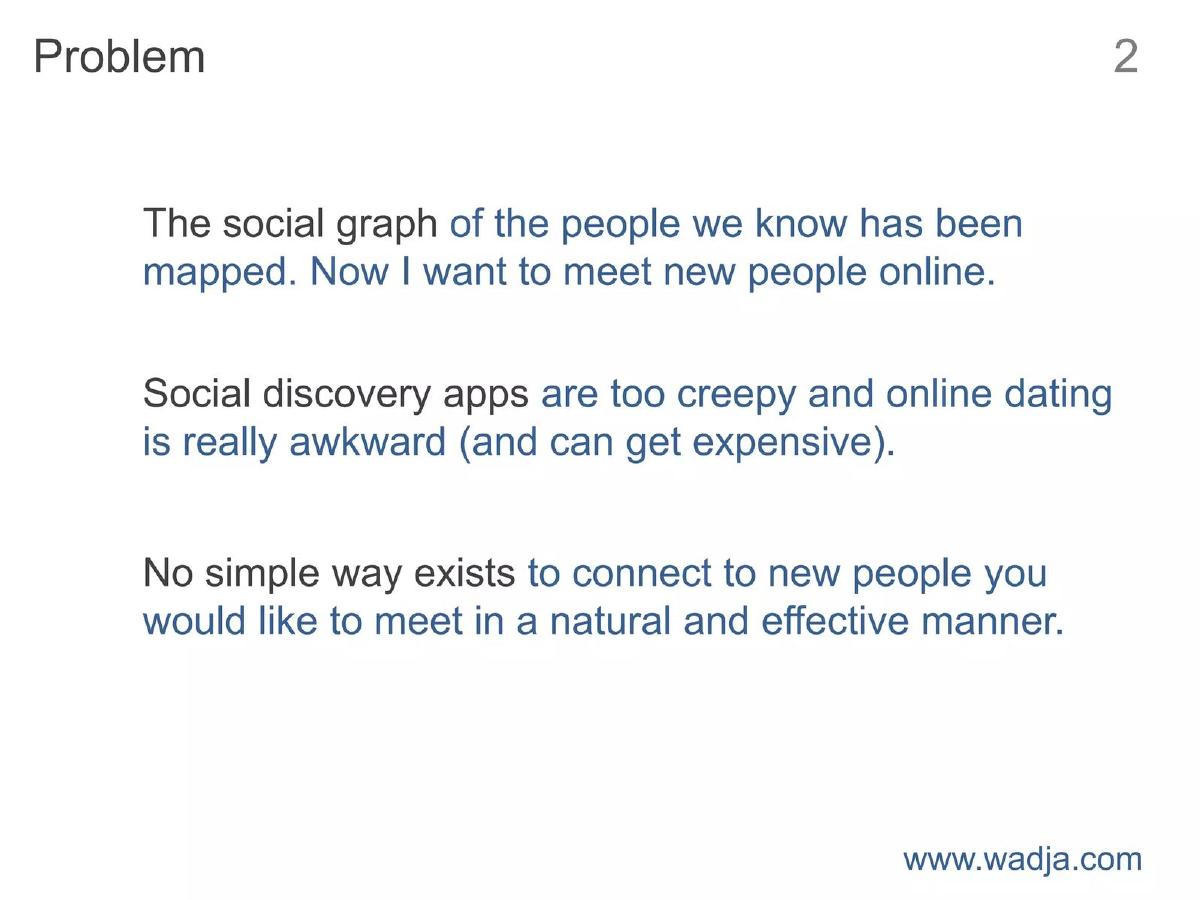
Wadja identifies three primary pain points in the social landscape:
The social graph of known people is already mapped, but meeting new people online is difficult. · Social discovery apps are perceived as "creepy" and online dating is "awkward" and "expensive." · There is no simple, natural, or effective way to connect with new people.
Slide 3: The Solution
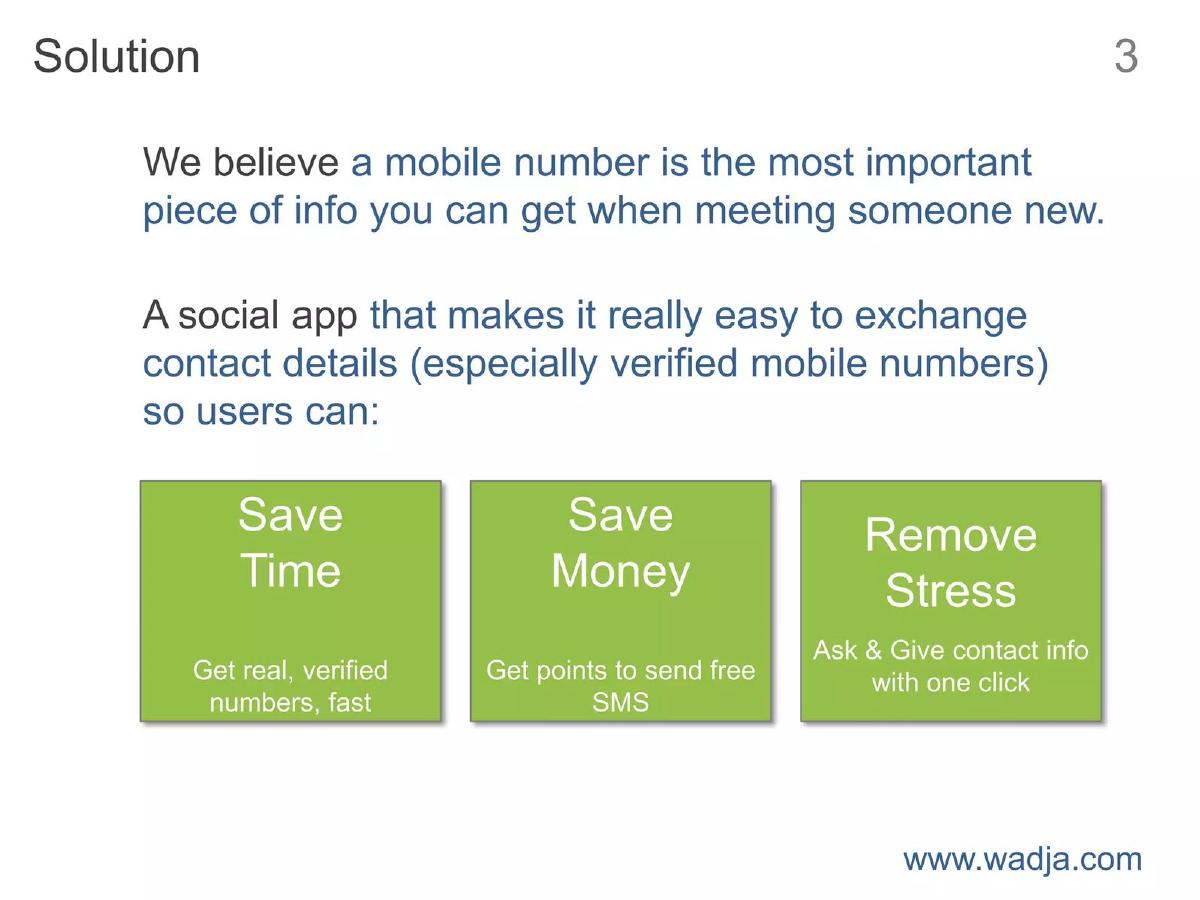
The solution is presented as a mobile app that prioritizes the mobile number as the most important piece of contact information. The slide highlights three value propositions:
Save Time: Get real, verified numbers quickly. · Save Money: Get points to send free SMS. · Remove Stress: Ask for and give contact info with one click.
Slide 4: About the Platform
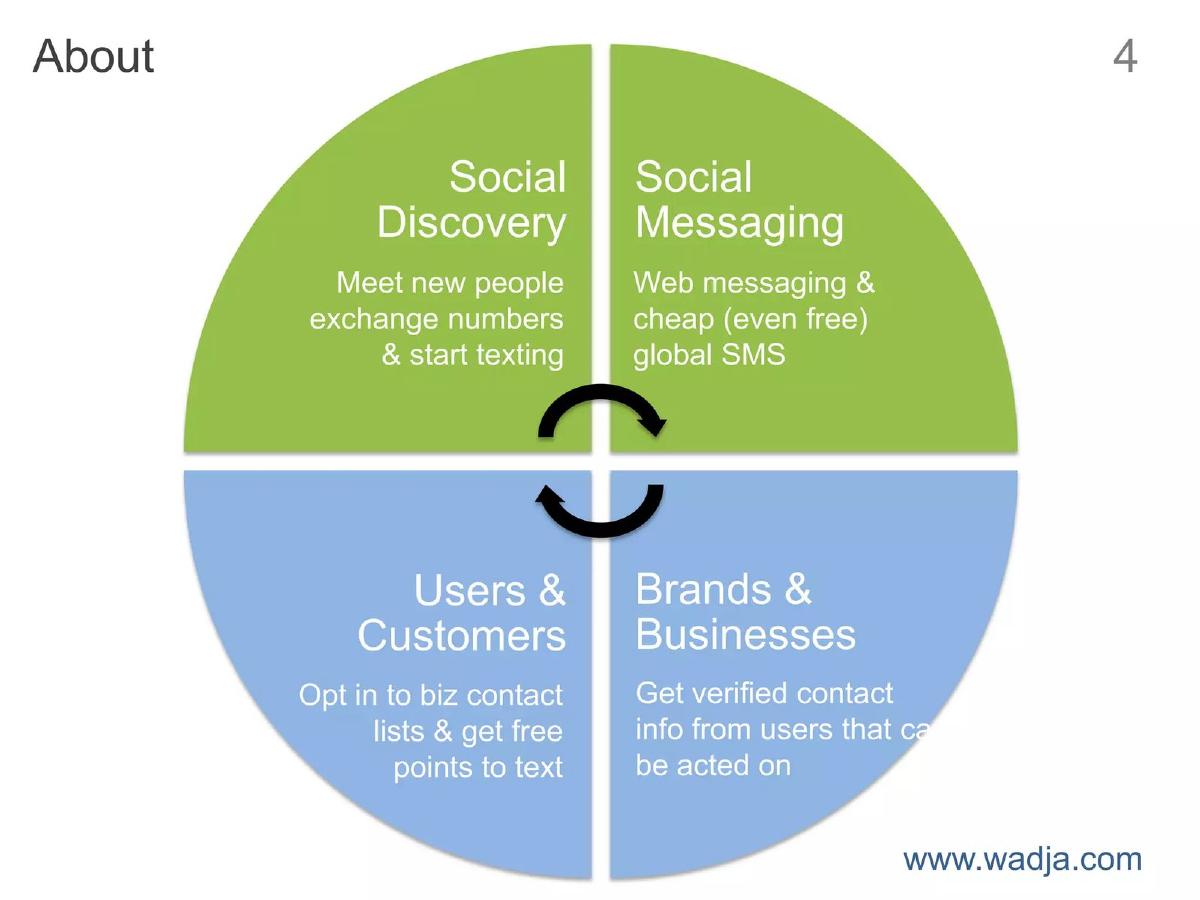
This slide uses a quadrant diagram to explain the ecosystem. It connects Social Discovery (meeting people and exchanging numbers) with Social Messaging (web messaging and cheap/free global SMS). It also bridges Users & Customers (who opt-in to lists for points) with Brands & Businesses (who get verified contact info to act upon).
Slide 5: Product Interface
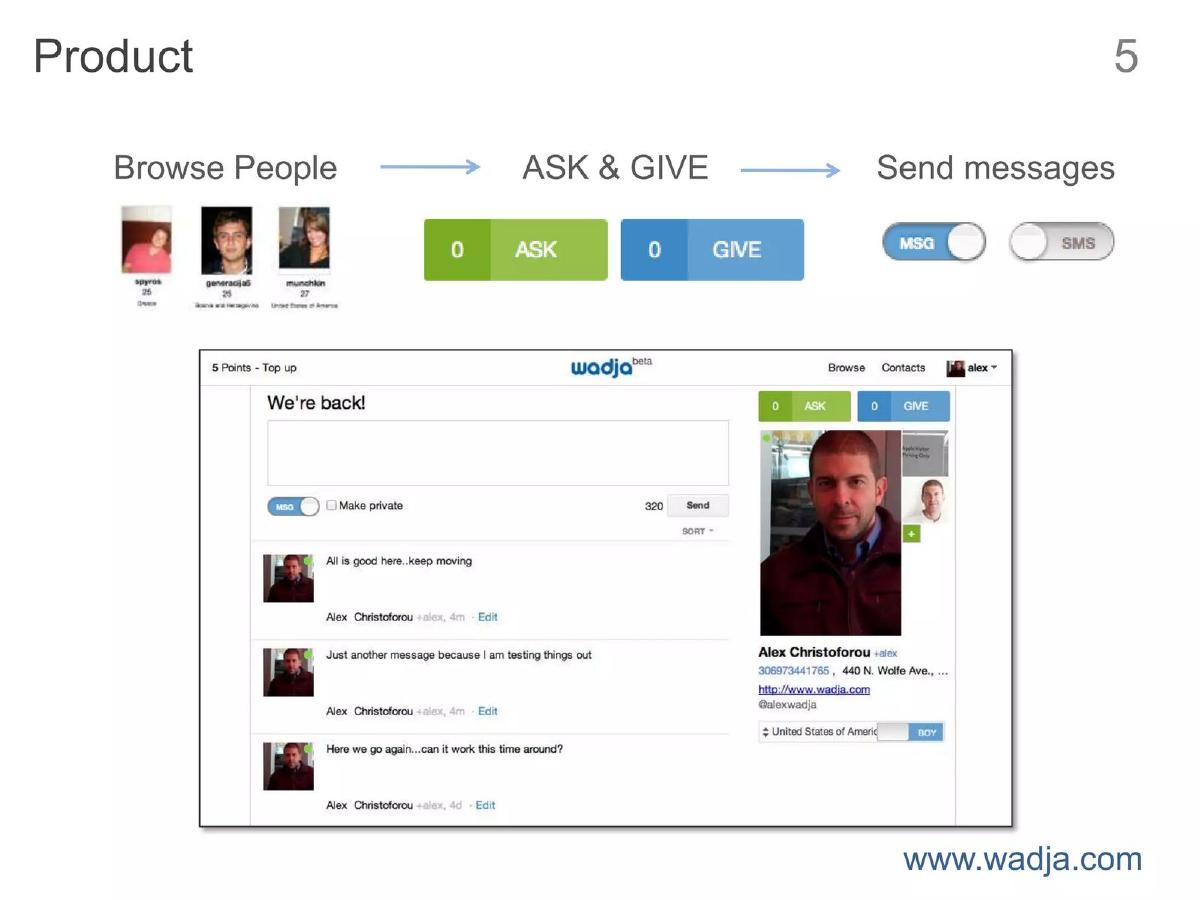
Slide 5 provides a workflow: Browse People -> ASK & GIVE -> Send messages. It includes a screenshot of the "wadja beta" web interface, showing a user profile for Alex Christoforou, a messaging feed, and buttons for "ASK" and "GIVE." The interface looks like a hybrid of a social wall and a contact management tool.
Slide 6: The Team
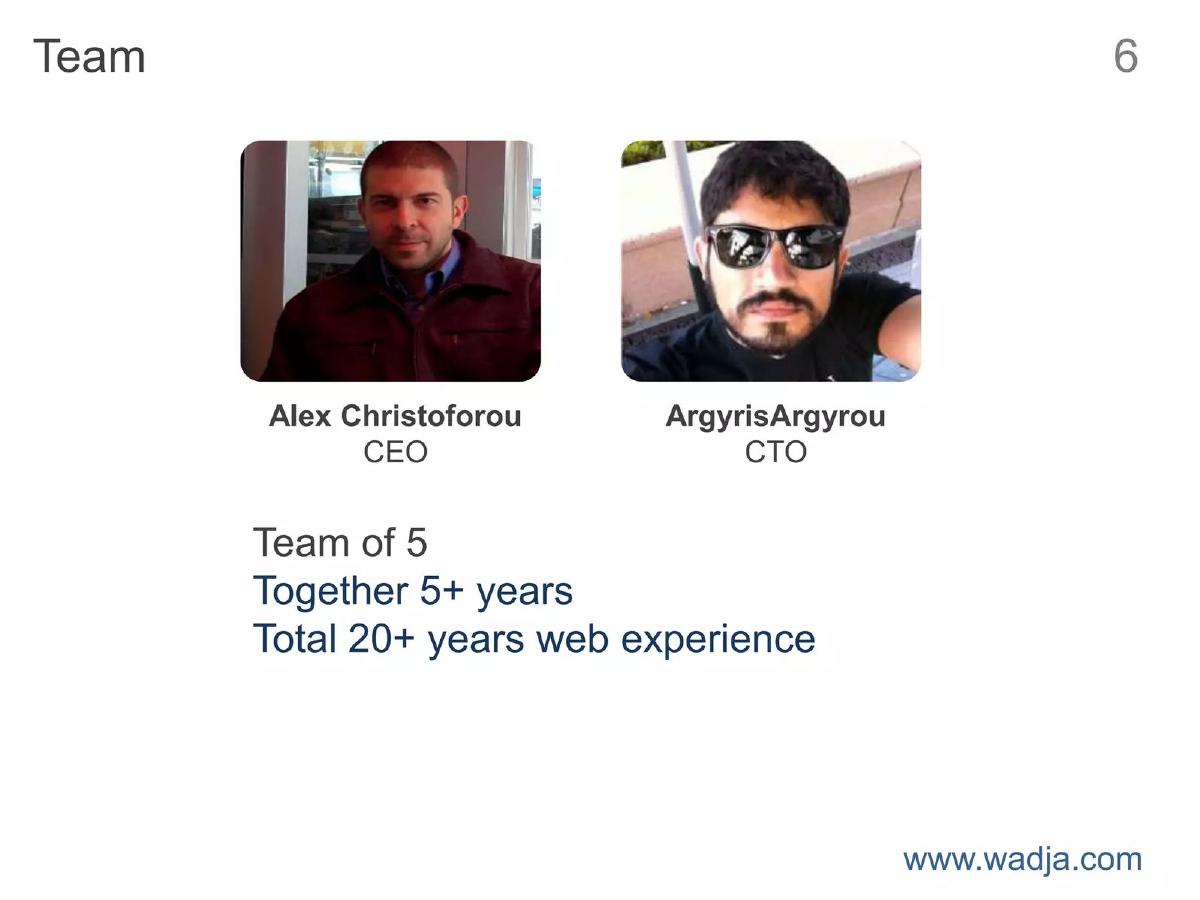
The team slide features two key members: Alex Christoforou (CEO) and Argyris Argyrou (CTO). The slide notes a total team of 5 people who have been together for 5+ years, boasting a combined 20+ years of web experience. No specific past companies or educational backgrounds are listed for the founders.
Slide 7: Market Validation
Wadja uses large-scale industry metrics to validate their opportunity:
$4 Billion: Estimated global online dating market by 2013. · 8.7 Trillion: SMS messages projected to be sent in 2015 (a 57% increase from 2010). · 9% Decline: Telecom operator SMS revenue in 2011 due to IP messaging apps (which Wadja views as an opportunity to disrupt).
Slide 8: Market Size
This slide visualizes the TAM (Total Addressable Market) and SAM (Serviceable Addressable Market):
$31 Billion+: Future available market driven by IP messaging apps. · 300 Million+: Present available market of global online dating users. · 30 Million+: Wadja's potential share of the market in terms of monthly visitors.
Slide 9: Competition
Wadja compares itself to three major players of the era: Badoo, Tagged, and Zoosk. The slide lists their registered users (140M+, 100M+, and 50M+ respectively) and their 2011 revenues ($100M+, $50M+, and $90M+). It also notes their revenue models: credits, virtual gifts, and subscriptions.
Slide 10: Market Position
A standard 2x2 matrix places Wadja in the upper-middle quadrant. The axes are People You Know vs. People You Want to Know and Casual Relationships vs. Intimate Relationships. Wadja is positioned as a tool for meeting new people for casual-to-mid-level relationships, sitting above Match.com and Badoo, and opposite Facebook and LinkedIn.
Slide 11: Business Model
5 cents revenue on each user SMS sent. · 10 cents revenue on each brand SMS sent. · $1.68 ARPU (Average Revenue Per User). · Goal: 1 Billion messages leading to $50M in revenue by Year 5.
Slide 12: Growth and Adoption
Wadja claims significant traction: 6 million total registered users and 1,000 new sign-ups daily. Their growth engines include:
Rallying their existing global user base. · An "SMS signature" (via www.wadja.com) included in messages, which they call an excellent source of traffic. · Notification emails sent to outside contacts to verify their info.
Slide 13: Competitive Advantages
The company lists six core advantages: Simplicity (clutter-free UI), Team (long history together), Position (hybrid of discovery and messaging), Monetization (aligned with mission), Distribution (SMS covers every phone), and Habit Design (intuitive ask/give process).
Slide 14: Use of Capital
Recruit: Key sales and biz dev people for a US office. · Grow: The development team in the Cyprus office.
Note: The slide does not state the amount of capital being raised.
Slide 15: Thank You
The final slide provides contact information for Alex Christoforou, including his Twitter handle (@alexwadja) and the company website.
What Wadja Does Well
Wadja excels at defining a very specific niche in the social hierarchy. By focusing on the verified mobile number , they address a real friction point in early mobile social networking: the transition from an app-based chat to a real-world connection. Their traction numbers (6 million users) are impressive for a startup of that era and provide a level of proof-of-concept that many seed-stage decks lack. The business model is also refreshingly simple; while many social apps struggle with monetization, Wadja’s per-message fee is easy to understand and directly tied to usage.
What is Missing from the Wadja Deck
The most glaring omission is the Ask. A pitch deck is a fundraising tool, yet this deck fails to mention how much money is being raised or the valuation sought. Furthermore, while they mention a 5-cent revenue per SMS, they do not disclose the cost per SMS. In many regions, the wholesale cost of sending an SMS can be close to or even exceed 5 cents, meaning their margins could be razor-thin or non-existent without significant scale. The deck also lacks a detailed roadmap; beyond a "Year 5" revenue target, there are no quarterly milestones or product development goals. Finally, the team slide is thin on credentials, relying on "years of experience" rather than specific achievements or past successful exits.
Founder Takeaways: What to Copy and What to Avoid
Copy the Market Positioning: Slide 10 is a classic example of how to use a 2x2 matrix effectively. By defining the axes as "People You Know" vs. "People You Want to Know," Wadja creates a clear white space for themselves that differentiates them from giants like Facebook and LinkedIn. This is a powerful way to show investors where you fit in a crowded market.
Avoid Vague Use of Capital: Slide 14 is too generic. Simply saying you will "recruit" and "grow" is not enough. Modern founders should provide a breakdown of how the funds will be allocated (e.g., 40% Engineering, 30% Marketing, 30% Operations) and, most importantly, what those funds will achieve (e.g., "This $2M round will take us to 15M users and $5M ARR").
Copy the Viral Loop Explanation: Slide 12 effectively explains how the product grows organically through the "SMS signature." Showing investors that your product has a built-in distribution mechanism (in this case, every message sent acts as an advertisement) is a key way to demonstrate scalability without massive marketing spend.
Avoid Dated Market Data: While this deck was likely current at the time, it serves as a reminder to always use the most recent data available. Referencing 2011 revenue in a pitch for 2013 or 2014 can make a company look out of touch with the rapid pace of the tech industry. Always ensure your market validation reflects the current year's reality.
Frequently asked questions
- What is the core problem Wadja is trying to solve?
- According to Slide 2, Wadja identifies that while the existing social graph (people you already know) is mapped, meeting new people online remains 'creepy,' 'awkward,' or 'expensive.' They argue no simple, natural way exists to connect with new people, which they aim to solve by facilitating the exchange of verified mobile numbers.
- How does Wadja plan to make money?
- The business model detailed on Slide 11 is transaction-based. They charge $0.05 for every SMS sent by a user and $0.10 for every SMS sent by a brand. They project an Average Revenue Per User (ARPU) of approximately $1.68 and set a Year 5 revenue goal of $50 million based on 1 billion messages.
- What is the current scale of the platform according to the deck?
- Slide 12 states that Wadja has 6 million total registered users and is adding 1,000 new users daily. The deck also mentions a 'large, global user base' that they intend to rally for new features, though it does not specify active user counts versus total registrations.
- Who are Wadja's primary competitors?
- Slide 9 and 10 identify Badoo, Tagged, and Zoosk as primary competitors in the social discovery space, noting their high user counts (up to 140 million for Badoo) and revenue models like virtual gifts and subscriptions. They also contrast themselves against Facebook, LinkedIn, and Twitter on a relationship-type matrix.
- What is missing from the Wadja pitch deck?
- The deck lacks a specific 'Ask' or dollar amount for the funding round. It also omits detailed unit economics beyond the per-SMS revenue, such as the cost of goods sold (COGS) for sending those SMS messages. Furthermore, there are no detailed historical financial statements or a clear roadmap of milestones achieved to date.