Vybe’s 13-slide Seed deck is a masterclass in founder-market fit. By explicitly naming competitors like Retool, Airtable, and Replit, the company carves out a niche for 'lovable' internal apps that bridge the gap between simple spreadsheets and complex developer tools. The deck’s strength lies not in its financial data—which is entirely projected—but in its social proof. With a team of repeat YC founders and an investor list featuring the CEOs of Datadog and Coda, Vybe uses its 'unfair advantage' in community access to justify a $10M raise just two months after incorporation. It successfully…
Key takeaways
- Vybe positions itself as the solution to 'vibe-coding' tools like Replit and Bolt, which it claims are great for prototyping but 'terrible for internal company use' due to security risks (Slide 3).
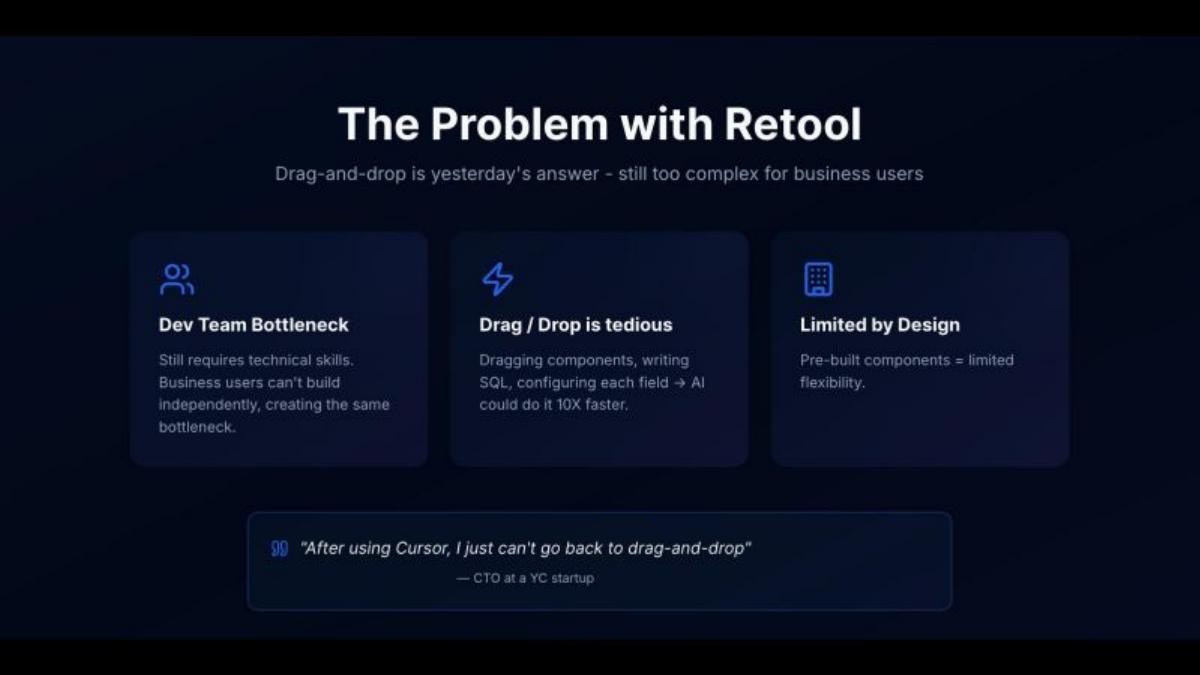
- The deck directly attacks Retool, arguing that drag-and-drop is 'yesterday's answer' and creates a developer bottleneck (Slide 4).
- The founders leverage significant pedigree, including a previous acquisition by Coda and leadership roles at Wealthfront and Facebook (Slide 7).
- The enterprise pipeline is built entirely on the founders' personal network, projecting up to $4.2M in ARR from a single unnamed 'Company A' (Slide 9).
- Vybe claims a competitive moat through a community of 30,000 engineering leaders via the Plato community (Slide 10).
- The company was incorporated only two months prior to the deck's creation yet claims to be already shipping product (Slide 12).
- The deck omits a traditional 'Ask' slide, current revenue figures, and detailed unit economics, relying instead on projected seat pricing of $500-$1000/year (Slide 9).
- The 'Why Now' argument is tied to the release of specific high-tier AI models like Claude Opus 4.5 and GPT 5.2 (Slide 11).
The Narrative: Moving Beyond Drag-and-Drop
Vybe enters the market at a specific inflection point in software development: the transition from low-code/no-code to AI-generated code. The deck’s primary thesis is that while AI has made coding accessible (vibe-coding), the resulting apps are often insecure and disconnected from enterprise data. Vybe positions itself as the 'lovable' middle ground that provides the infrastructure—SSO, integrations, and security—that raw AI prompts lack.
Slide 1: Title Slide
The deck opens with a minimalist dark theme and the tagline: "Lovable for internal apps." It defines the mission as empowering anyone in a company to build AI-powered internal tools with no coding required. The branding is clean, signaling a focus on user experience, which is a core part of their critique of existing tools.
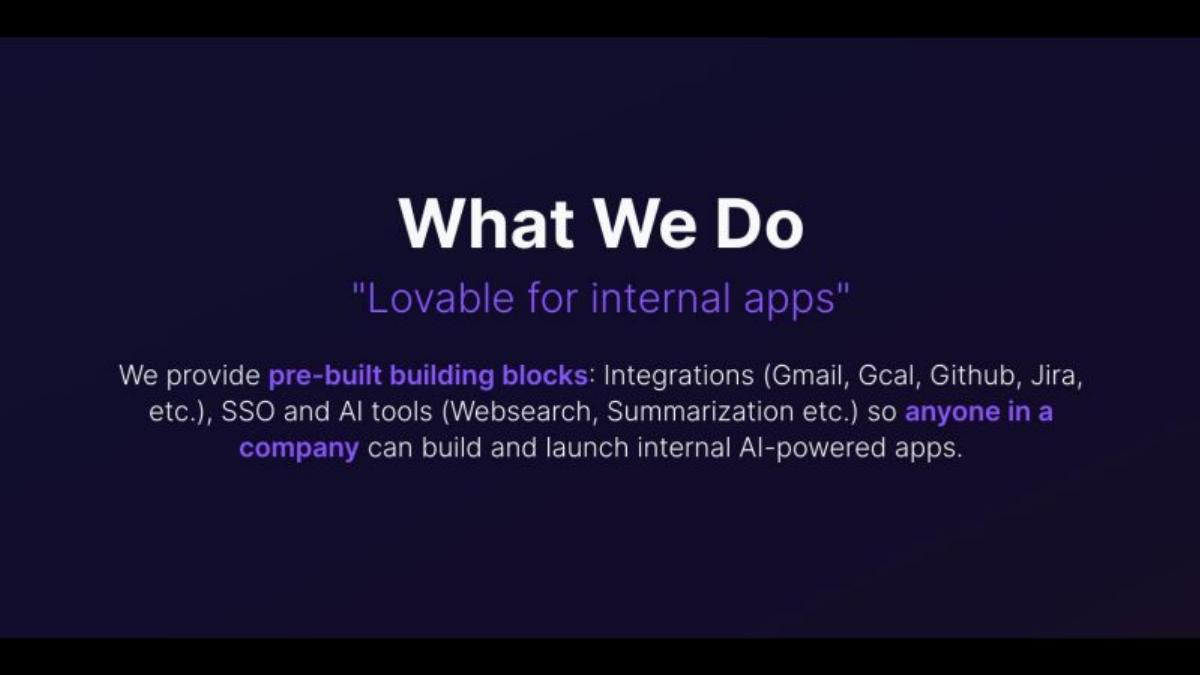
Slide 2: What We Do
This slide provides the functional definition of the product. Vybe offers "pre-built building blocks" including integrations (Gmail, Gcal, Github, Jira), SSO, and AI tools (Websearch, Summarization). The emphasis is on the user: "anyone in a company" can build and launch apps. This is a classic horizontal SaaS play, targeting the internal tool bottleneck.
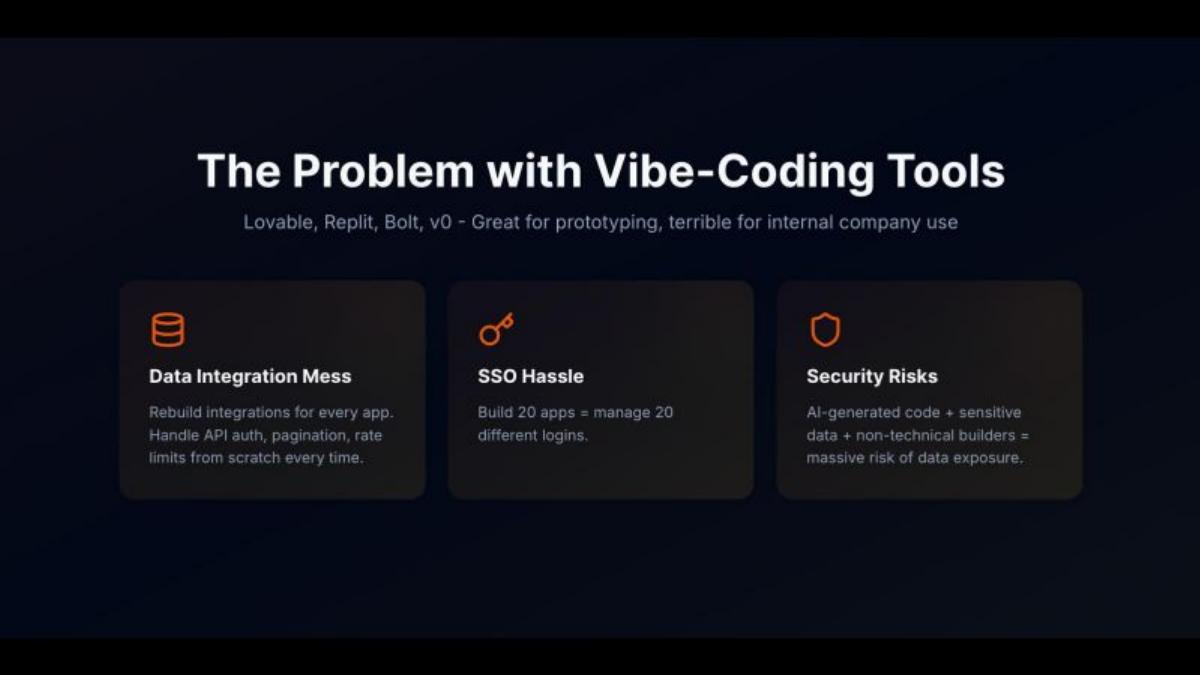
Slide 3: The Problem with Vibe-Coding Tools
Vybe identifies its first set of competitors: Lovable, Replit, Bolt, and v0. It acknowledges they are "Great for prototyping" but "terrible for internal company use." The slide lists three specific pain points: Data Integration Mess (rebuilding integrations for every app), SSO Hassle (managing separate logins for every small tool), and Security Risks (the danger of non-technical builders exposing sensitive data via AI-generated code).
Slide 4: The Problem with Retool
This is a bold slide that directly targets the market leader in internal tools. Vybe claims "Drag-and-drop is yesterday's answer." They argue Retool still requires technical skills, creating a "Dev Team Bottleneck." They further claim that dragging components is "tedious" and that AI could do it "10X faster." A quote from a CTO at a YC startup reinforces the sentiment: "After using Cursor, I just can't go back to drag-and-drop."
Slide 5: The Problem with No-Code Tools
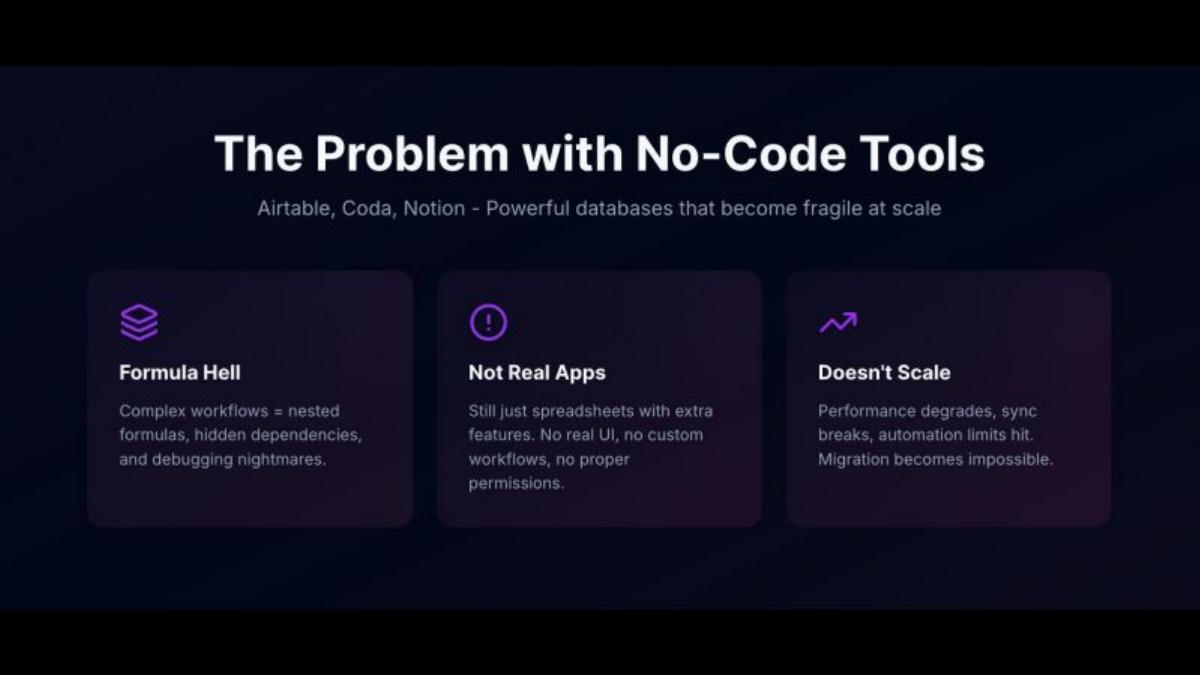
The critique extends to Airtable, Coda, and Notion. Vybe describes these as "Powerful databases that become fragile at scale." They cite "Formula Hell" (nested formulas and hidden dependencies), the fact that they are "Not Real Apps" (lacking proper UI and permissions), and their inability to scale due to performance degradation and automation limits.
Slide 6: High Ceiling, Low Floor
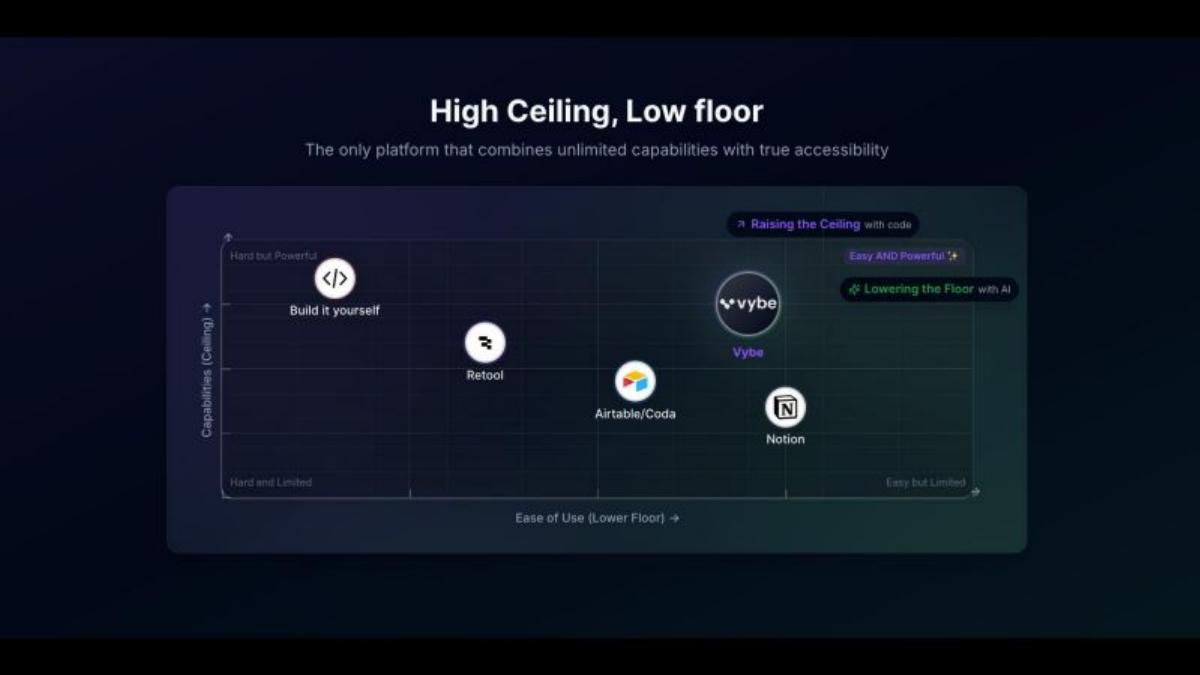
This 2x2 matrix positions Vybe in the top-right quadrant: "Easy AND Powerful." The X-axis measures "Ease of Use (Lower Floor)" and the Y-axis measures "Capabilities (Ceiling)." Vybe claims to be the only platform that combines the unlimited capabilities of custom code with the true accessibility of no-code tools. It places Notion as easy but limited, and "Build it yourself" as powerful but hard.
Slide 7: The Team
This is arguably the strongest slide in the deck. Quang Hoang (CEO) is a repeat YC founder whose previous company, PlatoHQ, was acquired by Coda. He also led Product/GTM for Coda Solutions. Fabien Devos (CTO) was a Director of Engineering at Wealthfront, founded a YC-backed company (Wolfia), and was an early engineer at Facebook. The slide notes they are "Repeat YC founders with proven track records" and are currently in the YC X25 batch.
Slide 8: Backed by the Best
Social proof is used to compensate for the company's early stage. The slide features a grid of high-profile investors, including Tido Carriero (VP Enterprise @ Cursor) , Shishir Mehrotra (CEO @ Coda) , Ami Vora (Head of Product @ Anthropic) , and Oli Pomel (CEO @ Datadog) . This list suggests that the leaders of the very companies Vybe integrates with or competes against are backing the vision.
Slide 9: Enterprise Pipeline
Since the company is only two months old, this slide focuses on "projected annual revenue" rather than historical data. It lists four anonymous companies (A through D) with employee counts ranging from 8,200 to 14,000. Based on an assumed 20% adoption and $500-$1000/seat/year pricing, they project ARR between $1.6M and $4.2M per customer. Crucially, these are noted as being from the founders' "network only."
Slide 10: Community Power & Go-to-Market
Vybe outlines its competitive moat: 10+ years of building tech communities. They claim access to 30K+ Engineering Leaders via the Plato community and 1M Product Leaders via Lenny Rachitsky. This slide argues that their GTM strategy isn't just ads, but direct access to decision-makers through "150+ intimate dinners" and relationships with 60 CTOs who are LPs in the founders' funds.
Slide 11: Why Now?
The "Why Now" slide attributes the opportunity to "AI Code Generation Maturity." It specifically names Claude Opus 4.5, Gemini 3.0, and GPT 5.2 as models that can now generate production-ready code. It also mentions an "Enterprise AI Wake-Up Call," citing CEOs at Shopify and Duolingo who are demanding AI-first transformations.
Slide 12: Key Takeaways
The summary slide highlights "Fast execution" (shipping product 2 months after incorporation), "Committed ARR" (though no figure is given), and a "700 waitlist." It reiterates the "Proven team" and the "Time is now" narrative. The contact information provided is for the YC X25 batch.
Slide 13: Closing Slide
The final slide is a standard call to action for the BestPitchDeck.com library, featuring logos of famous startups like Uber and Airbnb. It does not contain Vybe-specific information.
What Vybe Does Well
The Vybe deck is a masterclass in positioning . Instead of trying to be everything to everyone, it picks a very specific fight with Retool and the 'vibe-coding' movement. By naming names (Retool, Airtable, Replit), the founders make it easy for an investor to understand exactly where they sit in the ecosystem. The founder-market fit is also undeniable; the CEO's history at Coda and the CTO's background at Wealthfront and Facebook provide the technical and commercial credibility needed for a $10M Seed round in a crowded AI space.
What is Missing from the Vybe Deck
The most glaring omission is actual traction data . While the deck mentions "Committed ARR" and a "700 waitlist," it provides no evidence of current usage, retention, or revenue. The entire financial slide (Slide 9) is based on projections and assumptions. There is also no "Ask" slide —the deck doesn't specify how much they are raising or how they plan to spend the capital, though the catalogue listing confirms a $10M raise. Finally, the product demo is missing; for a tool that claims to be 10x faster than drag-and-drop, showing the interface would have been more powerful than the 2x2 matrix on Slide 6.
What Other Founders Should Copy
Founders should emulate Vybe's "Competitive Moat" slide (Slide 10) . Most startups claim their moat is their technology, which is rarely true in the age of LLMs. Vybe honestly identifies its moat as access —specifically, a decade of building relationships with engineering leaders. This is a tangible, defensible advantage. Additionally, the problem slides (Slides 3-5) are excellent because they don't just say "the old way is bad"; they explain why it's bad for a specific user (the enterprise) by citing SSO, security, and formula complexity.
Final Thoughts
Vybe's deck is a high-conviction bet on the founders' ability to sell into their own elite network. It is a "pedigree deck" that works because the team has already done the work of building the community they now intend to sell to. For founders without this level of social proof, the lack of hard data and a product demo would be a dealbreaker, but for Vybe, it was enough to secure $10M from some of the biggest names in venture capital.
Frequently asked questions
- How much did Vybe raise and at what stage?
- According to the catalogue facts, Vybe raised $10M in a Seed round in 2025. The deck indicates they were part of the YC X25 batch and had only been incorporated for two months at the time of the presentation.
- Who are the key investors in Vybe?
- The deck and catalogue listing name a high-profile group of backers, including First Round Capital, Y Combinator, and Orange Collective. Individual angel investors include Oli Pomel (CEO of Datadog), Shishir Mehrotra (CEO of Coda), and Mathilde Collin (Cofounder of Front).
- What is 'vibe-coding' and why does Vybe focus on it?
- Vibe-coding refers to using AI to generate applications through natural language prompts. Vybe identifies a gap where tools like Replit and v0 are good for making prototypes but lack the SSO, data integration, and security features required for enterprise-grade internal tools.
- What is Vybe's pricing model?
- On Slide 9, the company outlines a projected seat-based pricing model of $500 to $1,000 per seat per year. They assume a 20% adoption rate within their target enterprise pipeline to reach their ARR projections.
- Does the deck show actual revenue?
- No. Slide 9 explicitly states that 'all figures shown are projected annual revenue.' While Slide 12 mentions 'Committed ARR,' no specific dollar amount for current realized revenue is provided in the deck.