Vue Storefront secured $20M in Series A funding in 2023 with a deck that prioritizes category creation and social proof. By positioning themselves as the 'Frontend as a Service' (FEaaS) equivalent to historical backend giants like Hybris and Demandware, they provided investors with a clear mental model for their potential scale. The deck leans heavily on the fact that 2,200+ businesses already trust the platform, effectively de-risking the investment. While the deck is light on specific financial metrics and unit economics, it compensates with a deep bench of leadership talent and a strategic…
Key takeaways
- The deck leads with massive social proof, citing 2,200+ eCommerce businesses worldwide on slide 2.
- Vue Storefront defines a new category, 'Frontend as a Service' (FEaaS), to differentiate from traditional monolithic stacks on slide 9.
- The company uses historical analogies, comparing its trajectory to Hybris ($1.5B exit) and Demandware ($2.8B exit) on slide 8.
- The solution claims to reduce frontend implementation costs by 60% according to slide 6.
- Market sizing is aggressive, projecting a TAM of $8.9B by 2030 with potential expansion into travel and insurance markets on slide 13.
- The team slide (14) highlights a significant headcount of 100 employees, with 40 dedicated to Product & Engineering.
- The deck features an impressive roster of advisors, including the founders of SAP Hybris, Vivino, and Vue.js on slide 15.
- The deck omits a specific 'Ask' slide, focusing instead on the vision and market positioning for the Series A round.
The Category Creation Playbook
Vue Storefront’s Series A deck is a masterclass in category creation. Rather than fighting for space in the crowded 'eCommerce platform' market, they carved out a new niche: Frontend as a Service (FEaaS). This teardown examines how they used 15 slides to convince investors that the frontend is the new center of the eCommerce universe.
Slide 1: Title and Backing
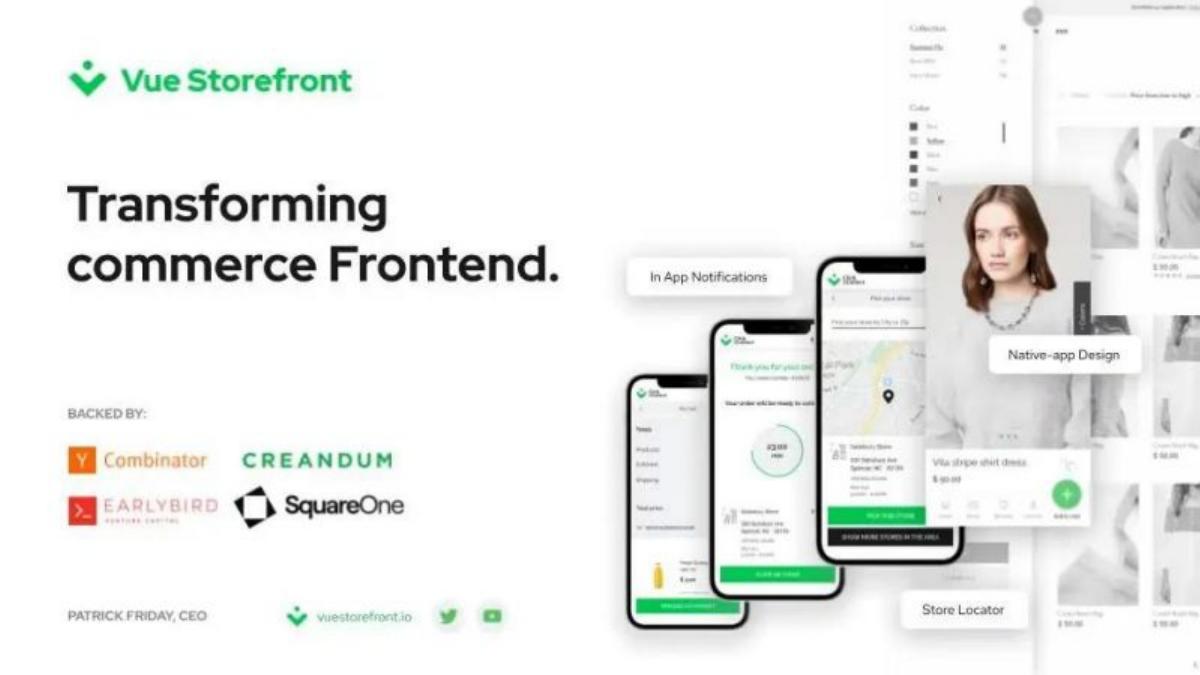
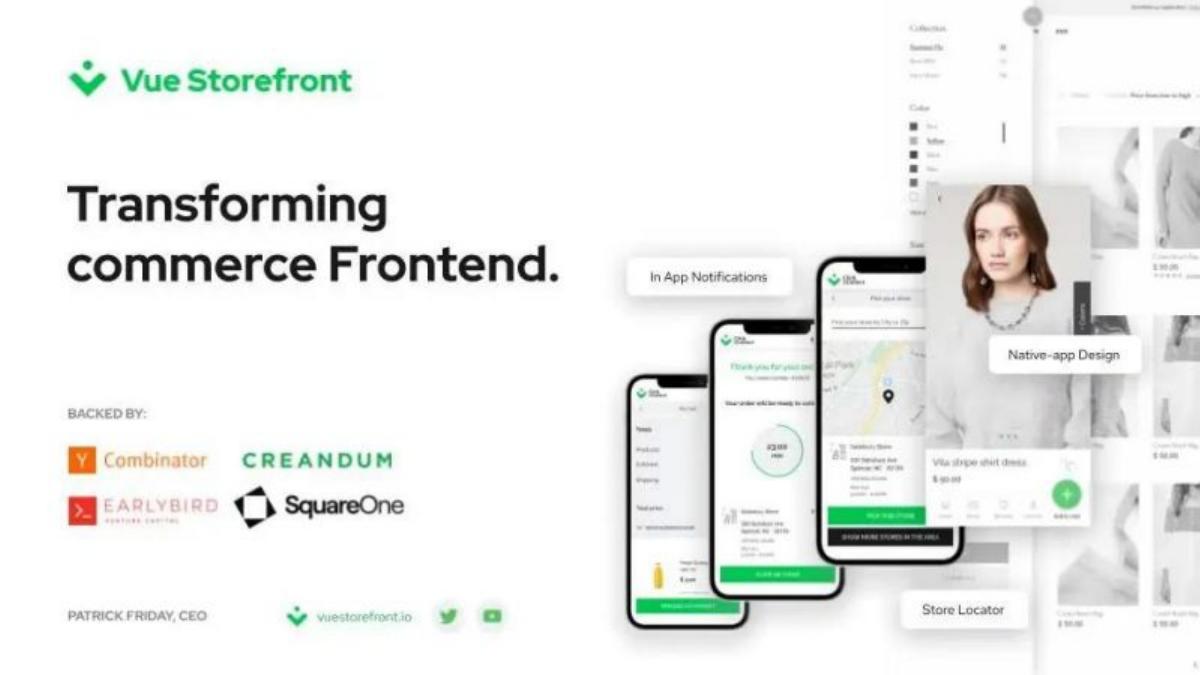
The cover slide is clean and professional, featuring the tagline 'Transforming commerce Frontend.' Notably, it prominently displays the logos of existing backers: Y Combinator, Creandum, Earlybird, and SquareOne. This immediate social proof sets a high bar for the rest of the presentation. It also identifies Patrick Friday as the CEO.
Slide 2: The Trust Signal
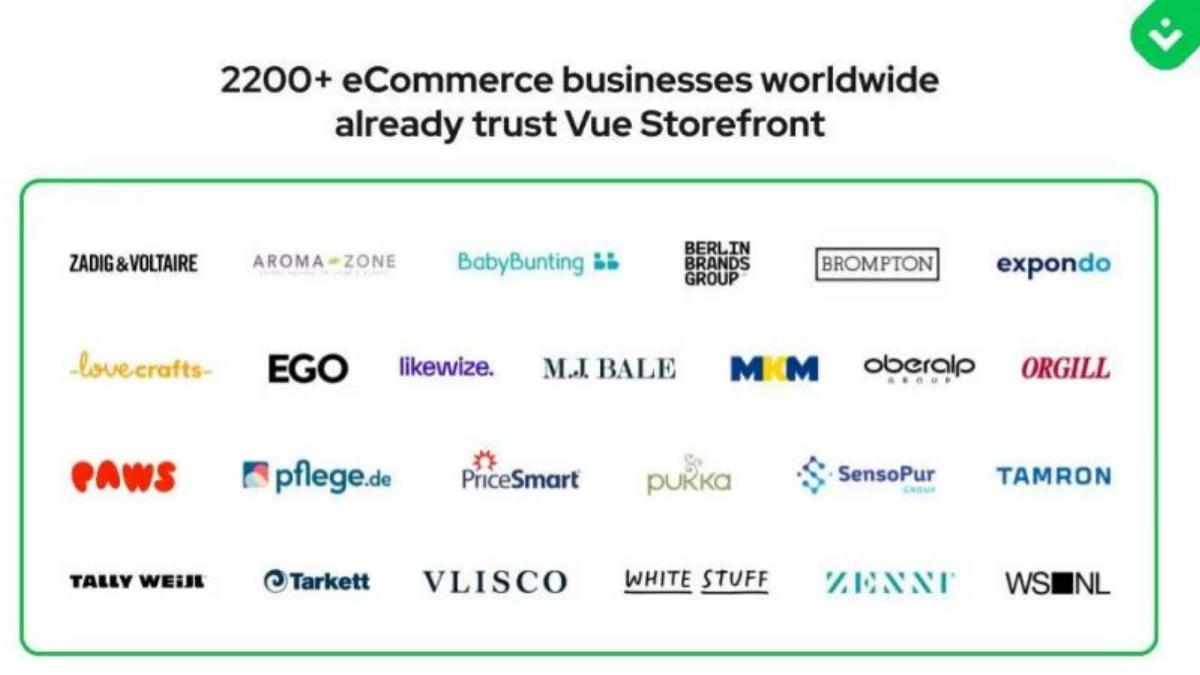
Before explaining the product, Vue Storefront leads with a massive wall of logos. The headline states that '2200+ eCommerce businesses worldwide already trust Vue Storefront.' This is a powerful move for a Series A deck. By showing high-profile brands like Zadig & Voltaire, Brompton, and Zenith, they demonstrate that the market has already validated the technology at scale.
Slide 3: Visualizing Complexity
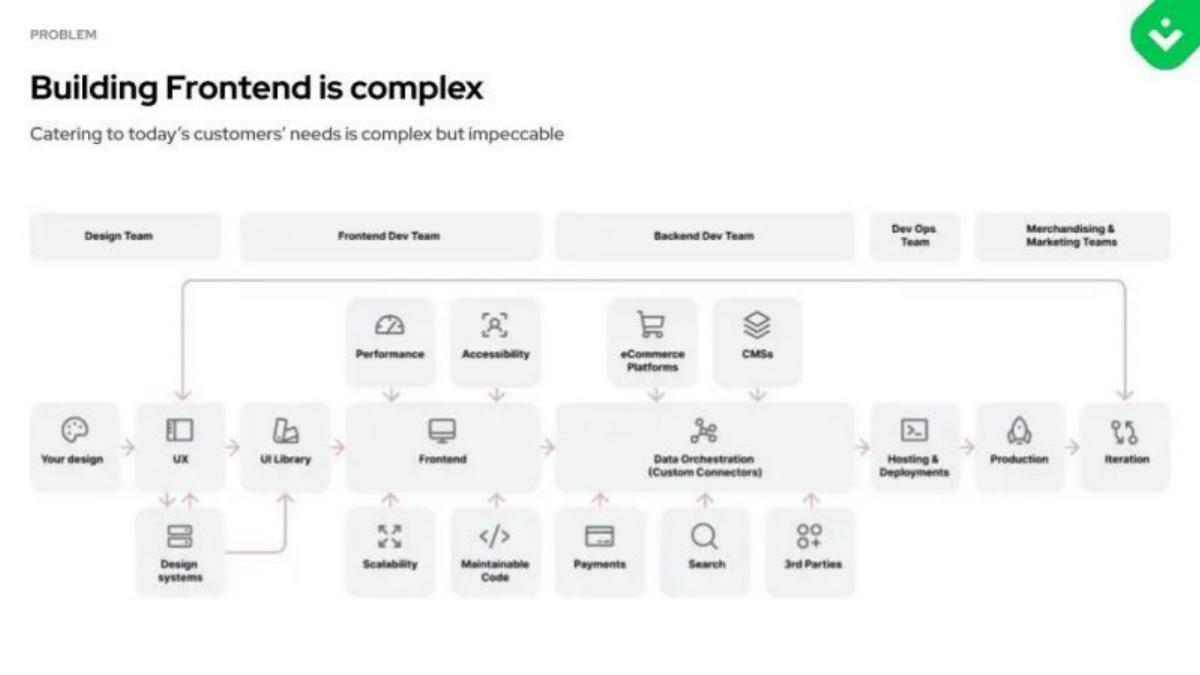
The first 'Problem' slide uses a complex flowchart to show the current state of building frontends. It highlights the silos between Design, Frontend Dev, Backend Dev, DevOps, and Marketing teams. The diagram illustrates a fragmented process involving UI libraries, data orchestration, hosting, and constant iteration. The message is clear: the status quo is messy and inefficient.
Slide 4 & 5: The Pain Points
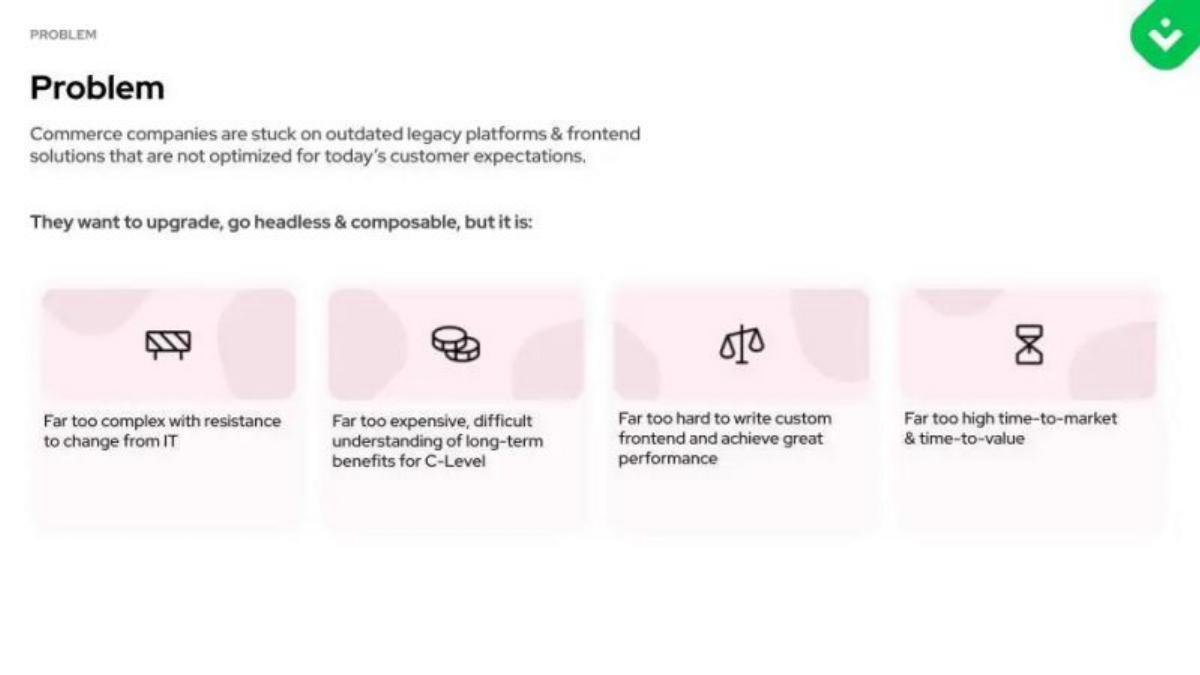
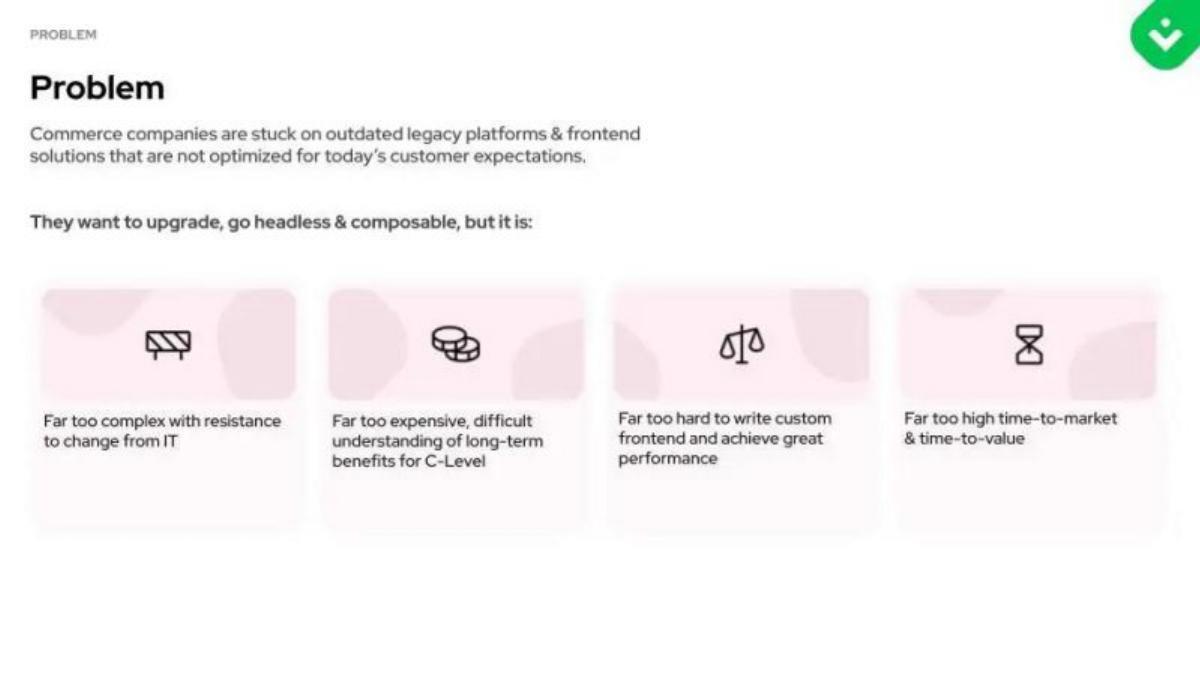
These identical slides (likely a duplicate in the source file) break down why commerce companies are 'stuck.' They identify four key barriers: IT resistance to change, high costs for C-level buy-in, the difficulty of writing custom frontends, and slow time-to-market. This slide transitions the problem from a technical one to a business one, focusing on 'time-to-value.'
Slide 6: The FEaaS Solution
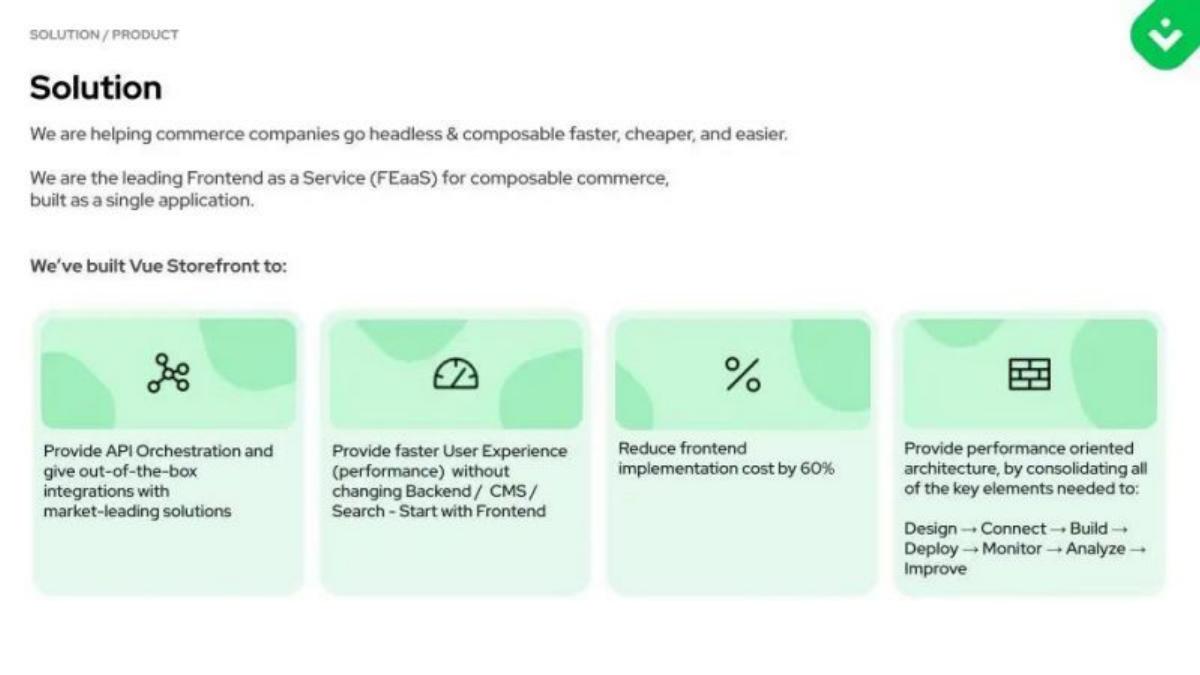
The solution slide introduces the 'Frontend as a Service' (FEaaS) terminology. It makes four specific promises: out-of-the-box API orchestration, faster performance without changing the backend, a 60% reduction in implementation costs, and a performance-oriented architecture that covers the entire lifecycle from Design to Analysis.
Slide 7: The Migration Strategy
This is a crucial technical slide. It shows how Vue Storefront acts as a flexible layer. Whether a customer has a legacy monolithic stack or is moving toward a fully headless architecture, Vue Storefront can integrate. This 'meet the customer where they are' approach reduces the friction of adoption, as companies don't have to rip and replace their entire backend to see benefits.
Slide 8: Historical Context
To help investors understand the potential upside, Vue Storefront uses an analogy. They point to Hybris (acquired for $1.5B), Demandware (acquired for $2.8B), and ATG (acquired for $1B). They argue that these companies created the 'eCommerce SaaS' category for backends, and Vue Storefront is doing the same for frontends. This is a classic venture capital framing: 'We are the [Successful Company] of [New Category].'
Slide 9: Defining the Category
This slide doubles down on the FEaaS category. It explicitly states that 'Composable & Headless is only a good fit for larger mid-market and enterprises at this point' and positions Vue Storefront as the 'key educator' in the market. They list potential competitors like Shogun and Frontastic but categorize them as 'not direct competitors' due to their focus on different market segments or lower-code solutions.
Slide 10: The Strategic Shift
The deck argues that the buying journey has changed. In 2022 and beyond, customers should 'Start with the Frontend.' The logic is that backend platforms have become a commodity and don't drive revenue, whereas the frontend is where the buyer experience and revenue impact happen. This is a bold attempt to reorder the traditional eCommerce implementation roadmap.
Slide 11 & 12: Market Potential
After a transition slide, the 'Market' slide presents a TAM growing from $4.4B today to $8.9B in 2030. Interestingly, they also list 'Potential Future Markets' like Digital Insurance and Online Banking. This suggests that while they are starting with eCommerce, their frontend orchestration layer is a horizontal technology that could disrupt any industry with a complex digital presence.
Slide 13: The Founders
The team slide highlights three founders with deep domain expertise. Patrick Friday (CEO) has 10 years in B2B sales and was an early employee at Vivino. Filip Rakowski (CTO) is the technical architect and an official Vue.js Community Partner. Bart Roszkowski (COO) is a serial entrepreneur who has sold three companies. This balance of sales, technical, and operational experience is exactly what Series A investors look for.
Slide 14: Organizational Maturity
The final content slide shows the scale of the company: 100 employees. The breakdown (40 in Engineering, 37 in GTM) shows a balanced organization ready for growth. Most impressive is the list of 'Angels' and advisors, which includes the founders of SAP Hybris, Vivino, Magento, and the creator of Vue.js itself. This level of industry support is a massive competitive moat.
What Works in the Vue Storefront Deck
1. Strong Category Positioning: By naming and defining 'Frontend as a Service,' the company moves away from being a 'tool' to being a 'platform.' This justifies a higher valuation and a larger round.
2. Historical Anchoring: Comparing themselves to billion-dollar exits like Demandware and Hybris gives investors a clear 'exit path' mental model. It shows the founders understand the history of their industry.
3. Massive Social Proof: Leading with 2,200+ customers and a list of high-profile advisors makes the investment feel like a 'sure thing' rather than a gamble on unproven tech.
4. Clear Migration Path: Slide 7 effectively addresses the 'how do we actually sell this?' question by showing that customers don't need a total overhaul to get started.
What is Missing from the Vue Storefront Deck
1. Financial Specifics: The deck is entirely devoid of revenue figures, ARR growth rates, or churn metrics. While the 2,200+ customer count is impressive, investors would typically want to see the financial health of those accounts in a Series A deck.
2. Unit Economics: There is no mention of CAC (Customer Acquisition Cost), LTV (Lifetime Value), or payback periods. This makes it hard to judge the efficiency of their Go-To-Market engine.
3. The 'Ask': The deck does not explicitly state how much they are raising or how they plan to use the funds. While the catalogue facts state it was a $20M round, that information is missing from the slides themselves.
4. Competitive Matrix: While they mention a few names on slide 9, a traditional feature-by-feature comparison or a 2x2 matrix is missing. They rely on narrative to dismiss competition rather than data.
What Other Founders Should Copy
1. The 'Start with the Problem' Flow: Vue Storefront does an excellent job of visualizing the 'complexity' of the current state before introducing their solution. Founders should use diagrams to make abstract technical pain points feel tangible.
2. Leveraging Advisors: If you have high-profile advisors, don't hide them. Vue Storefront’s advisor list is a 'who's who' of eCommerce, which provides immense credibility.
3. The Analogy Strategy: If you are in a complex B2B space, find the 'Hybris' of your world—the company that everyone knows and respects—and explain why you are the modern version of that success story.
4. Focus on 'Time-to-Value': In the current economic climate, 'cheaper and faster' is a winning message. Vue Storefront’s claim of a 60% reduction in implementation costs is a compelling hook for both customers and investors.
Frequently asked questions
- What is the primary value proposition of Vue Storefront?
- According to slide 6, Vue Storefront positions itself as a 'Frontend as a Service' (FEaaS) that helps commerce companies go headless and composable faster and cheaper. Key benefits include providing out-of-the-box API orchestration, improving user experience performance without changing the backend, and reducing frontend implementation costs by 60%.
- How does Vue Storefront justify its market potential?
- On slide 13, the company presents a TAM that grows from $4.4B 'Today' to $8.9B by 2030. They also list 'Potential Future Markets' such as Enterprise Content Management ($53.2B by 2030) and Online Travel ($1.8T by 2031) to show that their frontend technology is applicable beyond core eCommerce.
- Who are the key investors and advisors mentioned?
- The deck listing notes Felix Capital led the $20M round, joined by Creandum, Earlybird, and SquareOne. Slide 15 highlights a high-profile advisor network including Carsten Thoma (Founder of SAP Hybris), Heini Zachariassen (Founder of Vivino), and Evan You (Founder of Vue.js).
- What is the 'migration scenario' strategy shown in the deck?
- Slide 7 illustrates that Vue Storefront can sit on top of any stack. It shows three scenarios: connecting to a legacy backend and legacy CMS, connecting to a legacy backend and headless CMS, or connecting to a fully headless backend and CMS. This flexibility is a core part of their 'unique approach' to the market.
- How does the team structure look at the Series A stage?
- Slide 15 reveals a mature organization of 100 employees. The largest departments are Product & Engineering (40 people) and Go To Market (37 people), followed by Operations (16) and Community (7). This indicates a company that has already scaled past the early-stage 'scrappy' phase.