VR Motion’s 2016 pre-seed deck is a masterclass in brevity and high-stakes positioning. Spanning only 9 slides, the presentation focuses heavily on the lethal consequences of inadequate driver training in the military and law enforcement sectors. The deck highlights a $4 billion annual spend on training that fails to prevent accidents, which account for nearly half of all deaths in these fields. With a team featuring a former Indy 500 driver and an Intel R&D veteran, the company established immediate credibility. Despite the lack of a formal 'Ask' slide or detailed unit economics, the deck su…
Key takeaways
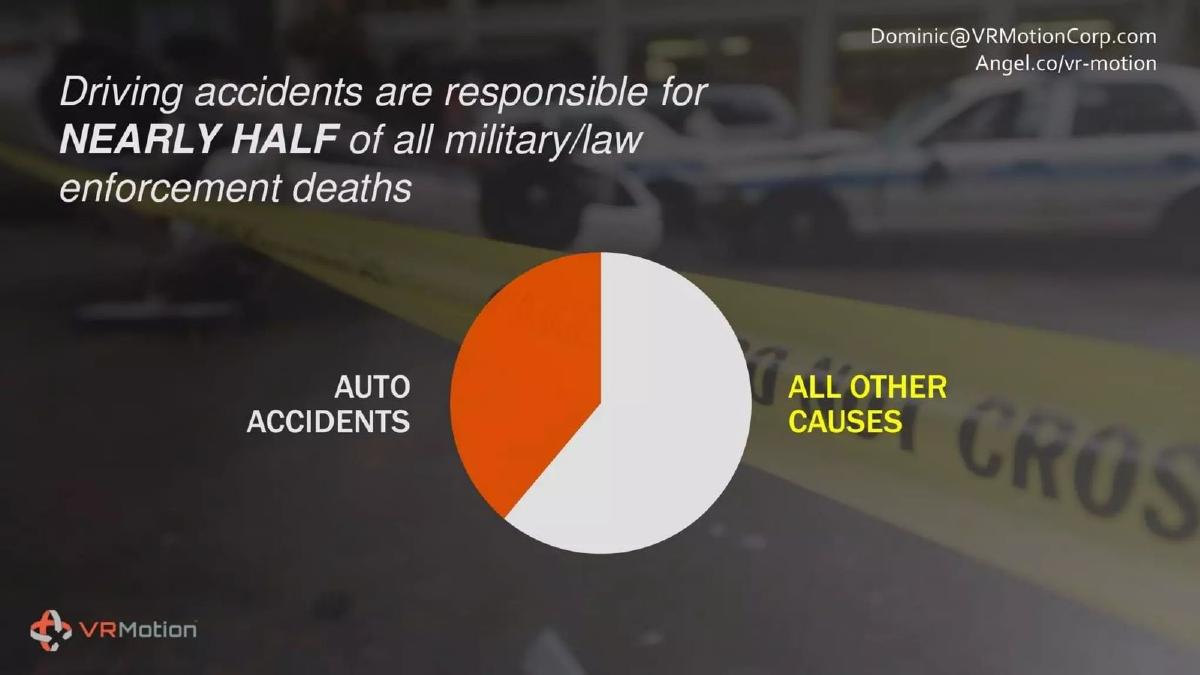
- The deck identifies a massive safety gap, noting that driving accidents cause nearly half of all military and law enforcement deaths on slide 2.
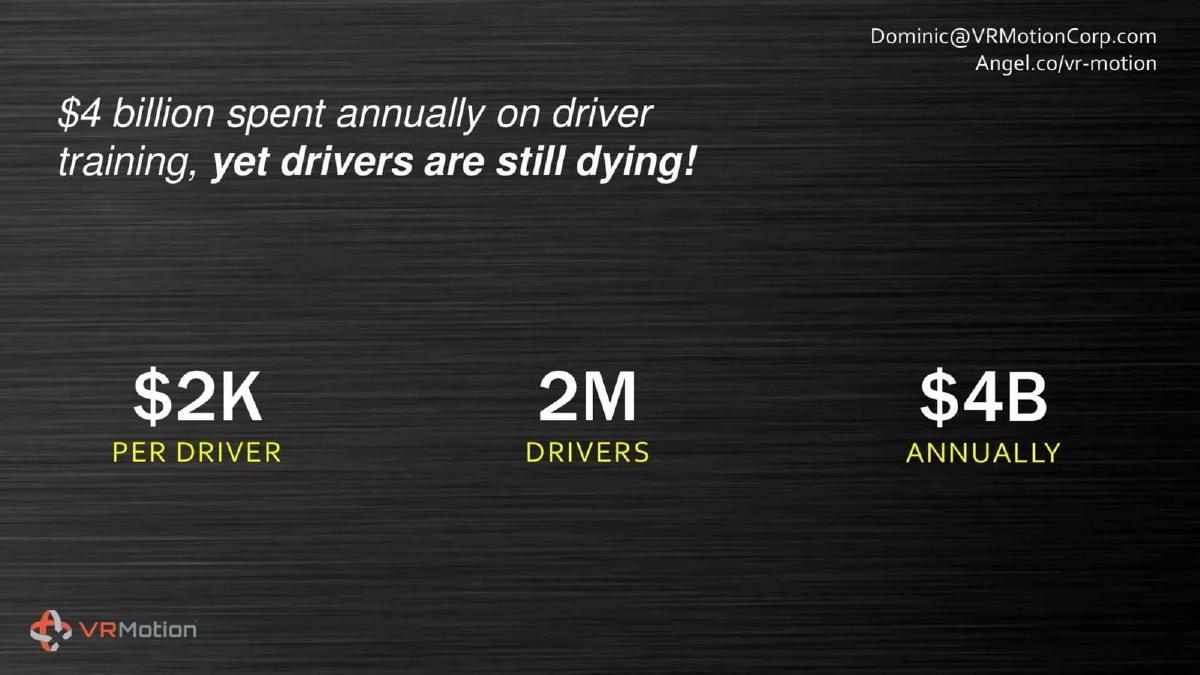
- Market sizing is defined by the $4 billion spent annually on driver training, averaging $2,000 per driver for 2 million drivers as shown on slide 3.
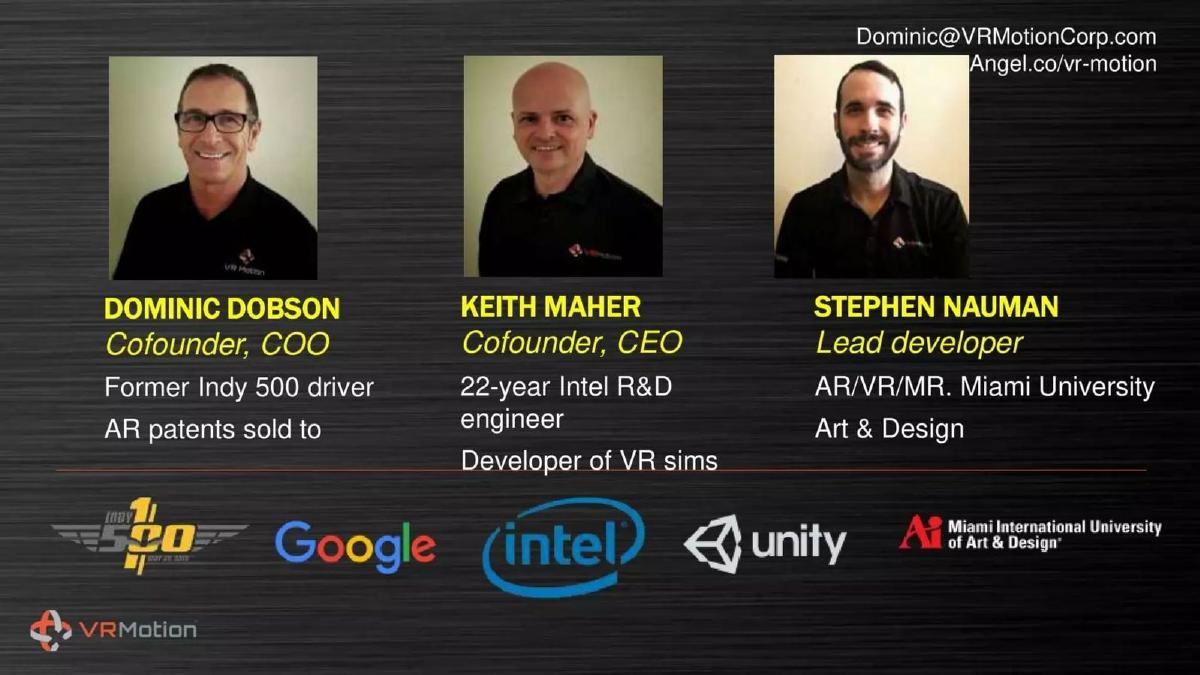
- The team slide (slide 6) provides high founder-market fit, featuring a former Indy 500 driver and a 22-year Intel R&D engineer.
- Traction is demonstrated with a revenue graph showing $266,000 earned over 12 months and 2,500 test drives completed on slide 7.
- The pipeline slide (slide 8) categorizes leads into 'In discussion,' 'Demo complete,' and 'RFQ/contract,' showing a clear path to a $4 million pipeline.
- The deck lacks a formal 'Ask' slide, omitting the specific amount sought or the intended use of funds within the slides themselves.
- There is no detailed breakdown of the hardware vs. software business model or unit economics for the VR rigs.
- Visual evidence of the product is limited to a single dark image on slide 5 and a cover photo, relying more on text-based problem statements.
The VR Motion Pre-Seed Teardown
VR Motion entered the market at the height of the 2016 VR hype cycle, but unlike many contemporaries focusing on gaming, they targeted the high-stakes transportation and defense sectors. This 9-slide deck is a lean, problem-oriented presentation that prioritizes the 'Why' and the 'Who' over the 'How.' By framing driver training as a life-or-death issue for the military and police, they moved the conversation away from 'cool tech' and toward 'essential safety infrastructure.'
Slide 1: Title and Contact
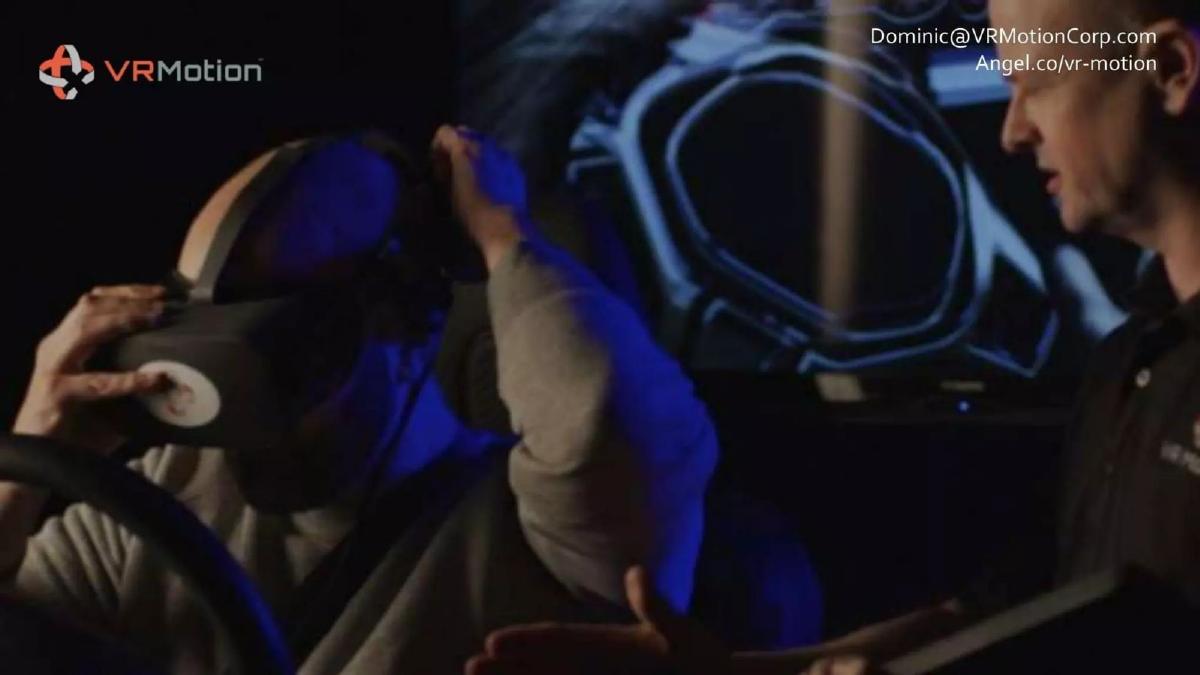
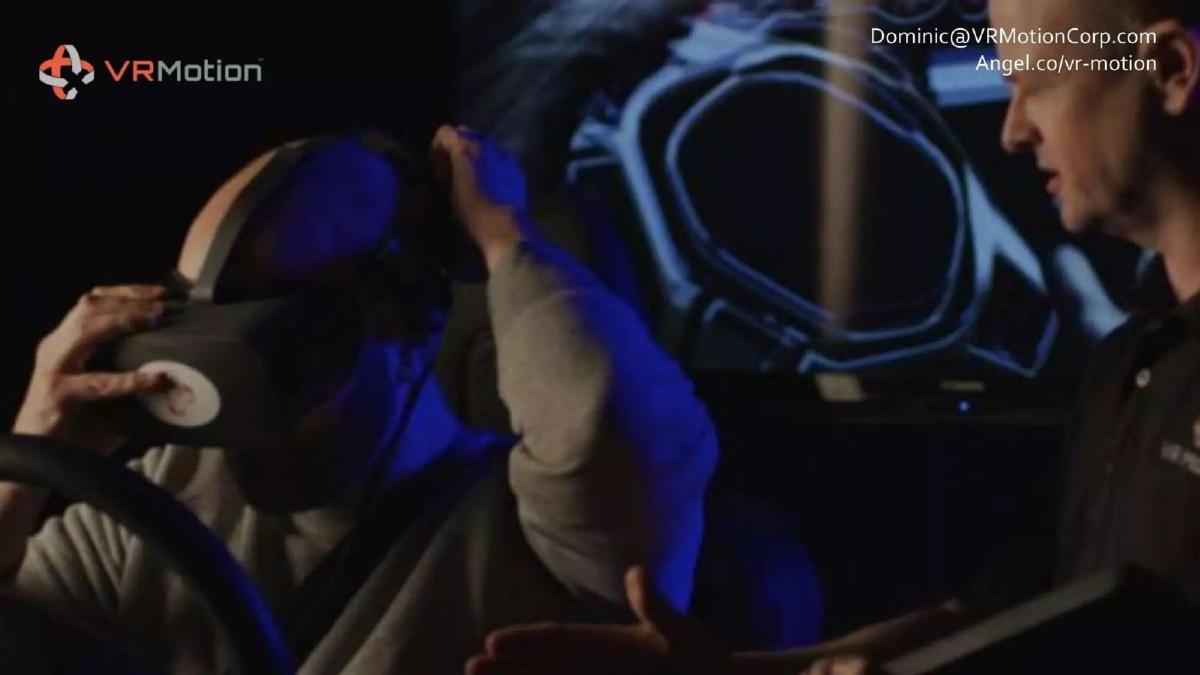
The cover slide features a high-contrast image of a user in a VR headset, presumably a driver, with an instructor looking on. The VR Motion logo is prominent, and the contact information for Dominic Dobson is clearly displayed. Notably, the slide includes an Angel.co link, signaling that this deck was likely used for online platform fundraising or as a leave-behind for digital outreach.
Slides 2-4: The Problem and Market Opportunity
Slide 2 is the emotional hook. It uses a stark pie chart to show that auto accidents account for nearly half of all military and law enforcement deaths. This immediately elevates the product from a training tool to a life-saving necessity. The background image of police tape reinforces the gravity of the problem.
Slide 3 transitions from lives lost to dollars spent. It quantifies the market at $4 billion annually, broken down into $2,000 per driver for 2 million drivers. The headline, "yet drivers are still dying!", creates a sense of urgency and implies that the current $4 billion spend is being wasted on ineffective solutions.
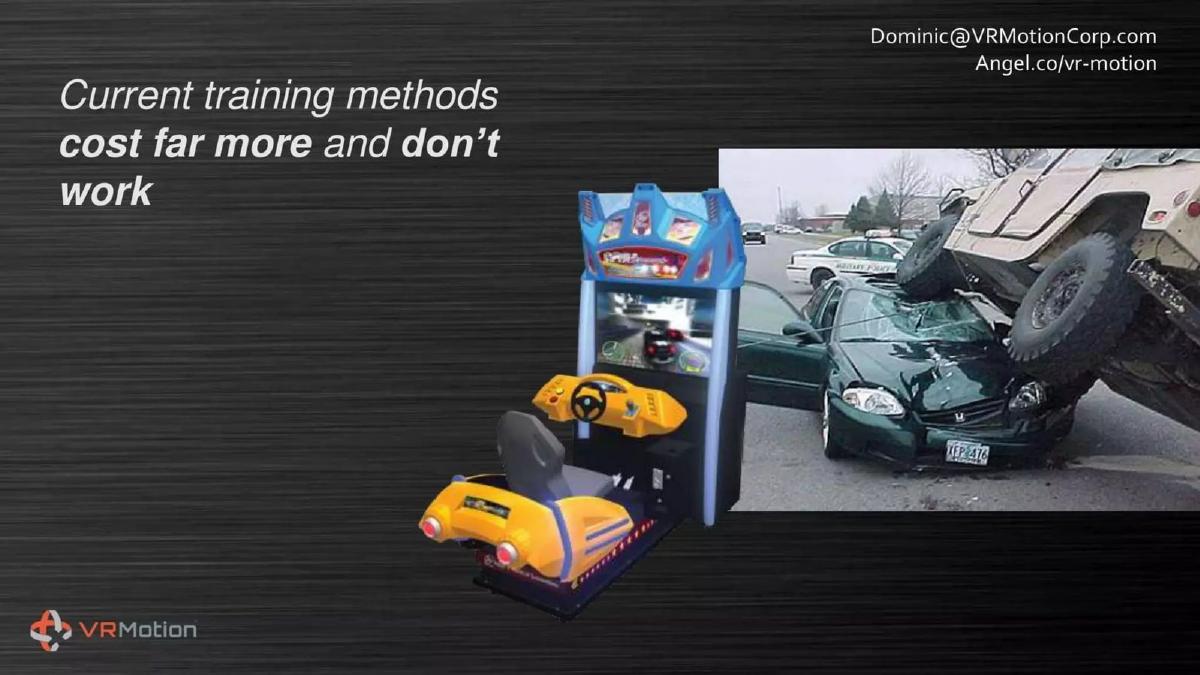
Slide 4 attacks the status quo. It features an image of a low-fidelity arcade-style driving simulator next to a photo of a real-world Humvee crash. The text states, "Current training methods cost far more and don’t work." This is a direct challenge to legacy simulator companies, positioning VR as a more effective and potentially more affordable alternative.
Slide 5: The Product Reveal
Slide 5 is a very dark, almost obscured image of what appears to be a person in a simulator rig. There is no text on this slide. In a live presentation, this would likely be the moment the founder describes the specific hardware and software capabilities. As a standalone slide, it is the weakest in the deck, providing very little information to a reader who isn't hearing the accompanying pitch.
Slide 6: The Team
This is arguably the strongest slide in the deck. The founders have exceptional founder-market fit. Dominic Dobson is listed as a former Indy 500 driver who sold AR patents to Google. Keith Maher is a 22-year Intel R&D engineer. Stephen Nauman provides the technical execution as Lead Developer. The inclusion of logos like Google, Intel, Unity, and the Indy 500 provides immediate institutional credibility that offsets the early stage of the company.
Slide 7: Traction and Revenue
Slide 7 provides the hard data. The company shows a revenue graph peaking near $60,000 in February, with a total of $266,000 in revenue over 12 months. They also note 2,500 test drives and a $4 million pipeline. The presence of the 500 Startups logo indicates they were part of the accelerator, which serves as a third-party validation of their business model.
Slide 8: The Pipeline
Slide 8 breaks down the $4 million pipeline mentioned on the previous slide. It categorizes logos into three stages: "In discussion," "Demo complete," and "RFQ/contract." High-profile names like the U.S. Air Force, State Farm, and the Oregon State Police are included. This slide is crucial because it proves that the problem identified in slides 2-4 is recognized by major government and corporate entities who are actively seeking a solution.
Slide 9: Closing and Contact
The final slide features a General Motors vehicle and the company's contact information again. It serves as a visual placeholder for Q&A. Like the rest of the deck, it is minimalist and focused on the brand identity.
What Works in This Deck
High-Stakes Problem Framing: By focusing on deaths in the military and law enforcement, VR Motion makes their product feel mandatory rather than optional. They aren't selling a better way to learn to drive; they are selling a way to stop soldiers and officers from dying in preventable accidents.
Founder-Market Fit: The combination of a professional racing driver and a long-term Intel engineer is a powerful narrative. It suggests that the company understands both the physical reality of high-performance driving and the technical requirements of building complex simulation hardware.
Clear Traction: For a pre-seed round, $266,000 in revenue is significant. It proves that there is a willingness to pay in this market, even before the product is fully scaled.
What Is Missing
The Ask: There is no slide detailing how much money the company is looking to raise or what they plan to do with the capital. While this was likely handled via the Angel.co link or in person, its absence makes the deck feel incomplete as a standalone fundraising tool.
Product Detail: We see very little of the actual software or hardware. Investors in 2016 were wary of 'vaporware' in the VR space, and more screenshots or a diagram of the simulator rig would have helped demystify the offering.
Competition: The deck ignores the existing simulator market. While slide 4 mocks arcade-style sims, it doesn't address the high-end aerospace and defense contractors who have been building multi-million dollar simulators for decades. Explaining why VR Motion is better or cheaper than those incumbents is a missed opportunity.
What a Founder Should Copy
The Pipeline Slide: Slide 8 is a perfect example of how to show a sales funnel. Instead of just listing logos, categorizing them by 'Demo complete' or 'RFQ' gives investors a clear sense of how close the company is to closing new revenue.
Quantified Problem Statements: Don't just say the market is big. Say exactly how much is spent per user ($2,000 per driver) and what the current failure rate is (nearly half of deaths). This level of specificity makes the business case much more compelling.
Minimalist Design: The deck uses very little text and relies on bold headlines and clear charts. This ensures that the audience stays focused on the speaker rather than reading paragraphs of text on the screen.
Conclusion
VR Motion’s deck is a lean, effective tool that leans heavily on the founders' expertise and the grim reality of their target market's safety record. While it leaves many technical and financial questions unanswered, it succeeds in its primary goal: proving that a massive problem exists and that this specific team is uniquely qualified to solve it. For a $500,000 pre-seed round, the traction and pipeline data provided were more than enough to justify the investment.
Frequently asked questions
- How much did VR Motion raise with this deck?
- According to the catalogue listing, VR Motion raised $500,000 in a Pre-Seed round in 2016. The deck itself does not state the amount raised or the terms of the investment, which is common for decks intended for live presentations where the 'Ask' is delivered verbally or in a follow-up document.
- What is the primary problem VR Motion aims to solve?
- The deck focuses on the failure of current driver training methods. Slide 2 states that driving accidents are responsible for nearly half of all military and law enforcement deaths. Slide 4 further argues that current training methods 'cost far more and don’t work,' illustrating this with an image of a vehicle collision.
- Who are the founders of VR Motion?
- The team consists of Dominic Dobson (Cofounder, COO), a former Indy 500 driver who sold AR patents to Google; Keith Maher (Cofounder, CEO), a 22-year Intel R&D engineer and developer of VR sims; and Stephen Nauman (Lead Developer), who has a background in AR/VR/MR from Miami University (Slide 6).
- What kind of traction did the company have at the time of the pitch?
- VR Motion showed significant early traction for a pre-seed company. Slide 7 reports $266,000 in revenue over the previous 12 months, 2,500 test drives, and a $4 million pipeline. The slide also features logos for Honda and 500 Startups, suggesting participation in the accelerator.
- What is missing from this pitch deck?
- The deck is missing several standard components: a formal 'Ask' slide, a detailed competitive analysis, a breakdown of unit economics, and a clear product roadmap. It also lacks a clear explanation of the technology stack, focusing instead on the market opportunity and the founders' credentials.