KidzJet’s 2013 seed deck is a lean, 8-slide presentation that focuses on the inefficiencies of the traditional school bus system. By positioning itself as a B2B platform connecting educational institutions with a partner network of transportation providers, KidzJet attempts to solve the 'expensive and unreliable' nature of current options. The deck excels at demonstrating early social proof, listing nearly 15 private and public institutions as partners or clients. However, it is a 'teaser' deck at best. It lacks a slide for business model mechanics, financial projections, or a specific fundra…
Key takeaways
- The deck identifies the core problem as current transportation being 'Inefficient, Expensive, and Unreliable' on slide 2.
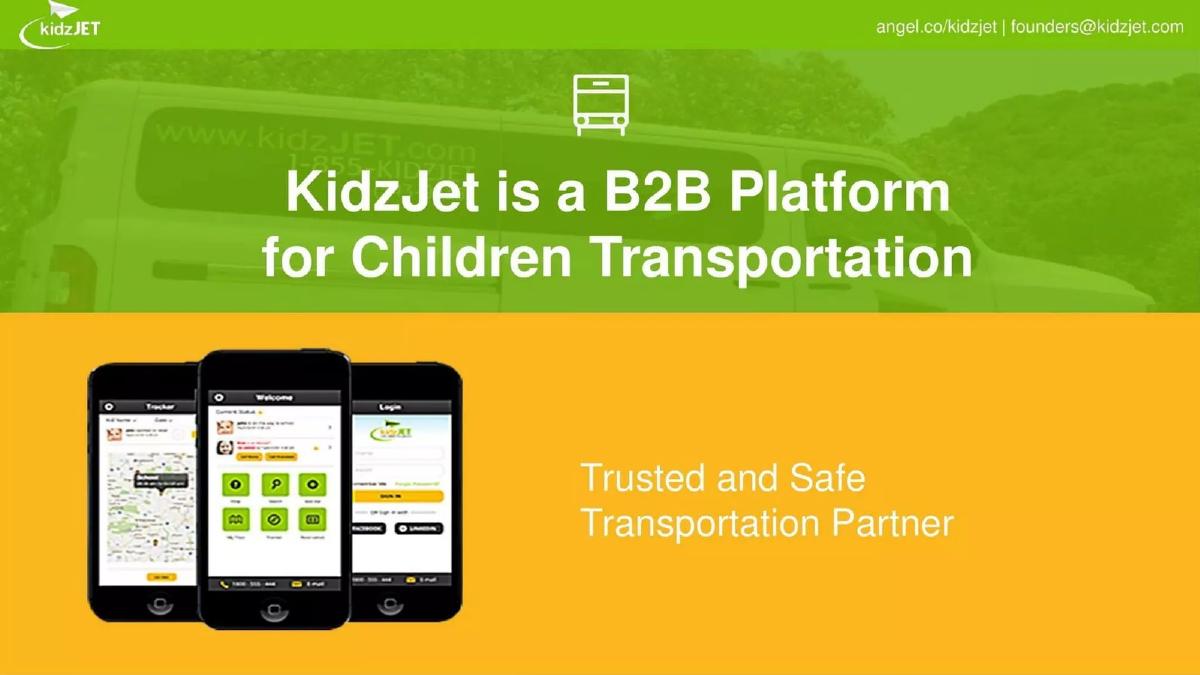
- KidzJet defines itself specifically as a B2B platform, rather than a consumer ride-sharing app, on slide 3.
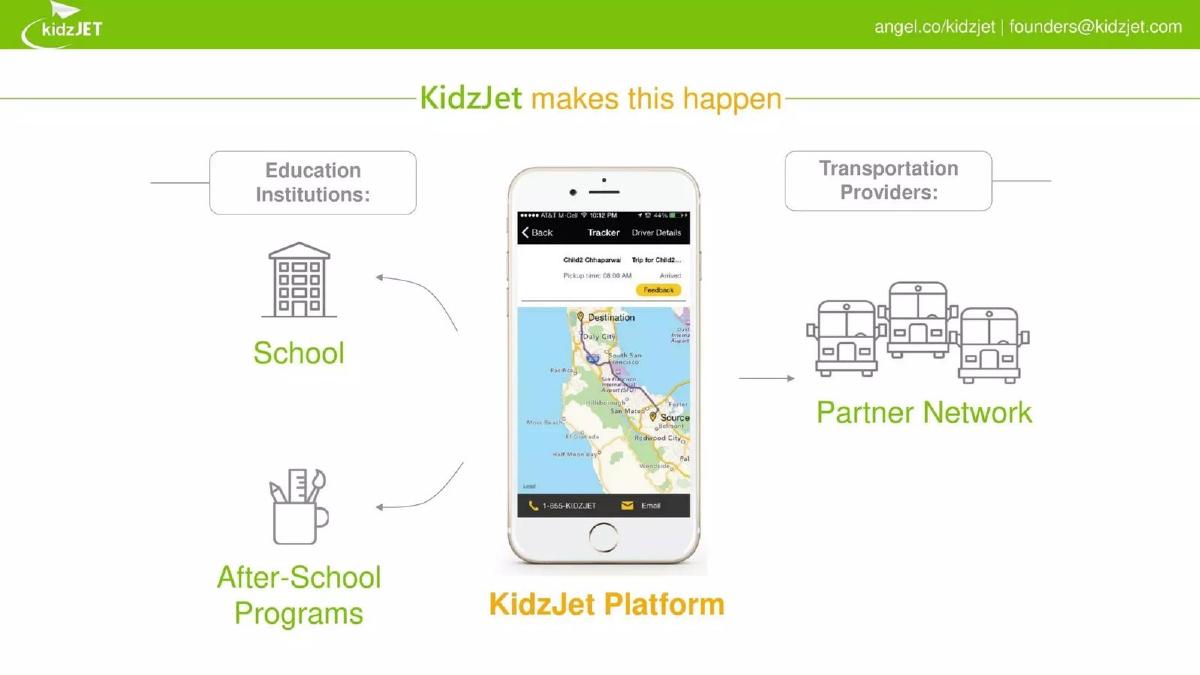
- The platform acts as a middleman between schools/after-school programs and a 'Partner Network' of transportation providers as shown on slide 4.
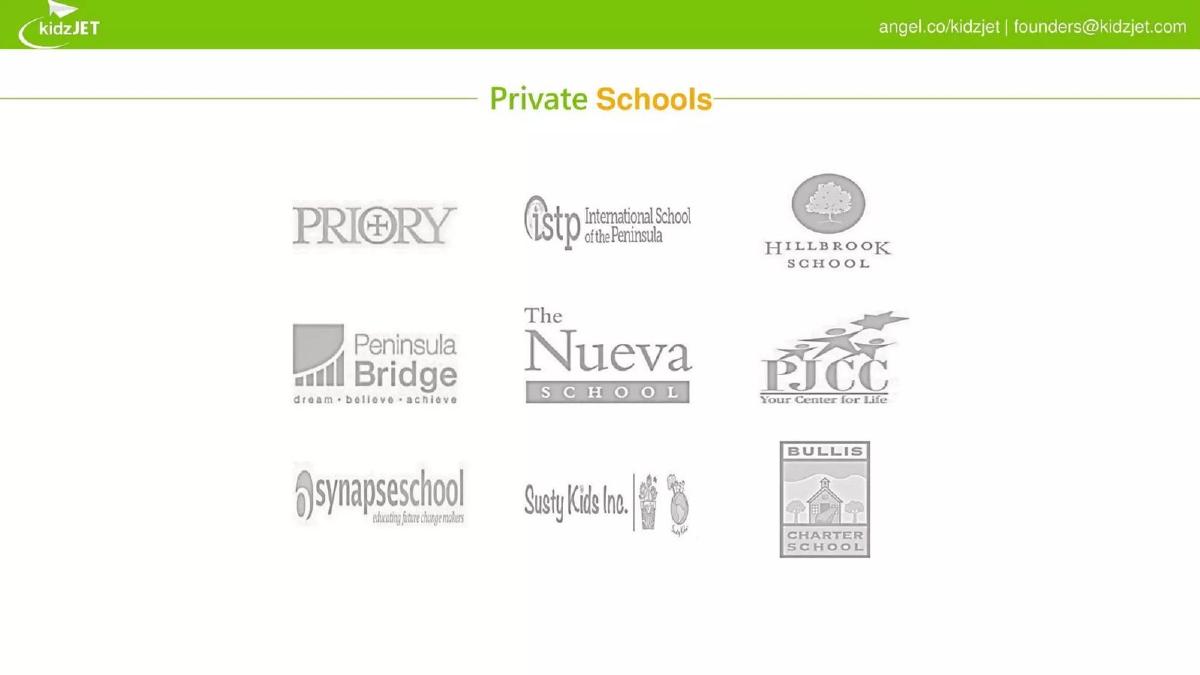
- The company demonstrates significant early traction with private schools including The Nueva School and Hillbrook School on slide 5.
- Public sector interest is evidenced by logos from the City of Saratoga and Burlingame School District on slide 6.
- The total addressable market is valued at $22 billion for the US, with a $1 billion opportunity in the Bay Area alone, according to slide 7.
- The founding team emphasizes their personal connection to the problem, stating 'Being a parent, KidzJet is more than a business to us' on slide 8.
- The deck completely omits a financial 'Ask' slide, leaving the intended raise amount and valuation unknown from the slides alone.
KidzJet: The 8-Slide Seed Teaser
The KidzJet pitch deck from 2013 is a minimalist document. At only eight slides, it functions more as a high-level introductory teaser than a comprehensive investment memorandum. The company positions itself at the intersection of EdTech and Logistics, targeting the specific pain points of school transportation. By focusing on a B2B model rather than the high-liability B2C 'Uber for kids' model that many competitors attempted, KidzJet presents a more controlled, institutional approach to the market.
The Problem and Vision (Slides 1-2)
Slide 1: Title The deck opens with the KidzJet logo and the tagline: "safe, reliable, transparent." The subtitle, "Redefining Children Transportation..." sets a broad, ambitious tone. The branding is consistent with the yellow and green color palette associated with school buses and safety.
Slide 2: The Problem KidzJet wastes no time identifying the antagonist. Against a backdrop of traditional yellow school buses, the slide states: "Current School Transportation options are Inefficient. Expensive. Unreliable." This is a classic 'status quo' slide. It targets the three main complaints of school administrators and parents: the high cost of maintaining a fleet, the logistical nightmare of routing, and the lack of real-time visibility into where a child is at any given moment.
The Solution and Platform (Slides 3-4)
Slide 3: The B2B Platform This slide is the most important for defining the business model. It explicitly states: "KidzJet is a B2B Platform for Children Transportation." By labeling itself a B2B platform, the company signals to investors that it is not looking to acquire individual parents one by one (a high CAC endeavor). Instead, it sells to institutions. The slide features three smartphone mockups showing a login screen and a tracking map, emphasizing the "Trusted and Safe" nature of the technology.
Slide 4: How It Works Slide 4 provides a simple flow chart of the ecosystem. On the left are the clients: "Education Institutions" (Schools and After-School Programs). In the center is the "KidzJet Platform," represented by an iPhone showing a live map with a driver's name ("Child2 Chhaparwal") and a pickup time of 08:00 AM. On the right is the supply side: "Transportation Providers" (Partner Network). This confirms that KidzJet acts as a marketplace or logistics layer, connecting existing transport capacity with institutional demand.
Traction and Social Proof (Slides 5-6)
Slide 5: Private Schools Traction is the strongest part of this deck. Slide 5 displays nine logos of private schools and organizations. Notable names include Priory, ISTP (International School of the Peninsula), Hillbrook School, Peninsula Bridge, The Nueva School, PJCC, Synapse School, Susty Kids Inc., and Bullis Charter School. For a seed-stage company in 2013, this is a significant list of high-end private educational partners, suggesting the product had already cleared the high bar of institutional safety requirements.
Slide 6: Public Schools The deck doubles down on social proof by showing public sector adoption. Logos include the City of Los Altos Recreation Department, the City of Saratoga, Burlingame School District, and Foster City Parks & Recreation. This indicates that the platform is versatile enough to handle both private tuition-based schools and municipal recreation programs, significantly expanding the potential user base.
Market Size and Team (Slides 7-8)
Slide 7: Market Opportunity KidzJet uses a vertical bar chart to illustrate the "Disrupting $22B Market." The data points are specific: $1 billion in the Bay Area, $5 billion in California, $16 billion in the top 100 US Metros, and a total US market of $22 billion. This slide tells investors that while the company is currently focused on the Bay Area (as evidenced by the traction slides), there is a clear path to a massive national scale.
Slide 8: The Team The final slide introduces the three founders. Benazir Shaikh (CEO/Co-Founder) is labeled an entrepreneur with a background from York University. Ashish Chhaparwal (Co-Founder) brings finance and entrepreneurship experience, with an IIT logo. Rajat Tikoo (Engineering) covers the technical side with a background in finance and technology from the University of Virginia. The slide ends with a personal note: "Being a parent, KidzJet is more than a business to us," aiming to establish founder-market fit through personal empathy.
What Works in the KidzJet Deck
The deck is exceptionally clear about what the company does and who it serves. By using the term "B2B Platform" repeatedly, it avoids the confusion of being mistaken for a consumer app. The traction slides (5 and 6) are the highlight; seeing recognizable, high-trust institutions like The Nueva School or municipal recreation departments provides immediate credibility that a startup in the transportation space desperately needs. The market sizing on slide 7 is also well-structured, showing a logical progression from a local pilot to a national opportunity.
What is Missing from the KidzJet Deck
The most glaring omission is the Financial Ask . There is no slide stating how much money the company is raising, what the terms are, or what milestones the funding will achieve. Furthermore, the deck lacks any mention of Unit Economics . Investors would want to know the take-rate from the partner network, the cost of acquiring a school, and the average contract value. There is also no Competition slide. In 2013, several startups were entering the 'safe transport for kids' space, and failing to address how KidzJet differs from competitors (or traditional bus companies) is a missed opportunity. Finally, the Product section is thin; we see a map, but we don't see the administrative dashboard that a school would use to manage their fleet, which is a key part of a B2B value proposition.
What a Founder Should Copy
Founders should emulate the Institutional Social Proof layout used on slides 5 and 6. Grouping logos by category (Private vs. Public) tells a story of market versatility. Additionally, the Market Sizing approach on slide 7 is a great template for startups starting in a specific geography. By showing the Bay Area as a $1B subset of a $22B national market, the founders prove they have a massive ceiling while remaining grounded in their current operational reality. Lastly, the Problem Slide (Slide 2) is a model of brevity—using three powerful adjectives and a clear image to establish the need for change.
Frequently asked questions
- What is the primary business model of KidzJet based on this deck?
- Based on slide 4, KidzJet operates as a B2B platform. It serves as the connective tissue between 'Education Institutions' (schools and after-school programs) and 'Transportation Providers' (a partner network). The platform provides the technology interface—shown as a mobile tracking app—to facilitate these logistics. It does not appear to own the fleet directly, but rather manages the 'Partner Network' through its software.
- How does KidzJet quantify its market opportunity?
- On slide 7, the company provides a tiered market analysis. They value the Bay Area market at $1 billion, the California market at $5 billion, the top 100 US Metros at $16 billion, and the total US market at $22 billion. This suggests a strategy of regional dominance starting in Northern California before scaling to other major metropolitan areas.
- Who are the key members of the KidzJet founding team?
- Slide 8 lists three key leaders: Benazir Shaikh (CEO/Co-Founder), Ashish Chhaparwal (Co-Founder), and Rajat Tikoo (Engineering). The slide highlights their educational backgrounds at York University, IIT, and the University of Virginia. Their professional focus is listed as finance, technology, and entrepreneurship, though specific past company names are not provided.
- What evidence of product-market fit is presented?
- Traction is presented through two logo walls on slides 5 and 6. Slide 5 shows partnerships with nine private institutions, including Priory, Synapse School, and Peninsula Bridge. Slide 6 shows five public sector entities, including the City of Los Altos Recreation Department and Foster City Parks & Recreation. This suggests the platform had successfully onboarded institutional clients prior to the 2013 seed round.
- What critical information is missing from the KidzJet pitch deck?
- The deck is missing several standard venture components. There is no 'Ask' slide detailing how much capital is being raised or how it will be used. There are no financial projections, unit economics (CAC/LTV), or revenue figures. Additionally, there is no competition slide, which is a significant omission in the crowded transportation logistics space.