Keyway raised $15M in 2021 with a deck that prioritizes market size and team expertise over granular financial disclosures. The presentation identifies a massive $5T+ target market of small and medium business (SMB) properties, characterized by a 'painful and costly' traditional sales process. By positioning themselves as a tech-enabled bridge between fragmented sellers and institutional investors, Keyway promises to reduce transaction times by 90%. While the deck is light on specific unit economics and historical traction—using placeholders like '$X' for volume projections—the strength of th…
Key takeaways
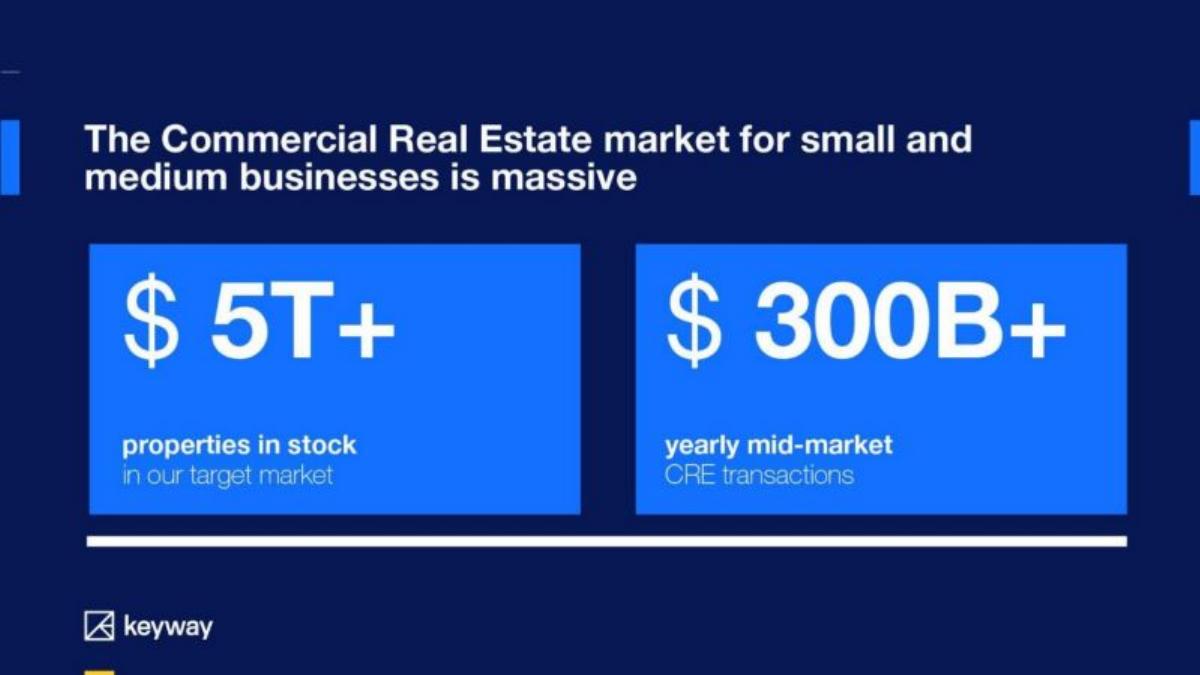
- The deck identifies a massive $5T+ property stock in its target market on Slide 4.
- The founding team leverages high-prestige alumni logos from Goldman Sachs, Google, and McKinsey to establish immediate credibility on Slide 3.
- Keyway claims its approach can reduce real estate transaction time by 90% compared to traditional methods on Slide 6.
- The business model relies on aggregating single properties into portfolios for institutional investors, as illustrated on Slide 8.
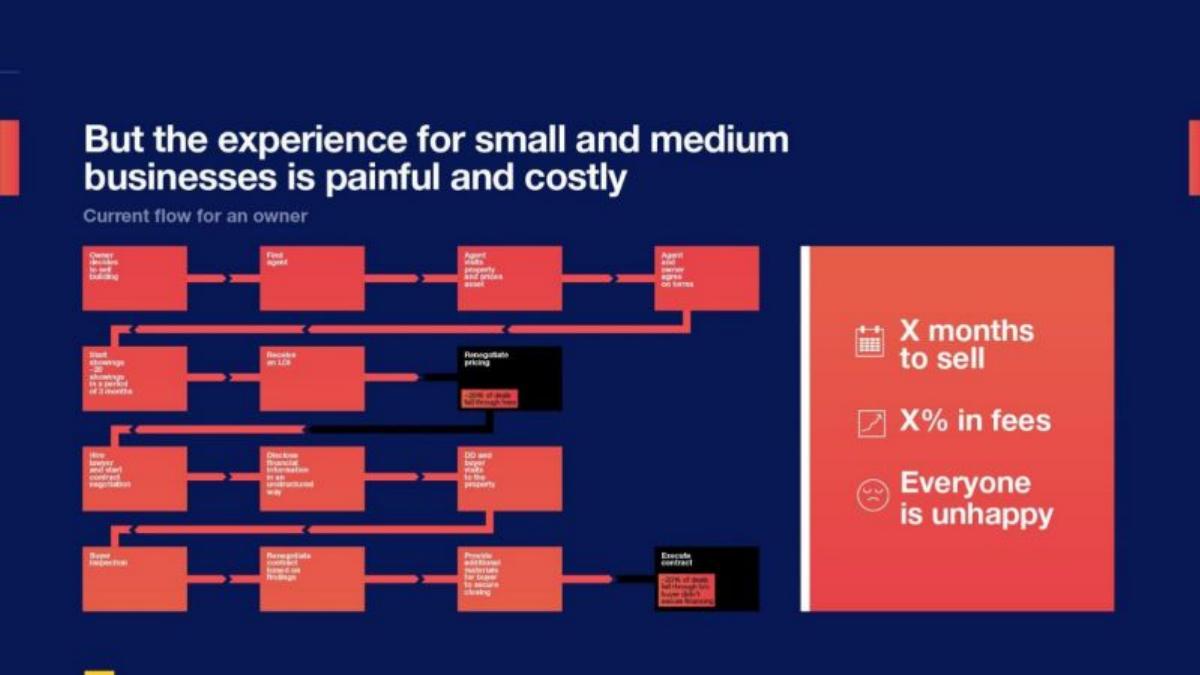
- The problem slide (Slide 5) uses a complex 15-step flowchart to visualize the 'painful' current state of CRE transactions.
- Keyway positions itself as a high-margin business with recurring revenues on Slide 8, though specific fee structures are not disclosed.
- The deck omits all specific financial figures, using '$X' and 'X%' as placeholders for transaction volume and costs on Slides 7 and 9.
- The technology stack is described as 'Machine Learning powered sourcing and underwriting' on Slide 7, but lacks technical detail.
The $15M Seed Deck: A Deep Dive into Keyway
Keyway’s 2021 pitch deck is a concise 10-slide presentation that focuses on the inefficiency of the mid-market commercial real estate (CRE) sector. By targeting properties valued under $10M—a segment often ignored by large institutional players due to fragmentation—Keyway positioned itself as a tech-enabled aggregator. This teardown examines how they used a 'team-first' and 'market-size-first' strategy to secure a $15M Seed round.
Slide 1: Title Slide
The deck opens with a minimalist title slide featuring the Keyway logo and name against a dark blue background. There is no tagline or mission statement on this slide, relying entirely on brand identity to set the tone.
Slide 2: The Mission Statement
"Keyway is the real estate solution that makes it easy for small and medium businesses to quickly and predictably achieve their goals."
This slide serves as the high-level value proposition. It identifies the target demographic (SMBs) and the primary benefits (speed and predictability). It is a standard 'About' slide that defines the company's purpose before diving into the mechanics of the business.
Slide 3: Team Pedigree
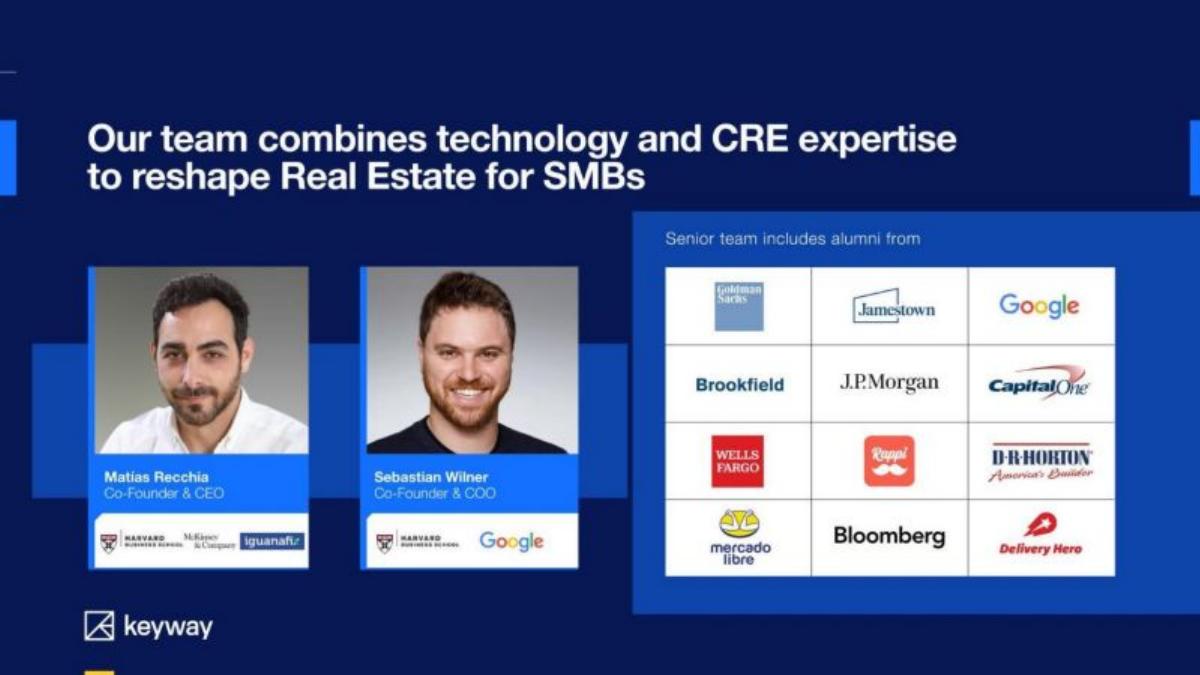
This is arguably the most important slide for a Seed-stage company. Keyway highlights its co-founders, Matías Recchia (CEO) and Sebastian Wilner (COO). The slide emphasizes a combination of "technology and CRE expertise."
The credibility is reinforced by a 'Senior team includes alumni from' section featuring 12 high-profile logos, including Goldman Sachs, J.P. Morgan, Google, Brookfield, and McKinsey & Company . For a $15M Seed round, investors are often betting on the team's ability to navigate complex markets, and this slide provides that assurance.
Slide 4: Market Opportunity
$5T+ properties in stock in their target market. · $300B+ yearly mid-market CRE transactions.
By defining the 'mid-market' as their playground, they signal to investors that they are not competing for trophy skyscrapers, but rather the vast, underserved 'long tail' of commercial real estate.
Slide 5: The Problem (The 'Painful' Flow)
This slide uses a red-themed flowchart to illustrate the current 15-step process an owner faces when selling a building. It highlights friction points such as "20 showings over 3 months," "20% of deals fall through" during price renegotiation, and "Buyer didn't secure financing."
The summary box on the right uses placeholders: "X months to sell," "X% in fees," and "Everyone is unhappy." Despite the lack of specific numbers, the visual complexity of the flowchart effectively communicates that the current system is broken.
Slide 6: The Solution
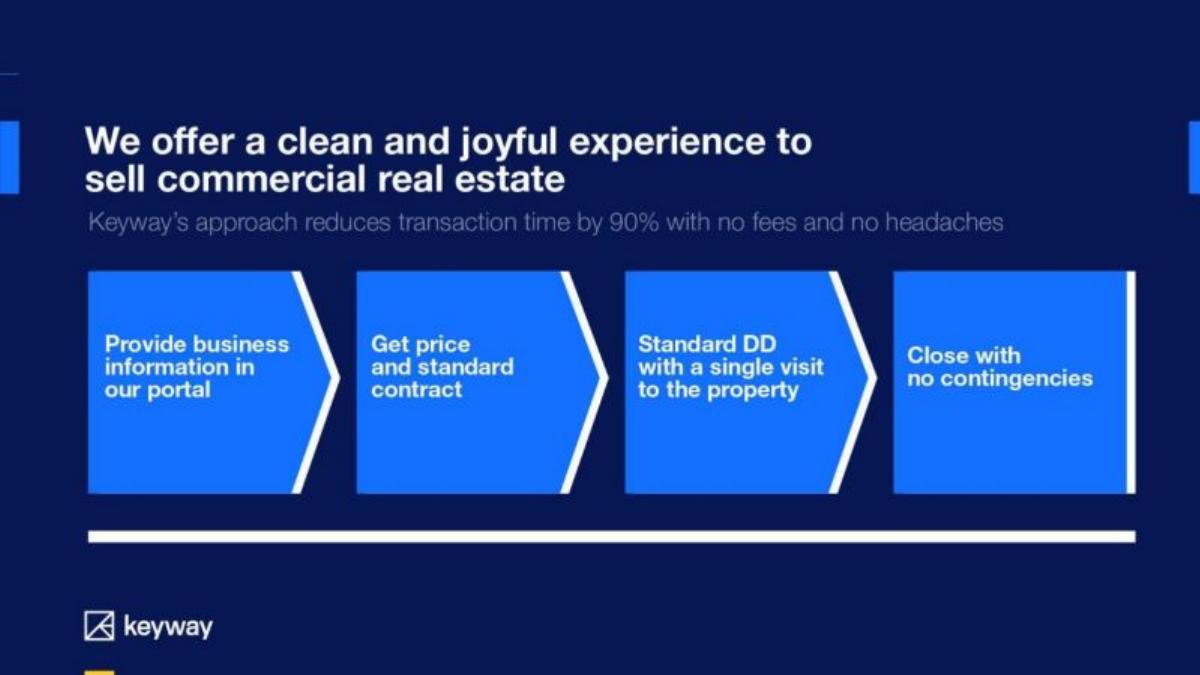
Keyway counters the previous slide with a blue, four-step 'joyful experience':
Provide business information in our portal. · Get price and standard contract. · Standard DD (Due Diligence) with a single visit. · Close with no contingencies.
The headline claims this approach "reduces transaction time by 90% with no fees and no headaches." This is a bold claim that sets the stage for their technological advantage.
Slide 7: The Technology Platform
This slide attempts to explain how they achieve the 90% reduction in time. They cite three components:
Machine Learning: For sourcing and underwriting. · UX: For customer experience. · Digital Tools: To simplify workflow.
A 'From/To' graphic at the bottom visualizes the compression of transaction costs and time, though it again uses "X months & X%" as placeholders. This slide is intended to convince investors that Keyway is a 'PropTech' company, not just a real estate brokerage.
Slide 8: The Business Model (Aggregation)
This slide clarifies Keyway's role as the middleman. They take "Single property" assets from "Sellers" and package them into "Property portfolios" for "Investors."
The value exchange is clearly defined: Sellers get an "easy, low-cost, guaranteed closing," while Investors get "asset-backed, high-yield investments." Keyway claims for itself "High margins" and "Recurring revenues," though the source of the recurrence (likely property management or asset management fees) is not detailed.
Slide 9: Growth Projections
The final content slide shows a bar chart titled "Our current playbook takes us to $X in transaction volume in 3 years." The chart shows aggressive year-over-year growth from 2021 to 2024. Because all values are listed as "$X," the slide functions more as a visualization of intended scale rather than a financial forecast. It suggests a 'blitzscaling' approach to market capture.
Slide 10: Closing Slide
The deck ends with a promotional slide for the source library, which is not part of the original Keyway presentation.
What Keyway's Deck Does Well
1. Clear Market Segmentation: By focusing on the sub-$10M market, Keyway avoids the 'red ocean' of institutional CRE and targets a fragmented space where technology can actually provide a competitive edge through aggregation.
2. Visualizing the Pain: The flowchart on Slide 5 is an excellent way to show, rather than just tell, how inefficient the status quo is. It makes the 90% time-reduction claim on the following slide feel necessary rather than just ambitious.
3. Institutional Credibility: The team slide is exceptionally strong. In real estate, who you know and where you've worked matters. The logos of Goldman Sachs and J.P. Morgan serve as a proxy for the 'trust' required to handle multi-million dollar transactions.
What is Missing from the Keyway Deck
1. Specific Unit Economics: The deck is entirely devoid of actual percentages or dollar amounts regarding their take rate, margins, or transaction costs. While this may have been redacted for public viewing, a Seed deck usually needs to demonstrate a clear path to profitability per transaction.
2. Competitive Landscape: There is no mention of other PropTech players or traditional brokerages. Investors would want to know how Keyway protects its 'high margins' from competitors like Roofstock or traditional firms like CBRE's small-cap divisions.
3. Traction Data: Since this was a 2021 Seed round, one would expect to see data from a pilot program or initial 'LOIs' (Letters of Intent). The deck focuses on the 'playbook' and 'projections' rather than what has already been achieved.
4. Regulatory and Capital Strategy: Real estate aggregation requires significant capital. The deck doesn't explain if Keyway is buying these properties on their own balance sheet (using a warehouse line) or if they are acting purely as a marketplace. This is a critical distinction for a business's risk profile.
Founder's Guide: What to Copy from Keyway
The 'Problem/Solution' Contrast: Founders should emulate the way Keyway uses color (Red for the problem, Blue for the solution) and layout to create a stark visual contrast between the 'painful' present and the 'joyful' future. It makes the product's value feel intuitive.
The Aggregation Narrative: If you are building a marketplace, Slide 8 is a perfect template. It shows the 'Input' (fragmented sellers), the 'Engine' (your company), and the 'Output' (institutional-grade products). It simplifies a complex business model into a single flow.
Focus on the 'Why Now': While not explicitly labeled, the combination of Slide 4 (Market Size) and Slide 7 (Tech Platform) creates a 'Why Now' narrative: the market is massive, and we finally have the ML/UX tools to aggregate it efficiently. Founders should always link their tech stack directly to a specific market inefficiency.
Frequently asked questions
- How much did Keyway raise with this deck?
- According to the catalogue listing, Keyway raised $15M in a Seed round in 2021. This is a notably large Seed round, likely driven by the capital-intensive nature of real estate aggregation and the high-pedigree founding team highlighted in the deck.
- What is Keyway's core value proposition?
- Keyway aims to simplify the commercial real estate (CRE) selling process for small and medium businesses. Slide 6 states they offer a 'clean and joyful experience' that reduces transaction time by 90% with no fees for the seller and no contingencies at closing.
- Who are the target customers for Keyway?
- The deck identifies two sides of its platform on Slide 8: Sellers (SMBs with properties under $10M) and Investors (institutional players seeking asset-backed, high-yield investments). The editorial context notes an initial focus on the medical domain, such as dental clinics and veterinarian offices.
- What technology does Keyway use?
- Slide 7 highlights a 'tech platform' consisting of three pillars: Machine Learning for sourcing and underwriting, a UX-focused customer portal, and digital workflow tools to simplify application and closing. The goal is to move from a multi-month process to a single-month transaction.
- Why are there so many 'X' placeholders in the deck?
- Slides 5, 7, and 9 use 'X' instead of specific numbers for transaction costs, timeframes, and volume. This is common in public versions of decks to protect sensitive competitive data or because the deck was used as a visual aid for a verbal presentation where the numbers were discussed.