Kenjo’s 2019 seed deck is a masterclass in brevity, consisting of only eight slides. The company, an all-in-one HR software for SMEs, successfully raised $7.2 million by focusing heavily on the pain points of the European market. The deck relies on startling statistics—such as the fact that 93% of SMEs use outdated HR software—to establish a clear need. While it lacks standard sections like a detailed roadmap, competitor analysis, or a specific financial ask, it compensates with high-fidelity product mockups and a clear value proposition for both employers and employees. This teardown explore…
Key takeaways
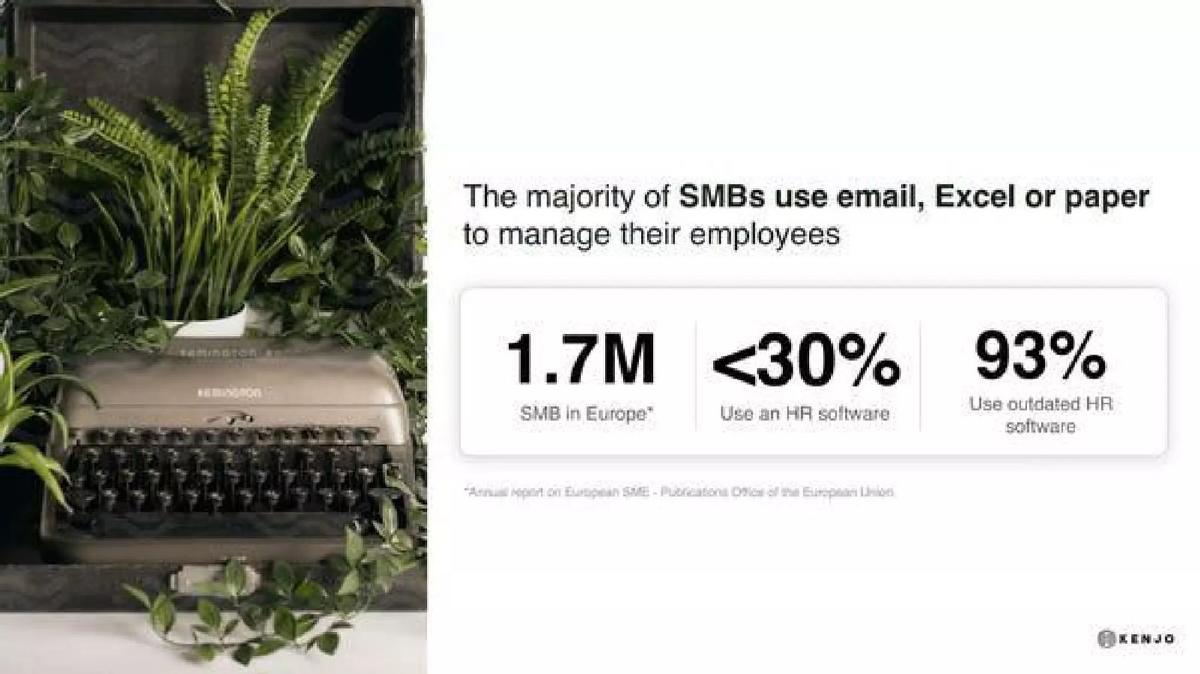
- The deck identifies a massive market gap, noting that 1.7M European SMBs exist but less than 30% use HR software (Slide 2).
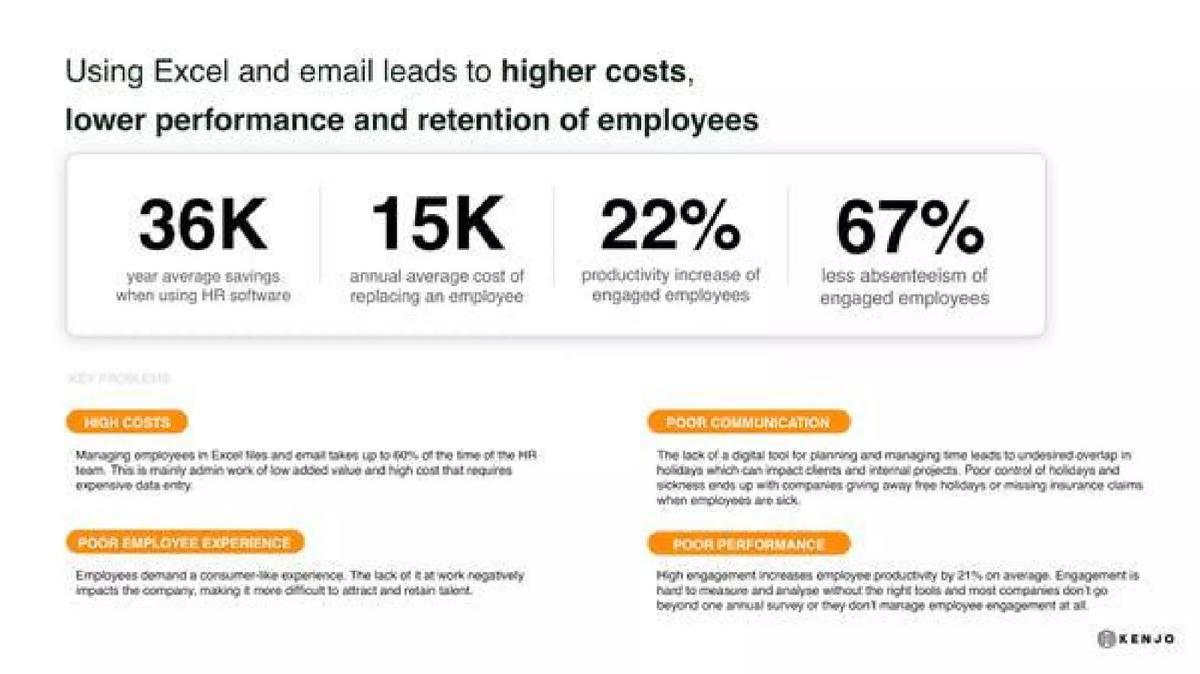
- Kenjo quantifies the cost of the status quo, citing a 36K average annual savings when switching to HR software (Slide 3).
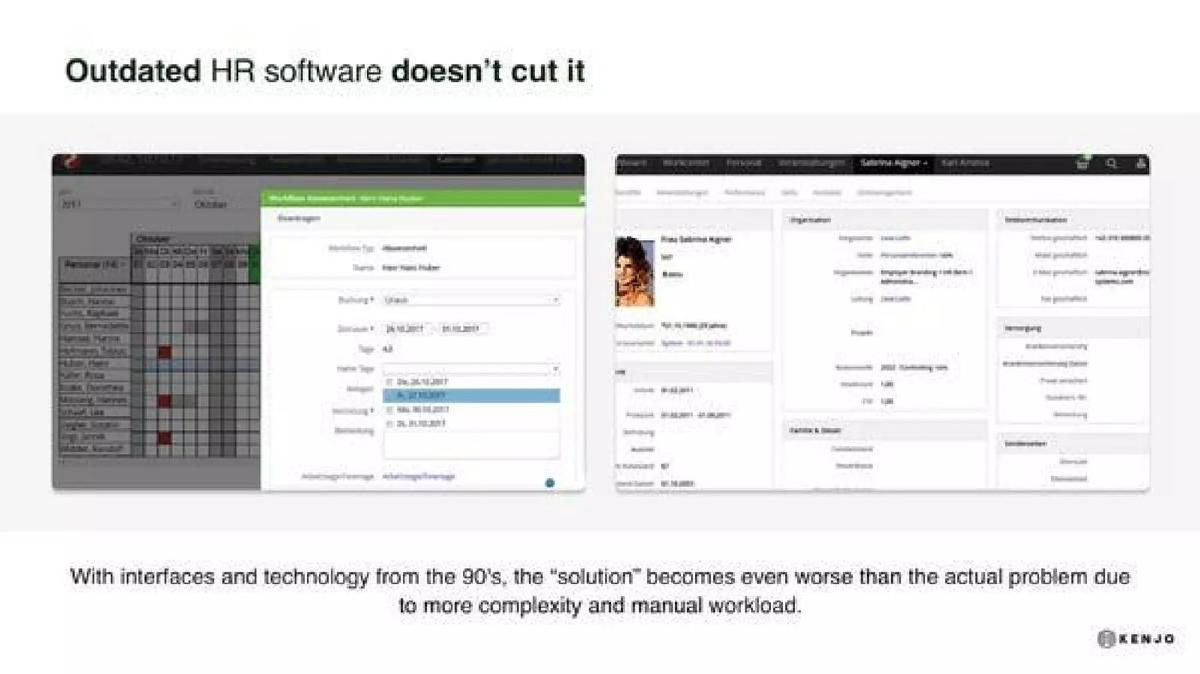
- The presentation uses a 'villain' slide to show the complexity and 90s-era interfaces of existing legacy solutions (Slide 4).
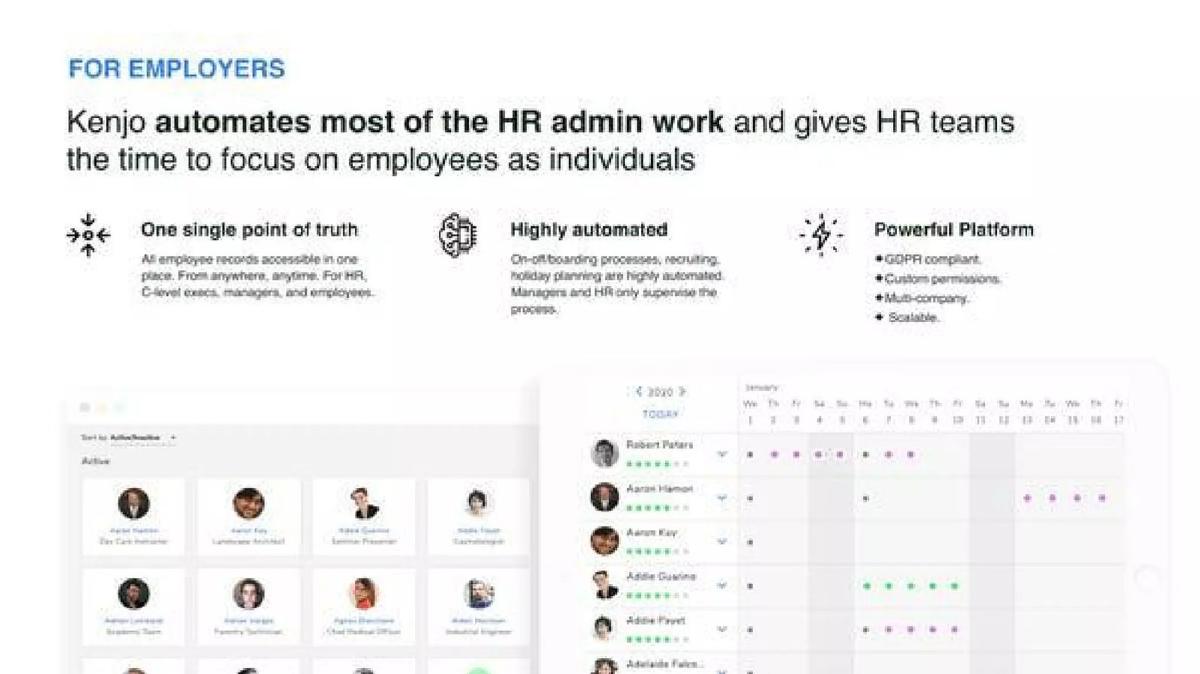
- Product features are split between two distinct user personas: Employers (Slide 6) and Employees (Slide 7).
- The deck highlights specific automation capabilities, such as on/offboarding and holiday planning, to address the 60% of HR time spent on admin (Slide 3, Slide 6).
- There is a complete absence of a 'Competition' slide, suggesting the founders viewed the primary competitor as manual processes like Excel.
- No financial projections, business model details, or specific funding 'ask' are included in these 8 slides.
- The team slide is reduced to a single individual, Co-founder & CEO David Padilla, on the final 'Thank You' slide (Slide 8).
The 8-Slide Strategy: Less is More in HR Tech
Kenjo’s 2019 seed deck is an anomaly in the world of venture capital. While many founders struggle to condense their vision into 20 slides, Kenjo managed to secure a $7.2 million round using just eight. The deck is characterized by clean design, a heavy emphasis on market pain points, and a bifurcated view of the product’s value. It doesn't try to answer every question; instead, it focuses on proving that the current way SMEs manage people is fundamentally broken.
Slides 1-2: The Hook and the Market Gap
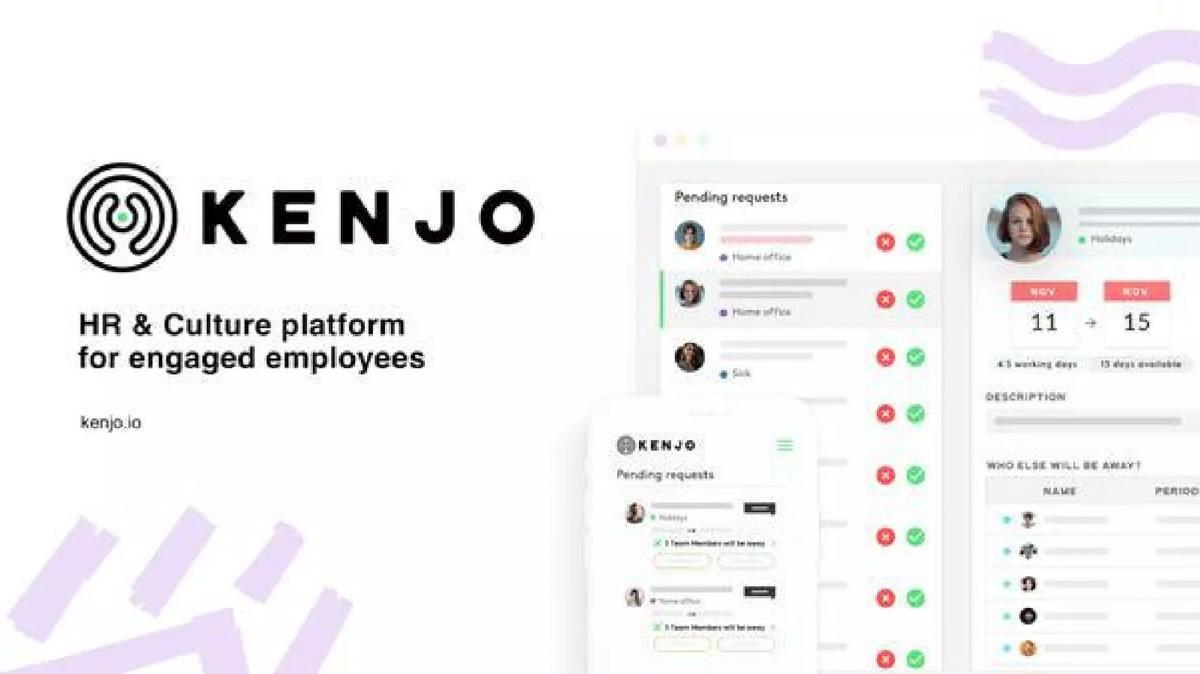
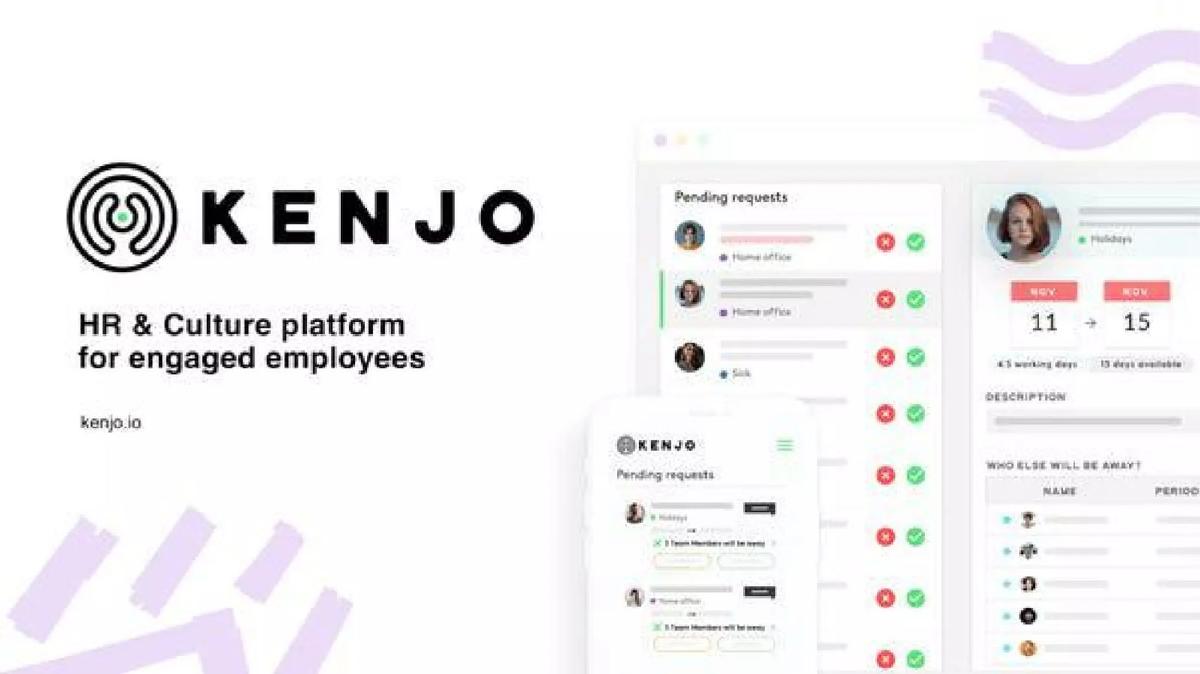
Slide 1 is a standard title slide, introducing Kenjo as an "HR & Culture platform for engaged employees." The inclusion of "Culture" in the tagline is a strategic choice, signaling that this isn't just a database for payroll, but a tool for organizational health. The visual features a clean mobile and desktop interface mockup, establishing the brand's modern aesthetic immediately.
Slide 2 dives straight into the problem. It uses a striking image of a vintage typewriter surrounded by plants to symbolize how outdated current HR practices are. The data points are the stars here: 1.7M SMBs in Europe, with less than 30% using any HR software. The most damning statistic provided is that 93% of those who do use software are using "outdated" versions. This slide successfully argues that the market isn't just underserved; it is poorly served by incumbents.
Slides 3-4: Quantifying the Pain and Identifying the Villain
Slide 3 shifts from market size to economic impact. It lists four key metrics to justify the investment in HR tech: a 36K average annual savings, a 15K cost to replace an employee, a 22% productivity boost from engagement, and a 67% reduction in absenteeism. Below these figures, the deck outlines "Key Problems" such as high costs—noting that HR teams spend up to 60% of their time on low-value admin work. By quantifying the problem in dollars and percentages, Kenjo moves the conversation from "nice-to-have" to "business-critical."
Slide 4 is the "Villain" slide. It shows two screenshots of legacy HR software that look like Windows 95 spreadsheets. The caption, "Outdated HR software doesn't cut it," reinforces the idea that the existing solutions are actually worse than the problem because they add complexity and manual workload. This creates a perfect segue into Kenjo’s modern solution.
Slides 5-7: The Solution and Persona-Based Value
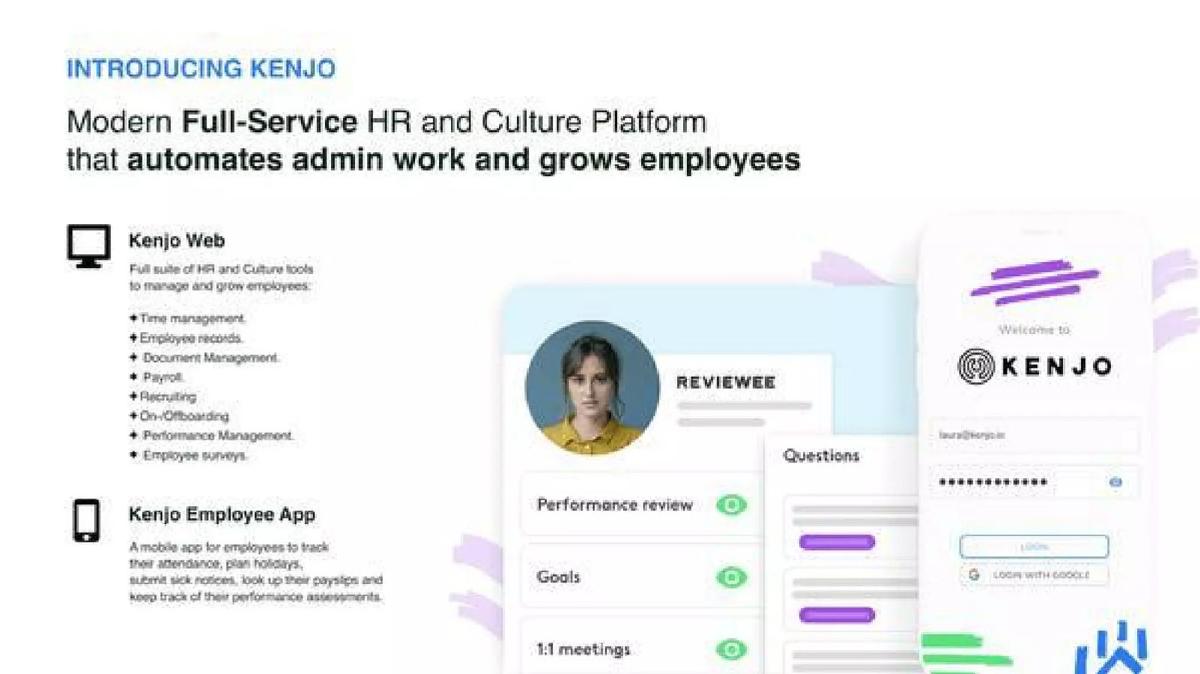
Slide 5 introduces Kenjo as a "Modern Full-Service HR and Culture Platform." It breaks the offering into two components: Kenjo Web (the full suite for admin) and the Kenjo Employee App (the mobile tool for staff). The slide lists features like time management, payroll, recruiting, and performance management. This is the first time the investor sees the breadth of the "all-in-one" claim.
Slide 6 focuses on the "Employer" persona. It highlights three pillars: a single point of truth, high automation (specifically for onboarding and holiday planning), and a powerful, GDPR-compliant platform. The mockups show a clean directory of employees and a calendar view, emphasizing ease of use for managers who are currently drowning in Excel files.
Slide 7 addresses the "Employee" persona. This is a crucial distinction in modern SaaS; if employees hate the tool, adoption fails. Kenjo highlights mobile access for payslips and holidays, alongside "Goals and Performance" tracking. The visual shows a 9-box grid for talent management ("Future leader" vs. "High impact performer"), suggesting that Kenjo helps companies identify and nurture talent, not just track their time off.
Slide 8: The Conclusion and Missing Elements
Slide 8 is a simple "Thank You" slide featuring Co-founder & CEO David Padilla. Notably, this is the only mention of the team in the entire deck. There are no bios for other co-founders, no mention of previous exits, and no logos of former employers like Google or McKinsey that often clutter seed decks.
What Works in the Kenjo Deck
The strength of this deck lies in its clarity of purpose . It identifies a specific geographic market (Europe) and a specific segment (SMBs) that are demonstrably behind the digital curve. By using Slide 4 to show how ugly and difficult legacy software is, they make their own product look revolutionary by comparison, even if the features (payroll, time tracking) are standard for the industry.
The economic justification on Slide 3 is also excellent. Founders often forget to tell investors how their product saves or makes money. Kenjo explicitly states that HR teams spend 60% of their time on admin and that replacing an employee costs 15K. These numbers give an investor a framework for calculating the Return on Investment (ROI) for a potential customer.
What is Missing from the Kenjo Deck
For a $7.2M seed round, this deck is extraordinarily light on business fundamentals . The following elements are completely absent:
Business Model: There is no mention of pricing tiers, average contract value (ACV), or whether they charge per seat or per month. · Go-To-Market (GTM): How will they acquire these 1.7M SMBs? Will they use a direct sales force, partnerships, or a product-led growth (PLG) model? · Competition: The deck ignores other modern HR players like Personio or Hibob, which were already active in the European market in 2019. · Traction: There are no charts showing user growth, revenue growth, or current customer logos. · The Ask: The deck does not state how much money they are looking for or what they plan to do with it.
The absence of these slides suggests that this deck was likely a visual accompaniment to a much more detailed conversation or a comprehensive data room. It is a "narrative deck" designed to sell the vision, not a "diligence deck" designed to prove the math.
What a Founder Should Copy
Founders should emulate Kenjo’s persona-based feature breakdown . By splitting the product slides into "For Employers" and "For Employees," Kenjo demonstrates that they understand the dual-sided nature of enterprise software adoption. If you are building a tool that requires two different groups to interact, show how both groups win.
Additionally, the use of a 'Villain' slide is highly effective. If you are entering a crowded market, don't just say you are better; show why the current leaders are frustrating. A side-by-side comparison (or in this case, a sequential comparison) of a clunky 90s UI versus a sleek 2019 UI is a powerful emotional trigger for investors who have likely used bad corporate software themselves.
Final Thoughts
Kenjo’s deck is a reminder that you don't need 40 slides to tell a compelling story. If the market opportunity is massive and the current solutions are objectively terrible, a few well-placed statistics and high-quality product shots can be enough to open the door. However, most founders should treat this as a minimum viable deck; unless you have the pedigree or the existing investor interest that Kenjo likely had, you will probably need to include the traction and competition slides that this deck so boldly omitted.
Frequently asked questions
- How did Kenjo raise $7.2M with only 8 slides?
- Kenjo likely used this deck as a 'teaser' or a high-level visual aid for in-person meetings rather than a standalone document. By focusing on the massive inefficiency in the European SME market—where 93% of companies use outdated tools—they established a compelling 'why now' that justified deeper due diligence beyond the slides themselves.
- What are the most significant omissions in this deck?
- The deck lacks a Go-To-Market (GTM) strategy, a competitive landscape, unit economics (CAC/LTV), and a roadmap. Most importantly, there is no slide detailing the use of funds or the specific amount being raised. These are usually mandatory for Seed rounds, suggesting Kenjo had strong existing investor relationships or a separate data room.
- Why does the deck focus so much on employee engagement?
- Slide 3 links engagement directly to the bottom line, citing a 22% productivity increase and 67% less absenteeism for engaged employees. By framing HR software as a performance tool rather than just an admin tool, Kenjo elevates its value proposition from a cost-center to a profit-driver.
- Is the market size clearly defined?
- The deck defines the market by volume (1.7M SMBs in Europe) rather than Total Addressable Market (TAM) in dollars. While this shows the breadth of the opportunity, it leaves the investor to calculate the potential revenue based on assumed seat prices or subscription tiers.
- How is the product demonstrated?
- Instead of bulleted lists, Kenjo uses high-fidelity mockups of their web and mobile interfaces. Slides 5, 6, and 7 show the actual UI for performance reviews, holiday tracking, and employee records, which helps investors visualize the 'modern' alternative to the 90s-style software shown on Slide 4.