The July 2021 HUT 8 investor presentation serves as a progress report and strategic roadmap for one of North America's largest publicly traded cryptocurrency miners. The deck emphasizes operational scale, citing a projected Q4 2021 hashrate of 2.5-3.0 E/H and a reserve of 3,806 self-mined Bitcoin. Beyond pure mining, the company outlines a 'diversified business model' that includes white-label hosting and earning yield on its Bitcoin holdings. By showcasing partnerships with industry giants like NVIDIA and Galaxy Digital, HUT 8 positions itself not just as a miner, but as a critical infrastru…
Key takeaways
- HUT 8 reported holding 3,806 self-mined Bitcoin as of July 2021, claiming the largest such holdings of any publicly traded company at the time (Slide 4).
- The company projected a significant increase in mining capacity, targeting 2.5-3.0 E/H for Bitcoin and 1,600 GH/s for Ethereum by Q4 2021 (Slide 4).
- Operational efficiency is highlighted through a partnership with Foundry USA, which reportedly reduced mining pool fees by 90% (Slide 13).
- Revenue diversification is a core strategy, with the company generating a 4% yield on 2,000 BTC loaned to Galaxy Digital and Genesis Mining (Slide 13).
- Financial data shows a recovery in Q1 2021 with $32.5 million in total revenue, following a dip to $5.8 million in Q3 2020 (Slide 16).
- The company utilizes NVIDIA GPU miners to mine Ethereum, with payouts converted to Bitcoin at a cost of $3,000 CAD per BTC (Slide 7).
- HUT 8 maintains two primary mining sites in Alberta, Canada: Medicine Hat and Drumheller (Slide 4).
- The deck includes an educational appendix to explain the 'Bitcoin Ecosystem Engine' and the mechanics of mining rewards (Slide 22).
Executive Summary
The HUT 8 Investor Presentation from July 2021 is a comprehensive look at an industrial-scale cryptocurrency mining operation during a period of significant institutional adoption. The deck focuses on three core themes: scale, diversification, and balance sheet strength. By emphasizing their 'self-mined' Bitcoin reserves and their ability to generate yield on those assets, HUT 8 attempts to differentiate itself from 'pure-play' miners that might be forced to sell production to cover operational costs. The presentation is data-heavy, relying on operational metrics like hashrate and power capacity to prove technical competence.
Slide 1: Title Slide
The deck opens with a high-resolution image of a data center, immediately establishing the company's identity as an infrastructure-heavy business. The branding is clean, featuring the HUT 8 logo and the subtitle 'Company Overview - July 2021'. There is no tagline or mission statement on this slide, letting the visual of the server racks communicate the scale of the operation.
Slide 4: Company Overview and Key Metrics
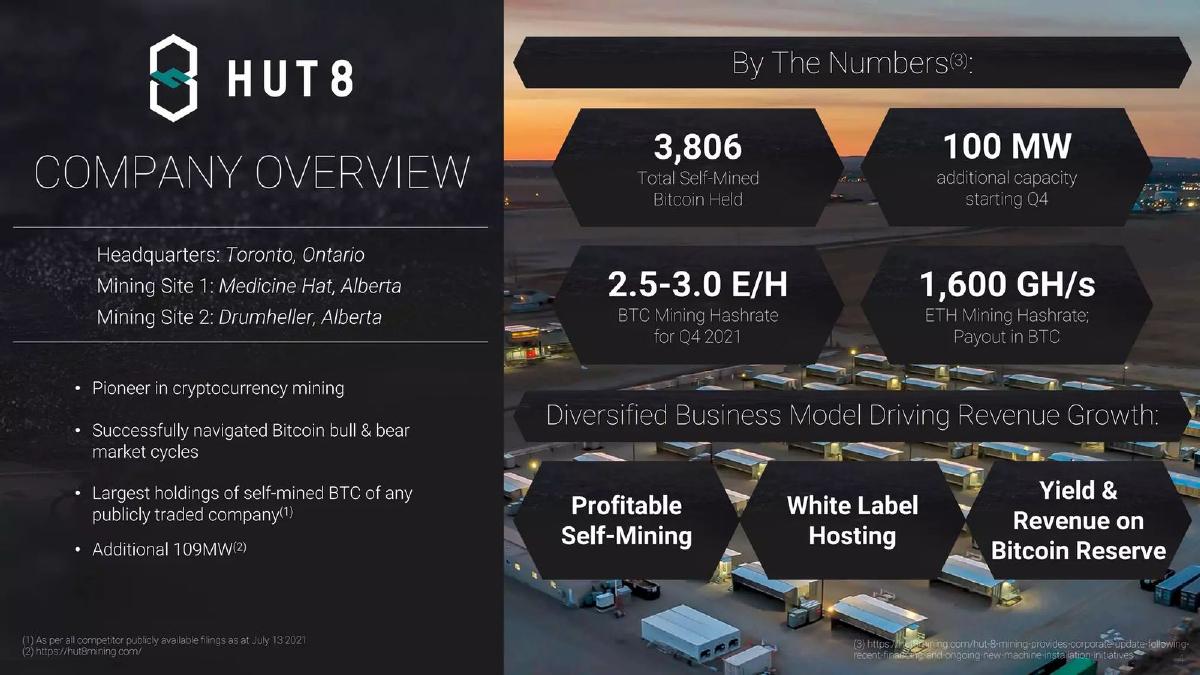
This slide serves as the 'at-a-glance' summary for investors. It lists the headquarters in Toronto and two mining sites in Alberta (Medicine Hat and Drumheller). The 'By The Numbers' section provides four critical KPIs: 3,806 total self-mined Bitcoin held, 100 MW of additional capacity starting in Q4, a projected Bitcoin hashrate of 2.5-3.0 E/H, and an Ethereum hashrate of 1,600 GH/s. The slide also introduces the 'Diversified Business Model,' which includes Profitable Self-Mining, White Label Hosting, and Yield & Revenue on Bitcoin Reserve. This is a strategic move to show that the company is not solely dependent on the daily price of Bitcoin for its survival.
Slide 7: Bitcoins Mined Per Day
Slide 7 focuses on the immediate growth trajectory of mining output. It compares Q3 2021 (14-16 Bitcoins/Day) to the projected Q4 2021 (20-22 Bitcoins/Day). A footnote specifies that these figures include Nvidia GPU miners mining Ethereum with payouts in BTC at a rate of $3,000 CAD per Bitcoin. This slide is crucial for modeling future revenue, as it provides a clear production target based on current network hashrates.
Slide 10: Bitcoin Holdings Growth
This slide is a simple bar chart showing the growth of BTC holdings from Q1 2018 (891 BTC) to Q3 2021 (3,806 BTC). The headline reinforces their competitive advantage: 'Hut 8 owns more self-mined bitcoin than any other publicly traded company worldwide.' This 'HODL' strategy is a key selling point for investors who want exposure to Bitcoin through a regulated equity vehicle rather than buying the underlying asset directly.
Slide 13: Strategic Opportunities and Partnerships
HUT 8 uses a staircase graphic to illustrate its growth initiatives. Key milestones include joining Foundry USA to reduce fees by 90%, partnering with NVIDIA for cutting-edge GPUs, and using Luxor Mining technology to improve efficiency. Most notably, it details their yield strategy: a 4% yield on 1,000 BTC loaned to Galaxy Digital and another 4% on 1,000 BTC loaned to Genesis Mining. The final step mentions 'Advancing Sustainability Objectives' through a partnership with Validus Power Corp for mobile energy generation. This slide effectively demonstrates that the company has an institutional-grade ecosystem supporting its operations.
Slide 16: Financial Highlights
This slide provides historical context for the company's financial performance. Two charts are presented: Total Revenue and Bitcoin Mined. The revenue chart shows a significant spike in Q1 2021 to $32.5 million, largely driven by the recovery in Bitcoin prices. The 'Bitcoin Mined' chart shows a downward trend in the number of coins mined (peaking at 2,816 in Q2 2019 and dropping to 539 in Q1 2021), which is a natural result of the Bitcoin halving event and increasing network difficulty. However, the rising orange line representing 'Avg BTC Price' explains why revenue increased even as coin production decreased.
Slide 21: Appendix Title
A simple transition slide marking the beginning of the supplemental information section.
Slide 22: The Bitcoin Ecosystem Engine
The final slide in the provided set is educational. It defines 'Mining' and 'A Miner' in plain language and provides a five-step 'How It Works' flowchart. This is a common inclusion in 2021-era crypto decks, as many institutional investors were still familiarizing themselves with the mechanics of blockchain technology. It notes the current reward of 6.25 BTC per block and the 10-minute average block time.
What HUT 8 Does Well
The deck is exceptionally strong in its use of hard metrics. By providing specific hashrate targets (2.5-3.0 E/H) and exact Bitcoin holding counts (3,806), HUT 8 removes ambiguity about its market position. The focus on 'self-mined' Bitcoin is a clever branding play, suggesting a higher quality of asset than coins purchased on the open market. Furthermore, the inclusion of high-tier partners like NVIDIA and Galaxy Digital provides significant third-party validation, which is critical in the often-volatile cryptocurrency sector. The financial slide (Slide 16) is also transparent about the impact of the Bitcoin halving, showing that the founders understand the cyclical nature of their industry.
What is Missing from the Deck
The most glaring omission in the provided slides is a dedicated 'Team' slide. While the company is publicly traded and this information is available elsewhere, a pitch deck should ideally highlight the technical and financial expertise of the leadership team. There is also no explicit 'Ask' or 'Use of Funds' slide in this selection, though as an investor presentation for a public company, the goal may be general market awareness rather than a specific private placement. Additionally, while 'Sustainability' is mentioned on Slide 13, there is a lack of detailed data regarding their energy mix or carbon footprint, which was becoming a major investor concern in 2021.
Founder Takeaways: What to Copy
Founders in infrastructure-heavy or commodity-linked industries should take note of how HUT 8 handles volatility. Instead of hiding the fact that their revenue is tied to a fluctuating asset, they embrace it and show how they are diversifying through hosting and yield generation. The 'By The Numbers' slide (Slide 4) is a masterclass in summarizing a complex business into four digestible metrics. Finally, the use of an educational appendix (Slide 22) is a smart way to ensure that all potential investors—regardless of their technical background—can follow the core logic of the business without cluttering the main narrative of the deck.
Frequently asked questions
- What is HUT 8's primary business model according to the deck?
- HUT 8 operates a 'Diversified Business Model' centered on three pillars: profitable self-mining of Bitcoin, white-label hosting services for other miners, and generating yield and revenue on its Bitcoin reserves. As of Slide 4, they emphasize being a pioneer in the space that has navigated multiple bull and bear market cycles.
- How does HUT 8 manage its Bitcoin holdings?
- The company follows a 'HODL' strategy, accumulating self-mined Bitcoin. Slide 10 shows their holdings grew from 891 BTC in Q1 2018 to 3,806 BTC by Q3 2021. Additionally, Slide 13 notes they earn a 4% yield by loaning portions of their reserve to institutional partners like Galaxy Digital and Genesis Mining.
- What are the technical specifications of their mining operations?
- For Q4 2021, HUT 8 projected a Bitcoin mining hashrate of 2.5-3.0 E/H and an Ethereum mining hashrate of 1,600 GH/s. They utilize 10,000 NVIDIA machines at a 3MW power capacity and have joined Foundry USA, the largest mining pool in North America, to maximize rewards (Slides 4 and 13).
- What financial trends are visible in the presentation?
- Slide 16 illustrates significant revenue volatility tied to Bitcoin prices and halving events. Total revenue peaked at $32.5 million in Q1 2021, a sharp increase from the $9.2 million and $5.8 million reported in Q2 and Q3 of 2020, respectively. The data shows a clear correlation between the average BTC price and total company revenue.
- Who are HUT 8's strategic partners?
- The deck lists several high-profile partners on Slide 13, including Foundry (mining pool), NVIDIA (hardware provider), Luxor Mining (software/efficiency), Galaxy Digital and Genesis Mining (yield/lending), and Validus Power Corp (energy generation platform development).