Hype’s 13-slide deck is a highly focused presentation that successfully secured $10M in Series A funding in 2024. The narrative centers on the transition of creators from social media influencers to legitimate small business owners who require 'off-social' infrastructure. By positioning itself as a mobile-first hybrid of HubSpot and PayPal, Hype addresses the specific pain points of the creator economy: fragmented tools, desktop-centric workflows, and a lack of direct audience ownership. The deck highlights significant early traction, citing 4 million contacts already in their ecosystem and a…
Key takeaways
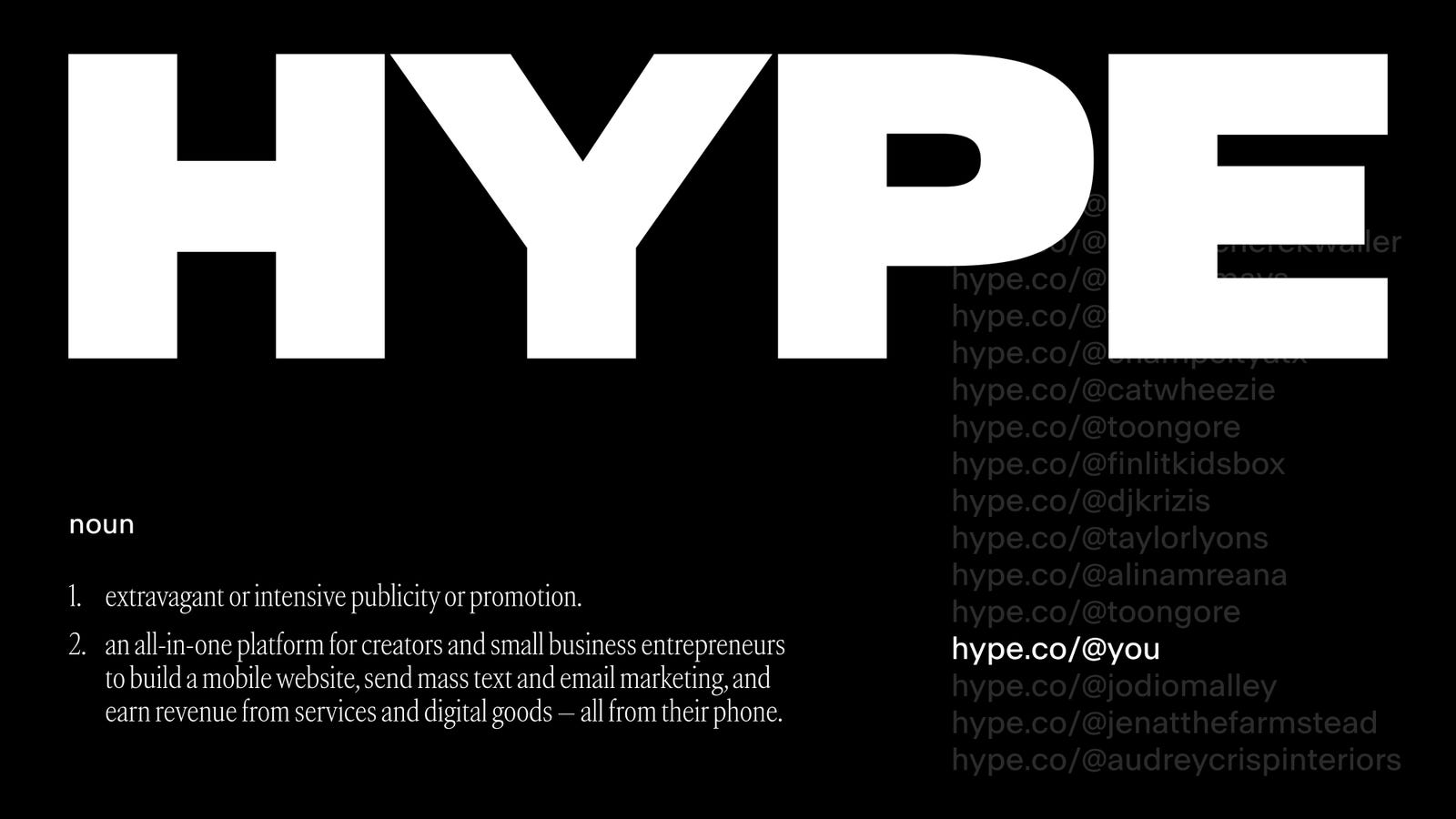
- Hype defines itself as an all-in-one platform for creators to build mobile websites, manage marketing, and earn revenue from their phones (Slide 1).
- The deck identifies three core failures of existing solutions: they are website-centric, desktop-first, and single-purpose (Slide 2).
- Product functionality is demonstrated through 'Lead Capture' tools that turn social followers into owned contacts (Slide 3).
- The platform claims a massive early footprint with 4 million contacts already managed through Hype Pages (Slide 4).
- Hype reports that 8% of their 4 million contacts have Hype Wallets, creating a cross-platform payment network (Slide 4).
- Monetization features include content subscriptions, popups, and paywalls, illustrated by real-world use cases like Block Club Chicago (Slide 5).
- The company emphasizes team stability, stating their 'team of 20 is already set' with no immediate need for additional headcount (Slide 6).
- The executive team brings experience from major tech firms including Google, Spotify, HubSpot, Meta, and Foursquare (Slide 6).
The Series A Narrative: From Influencer to Small Business
Hype’s 13-slide deck (of which 7 key slides are analyzed here) represents a shift in how the creator economy is being pitched to VCs in 2024. No longer is the focus just on 'getting famous'; the focus has moved to 'business infrastructure.' According to publisher reports, this deck helped secure $10M in Series A funding. The deck is notable for its minimalist aesthetic, high-contrast black-and-white design, and a clear focus on audience ownership.
Slide 1: The Definition of Hype
The deck opens with a bold, typographic cover that serves two purposes. First, it defines the word 'hype' in a traditional sense ('extravagant or intensive publicity'). Second, it provides a functional definition of the company: 'an all-in-one platform for creators and small business entrepreneurs to build a mobile website, send mass text and email marketing, and earn revenue... all from their phone.' By including 'small business entrepreneurs' alongside 'creators,' Hype immediately signals a larger Total Addressable Market (TAM) than a simple influencer tool.
Slide 2: The Problem with Legacy SaaS
Slide 2 is a classic 'anti-hero' slide. It features the logos of massive incumbents—Mailchimp, WordPress, Squarespace, HubSpot, and Intuit—scattered and faded in the background. The text identifies the core friction: creators need 'off-social' marketing and payment solutions, but existing tools are 'COMPLEX and reliant on INTEGRATIONS.' Hype identifies three specific 'X' marks against the old guard: they are website-centric, desktop-first, and single-purpose. This sets the stage for Hype to present itself as the mobile-native, multi-purpose alternative.
Slide 3: Lead Capture and Audience Ownership
Slide 3 focuses on the top of the funnel. It showcases a mobile UI for a 'Hype Page' where creators can collect signups. The slide emphasizes 'owning your audience relationships fully outside the social media platforms.' This is a critical pain point for creators who fear de-platforming or algorithmic changes. The visual shows a transition from a mobile signup form to a desktop 'Contacts' CRM, demonstrating that while the creator works on mobile, the data collected is professional-grade.
Slide 4: The Power of the Hype CRM
This is the 'meat' of the traction argument. Slide 4 introduces the 'Hype CRM' and provides two staggering figures: 4 million contacts and 8% with Hype Wallets. The slide uses a clever analogy: 'It’s like HubSpot + PayPal.' The 8% figure is particularly important because it suggests a network effect; if a fan has a Hype Wallet, they can pay any Hype creator instantly. This moves Hype from a software-as-a-service (SaaS) model toward a platform/fintech model with lower friction for transactions.
Slide 5: Monetization in Action
Slide 5 demonstrates the revenue side of the platform. It shows real-world applications, specifically mentioning 'Block Club Chicago.' The slide illustrates how creators can configure popups and paywalls for content subscriptions. By showing a $59/year subscription model, Hype proves that its tools aren't just for selling $5 digital downloads, but for building sustainable, recurring revenue businesses. The UI mockups are clean and emphasize a 'log in' experience that keeps fans connected to the creator's ecosystem.
Slide 6: The 'Already Set' Team
The team slide is a masterclass in building investor confidence. Rather than saying 'we are hiring,' Hype states 'OUR TEAM OF 20 IS ALREADY SET.' This suggests that the $10M Series A isn't just to keep the lights on or find talent, but to pour fuel on an already functioning engine. The logos at the bottom—Google, Stanford, Spotify, HubSpot, Foursquare, Meta, and On Deck—provide massive social proof. It tells investors that this isn't a group of amateurs, but seasoned operators from the very companies Hype is looking to disrupt or evolve from.
Slide 7: The Vision Statement
The final slide in this selection is a simple, black-and-white closing: 'HYPE: The next-gen small business platform.' It reinforces the pivot away from 'creator tools' toward 'small business infrastructure.' This is a strategic choice; 'small business' is a category investors understand and value at higher multiples than 'creator economy,' which has seen significant volatility in recent years.
What Works in the Hype Deck
Mobile-First Positioning: By explicitly attacking 'desktop-first' legacy tools, Hype carves out a specific niche that resonates with how modern creators actually work. · Network Effect Tease: The mention of the 'Hype Wallet' (Slide 4) hints at a future where Hype isn't just a tool, but a payment network, which is a much more venture-scale business model. · High-Signal Traction: 4 million contacts is a significant number for a Series A company. It proves that their 'link-in-bio' style landing pages have massive reach. · Team Pedigree: The combination of Big Tech experience and the statement that the team is 'already set' reduces execution risk in the eyes of an investor.
What is Missing from the Hype Deck
Unit Economics: While the deck mentions 4 million contacts and 8% wallet adoption, it does not disclose the Average Revenue Per User (ARPU) or the take rate Hype earns on transactions. · Competitive Landscape: The deck mentions legacy tools like WordPress, but it ignores direct 'link-in-bio' competitors like Linktree or specialized creator platforms like Kajabi or Beehiiv. · The 'Ask': The provided slides do not include a specific breakdown of how the $10M will be spent, though the team slide suggests it won't be primarily for new hires. · Financial Projections: There are no charts showing Month-over-Month (MoM) growth or projected revenue for the next 18-24 months.
Founder Takeaways: How to Emulate Hype
1. Define Your Category Broadly: Hype doesn't just call itself a 'link-in-bio' tool. It calls itself a 'next-gen small business platform.' Founders should look for the largest credible category they can occupy. If you are building a tool for a specific niche, frame it as the 'operating system' or 'infrastructure' for that niche to increase perceived value.
2. Use Analogies for Complexity: 'HubSpot + PayPal' (Slide 4) is a brilliant shorthand. It tells an investor exactly what the product does (CRM + Payments) without requiring a 10-minute demo. If your product is a hybrid, find two well-known companies to anchor your description.
3. Highlight Owned Data: In an era of privacy changes and algorithm shifts, 'audience ownership' is a winning theme. Hype leans heavily into the 'off-social' narrative. If your startup helps users move away from dependency on a single platform (like Amazon, Google, or Meta), make that a central pillar of your problem/solution slides.
4. Design for Impact: Hype uses a high-contrast, minimalist design that feels 'premium' and 'modern.' For a Series A deck, the visual polish must match the scale of the raise. Avoid cluttered slides; let one big number or one clear UI mockup do the talking.
5. Address Headcount Early: The 'Team of 20 is already set' line is a unique way to handle the team slide. It signals maturity. If you have already recruited your core leadership, emphasize that you are ready to scale immediately rather than spending the first six months after the round in a hiring cycle.
Frequently asked questions
- What is Hype's core value proposition?
- Hype positions itself as a mobile-first CRM and monetization suite for creators. It allows users to build landing pages, capture leads (email and SMS), and manage subscriptions or digital goods directly from a smartphone. The goal is to help creators own their audience data 'off-social' rather than relying solely on third-party social media algorithms.
- How does Hype compare itself to legacy marketing tools?
- On Slide 2, Hype explicitly critiques legacy tools like Mailchimp, HubSpot, and WordPress for being 'website-centric' and 'desktop-first.' Hype argues that modern creators need integrated, mobile-native tools that combine marketing and payments without requiring complex third-party integrations.
- What traction metrics did Hype share in this deck?
- The deck highlights two primary metrics on Slide 4: 4 million contacts currently managed within the Hype CRM and an 8% conversion rate of those contacts to 'Hype Wallets.' This wallet feature allows fans to stay logged in and pay any Hype creator using a saved payment method, similar to a closed-loop payment network.
- Who are the key people behind Hype?
- The team slide (Slide 6) features six key executives led by CEO Nick. The team boasts a 'Big Tech' pedigree, with former roles at Google, Spotify, HubSpot, Foursquare, and Meta, as well as academic backing from Stanford. The deck notes they have a full team of 20 already in place.
- What was the outcome of this fundraising round?
- As reported by Business Insider, Hype raised $10 million in a Series A round in 2024. The funding is intended to further develop their 'next-gen small business platform' for the creator economy in North America.