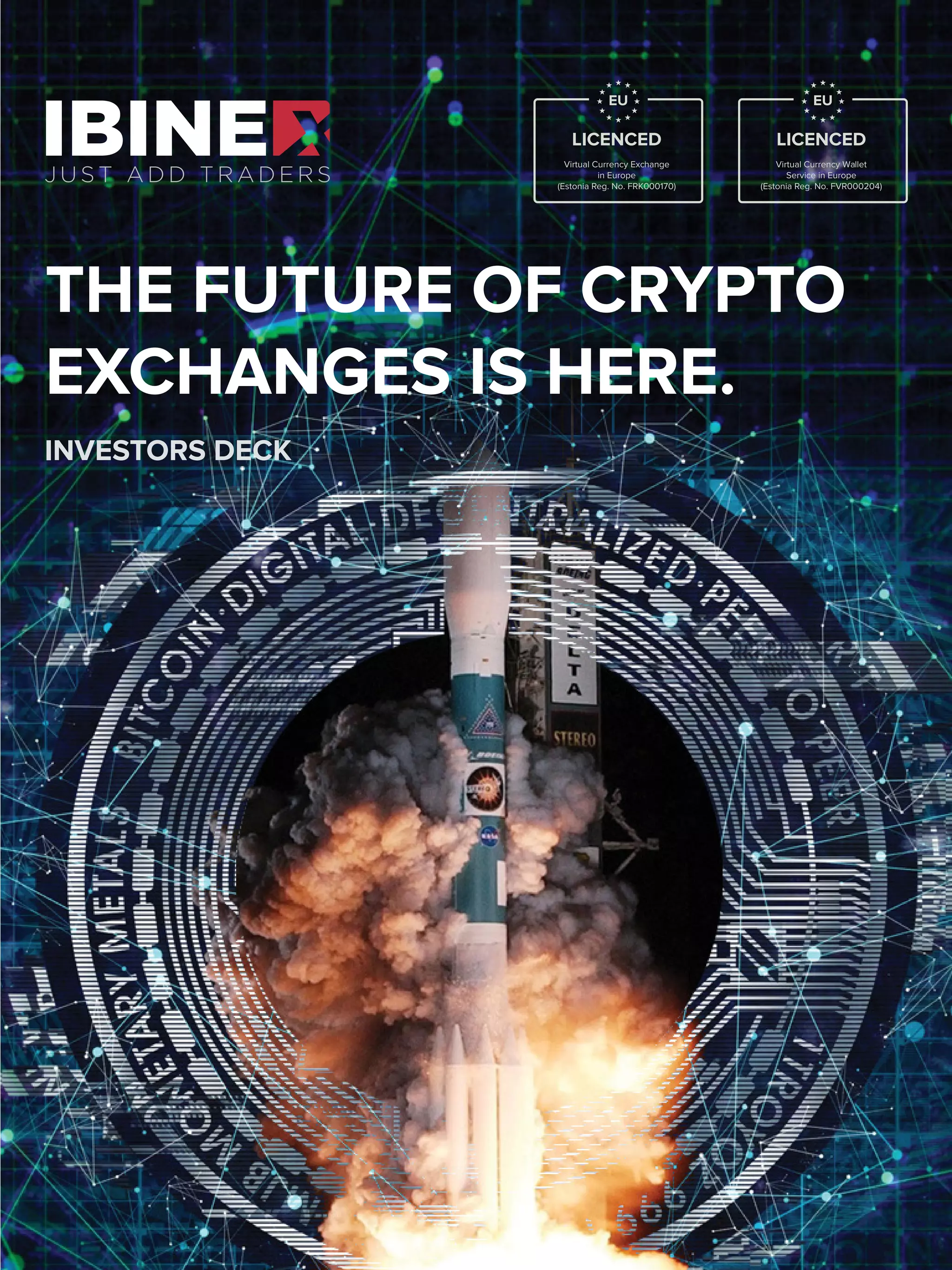
Ibinex positions itself as a 'plug and play' exchange solution provider, targeting the B2B2C market by offering localized exchanges with shared liquidity. The deck, likely produced around 2018 given the references to SEC Chairman Jay Clayton’s comments, argues that utility tokens are obsolete and that security tokens represent the future of the industry. The company highlights its regulatory standing with Estonian licenses for virtual currency exchange and wallet services. While the deck provides a robust competitive analysis against players like Huobi and BlockEx, it notably lacks a team sli…
Key takeaways
- Ibinex holds two Estonian licenses: one for Virtual Currency Exchange (FRK000170) and one for Virtual Currency Wallet Service (FVR000204), as shown on slide 1.
- The company identifies as a B2B2C provider, offering a PaaS (Platform as a Service) infrastructure to partners, according to slides 8 and 9.
- Ibinex claims to be the only crypto solution providing localized exchanges with shared liquidity for tokens that would otherwise lack value (slide 2).
- The deck cites a daily crypto volume of $10B compared to $5,000B for Global FX, suggesting significant room for market expansion (slide 4).
- A core thesis of the deck is that security tokens will replace utility tokens, which the company views as 'outdated' due to SEC regulatory pressure (slide 5).
- Ibinex explicitly states its intention to IPO, arguing that publicly traded crypto stocks offer better exposure for traditional investors (slide 7).
- The competitive analysis claims Ibinex offers 'Unlimited' coin listing and 'Fully Customizable' UI/UX, distinguishing it from Huobi's 'Limited' and 'Standard' offerings (slide 9).
- The company maintains a global footprint with offices listed in Estonia, New York, Israel, the Philippines, and Panama (slide 10).
Slide-by-Slide Teardown
Slide 1: Title and Licensing
The cover slide establishes the brand identity with the tagline 'Just Add Traders.' It immediately addresses the biggest hurdle in the crypto space: regulation. The slide prominently features two EU license badges for 'Virtual Currency Exchange' (Reg. No. FRK000170) and 'Virtual Currency Wallet Service' (Reg. No. FVR000204) in Estonia. This is a strategic move to build instant credibility with institutional investors who are wary of unregulated platforms.
Slide 2: The Vision
Titled 'Connecting the World,' this slide defines Ibinex as an 'ecosystem of interconnected exchanges.' The core value proposition is 'shared liquidity.' This addresses a common pain point for new or localized exchanges that struggle with thin order books. By sharing liquidity across a network, Ibinex claims to give value to tokens that would otherwise be illiquid.
Slide 3: Strategy and Expansion
This slide outlines the 'plug and play' nature of the business. It lists five pillars of their solution: Local regulation, Marketing and branding, User friendly interface, Complete education, and Local adaptation. The strategy is clear: Ibinex provides the engine, while partners handle the local market nuances. This is a classic B2B2C scaling strategy.
Slide 4: Market Opportunity
Ibinex uses a comparative data approach to show growth potential. They contrast Crypto's $10B daily volume with Global FX's $5,000B. They also compare Crypto's $250B market cap to the NYSE's $18,000B. While these numbers are dated, the logic is to show that crypto is still in its infancy compared to traditional finance, suggesting a massive 'catch-up' opportunity for investors.
Slide 5: The Regulatory Pivot (Reason #1)
This slide focuses on the shift away from utility tokens. It quotes former SEC Chairman Jay Clayton’s warnings about ICOs. Ibinex takes a firm stance, stating that 'utility tokens are outdated' and that the market is moving toward 'security tokens'—equity-based shares that represent actual ownership. This positions Ibinex as a forward-thinking, compliant platform ready for the 'Security Token Offering' (STO) era.
Slide 6: The Future of Crypto (Reason #3)
Continuing the theme from the previous slide, Ibinex predicts that security tokens will 'revolutionize conventional IPOs' by issuing shares and dividends over blockchain networks. They suggest that mainstream companies will eventually adopt STOs. This slide is designed to convince investors that Ibinex is building for the next wave of the industry, not just the current one.
Slide 7: Exit Strategy (Reason #5)
The company explicitly states, 'We plan to IPO.' The rationale provided is that investors want crypto exposure through traditional brokerage accounts. This slide is less about the product and more about the 'liquidity event' for the investor, framing Ibinex as a high-growth stock play rather than just a technology provider.
Slide 8: Competitive Analysis - BlockEx
This is a detailed feature-by-feature comparison. Ibinex claims superiority over BlockEx in areas like UI/UX (Fully Customizable vs. Standard), Custodial Services (B2B2C vs. None), and Infrastructure (PaaS vs. SaaS). The goal here is to show that Ibinex offers a more flexible and comprehensive 'Platform as a Service' model.
Slide 9: Competitive Analysis - Huobi
The comparison against Huobi, a major global exchange, is even more aggressive. Ibinex claims to offer 'Unlimited' coin listings compared to Huobi's 'Limited' ones and highlights its 'Unified' exchange matrix versus Huobi's lack thereof. By comparing themselves to a top-tier exchange, Ibinex is signaling its ambition to compete at the highest level of the market.
Slide 10: Global Presence
The final slide in this set lists physical office locations in Estonia, New York, Israel, the Philippines, and Panama. This is intended to show that Ibinex is a global operation with a decentralized footprint, covering financials, technology, development, and operations across multiple time zones and jurisdictions.
What Ibinex Does Well
Regulatory Front-Loading: By putting their Estonian licenses on the very first slide, Ibinex addresses the 'compliance' question before an investor even asks it. In the volatile world of crypto, this is a strong trust signal.
Clear B2B2C Positioning: The deck does a good job of explaining that they aren't just another exchange; they are an infrastructure provider . The 'shared liquidity' argument is a compelling solution to the 'cold start' problem that kills most new exchanges.
Market Thesis: The deck takes a strong, opinionated stance on the shift from utility tokens to security tokens. Investors often prefer founders who have a clear 'secret' or a specific view of how the future will unfold, even if that view is controversial.
What is Missing from the Deck
The Team: There is no mention of the founders, their backgrounds, or their previous successes. In early-stage fundraising, the team is often more important than the product. Without knowing who is steering the ship, the technical claims carry less weight.
Traction and Metrics: The deck is heavy on 'potential' but light on 'proof.' There are no figures regarding current trading volume, number of active partners, or revenue. Investors need to see that the 'plug and play' model is actually working in the wild.
The Ask: The deck ends without a clear call to action. How much are they raising? What is the valuation? What will the funds be used for? A pitch deck without an 'Ask' slide is just a brochure.
Unit Economics: While they mention being a PaaS, they don't explain the fee structure. Do they take a percentage of trade volume? A monthly licensing fee? A setup fee? The business model's profitability remains opaque.
Founder's Playbook: What to Copy
Use Comparative Tables: The competitive analysis slides (8 and 9) are excellent examples of how to use a table to highlight specific technical advantages. Instead of vague 'we are better' statements, they use specific categories like 'Token Economy' and 'Exchange Matrix.'
Address Macro Trends: Ibinex successfully ties its company mission to a larger regulatory shift (the move to security tokens). Founders should always try to frame their startup as the logical beneficiary of a massive, inevitable industry change.
Visual Hierarchy: The slides are clean, with large headers and clear bullet points. The use of icons for market comparisons (slide 4) makes complex financial data easy to digest at a glance. This is a good template for maintaining professional aesthetics without cluttering the message.
Frequently asked questions
- What is Ibinex's primary business model?
- Ibinex operates as a B2B2C white-label exchange provider. Instead of just running a single consumer-facing exchange, they build platforms for partners and provide them with shared liquidity. This 'plug and play' approach includes local regulation, marketing, and technical infrastructure, allowing partners to launch localized exchanges quickly while benefiting from a unified global liquidity pool.
- How does Ibinex view the regulatory landscape?
- The company takes a pro-regulation stance, specifically highlighting its Estonian licenses on the cover slide. A significant portion of the deck is dedicated to the transition from utility tokens to security tokens. Ibinex argues that utility tokens are outdated and that the future lies in equity-based security tokens that comply with SEC standards and offer ownership shares.
- Who are the main competitors mentioned in the deck?
- The deck includes a side-by-side competitive analysis against BlockEx and Huobi. Ibinex differentiates itself by offering a PaaS infrastructure, fully customizable UI/UX, internal KYC/AML, and a 'Wide Area Network' token economy, whereas it characterizes competitors as having siloed economies, limited branding, or lacking custodial services.
- What is missing from this investor deck?
- The provided slides lack several critical components of a standard venture pitch. There is no team slide introducing the founders or advisors, no slide detailing current revenue or user growth, and no specific 'Ask' slide outlining how much capital is being raised or how it will be deployed. It is primarily a vision and product-comparison deck.
- What is the significance of the 'Reason #5' slide regarding an IPO?
- Slide 7 signals that Ibinex is positioning itself for an exit or a public listing rather than remaining a private entity long-term. They argue that crypto-linked stocks are attractive to traditional investors because they can be bought in regular brokerage accounts, suggesting that Ibinex intends to be one of those publicly traded vehicles.