Iconfinder’s 15-slide deck is a minimalist, data-heavy presentation that prioritizes market dominance and user behavior over complex financial modeling. At the time of this presentation in January 2013, the company was already a category leader, boasting 125 million icon downloads and 3 million monthly visits. The deck’s primary objective was to secure $1.8 million in investment to transition from a simple search engine into a full-scale marketplace. By highlighting a combined $1.05 billion market for premium and custom icons, Iconfinder positioned itself as the logical aggregator for 15,000…
Key takeaways
- The company was founded in 2009 and utilized a 'Hacker, Hustler, Hipster' team framework (Slide 2).
- Iconfinder claimed the '#1' position in its niche with 125,000,000 icon downloads and 3,000,000 monthly visits (Slide 8).
- The deck identifies a total addressable market of $1.05 billion, split between premium icons ($400M) and custom design ($650M) (Slide 10).
- A competitive growth chart shows Iconfinder significantly outpacing rivals like 99designs and IconArchive in traffic volume since 2009 (Slide 9).
- The core value proposition focuses on solving 'Generic,' 'Time Consuming,' and 'Expensive' search problems (Slide 5).
- The marketplace strategy involves connecting 3 million monthly visitors with 15,000 designers looking for work (Slide 11).
- The 'What's Next' phase involves a transition to a paid marketplace model with support for vector icons and on-the-fly manipulation (Slides 13-14).
- The specific funding ask was for $1.8 million USD to fuel 'Marketplace' proceeds and 'Growth' (Slide 15).
Introduction: The Minimalist Path to $1.5M
The Iconfinder pitch deck, dated January 2013, is a 15-slide presentation that leans heavily on the company's existing status as a market leader. Rather than selling a dream of what could be, the deck focuses on the sheer volume of what already is. By 2013, Iconfinder was no longer a scrappy startup; it was a high-traffic utility looking to monetize its massive user base. The deck is characterized by high-contrast visuals, minimal text, and a clear focus on the transition from a search engine to a marketplace.
Slides 1-3: Identity and Foundation
Slide 1 is a standard title page featuring the company's CMO, Steffen Thilsted, and a high-quality 3D render of the company's mascot. This immediately establishes a design-centric brand identity, which is critical for a company selling visual assets.
Slide 2 , titled "Company Overview," provides the founding date (2009) and the core mission: "Building a marketplace." It uses the "Hacker, Hustler, Hipster" trope to describe the team composition. While this tells an investor the team is balanced, it is a missed opportunity to showcase specific pedigree or past successes of the founders.
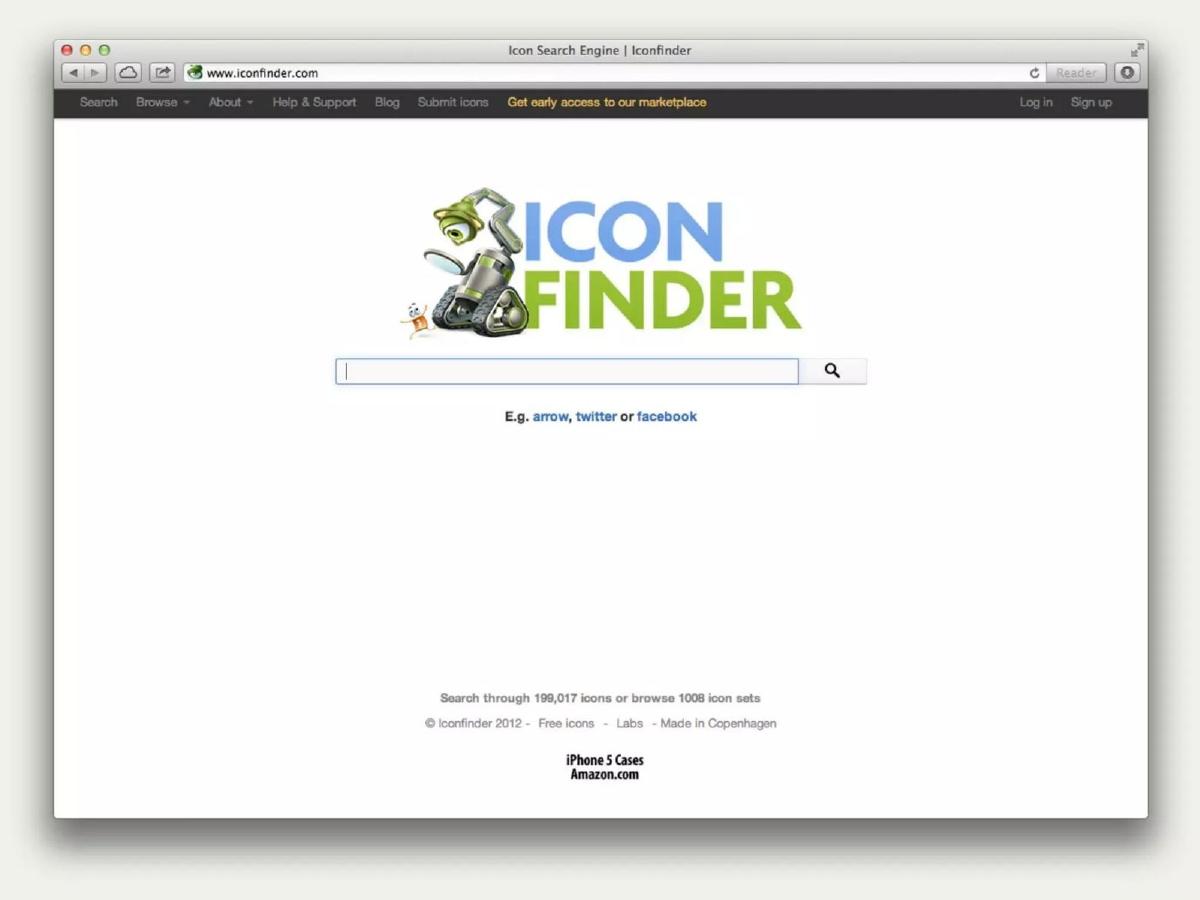
Slide 3 shows the product in its simplest form: a Google-style search bar. This reinforces the "search engine" utility that built their initial traction. The text at the bottom of the screenshot notes they were searching through 199,017 icons at the time, providing a baseline for their content library.
Slides 4-6: The Problem and Solution
Slide 4 identifies the three primary use cases for icons: Websites, Mobile Apps, and Presentations. This defines the target audience as developers, designers, and corporate professionals.
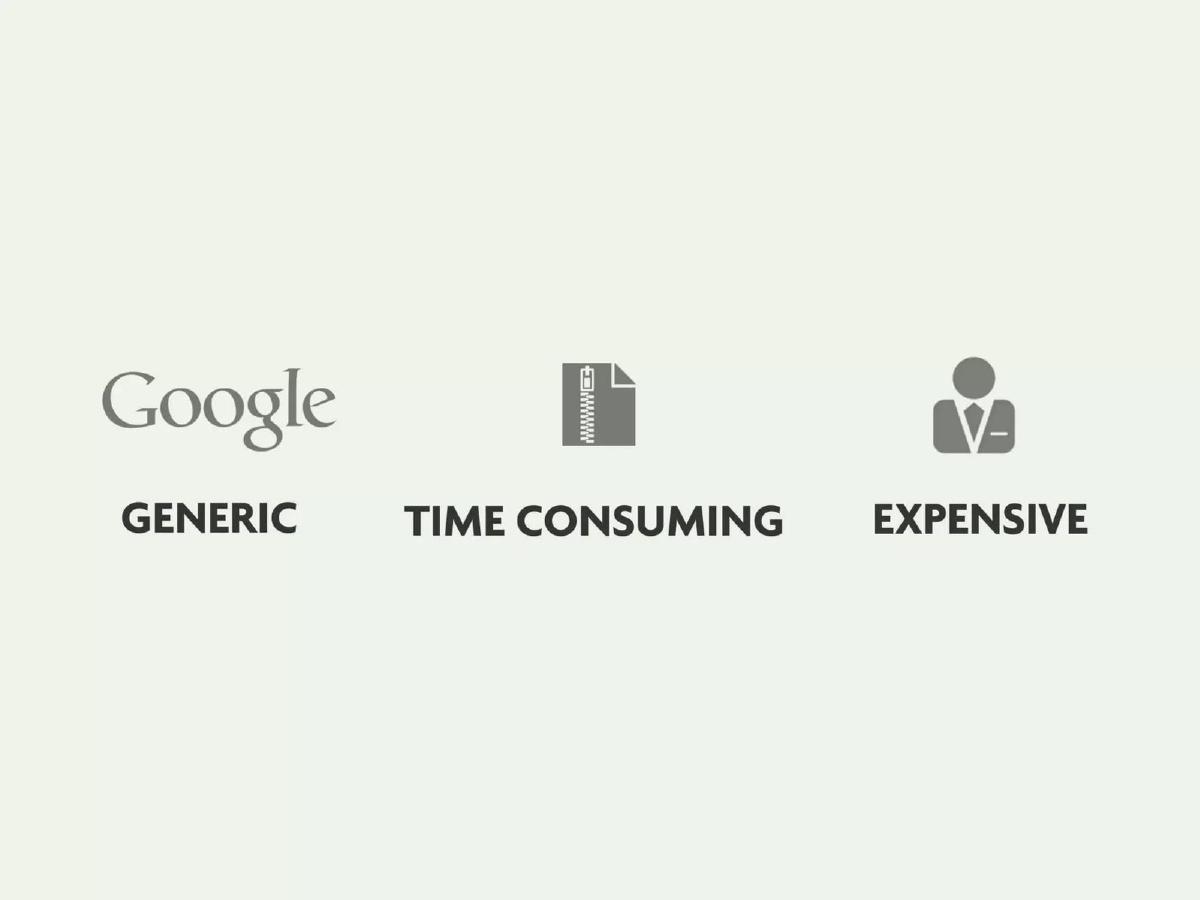
Slide 5 addresses the pain points of the current market. It labels existing solutions (represented by a Google logo) as "Generic," "Time Consuming," and "Expensive." This is a classic setup for a marketplace pitch: the current way is inefficient, and we are the aggregator that brings order to the chaos.
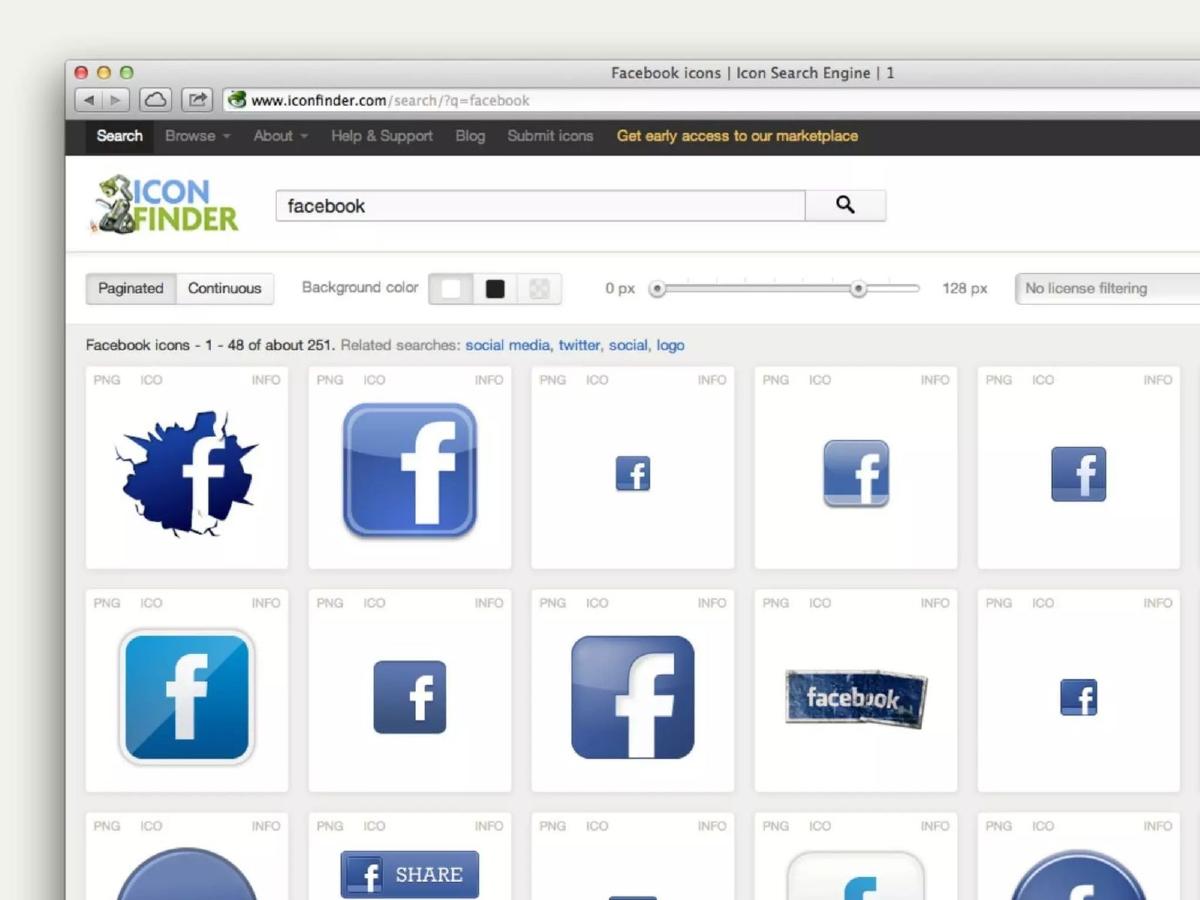
Slide 6 provides a product screenshot of the search results for "Facebook." It highlights the UI features that solve the "Time Consuming" problem: pagination vs. continuous scroll, background color toggles, and size sliders (0px to 128px). This demonstrates that the tool is built specifically for a designer's workflow.
Slides 7-9: Proving Market Dominance
Slide 7 is the "Traction" slide, and it is the strongest in the deck. It uses a massive "#1" graphic to claim the top spot in the industry. The metrics cited are significant: 125,000,000 icon downloads, 200,000 icons in the database, 20,000,000 searches, and 3,000,000 monthly visits. It also claims a spot in the "World top 1,000" websites, a major milestone for a niche utility.
Slide 8 , titled "We're Growing Faster," uses a line chart to compare Iconfinder's traffic against 99designs.com, FindIcons.com, and IconArchive.com from 2009 to late 2012. The blue line for Iconfinder shows a consistent upward trajectory, ending near the 20M mark (likely monthly pageviews or searches), while competitors remain flat or show slower growth. This visualizes the "winner-take-all" potential of the platform.
Slides 10-11: The Marketplace Opportunity
Slide 10 quantifies the market opportunity. It estimates the premium icon market at $400 million and the custom design market at $650 million annually. By totaling over $1 billion, Iconfinder justifies why a $1.8 million investment is a drop in the bucket compared to the potential revenue they can facilitate as a middleman.
Slide 11 illustrates the marketplace flywheel. It places the Iconfinder mascot in the center, connecting 3 million monthly visitors "looking for great icons" with 15,000 designers "looking for work." This is the core of the pitch: we have the demand (traffic), we have the supply (designers), we just need the infrastructure to facilitate the transaction.
Slides 12-15: The Future and the Ask
Slide 12 acts as a transition slide with the bold text "What's Next?"
Slide 13 shows the new marketplace UI. For the first time, we see "BUY ICON $2" buttons and "DOWNLOAD SVG" options. This is the visual proof of the monetization strategy. It moves the product from a free search engine to a revenue-generating store.
Slide 14 lists the technical roadmap for the marketplace: support for vector icons, on-the-fly manipulation, hosting services, and personal collection searching. These features are designed to increase user retention and make the platform a daily-use tool for designers rather than a one-off search destination.
Slide 15 delivers the final ask. It requests "1.8 M USD" for the purpose of building the "Marketplace" and driving "Growth." It is a very brief conclusion to a data-heavy deck, leaving the specifics of the valuation and terms for the follow-up conversation.
What Works in the Iconfinder Deck
Massive Traction: The 125 million downloads figure on Slide 7 is an undeniable proof of product-market fit. It is very difficult for an investor to say no to a platform that already has 3 million monthly visitors. · Visual Simplicity: As a company in the design space, the deck is appropriately clean. It uses large fonts and clear icons, practicing what it preaches regarding user experience. · Clear Competitive Positioning: The growth chart on Slide 9 clearly shows Iconfinder pulling away from the pack. Investors love to see a clear market leader emerging in a fragmented space. · Logical Pivot: The transition from a free search engine to a paid marketplace is a natural evolution. The deck successfully argues that they have already done the hard part (acquiring users) and now just need to "turn on" the revenue.
What is Missing from the Iconfinder Deck
Detailed Team Bios: While Slide 2 mentions the "Hacker, Hustler, Hipster" framework, it doesn't name the founders or provide their backgrounds. Investors invest in people, especially at the early stages, and this omission is significant. · Revenue Data: The deck mentions a $1B+ market, but it doesn't state how much revenue Iconfinder was making at the time (if any). Even if they were pre-revenue on the marketplace, some data on affiliate revenue or ad spend would have added weight. · Use of Proceeds: A $1.8M ask is substantial. The deck simply says it is for "Marketplace" and "Growth." A more detailed breakdown (e.g., 40% engineering, 30% marketing, 30% operations) would provide more confidence in the management's planning. · Unit Economics: There is no mention of Customer Acquisition Cost (CAC) or Lifetime Value (LTV). While their traffic is likely organic, understanding the conversion rate from a free searcher to a paid buyer is a critical metric for a marketplace.
What a Founder Should Copy
The Traction-First Approach: If you have big numbers, lead with them. Iconfinder doesn't bury its 125M downloads on Slide 10; it puts them front and center to establish authority early. · The "Flywheel" Visualization: Slide 11 is an excellent way to show how a marketplace works. It clearly identifies the two sides of the market and the volume of participants on each side. · Comparative Growth Charts: Using third-party data (like Alexa or Compete, which were common in 2013) to show your growth relative to competitors is a powerful way to prove you are winning the category. · Problem/Solution Alignment: The deck does a great job of linking the problems (Generic, Expensive) directly to the features of the new marketplace (Vector support, $2 icons).
Frequently asked questions
- How much did Iconfinder raise with this deck?
- According to the catalogue facts, Iconfinder raised $1,500,000. However, Slide 15 of the deck specifically lists an investment target of '1.8 M USD.' This discrepancy is common in fundraising where the final closed amount may differ from the initial target presented in the pitch.
- What is the 'Hacker, Hustler, Hipster' reference on Slide 2?
- This is a popular startup framework for a balanced founding team. The 'Hacker' handles the technology and coding, the 'Hustler' manages the business and sales, and the 'Hipster' focuses on design and user experience. While the deck doesn't name the individuals on this slide, it signals to investors that the core competencies of a tech startup are covered.
- How does Iconfinder define its market size?
- On Slide 10, Iconfinder identifies two primary revenue streams: Premium icons, valued at $400 million per year, and Custom designed icons, valued at $650 million per year. This combined $1.05 billion market represents the total opportunity they aimed to capture by moving beyond a free search engine.
- What competitive advantages does the deck highlight?
- The deck emphasizes scale and speed. Slide 9 shows a line graph where Iconfinder's growth trajectory is significantly steeper than competitors like IconArchive and FindIcons. Additionally, Slide 14 lists technical advantages for their new marketplace, including support for vector icons and the ability to manipulate icons 'on-the-fly' before downloading.
- What is missing from the Iconfinder pitch deck?
- The deck is notably missing a dedicated team slide with names and bios, a detailed breakdown of how the $1.8M will be spent (use of proceeds), and any mention of current revenue or unit economics. It relies almost entirely on usage metrics (downloads and visits) to prove value.