Ibble’s 2022 Series Seed deck is a masterclass in positioning a new social platform against established giants by identifying a specific emotional void in the market: the lack of 'genuine, vulnerable conversations.' The company raised $12.7M by showcasing strong early beta engagement, including 21+ minutes of average daily active engagement and over 25,000 videos recorded. While the deck leans heavily on philosophical 'why now' arguments and high-level market sizing, it anchors the opportunity with a leadership team featuring NASA and Goldman Sachs backgrounds. The teardown reveals a strategy…
Key takeaways
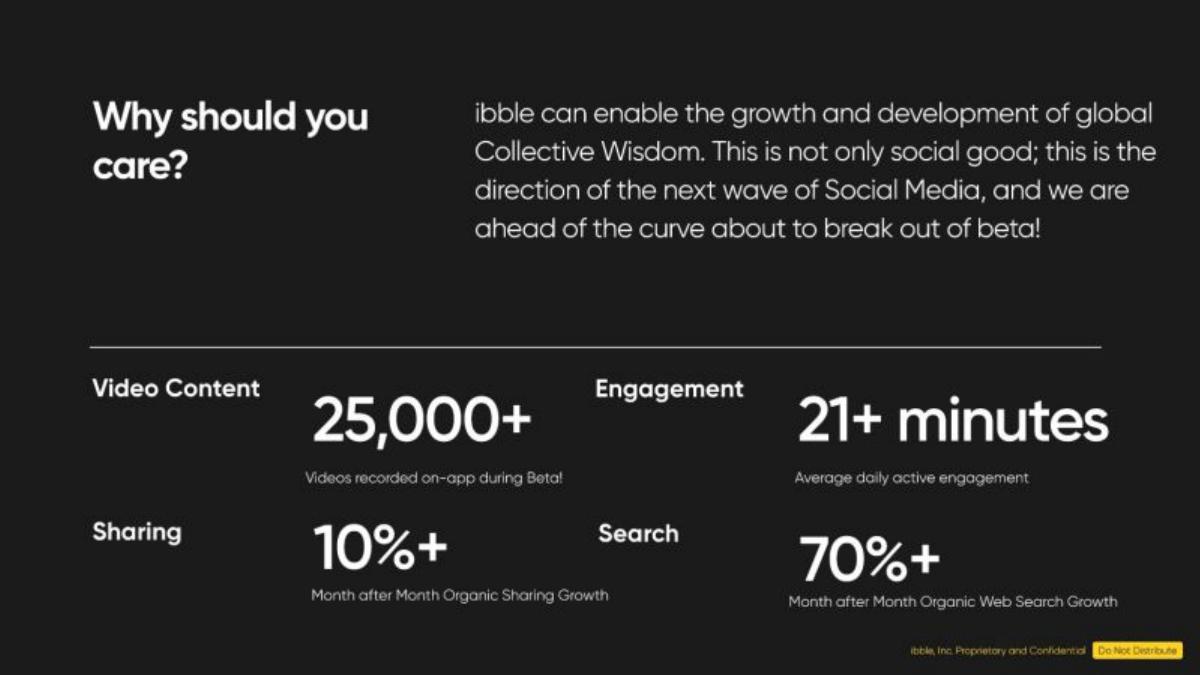
- The platform reported 21+ minutes of average daily active engagement during its beta phase (Slide 5).
- Ibble identifies its Serviceable & Target Market as 57 million users in the United States (Slide 9).
- The leadership team is anchored by CEO Raymond Kaminski, a former lead engineer at NASA and VP at Goldman Sachs (Slide 17).
- The company previously raised $2.3M in 2019 and received a $100k non-equity grant from Google (Slide 15).
- Beta testing resulted in 10%+ month-over-month organic sharing growth and 70%+ organic web search growth (Slide 5).
- The competitive landscape slide positions Ibble in the high 'Community Feedback' and 'Public News' quadrant, distinct from TikTok and Snapchat (Slide 11).
- The deck highlights a 'Product Foundation' that includes multiple international utility and design patents (Slide 14).
- Market validation data shows that social sharing of daily life details declined from 27% in 2014 to 20% in 2019 (Slide 20).
Introduction: The $12.7M Pivot to Asynchronous Connection
Ibble entered the social media fray in 2022 with a clear mandate: fix the isolation caused by 'debate and declaration' platforms. This teardown looks at the Series Seed deck that helped the Austin-based startup secure $12.7M. The deck is structured to move the investor from an emotional problem (isolation) to a technical solution (patented low-latency video) and finally to a high-pedigree team capable of execution.
Slides 1-2: The Vision and Reinvention
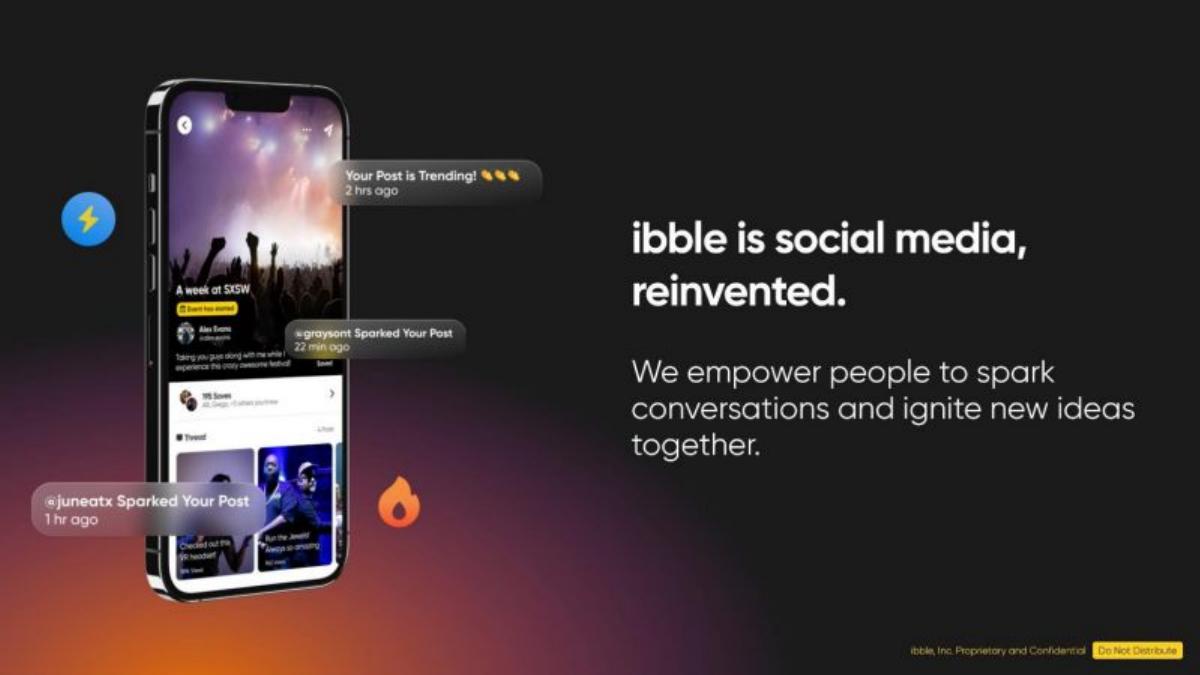
Slide 1 introduces Raymond Kaminski, Co-Founder and CEO, setting the stage for a Series Seed round. The branding is dark, sleek, and minimalist. Slide 2 immediately defines the product: 'ibble is social media, reinvented.' It uses a high-fidelity mobile mockup to show a 'Thread' interface, emphasizing 'sparking conversations' over passive scrolling. The use of terms like 'empower' and 'ignite' signals a focus on active engagement rather than consumption.
Slides 3-4: The Problem and Persona Lenses
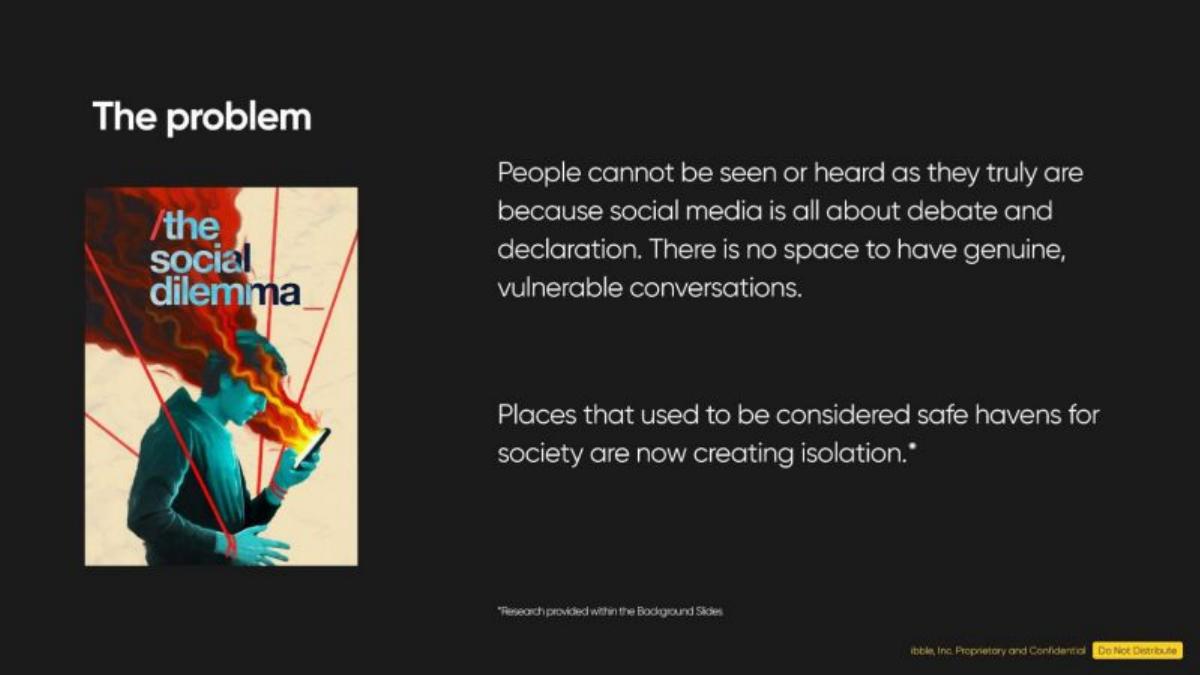
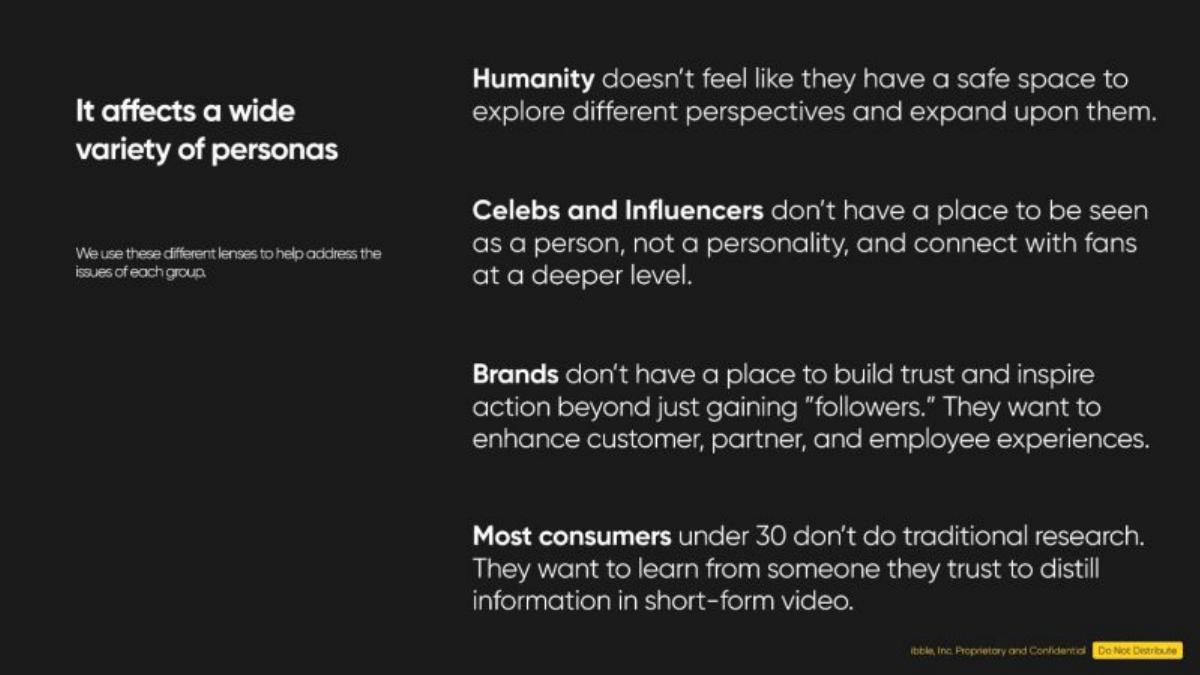
Slide 3 leverages cultural touchstones, specifically referencing '/the social dilemma.' It claims that social media has become a place of isolation rather than connection. The core thesis is that there is 'no space to have genuine, vulnerable conversations.' Slide 4 breaks down how this affects four distinct groups: Humanity (needing safe spaces), Celebs (needing to be seen as people), Brands (needing to build trust), and Consumers under 30 (who prefer short-form video research). This slide is critical because it expands the TAM from a simple social app to a tool for brands and influencers.
Slide 5: The 'Why You Should Care' Traction Slide
This is the 'money slide' of the first half. Ibble presents four key metrics from its beta phase: 25,000+ videos recorded , 21+ minutes of average daily active engagement , 10%+ month-over-month organic sharing growth , and 70%+ organic web search growth . For a seed-stage social app, 21 minutes of daily engagement is a strong indicator of 'stickiness,' providing a data-backed counterweight to the philosophical claims in the previous slides.
Slides 6-8: The Solution and Visual Proof
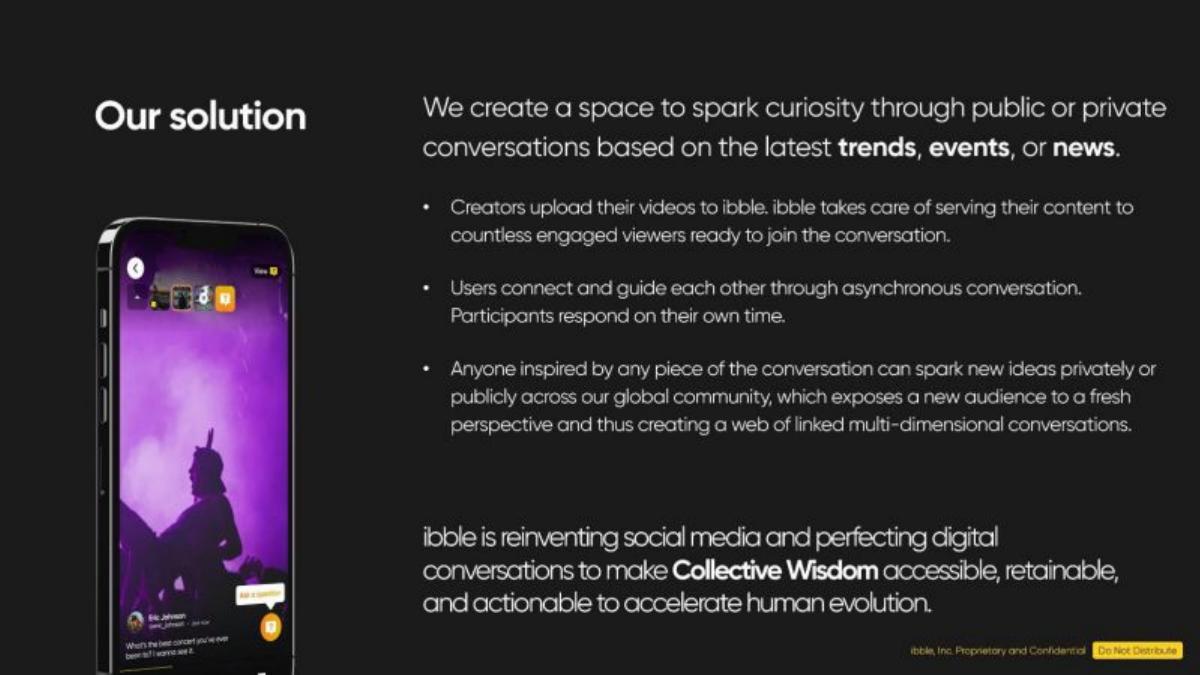
Slide 6 explains the mechanics: creators upload, users connect via asynchronous conversation, and ideas spark 'multi-dimensional' webs of linked content. The ultimate goal is 'Collective Wisdom.' Slide 7 provides YouTube links for further viewing, and Slide 8 serves as a transition, simply titled 'The data,' featuring more product mockups that highlight the 'Explore' and 'Threads' navigation.
Slides 9-10: Market Size and Timing
Slide 9 uses the standard TAM/SAM/SOM concentric circles. The Total Addressable Market is cited at 1.3 Billion Users globally , while the Serviceable & Target Market is narrowed to 57 Million Users in the United States . It also introduces user personas 'Danielle' (the mindful thinker) and 'Jason' (the catalyst). Slide 10 addresses 'Why now?' by pointing to the 'golden age of virtual conversations' and a 'large appetite for short-form content,' positioning Ibble as the interactive alternative to passive 'lip syncing' apps.
Slides 11-12: Competition and Go-To-Market
Slide 11 features a competitive matrix. Ibble places itself in the top-right quadrant (High Community Feedback, Public News), contrasting itself with Reddit (Community Feedback/My News) and TikTok/Snapchat (Individual Feedback/My News). It notably includes revenue figures for competitors, such as TikTok at $17B and Twitter at $3.5B , to illustrate the scale of the market. Slide 12 outlines a five-part GTM strategy, highlighting that they have already gained 'hundreds of top content creators' with 100k+ followings on IG and TikTok.
Slides 13-14: The Business and Product Foundation
Slide 13 is a visual transition. Slide 14 dives into the 'Product Foundation,' which is a defensive moat slide. It lists Multiple International Utility and Design Patents , a Full ML system for validation, and a proprietary way to stream low-latency mobile video . This suggests that Ibble isn't just a wrapper on existing tech but a custom-built infrastructure.
Slides 15-16: Financials and Roadmap
Slide 15 details the 'Use of Proceeds' (Marketing, Enterprise support, Proof of Monetization) and historical funding. It notes $2.3MM raised in 2019 and a $100k non-equity grant from Google at SXSW 2019 . Slide 16 shows the roadmap. Interestingly, the Spring 2021 'Initial Monetization' phase includes a parenthetical note '(NEEDS UPDATING),' which is a rare moment of 'deck debt' left in a final version, though it shows the company was actively iterating on its plans.
Slide 17: Leadership
This is arguably the strongest slide in the deck. CEO Raymond Kaminski’s pedigree is significant: Former lead engineer at NASA , Former VP at Goldman Sachs , and 7 U.S. patents . Head of Partnerships Irving Lee brings 10+ years in finance (Goldman Sachs, Honest Dollar). The Advisory Board is a 'who's who' of tech and media, listing senior execs from Google, YouTube, Instagram, Sony Music, and Riot Games . For a $12.7M seed round, this level of team seniority is a primary driver of investor confidence.
Slides 18-21: The Appendix/Background
The deck concludes with a 'Thank you' (Slide 18) followed by a 'Background' section. Slide 20 provides market validation data, showing that social sharing is declining (from 27% in 2014 to 20% in 2019) while online community participation is up (76% in 2019). Slide 21 highlights a 'Trusted sources shift,' noting that Gen Z trusts community sites (48%) almost as much as traditional news (51%) . This data supports Ibble’s focus on community-driven 'wisdom' over top-down news.
What Works
Strong Engagement Metrics: Leading with 21+ minutes of engagement (Slide 5) is the best way to prove a social media concept. · Technical Moat: Mentioning specific patents and a proprietary video streaming method (Slide 14) differentiates Ibble from 'feature-only' social apps. · High-Pedigree Team: The NASA/Goldman Sachs background of the CEO (Slide 17) provides immense credibility for a Series Seed. · Clear Market Shift: Using data to show the decline of 'daily life' sharing (Slide 20) creates a logical opening for a new type of platform.
What Is Missing
Specific Revenue Model: While 'Proof of Monetization' is mentioned as a use of proceeds (Slide 15), the deck does not explain how they will make money (ads, subscriptions, tipping?). · Unit Economics: There is no mention of Customer Acquisition Cost (CAC) or Lifetime Value (LTV), which are standard for social platforms, though Slide 16 mentions 'driving down CAC' as a goal. · Current User Count: While they mention 25,000 videos, they omit the total number of registered or monthly active users (MAU).
Founder Lessons
Sell the Team: If you have a NASA engineer or a Goldman VP on your founding team, give them their own bullet points and highlight their specific achievements (Slide 17). · Use 'Anti-Trends': Ibble didn't just say social media is big; they showed how current social media is failing (Slide 20) to justify their existence. · Patents Matter in Seed: For software, patents are often dismissed, but in a crowded space like social media, claiming 'Multiple International Utility Patents' (Slide 14) adds a layer of perceived value and protection. · Contextualize Competitors: Don't just list competitors; show their revenue (Slide 11). It reminds investors how big the 'prize' is if you succeed.
Frequently asked questions
- What is the core product offering of Ibble?
- Ibble is an asynchronous video conversation platform. Unlike traditional social media that focuses on 'debate and declaration,' Ibble allows users to upload videos and engage in linked, multi-dimensional threads where participants respond on their own time. The goal is to create 'Collective Wisdom' through public or private conversations based on trends, events, or news.
- How does Ibble plan to acquire users?
- The go-to-market strategy relies on five pillars: engaging content creators with 100k+ followings as brand ambassadors, SEO through indexing 25,000+ videos on Google, celebrity partnerships for co-branded content, PR positioning the app as the 'evolution of Twitter or TikTok,' and paid ads targeted via AppsFlyer.
- What specific problem is Ibble trying to solve?
- The deck cites 'The Social Dilemma,' arguing that current social media creates isolation and lacks space for genuine, vulnerable conversations. It specifically targets the 'safe space' void for humanity, the need for influencers to connect as people rather than personalities, and the preference of consumers under 30 for short-form video research over traditional methods.
- What are the key technical advantages mentioned in the deck?
- Ibble emphasizes its 'Product Foundation,' which includes a full machine learning system for video, audio, and news validation in real-time. They also claim a proprietary method for streaming low-latency mobile video and hold multiple international utility and design patents to protect their intellectual property.
- What is the current status of the company's roadmap?
- As of the deck's creation, Ibble had completed its 'Test Test Test' phase (Spring 2020). It was 'In Progress' with initial scaling (Winter 2020), which involved driving 300+ influencers to the platform. The 'Up Next' phase was initial monetization and a public launch on app stores scheduled for Spring 2021.