Hyro’s 15-slide deck is a masterclass in sector-specific enterprise storytelling, focusing heavily on the friction of traditional AI deployments versus their 'intent-less' adaptive model. The deck leverages significant social proof early on, citing Gartner and Microsoft awards on the cover, and follows through with a client list of major health systems like Novant Health and Montefiore. By highlighting a 0% churn rate and a 75% expansion rate, Hyro shifts the conversation from experimental AI to a proven utility that scales within large organizations. The narrative is anchored by a massive ma…
Key takeaways
- The cover slide establishes immediate credibility by showcasing awards from Gartner, Microsoft, and Juniper Research (Slide 1).
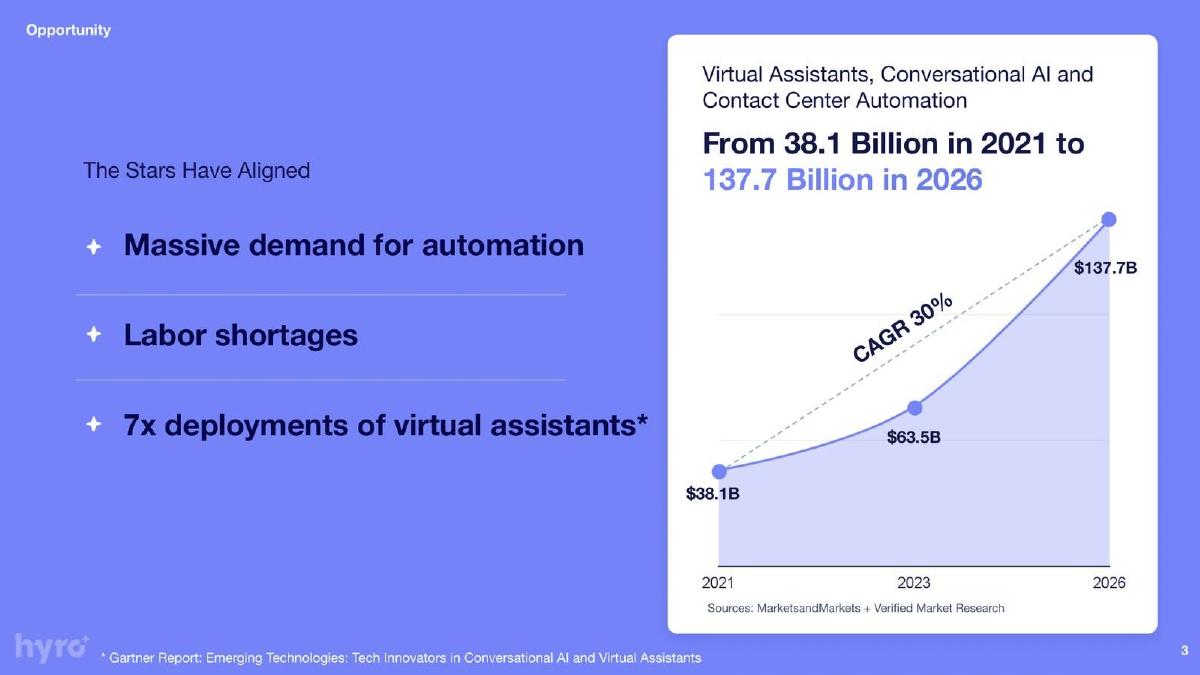
- Market demand is framed by a 30% CAGR, projecting a $137.7 billion market for conversational AI by 2026 (Slide 3).
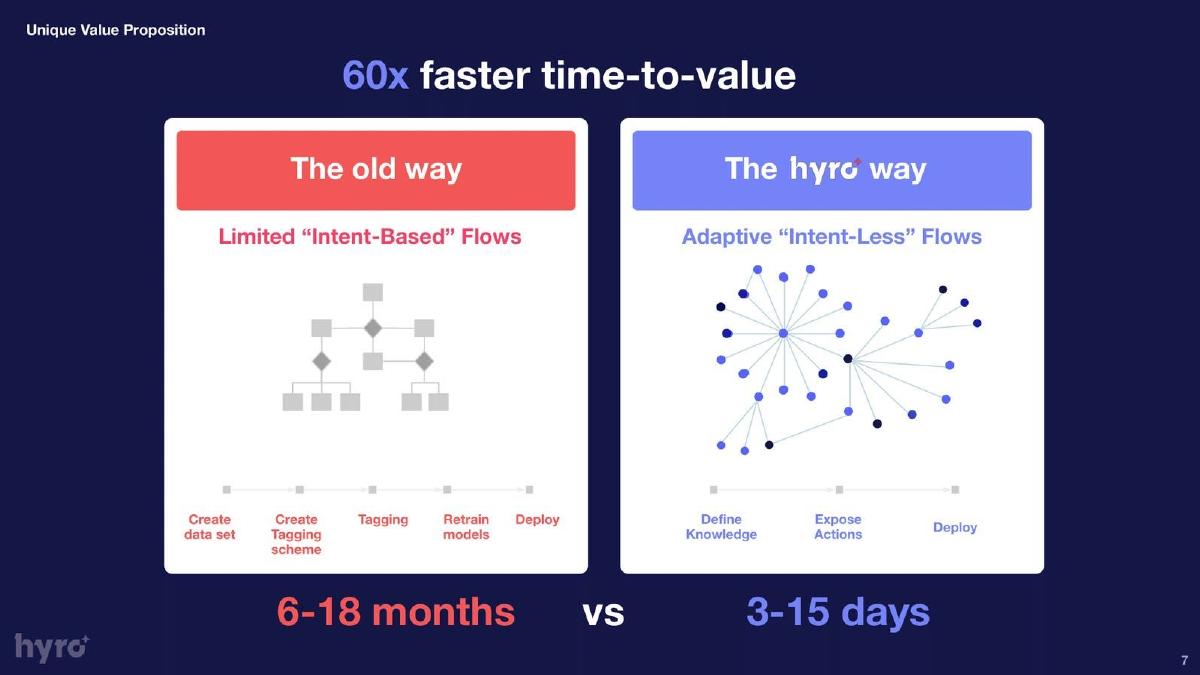
- Hyro claims a 60x faster time-to-value, reducing deployment from 6-18 months to just 3-15 days (Slide 7).
- The platform differentiates itself by moving from 'Intent-Based' flows to 'Adaptive Intent-Less' flows (Slide 7).
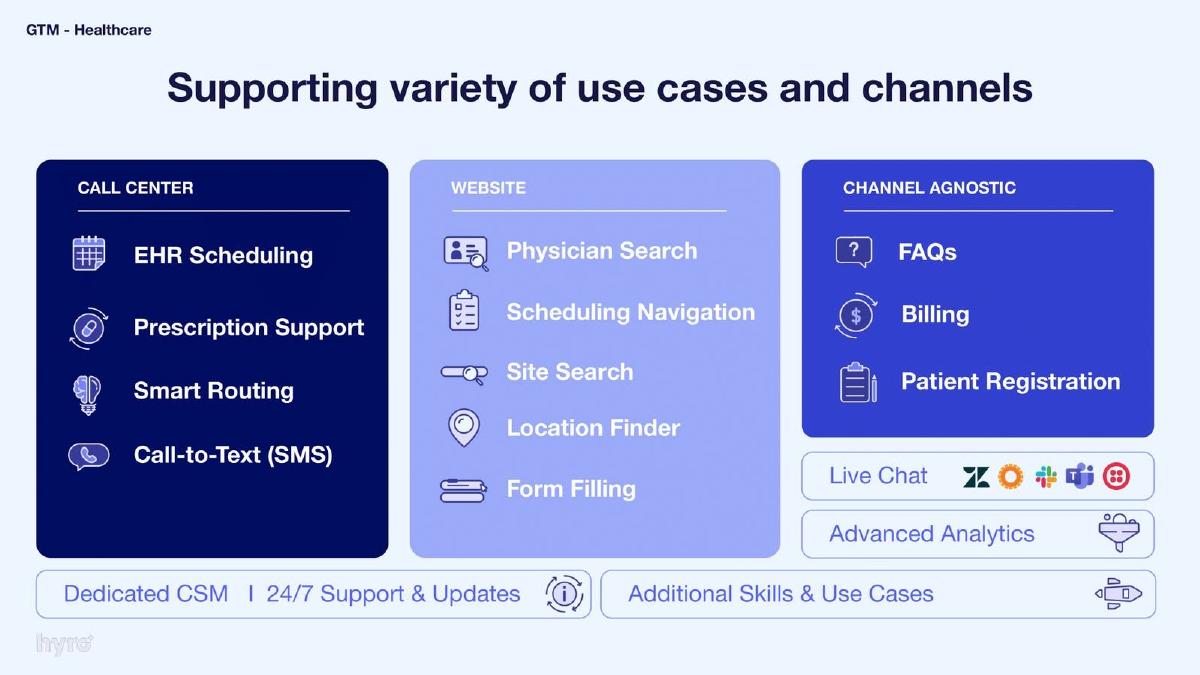
- The Go-To-Market strategy is deeply verticalized for healthcare, covering EHR scheduling, prescription support, and patient registration (Slide 9).
- Enterprise stickiness is demonstrated through a 0% churn rate and a 75% expansion rate among health systems (Slide 11).
- Revenue mix is shifting rapidly, with call center automation expected to drive over 50% of ARR by 2024 (Slide 13).
- The deck reports consistent 100%+ Year-over-Year ARR growth from 2021 through 2023 (Slide 13).
The Series B Narrative: From Tool to Infrastructure
Hyro’s 2024 Series B deck, which facilitated a $20M raise reported by Business Insider, is a study in enterprise de-risking. At the Series B stage, investors are no longer looking for just a 'cool' technology; they are looking for a scalable machine. Hyro addresses this by focusing on three pillars: technical superiority (the 'Adaptive' model), vertical dominance (Healthcare), and exceptional retention metrics. The deck is concise at 15 slides, using a clean, professional aesthetic that mirrors the 'plug-and-play' nature of their software.
Slide 1: The Credibility Lead
The cover slide does more than state the company name. It positions Hyro as 'The World’s First Adaptive Communications Platform.' Crucially, the bottom third of the slide is dedicated to third-party validation: a Gartner Cool Vendor award, Microsoft’s 2021 Partner of the Year, and a Juniper Research Platinum Winner badge. For a Series B company, lead-in credibility reduces the friction of the technical claims that follow.
Slide 3: The Macro Opportunity
Slide 3 frames the 'Opportunity' using a classic top-down market sizing approach. It cites a CAGR of 30%, moving from a $38.1 billion market in 2021 to a projected $137.7 billion in 2026. By listing 'Massive demand for automation' and 'Labor shortages' alongside a Gartner stat of '7x deployments of virtual assistants,' Hyro aligns its growth with unavoidable macroeconomic trends. This slide tells investors that the wind is at the company's back.
Slide 5: The Human-Centric Solution
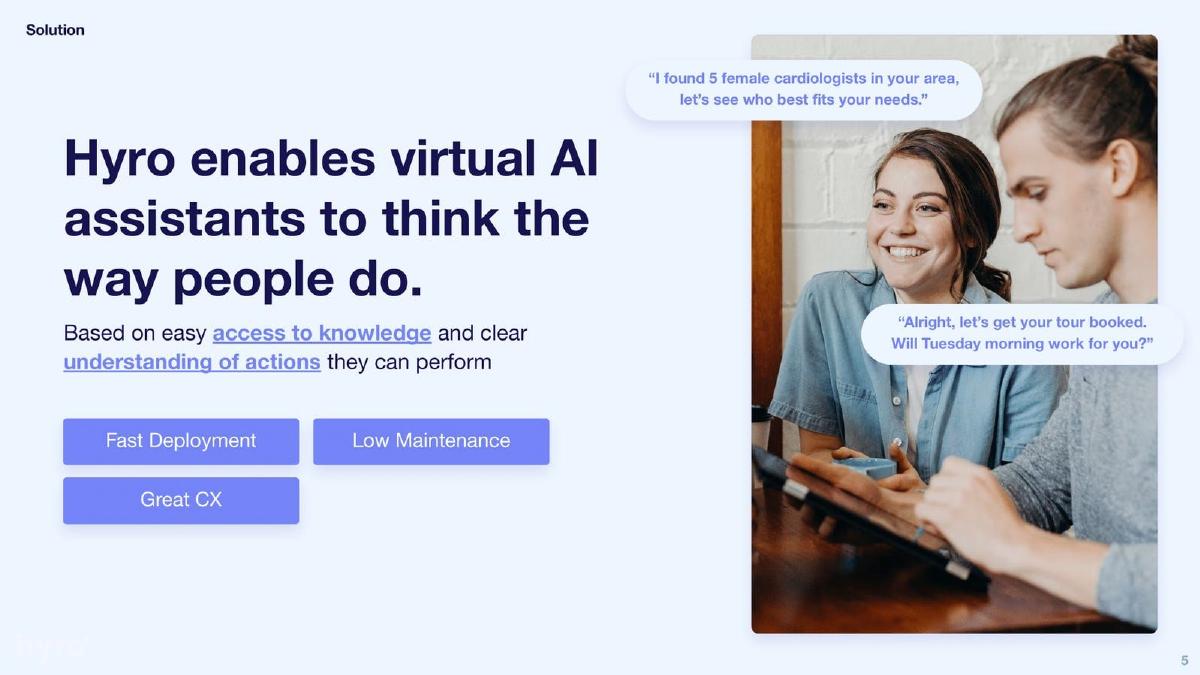
The 'Solution' slide moves away from abstract code and toward user experience. It claims Hyro enables AI assistants to 'think the way people do.' The slide highlights three core benefits: Fast Deployment, Low Maintenance, and Great CX. The visual includes a mockup of a healthcare interaction ('I found 5 female cardiologists in your area'), which immediately grounds the technology in a high-value, specific use case.
Slide 7: The '60x' Differentiator
This is arguably the most important slide in the deck. It contrasts 'The old way' (Intent-Based Flows) with 'The hyro way' (Adaptive Intent-Less Flows). By visualizing a rigid tree structure versus a fluid neural network, Hyro makes a complex technical argument simple. The '60x faster time-to-value' claim is backed by a stark timeline comparison: 6-18 months for traditional setups versus 3-15 days for Hyro. For an enterprise buyer, this is a compelling ROI argument.
Slide 9: Vertical Specialization (GTM)
Slide 9 focuses on the healthcare Go-To-Market strategy. It breaks down use cases into three categories: Call Center (EHR scheduling, prescription support), Website (Physician search, location finder), and Channel Agnostic (FAQs, billing). By showing integrations with platforms like Salesforce, Zendesk, and Microsoft Teams, Hyro demonstrates that it is not a siloed solution but a layer that sits on top of existing enterprise stacks.
Slide 11: The 'Double Down' Metrics
Traction is presented not just as new sales, but as deepening relationships. The headline 'They’re doubling down' is supported by two powerful figures: a 0% Churn Rate and a 75% Expansion Rate. These are 'best-in-class' metrics that suggest once a health system integrates Hyro, they find it indispensable. The right side of the slide is a 'wall of logos' featuring major providers like Novant Health, Montefiore, and Weill Cornell Medicine, proving they can navigate the complex procurement cycles of large-scale healthcare organizations.
Slide 13: Revenue Evolution and Growth
Slide 13 provides a bar chart showing 100%+ YoY ARR Growth. More interestingly, it shows the shift in revenue composition. In 2021, the business was 85% website-based. By 2023, call centers became the dominant segment at 50%. A callout note predicts that by 2024, contact center automation (including SMS) will drive over 50% of ARR. This indicates that Hyro is successfully moving from simple web chat to the 'harder' and more lucrative problem of voice and SMS automation.
Slide 15: The Patient Journey
The deck concludes with a simple closing slide: 'A stellar patient journey starts with hyro.' It provides the website and a contact email for the CEO. It serves as a thematic bookend to the healthcare-heavy narrative established in the middle of the deck.
What Hyro Does Exceptionally Well
Hyro excels at comparative positioning . By explicitly defining the 'Old Way' (Slide 7), they create a category for themselves ('Adaptive') rather than just being another chatbot company. This is essential in a crowded AI market. Furthermore, their focus on healthcare is a strategic masterstroke. Healthcare is notoriously difficult to sell into due to privacy and integration requirements; by showing a 0% churn rate in this sector, they signal to investors that their 'moat' is both technical and operational.
The deck also uses social proof as a foundation rather than an afterthought. Starting with awards on Slide 1 and ending the traction section with a 75% expansion rate creates a narrative of inevitable success. They aren't asking investors to believe the tech works; they are showing that the most demanding customers in the world already rely on it.
What is Missing from the Hyro Deck
The most glaring omission in the provided slides is a Team Slide . While the publisher-reported facts confirm a successful $20M raise, an investor would typically want to see the pedigree of the founders and the engineering team, especially for a technical 'Adaptive AI' play. There is also no Unit Economics slide (LTV/CAC ratios), which is standard for a Series B pitch to prove the efficiency of the sales motion.
Additionally, there is no 'The Ask' slide in the provided sequence. While we know they raised $20M, a standard deck usually outlines how that capital will be deployed—whether for R&{quot}D, international expansion, or scaling the sales team. Finally, a Competitive Landscape slide is missing. Given the explosion of LLM-based startups in 2023 and 2024, explaining exactly how Hyro sits alongside or above generic GPT-based solutions would be a likely question from any VC.
Founder Takeaways: Copy These Strategies
Quantify the 'Before and After': Hyro’s '60x faster' and '6-18 months vs 3-15 days' (Slide 7) is the strongest part of the deck. Founders should always look for a single, dramatic metric that defines their technical advantage. · Show Revenue Mix Shift: If your product is evolving from a simple use case to a complex one, show it visually like Hyro did on Slide 13. It proves that you are capturing more of the customer's value chain over time. · Lead with Validation: If you have won industry awards or have partnerships with giants like Microsoft, put them on the cover. It changes the tone of the entire meeting from 'convincing' to 'confirming.' · Verticalize Your Use Cases: Instead of saying 'we work for everyone,' Hyro showed exactly how they handle 'EHR Scheduling' and 'Physician Search' (Slide 9). Specificity wins in enterprise SaaS.
Frequently asked questions
- What is Hyro's primary value proposition?
- Hyro positions itself as an 'Adaptive Communications Platform' that replaces rigid, intent-based chatbots with a system that understands knowledge and actions. Their primary selling point is speed; they claim to deploy 60x faster than traditional methods, moving from an 18-month implementation cycle to as little as three days.
- How does Hyro demonstrate market traction?
- The deck highlights a 0% churn rate and a 75% expansion rate, which are elite metrics for enterprise SaaS. They also list several high-profile healthcare clients, including Weill Cornell Medicine, Intermountain Healthcare, and Baptist Health, signaling strong product-market fit in a highly regulated industry.
- What technical shift does Hyro advocate for?
- Hyro argues that the 'old way' of conversational AI relies on limited intent-based flows that require manual tagging and retraining. Their 'Hyro way' uses adaptive, intent-less flows that define knowledge and expose actions, allowing the AI to 'think' more like a human and adapt to new data without manual intervention.
- Which industries does Hyro target?
- While the platform is described as an enterprise-grade tool for various sectors, the deck focuses almost exclusively on healthcare. Use cases include EHR scheduling, physician search, and patient registration, indicating a deep vertical focus to win the Series B round.
- What are the key financial metrics mentioned?
- The deck reports 100%+ Year-over-Year ARR growth. It also shows a diversification of revenue: in 2021, 85% of revenue came from websites, but by 2023, call centers and SMS grew to represent 65% of the mix, showing a move into more complex automation.