icustommadeit is a vertical marketplace aiming to disrupt traditional e-commerce by focusing exclusively on custom-made, unique items. The deck positions the company against giants like Amazon and eBay by highlighting a 'discovery-based' model where buyers and creators collaborate directly. While the deck successfully identifies a market gap for personalized goods and showcases a functional website interface, it relies heavily on the success of external competitors like CustomMade and GlobeIn to validate its own 'proof of concept.' The presentation lacks internal financial metrics, specific u…
Key takeaways
- The company defines its core value proposition through three pillars: Connect, Collaborate, and Create (Slide 2).
- icustommadeit differentiates itself from 'one-size-fits-all' marketplaces like Amazon and Jabong by focusing on discovery and custom items (Slide 3).
- The platform targets a wide range of categories including clothes, shoes, jewelry, leather products, and household items (Slide 3).
- The founders claim it took 2 years to build the vertical marketplace model to bridge the gap between creators and products (Slide 5).
- Social validation is presented through a '1000 Fans' milestone on Facebook and mentions of interactive weekly campaigns (Slide 6).
- The deck uses the fundraising success of competitors, such as CustomMade raising $24 million, as its primary proof of concept (Slide 7).
- There is a notable absence of a team slide, financial projections, or a specific funding request in the provided slides.
- The business model relies on 'social ecommerce,' emphasizing the dialogue between the buyer and creator (Slide 5).
Executive Summary: The Bespoke Marketplace Vision
The icustommadeit pitch deck presents a vision for a vertical marketplace dedicated to the creation and sale of custom-made goods. The narrative is built on the premise that modern consumers are tired of mass-produced items and seek a more personal connection to the products they buy. By positioning itself at the intersection of e-commerce and social interaction, the company attempts to carve out a niche that generalist marketplaces like Amazon or Jabong cannot easily fill. However, the deck leans heavily on philosophical appeal and the success of competitors rather than its own internal performance data.
Slide 1: The Hook
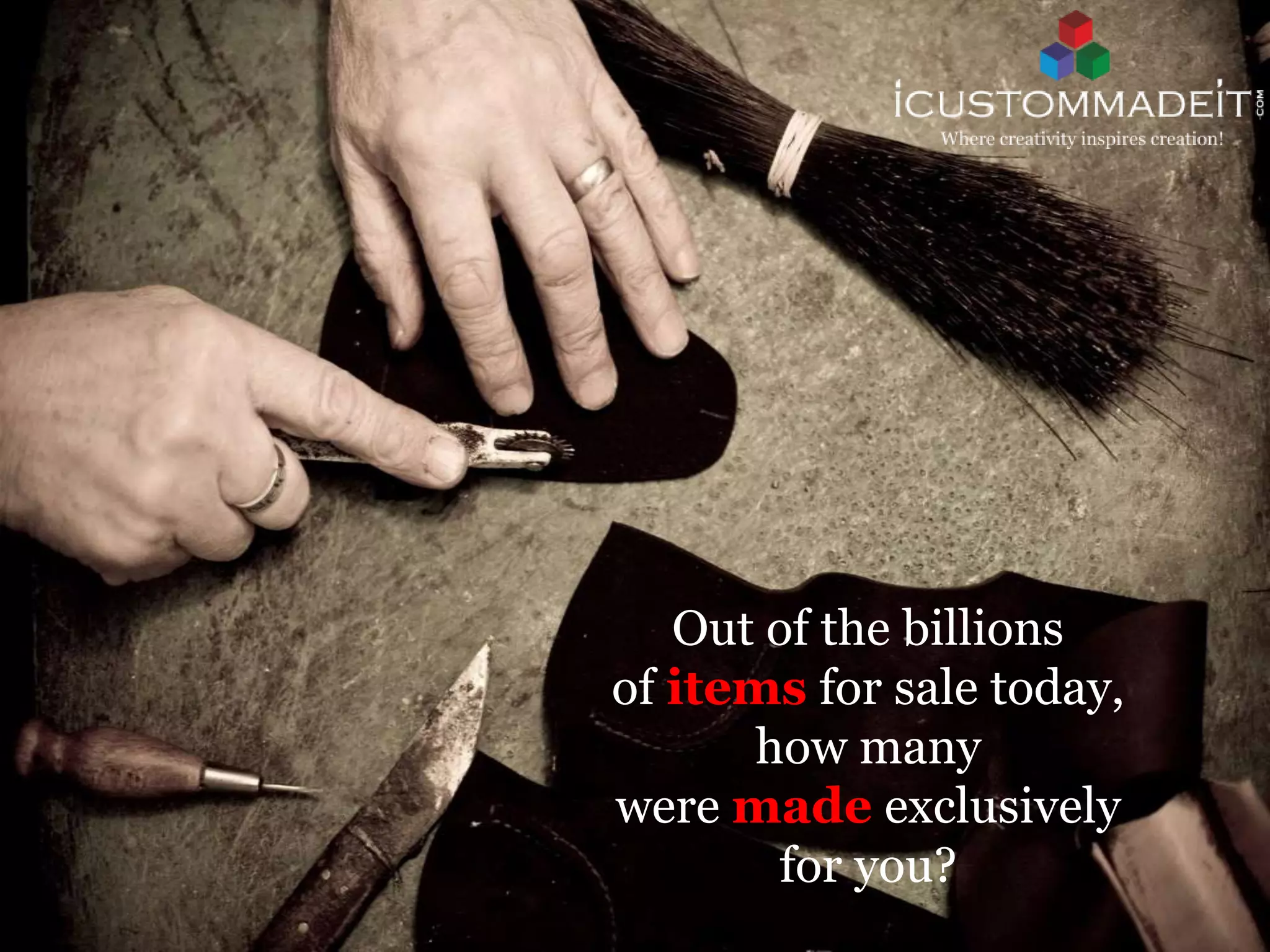
The opening slide uses a high-quality, atmospheric image of a craftsman working with leather. The text, "Out of the billions of items for sale today, how many were made exclusively for you?" serves as a classic rhetorical hook. It immediately identifies the emotional gap in the current retail landscape: the lack of personalization. The branding is clear, featuring the logo and the tagline "Where creativity inspires creation!"
Slide 2: The Core Process
Slide 2 introduces the three-step functional model of the platform: Connect , Collaborate , and Create . It defines the participants as "Creators" (designers, manufacturers, artists) and "enthusiastic buyers." The slide makes a bold claim that the platform allows users to create "something—anything—absolutely unique." This suggests a horizontal approach to custom goods, rather than focusing on a single category like furniture or jewelry.
Slide 3: Market Differentiation
This slide addresses the competitive landscape. It explicitly names eBay, Amazon, and Jabong as "one-size-fits-all" marketplaces. The differentiation for icustommadeit is "discovery." The text describes the platform as a "veritable goldmine of unique items" and lists specific categories: clothes, shoes, jewellery, leather products, and household items. The use of a thought bubble asking "How are we a different marketplace?" is a direct way to address investor concerns about competition.
Slide 4: Product Showcase
Slide 4, titled "The Look & Feel of our Website!", provides a screenshot of the platform's interface. The design appears clean and professional, featuring sections for "Meet Our Creators," "Creator Stories," and a "Trust and Safety" program. This slide is intended to prove that the product is not just a concept but a functional digital asset. It emphasizes transparency through creator profiles and video content.
Slide 5: Competitive Advantage and Longevity
The founders state that it took "2 dedicated years to build this vertical marketplace model." This is likely intended to demonstrate a barrier to entry or "moat," suggesting that the backend logic required to bridge the gap between creators and buyers is complex. The slide also introduces the term "social ecommerce," highlighting that the value lies in the dialogue between the parties involved. The phrase "competition minifies" is used to suggest that their specific focus on the creator-buyer relationship makes them immune to traditional retail threats.
Slide 6: Social Validation
Titled "Already Famous!", this slide focuses on social media traction. It lists "Thought-provoking Facebook Posts" and "Interactive Campaigns" as key drivers. The visual highlight is a graphic celebrating "1000 Fans!" While 1,000 fans is a modest number for a global marketplace, the slide is meant to show that there is an active community and early brand awareness. It lacks harder metrics like Customer Acquisition Cost (CAC) or conversion rates from these social channels.
Slide 7: External Proof of Concept
The final slide in this set is titled "Proof of Concept—A Highly Successful One." Interestingly, the proof provided is not the company's own revenue, but the fundraising and transaction success of other companies. It cites CustomMade (raised $24M) and GlobeIn (raised $1M). The slide includes links to TechCrunch and VentureBeat articles about these competitors. The closing statement notes they have a "Great Premise" and are now "looking for" "Solid Investors." This confirms the deck is intended for a seed or early-stage round.
What icustommadeit Does Well
The deck excels at defining a clear emotional and functional niche. By contrasting itself against the "one-size-fits-all" giants, it makes a compelling case for why a dedicated custom marketplace should exist. The visual identity is consistent, and the use of the "Connect, Collaborate, Create" framework makes the user journey easy to understand. The inclusion of a website screenshot (Slide 4) provides necessary evidence that the technical infrastructure is already in place, which reduces perceived execution risk for early-stage investors.
Missing Elements in the Pitch
The most significant omission in this deck is the lack of internal data. Relying on the success of competitors to prove one's own concept is a risky strategy; while it validates the market, it does not prove that icustommadeit has the specific operational capability to capture that market. Furthermore, the following critical slides are missing from the provided set:
Team Slide: There is no information on who is building this. In early-stage investing, the team is often more important than the idea. · Business Model: The deck does not explain the revenue stream. Does the platform take a 10%, 20%, or 30% commission? Are there listing fees? · Financial Projections: There is no mention of the expected GMV (Gross Merchandise Volume) or a path to profitability. · The Ask: While Slide 7 mentions they are looking for investors, it does not state how much money they need or what they will do with it.
Founder's Guide: What to Copy and What to Avoid
Copy the clarity of the problem statement. Slide 1 and Slide 3 do an excellent job of explaining exactly what is wrong with current e-commerce and how this platform fixes it. Using a simple three-word framework like "Connect, Collaborate, Create" is also a highly effective way to communicate a complex service model quickly.
Avoid using competitors as your only proof of concept. While it is helpful to show that a market exists, an investor wants to see your traction. Instead of citing CustomMade's $24 million raise, the founders should have highlighted their own transaction growth, the number of creators onboarded, or the average order value (AOV) on their own platform. Additionally, avoid using social media "likes" or "fans" as a primary metric for success; these are often viewed as vanity metrics unless they are tied directly to revenue or user retention data.
Conclusion
The icustommadeit deck is a strong conceptual start that successfully identifies a market trend toward personalization. It paints a picture of a sophisticated, creator-centric platform. However, to move from a "concept" to a "business," the founders need to supplement this narrative with hard data regarding their own unit economics, growth trajectory, and the specific expertise of the founding team. As it stands, the deck is a better marketing brochure than a comprehensive investment memorandum.
Frequently asked questions
- What is the primary problem icustommadeit is trying to solve?
- The deck identifies the saturation of mass-manufactured, 'one-size-fits-all' products in the global market. Slide 1 poses the question, 'Out of the billions of items for sale today, how many were made exclusively for you?' The company aims to provide a platform where buyers can escape generic retail and collaborate with artists to create unique, personalized goods.
- How does icustommadeit differentiate itself from Etsy or Amazon?
- According to Slide 3, while Amazon and eBay focus on expansive selection and sales volume, icustommadeit focuses on 'discovery' and a 'seamless platform' for communication. Slide 5 further claims they are a 'social ecommerce' company because they prioritize the dialogue between the buyer and the creator, rather than just the transaction of pre-made items.
- What evidence of traction does the deck provide?
- Traction is primarily presented through social media metrics. Slide 6 highlights '1000 Fans' on Facebook, 'thought-provoking' posts, and 'increasing fan engagement.' The deck does not provide internal transaction volume, revenue figures, or the number of active creators on the platform, choosing instead to focus on the 'look and feel' of the website (Slide 4).
- What is the company's 'Proof of Concept' strategy?
- Unusually, the company defines its 'Proof of Concept' by citing the success of other companies in the same space. Slide 7 points to CustomMade raising $24 million and GlobeIn raising $1 million as evidence that the market for custom goods is viable. It mentions that CustomMade facilitates $1 million in transactions per month to justify the icustommadeit model.
- What key investment information is missing from this deck?
- The deck omits several critical components required for a professional fundraise. There is no team slide detailing founder expertise, no business model slide explaining how the company makes money (e.g., commission rates), no financial roadmap, and no specific 'ask' regarding the amount of capital sought or the intended use of funds.