Paymetrics presented a focused seed-stage pitch aimed at solving the reporting deficiencies of the PayPal merchant ecosystem. By highlighting that PayPal transacted $168B in 2014 yet lacked robust native BI tools, the company positioned itself as the essential dashboard for 8 million business accounts. The deck is notably strong on founder-market fit, showcasing Shannon Sofield’s deep history as a PayPal 'Star Developer' and author. While the $300,000 ask is modest by modern standards, the launch strategy leverages existing proprietary assets—like a developer forum with 22,000 members—to bypa…
Key takeaways
- The company identified a massive gap in the market where PayPal transacted $168B in 2014 but provided poor native reporting tools (Slide 4).
- Founder Shannon Sofield demonstrates exceptional founder-market fit as a former PayPal Developer Advisory Board member and author of 'PayPal Hacks' (Slide 9).
- The launch strategy is highly efficient, utilizing a pre-existing community of 22,000 PayPal developers and 2,000 top sellers from a previous venture (Slide 10).
- Paymetrics uses a freemium business model, offering the core dashboard for free to capture market share while charging for 3rd party integrations and power user features (Slide 6).
- The competitive analysis highlights a significant volume advantage, noting 1 million websites using PayPal compared to just 12,000 for Stripe (Slide 7).
- The $300,000 seed ask is specifically allocated toward scaling AWS backend, design, and direct marketing (Slide 11).
- The deck lacks internal traction metrics, such as current user count or MRR, despite having launched in February 2015 (Slide 10).
- The solution emphasizes speed, claiming users can connect their account and see analyzed sales history in less than five minutes (Slide 5).
Paymetrics: The Analytics Layer for the PayPal Economy
Paymetrics entered the market with a very specific value proposition: PayPal is a giant in payments, but a laggard in data visualization. This teardown looks at their 11-slide seed deck, which seeks $300,000 to turn that gap into a scalable SaaS business. The deck is a masterclass in niche positioning and demonstrating founder-market fit, even if it leaves some questions about current traction unanswered.
Slide 1: Title Slide
The deck opens with a clean, minimalist title slide. The tagline, "Analytics for PayPal," immediately defines the product category and the target ecosystem. It includes contact information for founder Shannon Sofield and a link to their Angel.co profile, which was standard practice for seed rounds in the mid-2010s.
Slide 2: What We Do
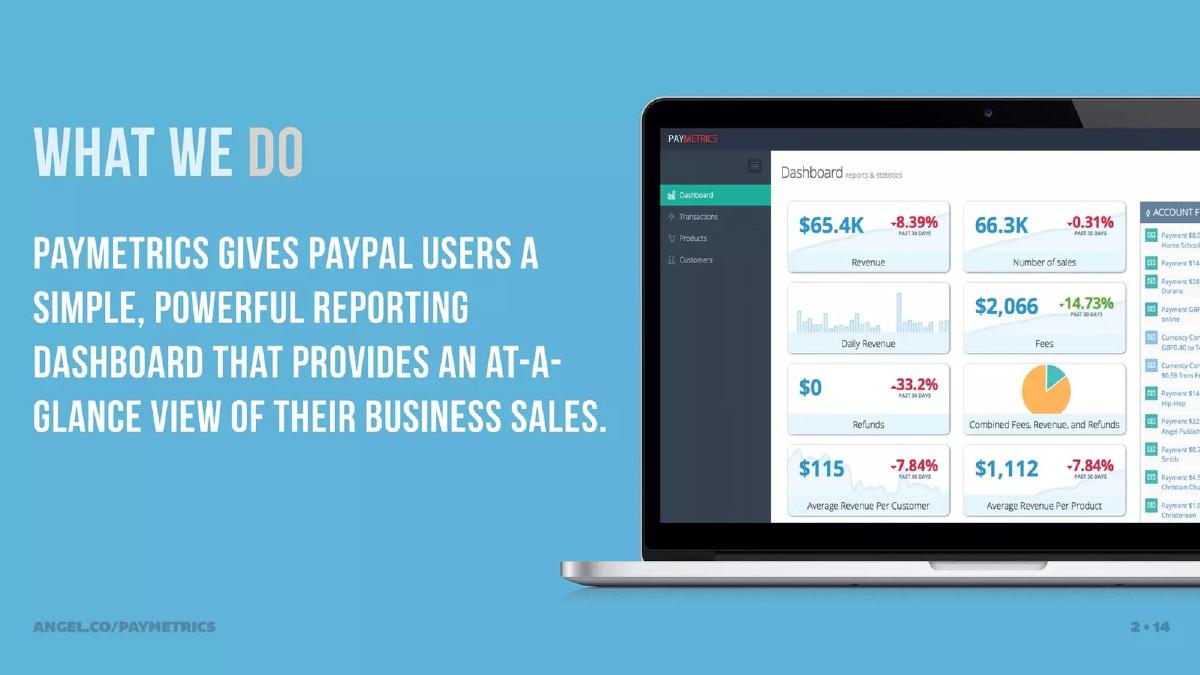
Slide 2 provides a high-level summary of the product. It describes Paymetrics as a "simple, powerful reporting dashboard" that provides an "at-a-glance view of their business sales." The slide features a high-fidelity mockup of the dashboard on a laptop, showing metrics like Revenue, Number of Sales, Fees, and Refunds. This visual proof is essential for a BI tool, as it demonstrates the UI/UX quality immediately.
Slide 3: The Problem
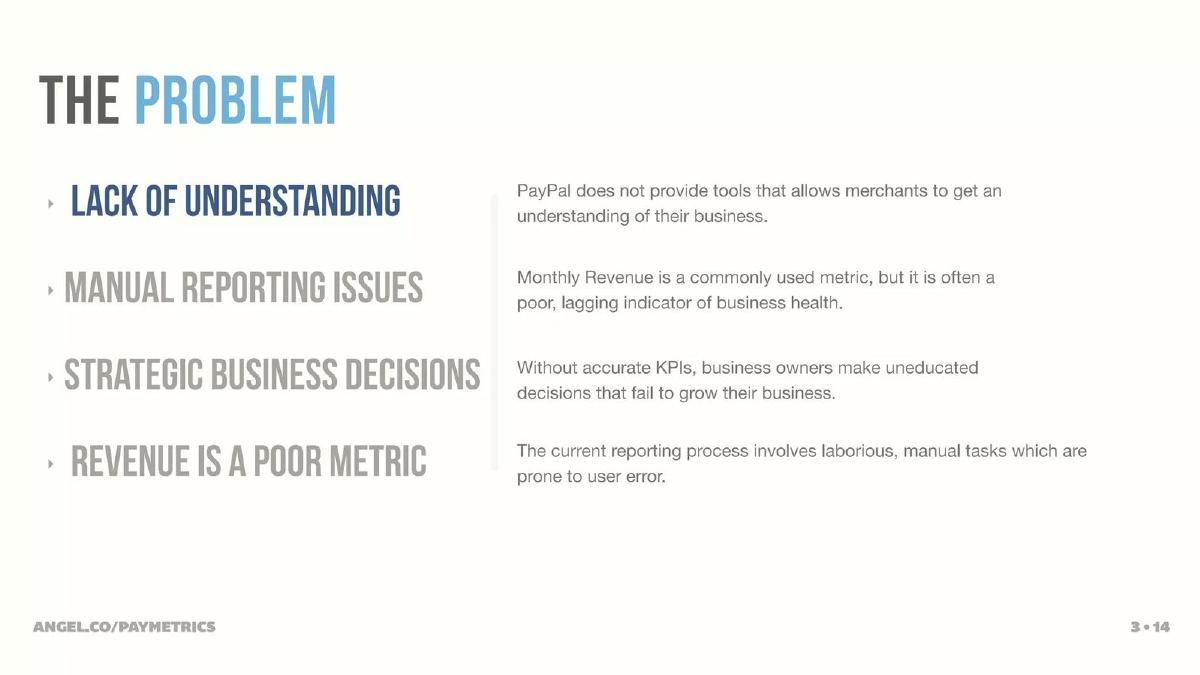
The problem slide identifies four pain points: Lack of Understanding, Manual Reporting Issues, Strategic Business Decisions, and Revenue as a Poor Metric. The text explicitly states that PayPal does not provide tools for merchants to understand their business and that current manual processes are "laborious" and "prone to user error." By framing revenue as a "lagging indicator," Paymetrics sets the stage for a tool that offers more predictive, actionable insights.
Slide 4: Market Opportunity
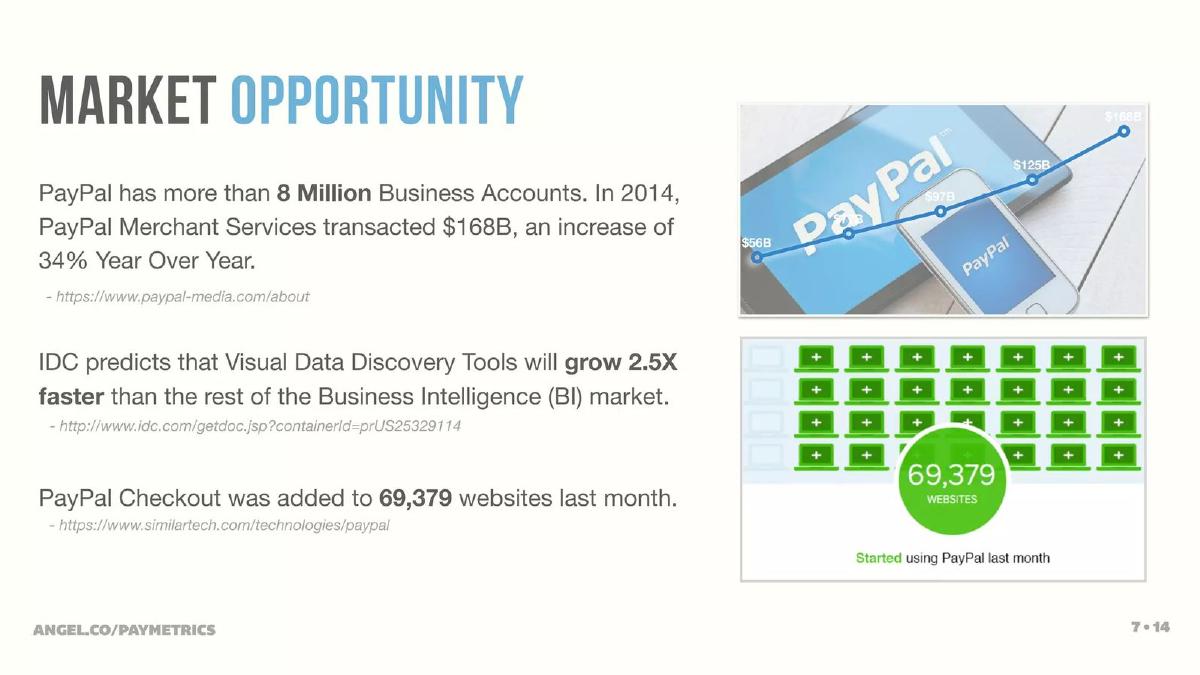
Paymetrics anchors its market size in hard numbers from 2014. It notes that PayPal has more than 8 million business accounts and transacted $168B, a 34% year-over-year increase. The slide also cites an IDC prediction that visual data discovery tools will grow 2.5x faster than the rest of the BI market. Most importantly, it mentions that 69,379 websites added PayPal Checkout in just the last month, suggesting a rapidly expanding top-of-funnel for their service.
Slide 5: Paymetrics Solution
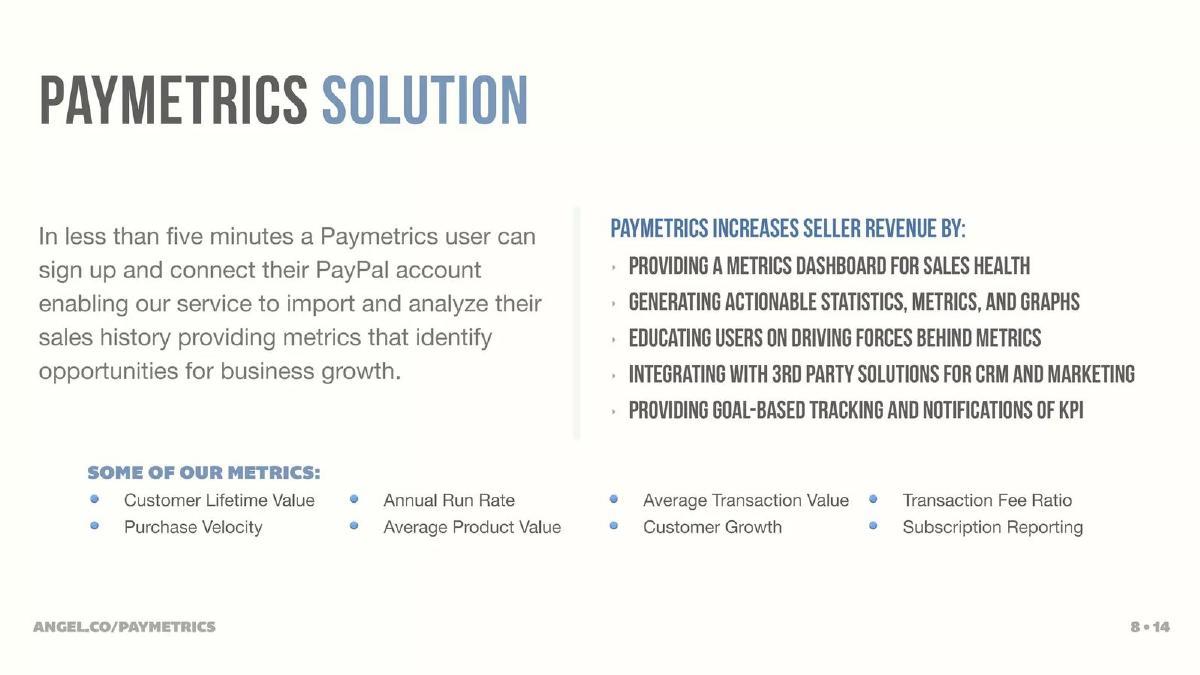
The solution slide focuses on speed and utility. It claims a user can sign up and connect their account in "less than five minutes." It lists specific metrics provided, such as Customer Lifetime Value, Annual Run Rate, and Transaction Fee Ratio. The right side of the slide explains how these metrics increase seller revenue by educating users on driving forces and integrating with 3rd party CRM and marketing solutions.
Slide 6: Business Model
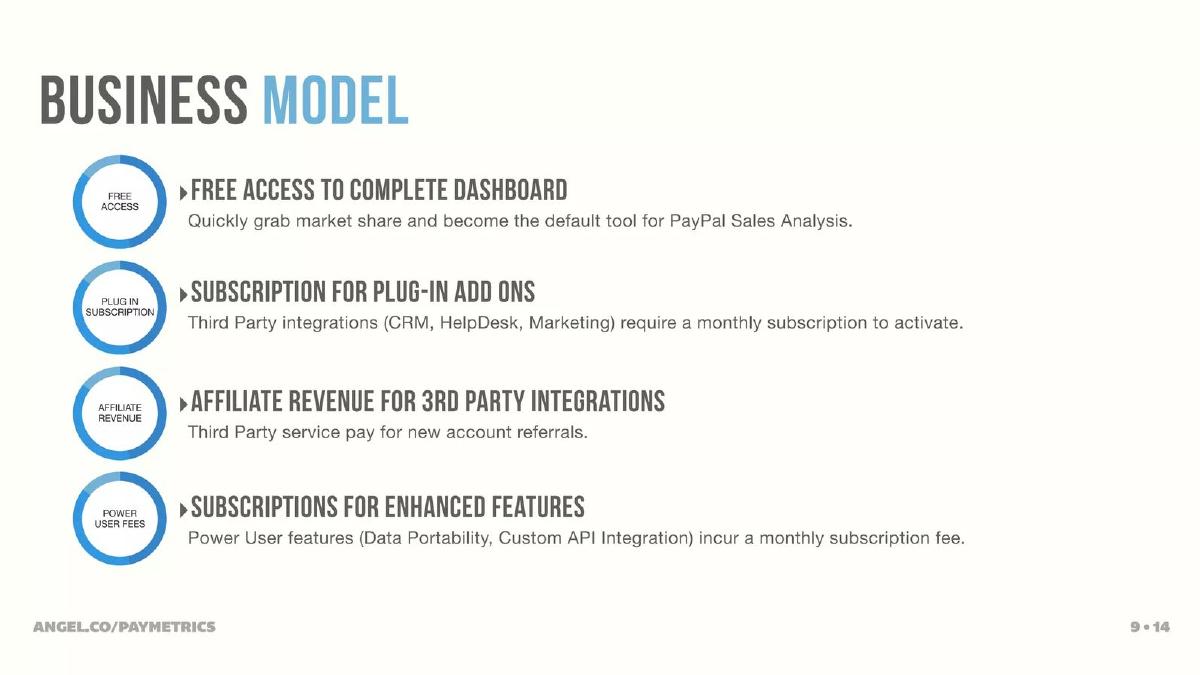
The business model is a classic freemium SaaS approach. Paymetrics offers "Free Access to Complete Dashboard" to acquire market share quickly. Monetization comes from three secondary streams: subscriptions for plug-in add-ons (CRM/HelpDesk), affiliate revenue for referrals to those 3rd party services, and "Power User Fees" for advanced features like custom API integration and data portability. This multi-pronged approach reduces the friction of initial adoption while providing clear paths to expansion revenue.
Slide 7: Competition
This is one of the strongest slides in the deck. It uses a grid to compare Paymetrics against competitors like ChartMogul, Baremetrics, and Putler. While many competitors focus on Stripe or Braintree, Paymetrics highlights that PayPal has 1 million website integrations, compared to Stripe's 12,000 and Braintree's 1,000. By pointing out that Baremetrics raised $500k and has $28k MRR on a much smaller ecosystem (Stripe), Paymetrics implies a massive, untapped upside for a PayPal-centric version of the same service.
Slide 8: Paymetrics Team
The team slide focuses entirely on founder Shannon Sofield. It builds an airtight case for founder-market fit: he founded PayLoadz.com (which processed $75M on PayPal), started the PayPalDev.org forum (22k members), served on the PayPal Developer Advisory Board, and authored "PayPal Hacks" for O'Reilly. The slide also mentions a "Development Partner," smartData Enterprises, to address technical execution, though the lack of a full-time in-house CTO might be a red flag for some investors.
Slide 9: Launch Strategy
The launch strategy slide outlines a 5-step plan. It notes the company launched as part of the PSLU Accelerator on February 2nd, 2015. The strategy relies heavily on the founder's existing assets: direct recruiting of the top 2,000 PayLoadz sellers and email solicitation of the 22,000 members of the PayPal developer forum. This "built-in" audience significantly de-risks the customer acquisition cost (CAC) in the early stages.
Slide 10: The Ask
Paymetrics seeks $300,000. The company is identified as a Delaware C Corporation. The use of funds is visualized through overlapping circles: Developers and Design, Scale AWS Backend, Direct Marketing, and Content Creation. The goal is stated clearly: "grow the user base as quickly as possible." The amount is modest, suggesting a bridge to a larger Series A or a path to profitability through the proposed freemium model.
Slide 11: Closing Slide
The deck concludes with a repeat of the title slide, ensuring the brand name and contact details are the final thing the investor sees. It maintains the consistent, professional branding found throughout the presentation.
What Paymetrics Does Well
The Paymetrics deck excels at niche validation . By comparing the sheer volume of PayPal integrations to the much smaller Stripe ecosystem, they make a compelling case that a "Baremetrics for PayPal" is not just a viable business, but potentially a much larger one. The founder-market fit is also exceptional; it is rare to see a founder who literally wrote the book on the platform they are building for.
Furthermore, the launch strategy is grounded in reality. Instead of vague promises about "viral growth," the founders point to specific, owned databases of thousands of potential users. This gives investors confidence that the initial "cold start" problem has already been solved.
What is Missing from the Deck
The most glaring omission is internal traction data . Slide 9 mentions a launch date of February 2, 2015, but the deck provides no information on how many users signed up in the weeks following the launch, what the retention looks like, or if any users have converted to the paid "Power User" tiers. Even in a seed round, investors want to see the initial reaction to the live product.
Additionally, the technical team is a bit thin. While the founder has deep domain expertise, the reliance on an external "Development Partner" (smartData) rather than a co-founder or an in-house engineering lead can be a point of friction for VCs who prefer to see core intellectual property developed internally.
Lessons for Founders
Leverage Ecosystem Disparities: If a popular service exists for one platform (like Stripe), look at larger but less "trendy" platforms (like PayPal) to see if a similar gap exists. Paymetrics used the success of Baremetrics to validate their own category. · Quantify Your Unfair Advantage: Don't just say you have a network; quantify it. Paymetrics cited 22,000 forum members and 2,000 top sellers they could reach immediately. · Show, Don't Just Tell: The use of a high-quality dashboard mockup on Slide 2 and Slide 5 helps investors visualize the product's value without needing a live demo. · Address the Platform Risk: When building on top of a single platform like PayPal, it is helpful to mention integrations with "3rd party solutions for CRM and Marketing" (Slide 5) to show that the product can eventually become a hub for multiple data sources, reducing the risk of being shut down by the primary platform.
Frequently asked questions
- What is the core problem Paymetrics solves?
- According to Slide 3, PayPal merchants suffer from a 'lack of understanding' of their business because the platform does not provide adequate BI tools. Paymetrics argues that monthly revenue is a lagging indicator and that manual reporting is prone to error, preventing business owners from making educated strategic decisions.
- How does Paymetrics plan to acquire users without a large marketing budget?
- Slide 10 outlines a five-step launch strategy that relies on 'unfair advantages.' This includes recruiting the top 2,000 sellers from the founder's previous company (PayLoadz), soliciting 22,000 members of the PayPalDev.org forum, and targeting a list of 20,000 websites known to use PayPal.
- What is the revenue model for the platform?
- Slide 6 details a multi-tiered model: free access to the main dashboard to grab market share, monthly subscriptions for 'Plug-in Add ons' (CRM/Marketing integrations), affiliate revenue from 3rd party referrals, and 'Power User Fees' for data portability and custom API access.
- Who is the competition and how does Paymetrics differentiate?
- Slide 7 compares Paymetrics to players like Baremetrics and ChartMogul. While those competitors focus on Stripe or Braintree, Paymetrics differentiates by focusing exclusively on the PayPal ecosystem, which it claims has 1 million website integrations—significantly more than its rivals' target platforms.
- What are the specific metrics the dashboard tracks?
- Slide 5 lists several key performance indicators the tool provides, including Customer Lifetime Value (CLV), Purchase Velocity, Annual Run Rate, Average Product Value, Transaction Fee Ratio, and Subscription Reporting.