Payvista's 9-slide pitch deck outlines its omni-channel payment system designed to integrate multiple payment methods and simplify reconciliation, primarily targeting the healthcare sector. The company identifies a Serviceable Obtainable Market (SOM) of USD 47 Billion in India and UAE, based on a 10% capture rate of the USD 477 Billion Serviceable Available Market (SAM). Traction is detailed across India, UAE, and Kenya, including signed agreements with hospitals, partnerships with software providers and banks, and active discussions with a total processing volume of approximately INR 14 Cror…
Key takeaways
- Payvista is presented as an omni-channel payment system that integrates multiple payment methods and provides reconciliation reports (Slide 1).
- The deck identifies current payment system complexities as fragmented integrations, multiple solutions, and operational challenges (Slide 2).
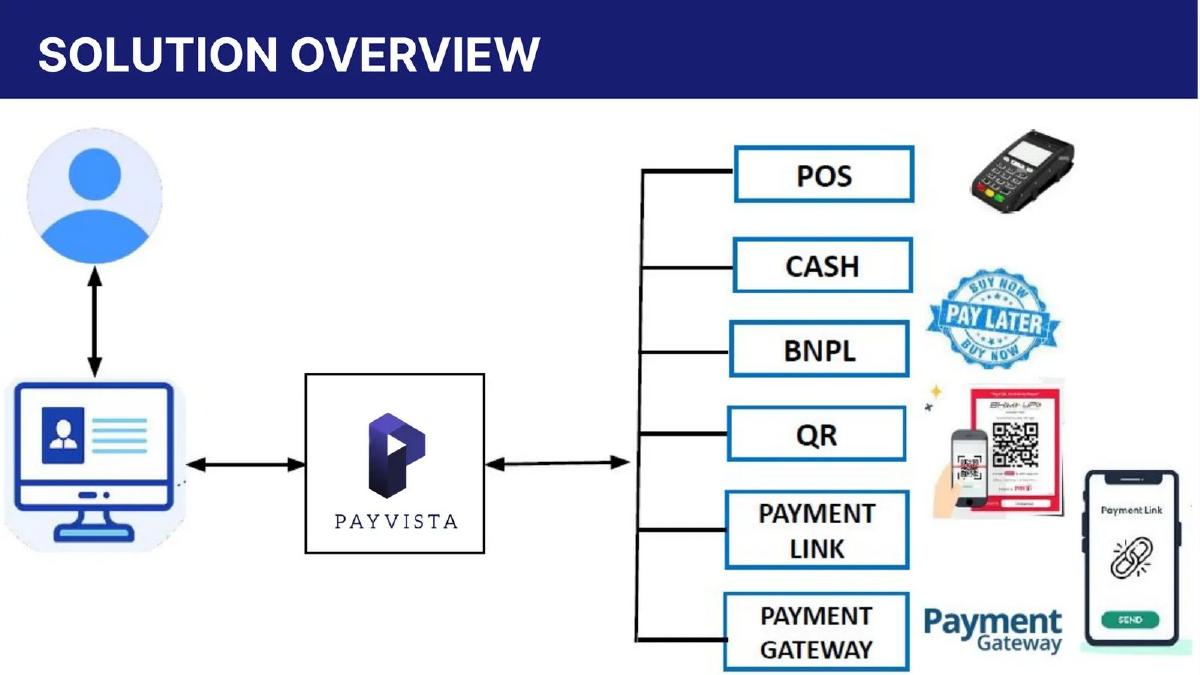
- Payvista's solution focuses on integration, simplicity, and reconciliation, consolidating various payment types like POS, QR, BNPL, and payment gateways (Slide 3, Slide 4).
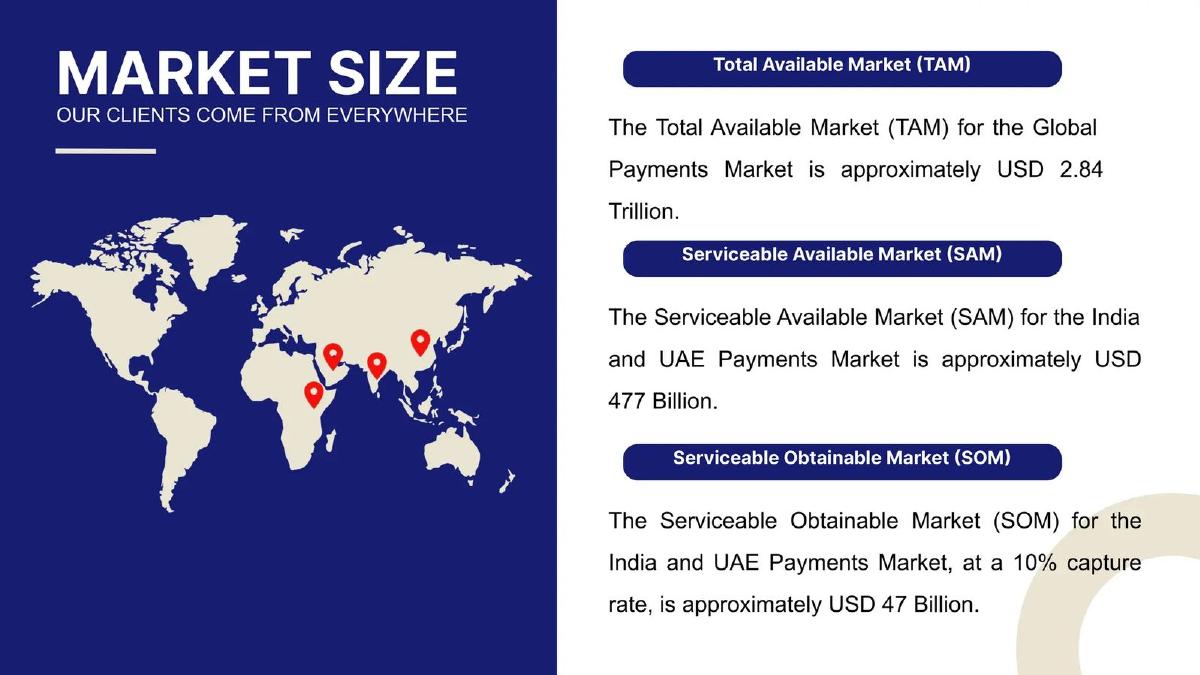
- The Serviceable Obtainable Market (SOM) for Payvista in India and UAE is estimated at USD 47 Billion, based on a 10% capture rate of the USD 477 Billion Serviceable Available Market (SAM) (Slide 5).
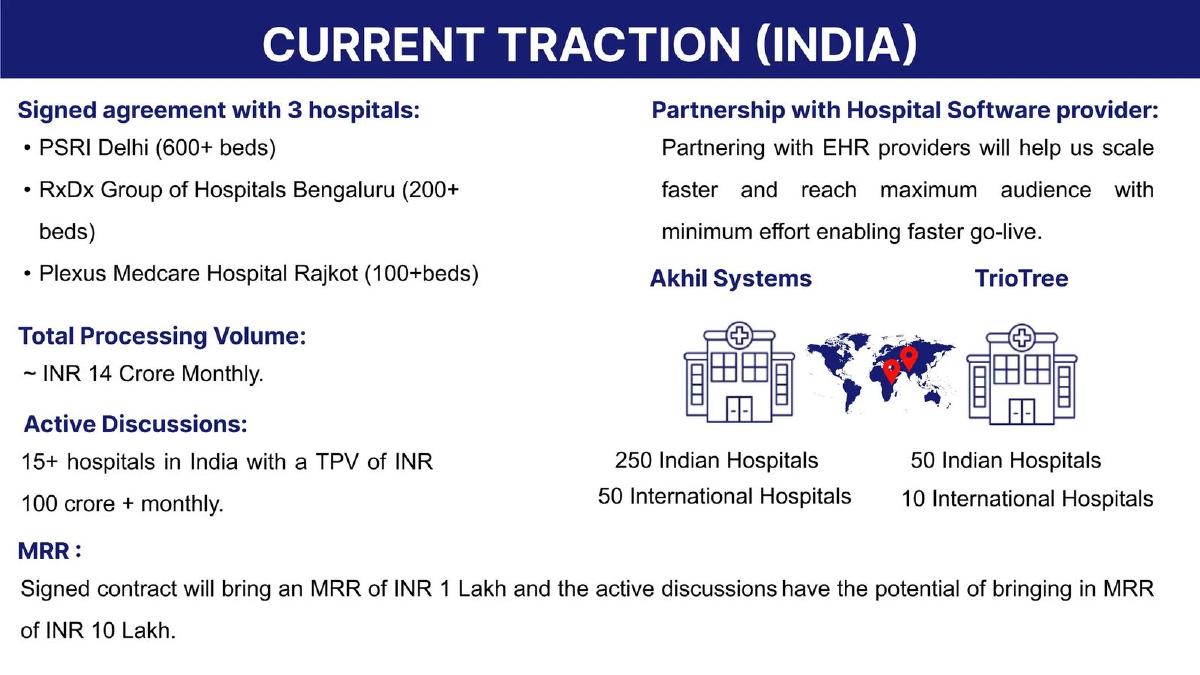
- Current traction in India includes signed agreements with 3 hospitals (PSRI Delhi, RxDx Group, Plexus Medcare) and partnerships with two hospital software providers (Akhil Systems, TrioTree) (Slide 6).
- Indian traction shows a Total Processing Volume (TPV) of approximately INR 14 Crore monthly and potential MRR of INR 10 Lakh from active discussions (Slide 6).
- International traction includes RFPs submitted to 4 hospitals in UAE and a partnership with UAE's largest acquirer, Network International, with a TPV of approximately $81 Million monthly (Slide 7).
- An active discussion in Kenya with MP Shah Hospital shows a TPV of ~$5 Million monthly, with a combined potential MRR of $160,000 from UAE and Kenya discussions (Slide 7).
Payvista Pitch Deck Teardown: Omni-Channel Payments for Healthcare
This teardown analyzes the 9-slide pitch deck for Payvista, an omni-channel payment system. The deck, titled "Payvista - Deck 2024 MXR Presentation.pdf" from SlideShare, focuses on the company's solution for simplifying payment operations and reconciliation, with a clear emphasis on the healthcare sector in India, UAE, and Kenya. The analysis will proceed slide-by-slide, detailing the content presented and then offering insights into what works well, what is missing, and key takeaways for other founders.
Slide 1: Title Slide
The first slide introduces PAYVISTA . On the left, a blue background features a white, stylized 'P' logo and the company name "PAYVISTA" in white text. The right side of the slide has a white background with "PAYVISTA" in large, dark blue, serif font, underlined. Below the company name, a descriptive paragraph states: "Payvista is an omni channel payment system that seamlessly integrates multiple payment methods, simplifying operations and providing comprehensive reconciliation reports." This slide serves as a clear introduction to the company and its core offering.
Slide 2: Current Payment Systems Complexity
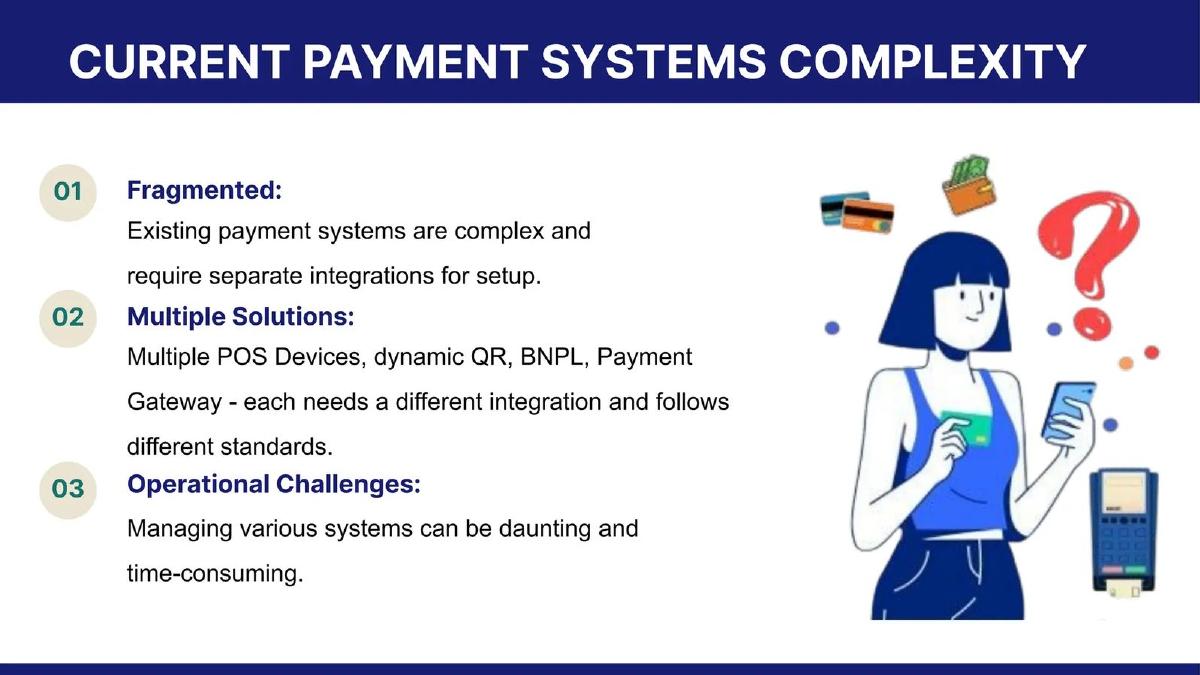
This slide, titled "CURRENT PAYMENT SYSTEMS COMPLEXITY" in bold, white text on a dark blue banner, outlines the problems Payvista aims to solve. It uses a numbered list format with three points: 01 Fragmented: "Existing payment systems are complex and require separate integrations for setup." 02 Multiple Solutions: "Multiple POS Devices, dynamic QR, BNPL, Payment Gateway - each needs a different integration and follows different standards." 03 Operational Challenges: "Managing various systems can be daunting and time-consuming." On the right side of the slide, an illustration depicts a person holding a phone, looking confused, with credit cards, cash, a wallet, and a payment terminal nearby, along with a large red question mark, visually representing the complexity.
Slide 3: Payvista's Solution
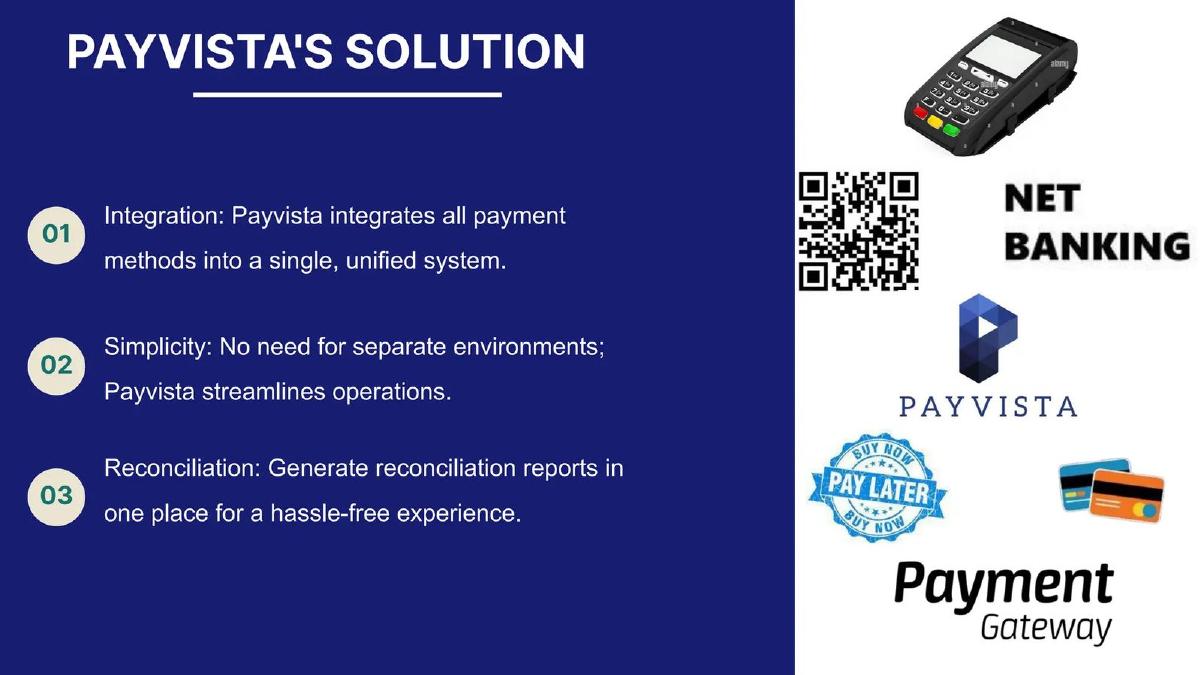
Titled "PAYVISTA'S SOLUTION" in bold, white text on a dark blue banner, this slide presents how Payvista addresses the problems identified on the previous slide. It uses a numbered list, mirroring the problem slide's structure: 01 Integration: "Payvista integrates all payment methods into a single, unified system." 02 Simplicity: "No need for separate environments; Payvista streamlines operations." 03 Reconciliation: "Generate reconciliation reports in one place for a hassle-free experience." The right side of the slide features various payment-related icons, including a POS terminal, a QR code, "NET BANKING" text, the Payvista logo, a "BUY NOW PAY LATER" badge, credit cards, and "Payment Gateway" text, illustrating the breadth of integrated payment types.
Slide 4: Solution Overview
This slide, titled "SOLUTION OVERVIEW" in bold, white text on a dark blue banner, provides a visual representation of Payvista's system. A diagram shows a user icon and a computer icon connected to the central "PAYVISTA" logo. From the Payvista logo, lines extend to a vertical stack of boxes representing different payment methods: "POS" (with an image of a POS terminal), "CASH", "BNPL" (with a "BUY NOW PAY LATER" badge), "QR" (with an image of a QR code and phone), "PAYMENT LINK" (with an image of a phone showing a payment link), and "PAYMENT GATEWAY" (with "Payment Gateway" text). This slide visually clarifies the integration capabilities of the Payvista platform.
Slide 5: Market Size
The "MARKET SIZE" slide, with the subtitle "OUR CLIENTS COME FROM EVERYWHERE," is divided into two main sections. The left side displays a world map with red pins indicating locations in India and the UAE, visually supporting the global reach claim. The right side quantifies the market opportunity: Total Available Market (TAM): "The Total Available Market (TAM) for the Global Payments Market is approximately USD 2.84 Trillion." Serviceable Available Market (SAM): "The Serviceable Available Market (SAM) for the India and UAE Payments Market is approximately USD 477 Billion." Serviceable Obtainable Market (SOM): "The Serviceable Obtainable Market (SOM) for the India and UAE Payments Market, at a 10% capture rate, is approximately USD 47 Billion." This slide clearly defines the market scope and potential for Payvista.
Slide 6: Current Traction (India)
Titled "CURRENT TRACTION (INDIA)", this slide details Payvista's progress within India. It lists: Signed agreement with 3 hospitals: "PSRI Delhi (600+ beds)", "RxDx Group of Hospitals Bengaluru (200+ beds)", and "Plexus Medcare Hospital Rajkot (100+beds)". Partnership with Hospital Software provider: "Partnering with EHR providers will help us scale faster and reach maximum audience with minimum effort enabling faster go-live." Two specific partners are named: "Akhil Systems" and "TrioTree". Total Processing Volume: "~ INR 14 Crore Monthly." Active Discussions: "15+ hospitals in India with a TPV of INR 100 crore + monthly." MRR: "Signed contract will bring an MRR of INR 1 Lakh and the active discussions have the potential of bringing in MRR of INR 10 Lakh." An image shows three hospital buildings with a world map overlay, suggesting expansion. Numbers below the image indicate "250 Indian Hospitals", "50 International Hospitals", "50 Indian Hospitals", and "10 International Hospitals" associated with the two software providers.
Slide 7: Current Traction (International)
This slide, titled "CURRENT TRACTION (INTERNATIONAL)", focuses on Payvista's progress outside India. It details: UAE: RFPs submitted at "Mediclinic Hospital group (1000+ beds)", "Kings College Hospital (500+ beds)", "American Hospital (600+ beds)", "Dubai London Clinic (300+beds)". Partnership with Bank: "Partnership with UAE's largest acquirer Network International for taking the solution to all their Healthcare Merchants." Total Processing Volume: "~ $ 81 Million monthly." Kenya: "Active discussion with one of the largest private healthcare system in Nairobi - MP Shah Hospital with a TPV of ~$ 5 Million monthly." MRR: "Opportunity of bringing in $160,000 monthly based on current discussions in UAE and Kenya." A globe icon is displayed on the right side of the slide.
Slide 8: Opportunity and Future Growth
The slide "OPPORTUNITY AND FUTURE GROWTH" presents potential revenue opportunities, divided into "India" and "International - UAE & Kenya". For India, it lists: Out of Pocket Healthcare Spending: "$53.5 Bn", "@10% Market Share - $5.35 Bn", "Revenue Opportunity @0.10% average fee per transaction - $5 Mn". For International - UAE & Kenya, it lists: Out of Pocket Healthcare Spending: "$7.5 Bn", "@20% Market Share - $1.5 Bn (higher spending on technology and heavy investment in healthcare)", "Revenue Opportunity @0.20% average fee per transaction - $3 Mn". Visual bar charts below each section illustrate these figures, with blue bars for India and colored bars (red, orange, green) for International.
Slide 9: Thank You
The final slide is a "THANK YOU" slide. It includes a call to action: "Choose Payvista for Seamless Payments" followed by three bullet points: "Streamline operations.", "Simplify payments.", and "Embrace the future of omni channel payments." On the right, an image shows a smiling woman sitting in an armchair with a laptop, pointing towards a monitor displaying the Payvista logo. At the bottom center, an email icon is shown above the contact email address: "sales@payvista.net".
What Works Well
The Payvista pitch deck effectively communicates its core value proposition and market focus. The problem-solution structure (Slides 2 and 3) is clear and easy to follow, immediately establishing the need for Payvista's service. The visual solution overview on Slide 4 helps to concretely illustrate how the system integrates various payment methods, making it accessible even to those less familiar with payment infrastructure. The market sizing on Slide 5 is well-structured, breaking down TAM, SAM, and SOM, which provides a clear understanding of the addressable market for investors. The explicit mention of a 10% capture rate for the SOM adds a layer of realism to the market projection. Furthermore, the detailed traction slides (Slides 6 and 7) are a significant strength. They provide specific names of hospitals, bed counts, and partnership details, lending credibility to the company's progress. Quantifying Total Processing Volume (TPV) and potential Monthly Recurring Revenue (MRR) in both local currency (INR) and USD offers tangible metrics of success and future potential. The separation of Indian and International traction also demonstrates a clear strategic approach to market expansion. Finally, the "Opportunity and Future Growth" slide (Slide 8) attempts to quantify the revenue opportunity based on out-of-pocket healthcare spending, connecting the product directly to a large financial flow.
What is Missing
Despite its strengths, the Payvista deck has several notable omissions. Crucially, there is no dedicated team slide. Investors typically want to understand the experience and expertise of the founders and key personnel driving the company. Without this, it's difficult to assess the team's capability to execute on the presented vision and traction. There is also no clear 'Ask' slide, which is fundamental for a pitch deck. The deck does not specify what Payvista is seeking (e.g., amount of funding, type of investment, specific milestones to be achieved with the funds). This leaves investors without a clear understanding of the purpose of the pitch. Unit economics, such as customer acquisition cost (CAC), lifetime value (LTV), or gross margins, are absent. While TPV and MRR are mentioned, a deeper dive into the profitability and scalability of each customer relationship would be beneficial. The competitive landscape is not addressed; there is no slide outlining who Payvista's competitors are, how it differentiates itself, or its unique selling propositions against existing solutions. While the problem slide hints at complexity, it doesn't explicitly position Payvista against other payment aggregators or systems. The deck also lacks a clear business model slide explaining how Payvista generates revenue beyond a generic "average fee per transaction" (Slide 8). Details on pricing structure, subscription models, or transaction fees would be valuable. Finally, a roadmap or future plans beyond general growth opportunities would provide a clearer vision of the company's strategic direction and upcoming milestones.
What a Founder Should Copy
Founders can learn several valuable lessons from Payvista's deck. Firstly, the clear problem-solution framing on Slides 2 and 3 is excellent. Articulating the pain points and then directly addressing them with a concise solution is a highly effective way to engage an audience. Secondly, the visual solution overview (Slide 4) is a strong element. Using diagrams to simplify complex technical integrations makes the product easier to grasp for non-technical investors. Thirdly, the detailed and specific traction slides (Slides 6 and 7) are exemplary. Naming specific clients, quantifying their size (e.g., bed counts for hospitals), and providing concrete metrics like TPV and potential MRR lend significant credibility. The separation of domestic and international traction also provides a structured view of growth. Fourthly, the market sizing (Slide 5) is well-executed by breaking down TAM, SAM, and SOM and providing a realistic capture rate. This demonstrates a thoughtful approach to market analysis. Lastly, the focus on a specific vertical (healthcare) is a good strategy for early-stage companies, as it allows for concentrated effort and easier market penetration, as evidenced by the specific hospital agreements and partnerships. The inclusion of a contact email on the final slide is a basic but essential element that should always be present.
In summary, Payvista's deck provides a solid foundation for understanding its product and market progress, particularly in the healthcare sector. By incorporating the missing elements, especially a team slide, a clear ask, and competitive analysis, the deck could be significantly strengthened for fundraising purposes.
Frequently asked questions
- What problem does Payvista aim to solve?
- Payvista aims to solve the complexity of current payment systems, which are described as fragmented, requiring multiple solutions, and posing operational challenges. The company seeks to simplify these processes by integrating various payment methods and providing comprehensive reconciliation reports (Slide 2).
- What is Payvista's core solution?
- Payvista's core solution is an omni-channel payment system that integrates all payment methods into a single, unified system. This aims to streamline operations, eliminate the need for separate environments, and generate reconciliation reports from one central place (Slide 3, Slide 4).
- What is Payvista's target market size?
- Payvista identifies a Total Available Market (TAM) for the Global Payments Market at USD 2.84 Trillion. Its Serviceable Available Market (SAM) for India and UAE Payments is USD 477 Billion, with a Serviceable Obtainable Market (SOM) of USD 47 Billion based on a 10% capture rate (Slide 5).
- What traction has Payvista achieved in India?
- In India, Payvista has signed agreements with 3 hospitals (PSRI Delhi, RxDx Group, Plexus Medcare) and partnered with two hospital software providers (Akhil Systems, TrioTree). It reports a Total Processing Volume of ~INR 14 Crore monthly and active discussions with 15+ hospitals (Slide 6).
- What is Payvista's international traction and revenue opportunity?
- Internationally, Payvista has submitted RFPs to 4 hospitals in UAE and partnered with Network International. It reports a TPV of ~$81 Million monthly in UAE and ~$5 Million monthly in Kenya. The projected revenue opportunity from out-of-pocket healthcare spending is $5 Mn in India and $3 Mn internationally (Slide 7, Slide 8).