Payhawk positions itself not just as a card issuer, but as a next-generation financial system that bridges the gap between bank accounts and ERPs. The deck is notable for its transparency regarding unit economics and cohort performance, showing a 2020 Q1 cohort reaching 707% retention by Q6. The strategy is clear: use company cards as a 'spearhead' to enter an organization, then expand into bill payments, reimbursements, and full ERP connectivity. While the deck heavily redacts specific financial figures in the P&L forecast, the structural logic of their 'negative revenue churn' and the pedig…
Key takeaways
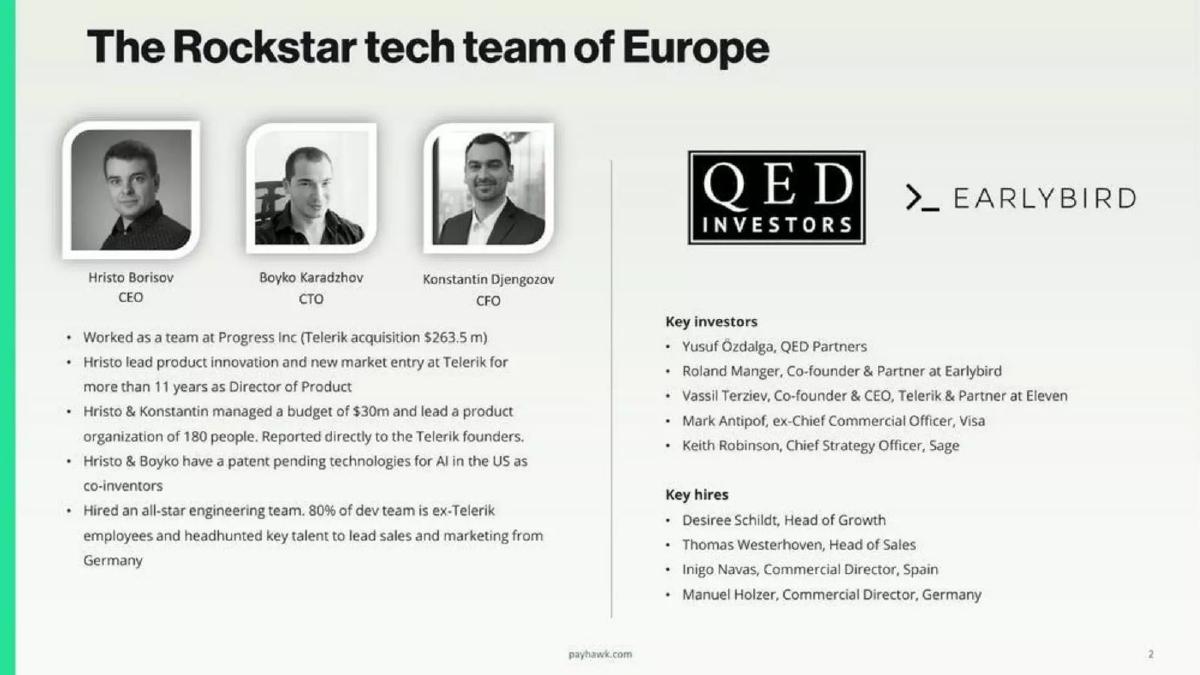
- The founding team highlights their history at Progress Inc (Telerik) where they managed a $30m budget and 180 people (Slide 2).
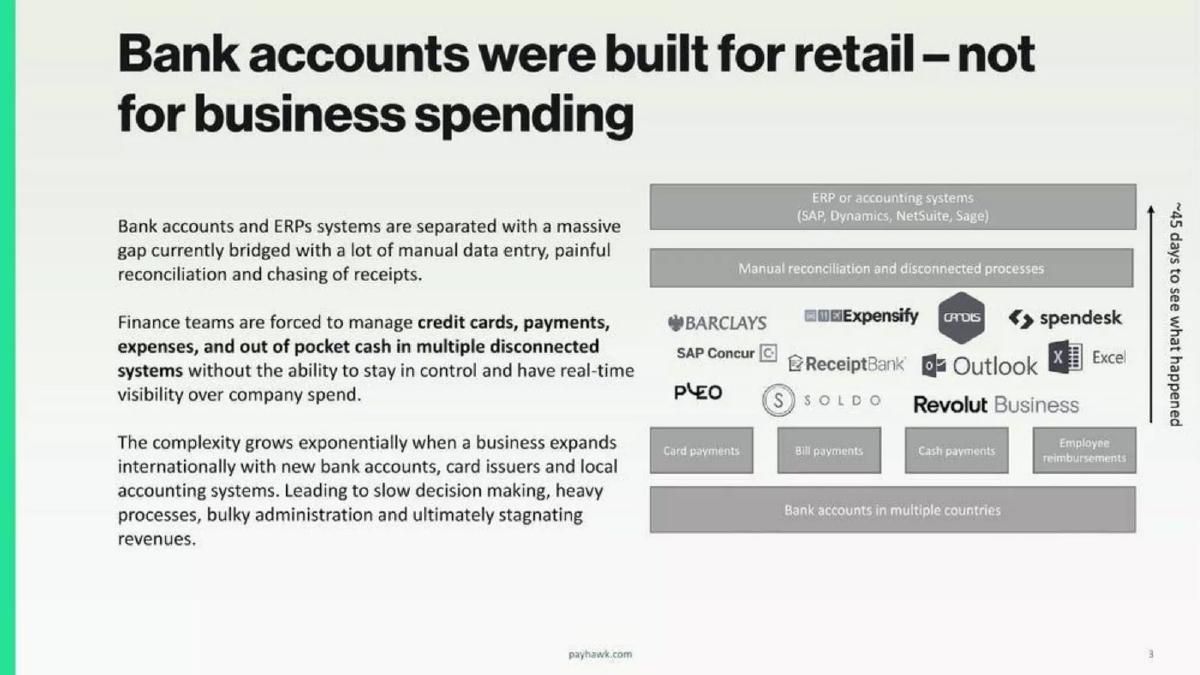
- Payhawk identifies a 'massive gap' between bank accounts and ERP systems that currently takes ~45 days to reconcile (Slide 3).
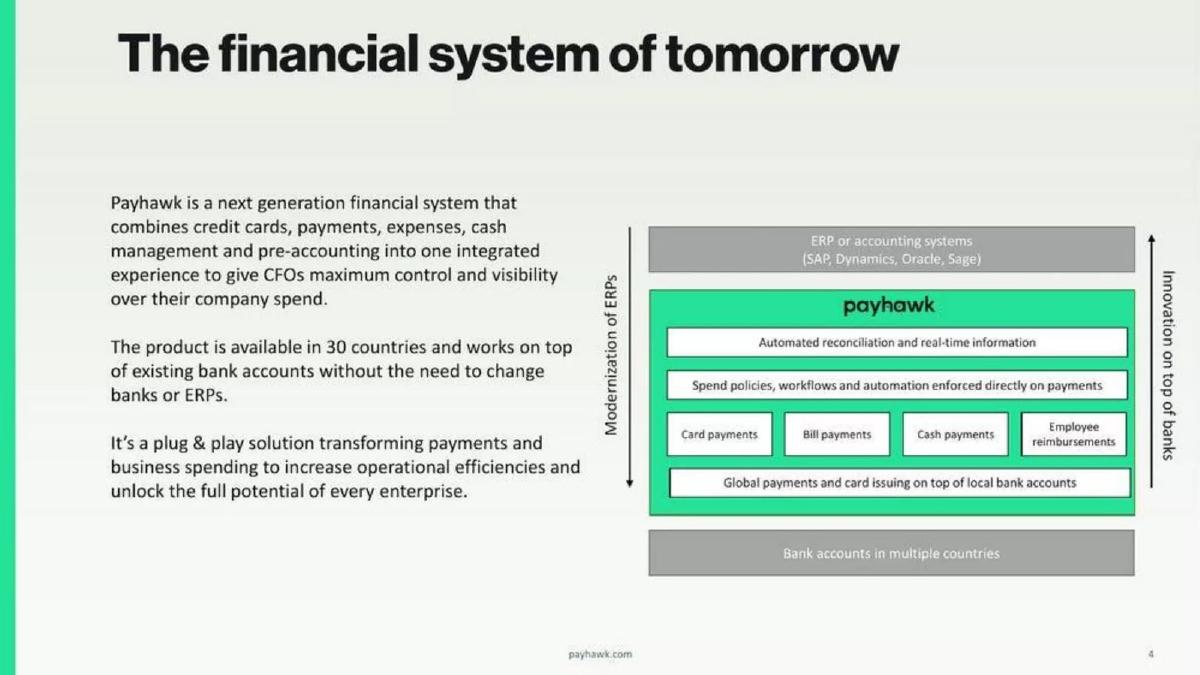
- The product is positioned as a 'plug & play' solution available in 30 countries that works on top of existing bank accounts (Slide 4).
- Customer segmentation is split between high-growth businesses (Slide 7) and multinational corporations with 500+ employees (Slide 8).
- The 'spearhead' strategy uses company cards to enter the market before expanding into the 'Adyen play of issuing' (Slide 9).
- Cohort data shows extreme expansion, with the 2019 Q4 cohort growing to 437% of its original value by Q7 (Slide 10).
- The revenue model is diversified across subscriptions, interchange, and FX fees (Slide 11).
- The platform features AI-powered OCR that supports automated data extraction in 60+ languages (Slide 20).
The Financial System of Tomorrow: A Strategic Overview
Payhawk’s pitch deck is a 21-slide document that moves methodically from team pedigree to market pain, and finally to a detailed breakdown of unit economics. The deck uses a clean, minimalist aesthetic with a consistent green accent color, mirroring the brand's identity. It is designed to convince investors that Payhawk is not just another corporate card provider, but a sophisticated software layer that sits between legacy banking and modern enterprise resource planning (ERP) systems.
Slide 1: Title and Vision
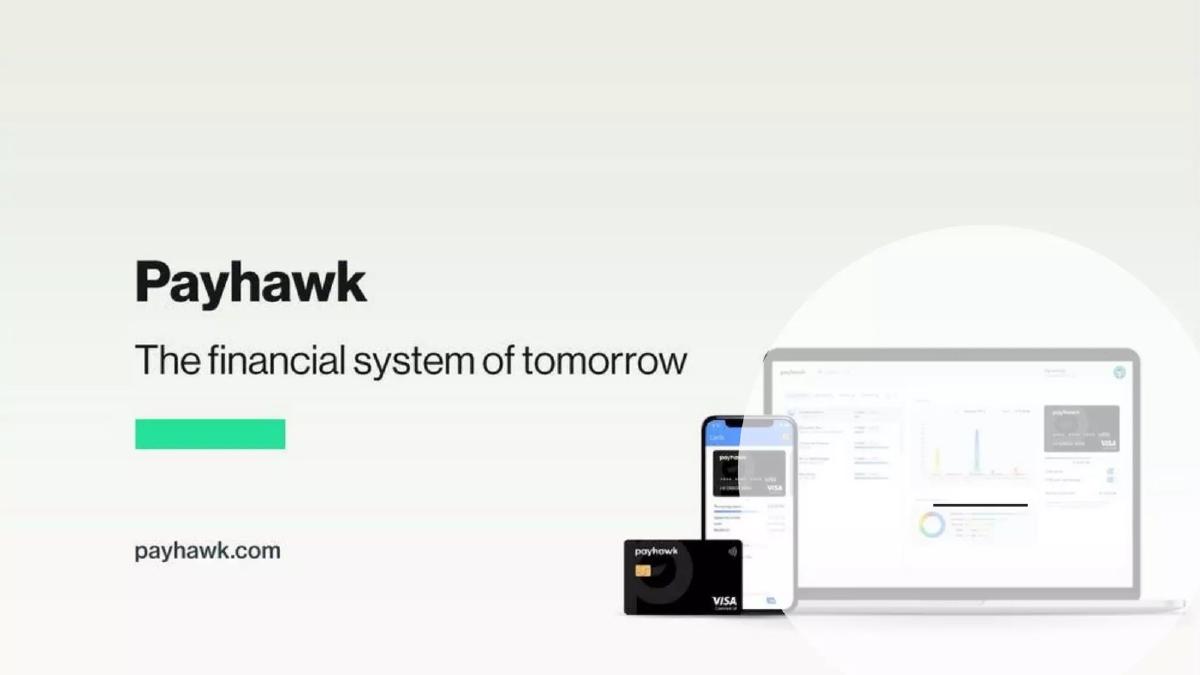
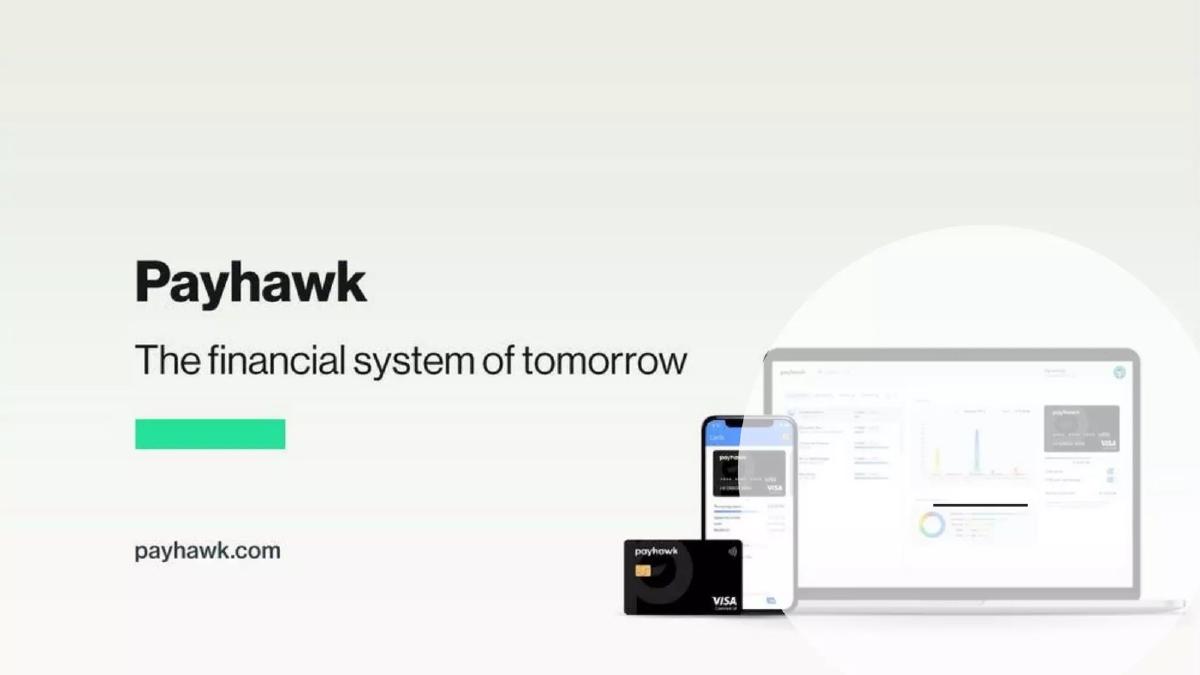
The cover slide introduces the company name and the tagline: "The financial system of tomorrow." It features a product mockup showing the interface across a laptop, smartphone, and a physical black Visa card. This immediately establishes the multi-platform nature of the service.
Slide 2: The Rockstar Tech Team
Payhawk leads with its team, which is a common strategy for companies with significant prior exits. The slide highlights three founders: Hristo Borisov (CEO), Boyko Karadzhov (CTO), and Konstantin Djengozov (CFO) . Key facts stated include their history at Progress Inc (following a $263.5m Telerik acquisition) and Hristo’s 11-year tenure as Director of Product. The slide also notes that 80% of the dev team are ex-Telerik employees. Investor logos for QED Investors and Earlybird are prominently displayed, along with key hires in growth and sales from Germany and Spain.
Slides 3-5: The Problem, Solution, and Product Architecture
Slide 3, titled "Bank accounts were built for retail – not for business spending," illustrates the current fragmented landscape. It shows a 'massive gap' between bank accounts and ERPs (SAP, Dynamics, NetSuite, Sage), noting it takes ~45 days to see what happened due to manual reconciliation. It lists competitors like Barclays, Expensify, Pleo, and Revolut Business as part of this disconnected ecosystem.
Slide 4 introduces Payhawk as the bridge. It claims the product is available in 30 countries and works on top of existing bank accounts. The visual shows Payhawk sitting as a green layer between the ERPs and the bank accounts, providing automated reconciliation and real-time information.
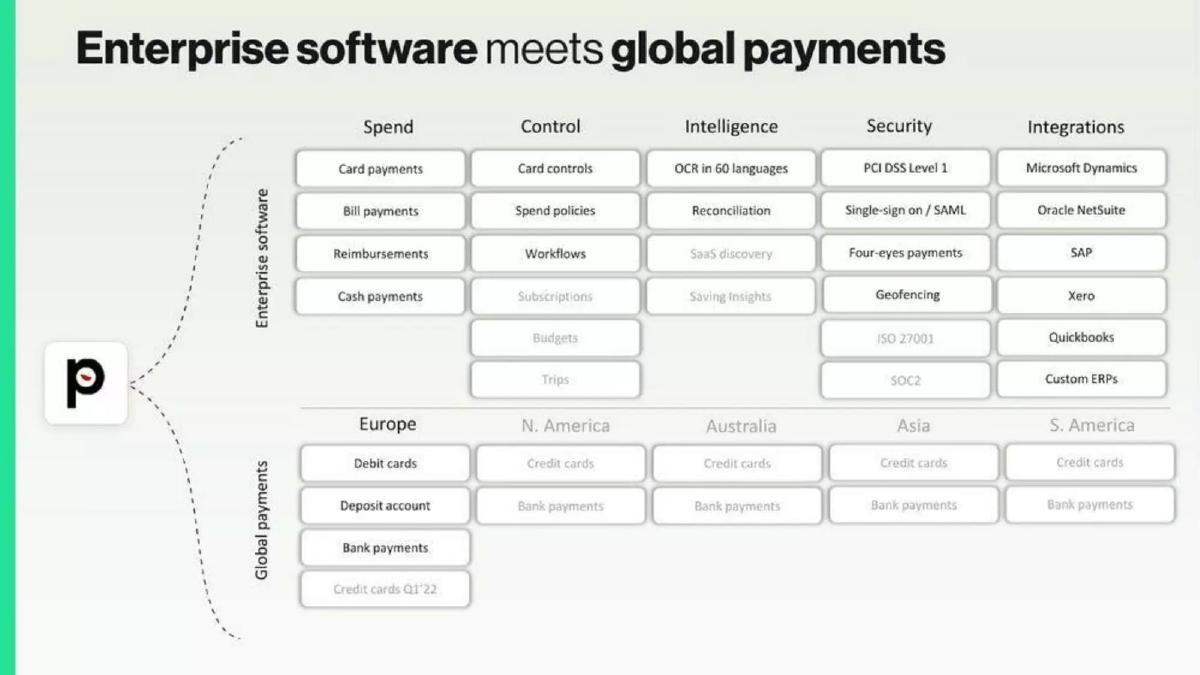
Slide 5, "Enterprise software meets global payments," provides a feature grid. It categorizes the offering into Spend, Control, Intelligence, Security, and Integrations. Notable features include OCR in 60 languages , PCI DSS Level 1 security, and direct integrations with SAP and Oracle NetSuite. It also maps out global payment capabilities across Europe, North America, Australia, Asia, and South America.
Slides 6-8: Market Strategy and Customer Segmentation
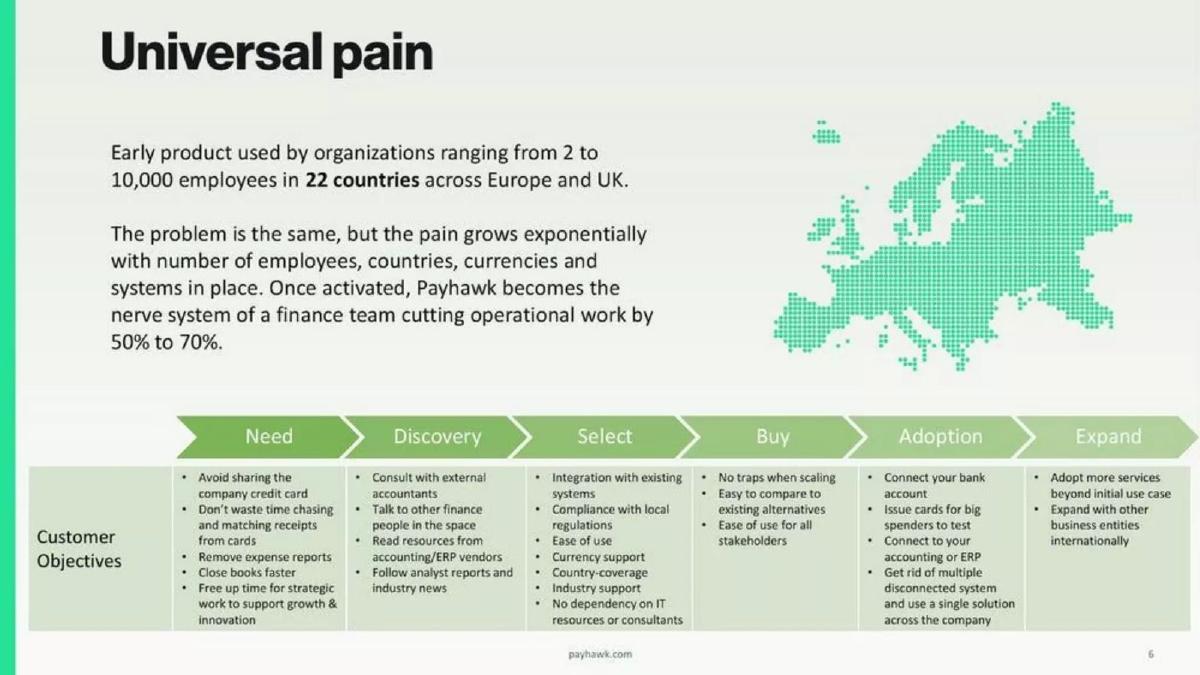
Slide 6 discusses "Universal pain," stating the product is used by organizations ranging from 2 to 10,000 employees in 22 countries . It includes a customer journey map from 'Need' to 'Expand,' claiming the tool cuts operational work by 50% to 70% .
Slide 7 focuses on "high growth businesses." It defines this segment as having $5m+ revenue, being less than 8 years old, and typically at Series A+ stage. Logos like MacPaw, Nexo, and Gtmhub are shown. A testimonial from Robbie Hadfield at Dendra Systems emphasizes the value of paying invoices through the system.
Slide 8 targets "multinational corporations." This segment has $50m+ revenue and 500+ employees. Logos include Lotto24, Luxair, and TBI Bank . The buying signal for this group is identified as a CFO/CIO/CDTO being hired in the last 12 months.
Slide 9: The Spearhead Strategy
This slide explains the 'Land and Expand' model. Titled "Come for the cards stay for everything else," it describes company cards as the 'spearhead.' Once a company is onboarded, they move through a pipeline of IBANs, Reconciliation, Payments, Workflows, and finally ERP connectivity. It explicitly mentions "The Adyen play of issuing" as the long-term goal.
Slides 10-12: The Financial Engine
Slide 10 is perhaps the most important for an investor. It shows a cohort analysis table from 2019 Q4 to 2021 Q3. The data indicates negative revenue churn . For example, the 2020 Q1 cohort reached 707% of its initial MRR by Q6 . The note explains that expansion includes new business entities, additional cards, and increased interchange fees.
Slide 11 covers "Sound unit economics." While specific dollar amounts are replaced with 'x', the structure is clear. They earn from subscriptions, interchange, and FX fees. They claim to earn 100% on interchange via Visa Corporate BINs and benefit from high gross profit due to multiple contracts with processors and issuers rather than a single vendor.
Slide 12 provides a P&L Forecast for FY'19 through FY'23. Again, figures are redacted, but the slide emphasizes an efficient R&D team in Sofia and the strategy of moving up-market to larger accounts to increase Average Deal Size (ADS).
Slides 13-20: Competitive Advantage and Product Deep Dive
Slide 13, "Why us," summarizes the competitive edge: a horizontal play with multiple issuers, no IT resources required for implementation, and a strong indirect channel through ERP ecosystems.
Slides 14-20 walk through specific product features with high-quality illustrations:
Connect (Slide 15): Direct connection to 3,000+ banks and dedicated IBANs. · Automated collection (Slide 16): Real-time receipt collection to replace petty cash. · Control (Slide 17): Real-time spend rules for individual cards, including prohibited merchants and time-based limits. · Workflows (Slide 18): Multi-level approval chains for unplanned purchases. · Payments (Slide 19): Support for SEPA, Faster Payments, and multi-currency cards with a 0.9% exchange markup . · OCR (Slide 20): AI-powered extraction of pre-accounting data in 60+ languages.
Slide 21: Contact and Presence
The final slide lists physical office addresses and phone numbers in London, Berlin, Barcelona, and Sofia , reinforcing their multi-national European footprint.
What Works in This Deck
The Team-Market Fit: By emphasizing the 'ex-Telerik' background, the founders establish themselves as people who know how to build and scale enterprise software. This mitigates the 'execution risk' often associated with complex FinTech infrastructure.
The Cohort Table: Including a detailed cohort expansion table is a high-conviction move. It proves that the 'spearhead' strategy actually works in practice, showing that customers don't just stay—they grow their spend by 4x to 7x within two years.
Clear Segmentation: Distinguishing between high-growth startups and multinational corporations shows a sophisticated understanding of the sales cycle. Identifying specific 'buying signals' (like a new CFO hire) demonstrates a mature go-to-market strategy.
What is Missing
Specific Financial Totals: While the structure of the P&L and unit economics is shown, all actual figures are redacted. A potential investor would need to see the 'x' values to determine if the growth is capital-efficient.
Burn Rate and Runway: There is no mention of the current burn rate or how long the requested funding will last. The deck focuses entirely on the business model and product rather than the specific 'Ask' or use of proceeds.
Competitive Landscape Detail: While Slide 3 mentions competitors, it doesn't provide a feature-by-feature comparison or a 'magic quadrant' style analysis. It assumes the investor already understands why a 'software-first' approach is superior to a 'bank-first' approach.
What a Founder Should Copy
The 'Spearhead' Narrative: Founders should copy how Payhawk frames their product as an entry point into a much larger ecosystem. They aren't just selling cards; they are selling a 'nerve system' for finance teams. This justifies a higher valuation than a simple payment processor.
Visualizing the 'Gap': Slide 3 is an excellent example of how to visualize a problem. By showing the 'disconnected processes' and the '45-day delay,' they make the pain point tangible and urgent.
Transparency in Unit Economics: Even if you redact the final numbers for a public version of the deck, showing the structure of your unit economics (as seen on Slide 11) tells investors that you understand your margins, your costs (KYC, card shipping, storage), and your revenue drivers.
Conclusion Payhawk’s deck is a clinical, data-driven presentation. It avoids fluff and focuses on the mechanics of growth and the technical superiority of their software layer. It is a model for B2B FinTech companies looking to move from the SME market into the enterprise space.
Frequently asked questions
- What is Payhawk's primary value proposition for CFOs?
- According to Slide 4, Payhawk combines credit cards, payments, expenses, and cash management into one integrated experience. This gives CFOs maximum control and visibility over company spend without requiring them to change their existing banks or ERP systems. The deck claims this can cut operational work by 50% to 70% (Slide 6).
- How does Payhawk handle competition from neobanks?
- Slide 13 argues that while neobanks target SMEs, Payhawk targets customers out of their reach. The company claims that since 'Fintech already matches a neobank,' the real competitive level-playing field is software. Payhawk positions itself as a horizontal play with multiple issuers to cover all countries and currencies, unlike limited neobank offerings.
- What does the cohort data reveal about their business model?
- Slide 10 shows 'negative revenue churn,' meaning existing customers spend significantly more over time. For example, the 2020 Q1 cohort grew to 707% of its initial value by the sixth quarter. This expansion is driven by adding more business entities, issuing more cards, and increasing turnover, which generates more interchange and FX fees.
- What are the key components of Payhawk's unit economics?
- Slide 11 outlines a model where they earn 100% on interchange, FX fees, and transfers via Visa Corporate BINs. Because they are perceived as a software layer rather than just a bank, they can charge high SaaS subscription costs. This results in a 'relatively high gross profit' compared to other fintechs that rely on a single vendor.
- How does the product integrate with existing enterprise workflows?
- Slide 5 lists integrations with major ERPs including Microsoft Dynamics, Oracle NetSuite, SAP, Xero, and QuickBooks. The product includes features like OCR in 60 languages, multi-level approval workflows (Slide 18), and real-time spend rules (Slide 17) to ensure compliance and security (PCI DSS Level 1, SOC2) within the enterprise environment.