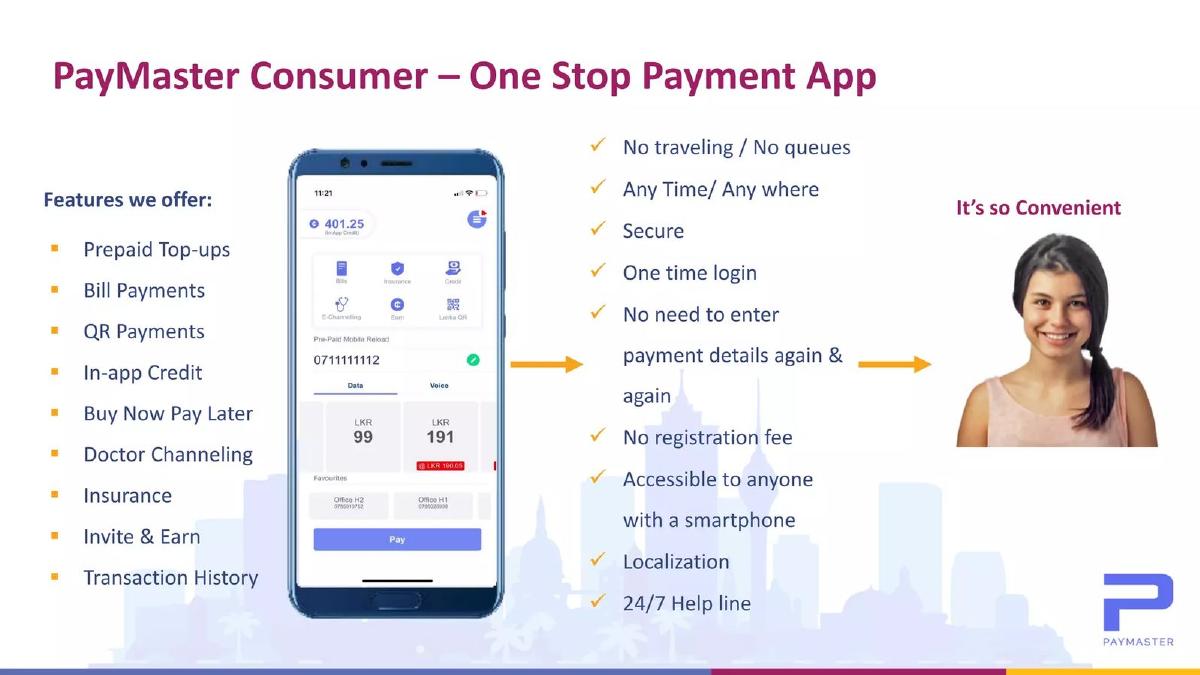
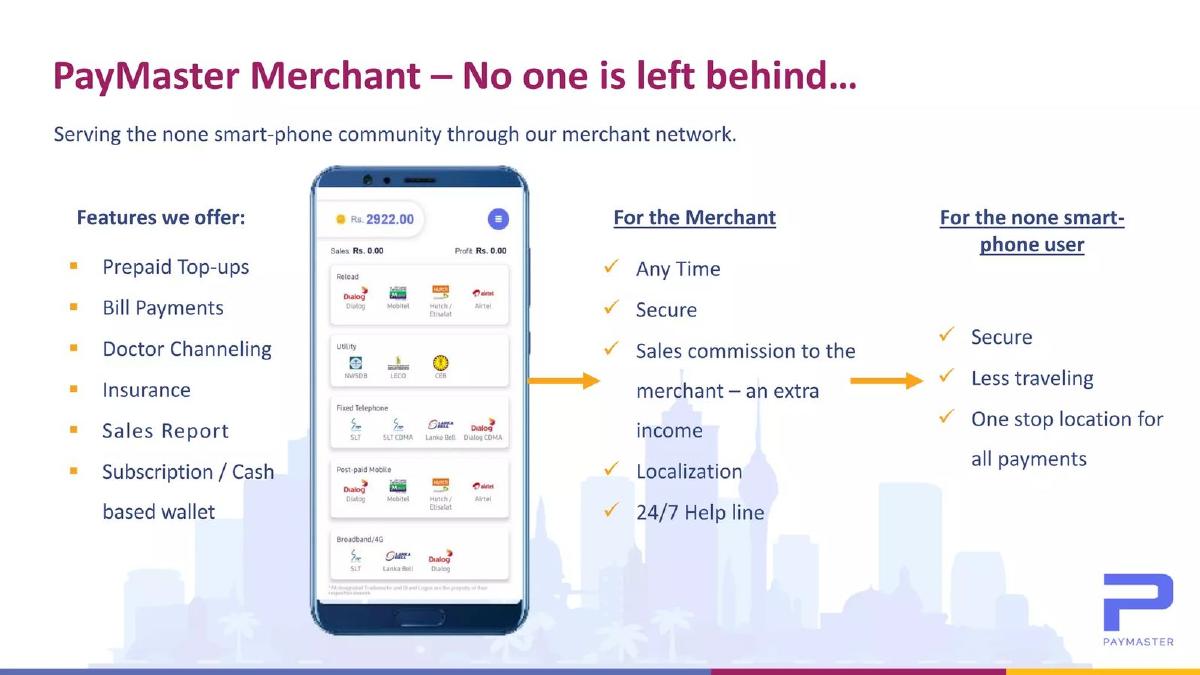
PayMaster Plus presents a regional fintech play, explicitly modeling itself after Asian giants like Paytm and PhonePe to capture the Sri Lankan market. The deck focuses on the friction of existing cash-based and digital payment systems, proposing a unified mobile solution for everything from utility bills to doctor bookings. With a diverse revenue model including commissions ranging from 0.17% for QR payments to 10% for insurance, and a weekly interest rate of 4-9% on in-app credit, the company targets high-frequency user interactions. While the deck provides strong evidence of technical stan…
Key takeaways
- The company uses a 'X for Y' positioning strategy, labeling itself 'The Paytm of Sri Lanka' on Slide 1.
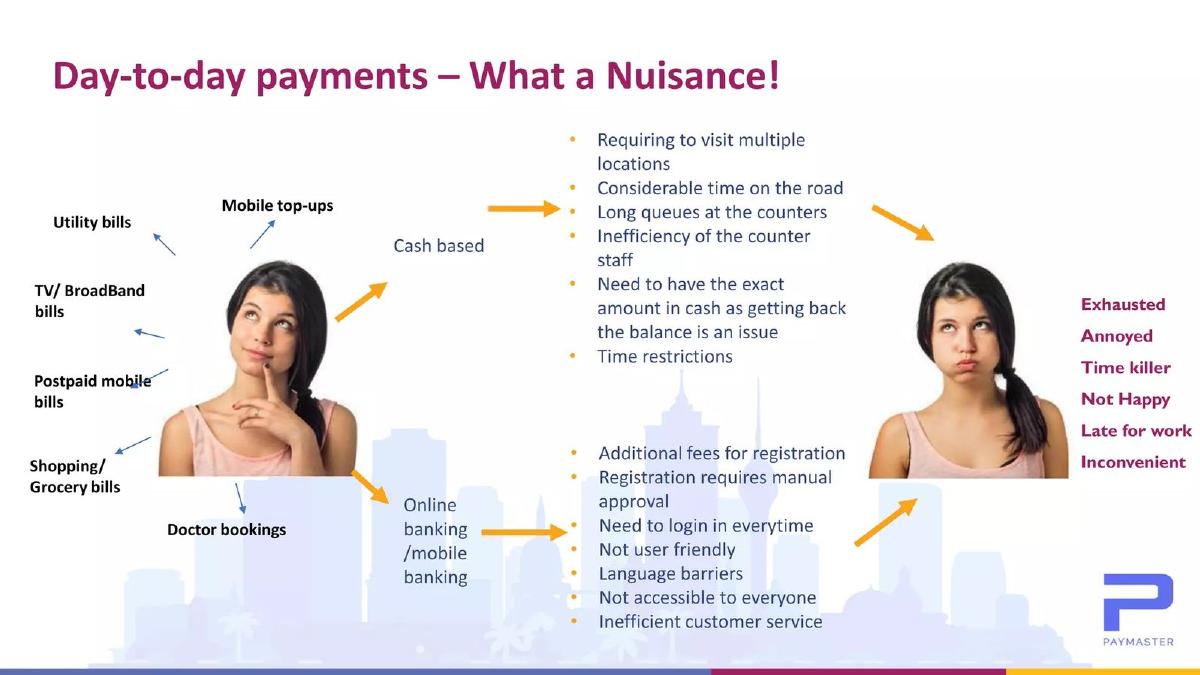
- Problem identification focuses on both physical cash inconveniences and the poor UX of existing mobile banking apps on Slide 2.
- The technical stack is built on AWS, Java (Spring), and Swift, emphasizing security compliance with OWASP MASVS 1.1 and CIS control version 7.0 on Slide 3.
- Market validation is sought through comparison with regional unicorns like Paytm ($16B) and PhonePe ($5.5B) on Slide 4.
- Mobile adoption data shows high engagement, with 19-24 year olds unlocking screens 10 times per hour on Slide 5.
- Revenue is highly diversified, featuring seven distinct streams including a $1.50 monthly merchant subscription on Slide 7.
- High-margin credit products are a core focus, with in-app loans carrying a 4-9% weekly interest rate on Slide 7.
- The deck includes social proof through specific, dated user reviews from late 2020 and early 2021 on Slide 6.
Executive Summary: The Regional Super-App Play
PayMaster Plus is positioning itself as the definitive fintech solution for Sri Lanka. By adopting the 'Paytm of Sri Lanka' moniker, the company signals an intent to follow a proven playbook: start with high-frequency utility payments and expand into high-margin financial services like insurance and credit. The deck is structured to validate the opportunity through regional success stories and local behavioral data, though it leaves significant gaps regarding the internal team and the specific financial ask.
Slide 1: Title and Positioning
The cover slide is minimalist, featuring the PayMaster logo and the name of the Founder/CEO, Ransika De Silva. The most critical element here is the subtitle: "The Paytm of Sri Lanka." This is a classic fundraising tactic used to provide investors with an immediate mental model of the business. By referencing Paytm, the founder is communicating a vision of a multi-service ecosystem that handles payments, commerce, and financial services. The background silhouette of a city skyline reinforces the urban, tech-forward focus of the product.
Slide 2: The Multi-Faceted Problem
Slide 2, titled "Day-to-day payments – What a Nuisance!", uses a 'before and after' visual to illustrate consumer pain points. It categorizes the problem into two distinct buckets: cash-based hurdles and digital-based hurdles. For cash, it cites the need to visit multiple locations, time spent on the road, and the difficulty of getting exact change. For existing digital solutions (online/mobile banking), it lists barriers such as manual registration approvals, language barriers, and lack of user-friendliness. The slide concludes with a list of emotional outcomes for the user: "Exhausted," "Annoyed," and "Late for work." This slide effectively argues that even in a market with existing digital banking, there is a massive gap in user experience and accessibility.
Slide 3: Technical Infrastructure and Security
Fintech investors are notoriously sensitive to security and scalability. Slide 3 addresses this head-on by listing a modern tech stack: Android (Java), iOS (Swift), and a Spring Java backend hosted on AWS. The slide specifically mentions "0 downtime deployment" and "Multi zoned deployment for redundancy." More importantly, it cites compliance with high-level security frameworks: OWASP MASVS 1.1, CIS control version 7.0, and NIST standards. This level of technical specificity is designed to reduce the perceived risk of a catastrophic data breach or system failure as the user base scales.
Slide 4: Regional Market Validation
Slide 4, "Success Stories in Asia," provides the macro-economic justification for the venture. It lists five regional peers and their valuations: PayTM (India) at $16B, PhonePe (India) at $5.5B, MobiKwik (India) at $700M, Alterra (Indonesia) at $25M, and Wave Money (Myanmar) at $78M. By showing that similar models have reached unicorn or near-unicorn status in neighboring markets, PayMaster Plus is attempting to prove that the 'Super-App' model is not just a Western or Chinese phenomenon, but a viable path for emerging Asian economies. The inclusion of Wave Money (Myanmar) is particularly relevant, as it shows success in a market that shares more socio-economic similarities with Sri Lanka than India does.
Slide 5: Behavioral Data and Mobile Penetration
To prove the market is ready, Slide 5 focuses on smartphone usage metrics. A bar chart titled "Frequency of mobile screen unlocks" shows that the 19-24 age group unlocks their phones 10 times per hour , while even the 65+ demographic does so 5 times per hour. The slide also notes 7.90 million active social media users , with 98.7% accessing via mobile. This data serves to convince investors that the 'surface area' for a mobile app is large enough to support a high-frequency payment business. If users are already on their phones 5-10 times an hour, capturing one of those sessions for a financial transaction is a lower hurdle than changing their behavior entirely.
Slide 6: Social Proof and User Feedback
Slide 6 displays five user reviews from late 2020 and early 2021. The reviews highlight specific features: one user mentions the "new insurance policy service provided by Paymaster and Fairfirst collab," while another praises the ability to use "points as reloads." This slide is crucial because it proves the product is live and functional. It also hints at the company's ability to form strategic partnerships (like the one with Fairfirst insurance) and its use of gamification (points) to drive retention. The reviews are dated, which gives investors a sense of the timeline of the product's evolution.
Slide 7: The Revenue Engine
This is arguably the most important slide in the deck. It breaks down seven distinct revenue streams. The commissions are varied: 4-6% for reloads, 2-3% for bill payments, 10% for insurance, and 8-10% for doctor appointments. The inclusion of a $1.50 monthly subscription per merchant suggests a B2B component to the business. Most notable, however, is the "Interest per In-App Credit Loan (Weekly)" at 4-9%. This indicates that PayMaster Plus is not just a payment gateway but a micro-lender. High-frequency, high-interest micro-loans are often the primary profit driver for fintechs in emerging markets, subsidizing the lower-margin payment processing business.
Slide 8: Contact and Closing
The final slide provides the contact information for Ransika De Silva. It includes a professional email address and a Sri Lankan phone number. While it serves its purpose, it misses an opportunity to reiterate the core value proposition or provide a final 'call to action' for the investor.
What Works in This Deck
Clear Analogy: The 'Paytm of Sri Lanka' tag is a powerful shorthand that eliminates confusion about the business model. · Revenue Transparency: Slide 7 is exceptionally detailed. Many early-stage decks are vague about how they make money; PayMaster Plus provides exact percentages and fees. · Security Focus: Mentioning specific standards like OWASP and CIS shows a level of professional maturity often missing in seed-stage fintech decks. · Behavioral Context: Using 'screen unlocks per hour' is a more visceral metric for engagement than just 'total internet users.'
What Is Missing
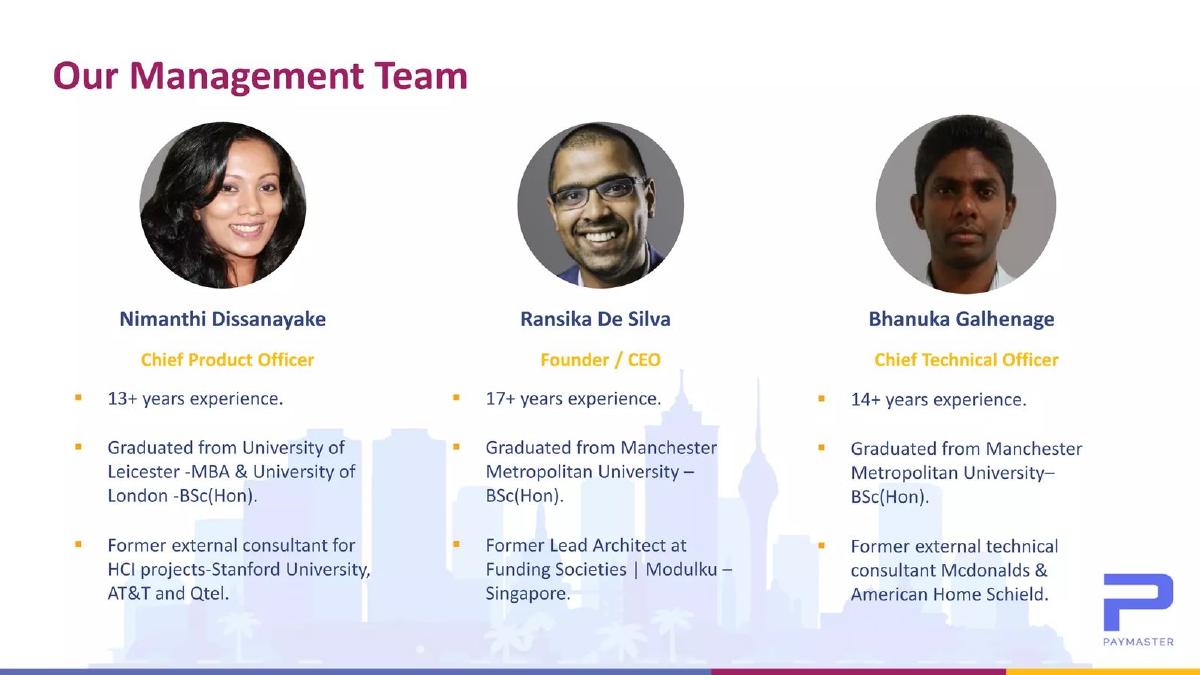
The Team: There is no slide detailing the experience of the founding team or advisors. Investors need to know why this specific team is capable of navigating the complex regulatory and technical landscape of Sri Lankan fintech. · Growth Metrics: While there is social proof, there are no charts showing Month-over-Month (MoM) growth in users, Transaction Volume (GTV), or Revenue. · The Ask: The deck does not state how much money is being raised, the valuation, or how the funds will be allocated (e.g., 40% marketing, 30% engineering). · Competitive Landscape: The deck compares itself to successful companies in other countries, but it does not address local competitors in Sri Lanka.
Founder's Playbook: What to Copy
The 'Success Stories' Slide: If you are building in a frontier market, always include a slide showing that your model has worked in similar geographies. It de-risks the 'market' portion of the investor's thesis. · Granular Revenue Breakdown: Don't just say 'transaction fees.' List the specific categories and percentages as seen on Slide 7. It shows you have a deep understanding of your unit economics. · Specific Social Proof: Instead of generic quotes, use reviews that mention specific features or partnerships. It proves that your product roadmap is actually being executed and appreciated by users.
Frequently asked questions
- What is the primary value proposition of PayMaster Plus?
- PayMaster Plus aims to be a 'super-app' for the Sri Lankan market, consolidating fragmented financial tasks into one interface. According to Slide 2, it addresses 'nuisances' like visiting multiple physical locations for bills, long queues, and the 'not user friendly' nature of current online banking. It covers mobile top-ups, utility bills, doctor bookings, and grocery payments.
- How does PayMaster Plus generate revenue?
- The company employs a multi-layered revenue model detailed on Slide 7. This includes commissions on reloads (4-6%), bill payments (2-3%), insurance (10%), and doctor appointments (8-10%). They also charge a 0.17% fee for QR payments, a $1.50 monthly merchant subscription, and high-yield weekly interest (4-9%) on in-app credit loans.
- What technical standards does the platform follow?
- Security is a major pillar of their pitch. Slide 3 specifies that the platform adheres to the OWASP Mobile Application Security Verification Standard (MASVS 1.1), CIS control version 7.0, and NIST standards. The stack is hosted on AWS using RDS/PostgreSQL with a microservices-simulated backend.
- What market data supports their growth potential?
- Slide 5 highlights high smartphone penetration and social media usage in their target market. It notes 7.9 million active social media users, with 98.7% accessing via mobile. The chart shows that even the 35-50 age demographic unlocks their phones 7 times per hour, suggesting a broad addressable market beyond just Gen Z.
- Is there information about the founding team or the investment ask?
- The provided slides identify Ransika De Silva as the Founder/CEO on Slide 1 and Slide 8. However, there is no dedicated team slide detailing the background of other key members, nor is there a slide specifying the amount of capital being raised or the intended use of funds.