PayMaster's seed deck focuses on the massive gap between mobile connectivity (131% of population) and digital payment usage (0.1% mobile-based payments) in Sri Lanka. The company positions itself as a 'Super App' contender, offering everything from utility payments to health services and insurance. With 37,500+ downloads within two months of launch, the deck emphasizes rapid early traction compared to established banking competitors. The financial model projects a path to 483,000 active customers by Year 3, seeking a total cash requirement of US$ 460,000 to fuel marketing and regional expansi…
Key takeaways
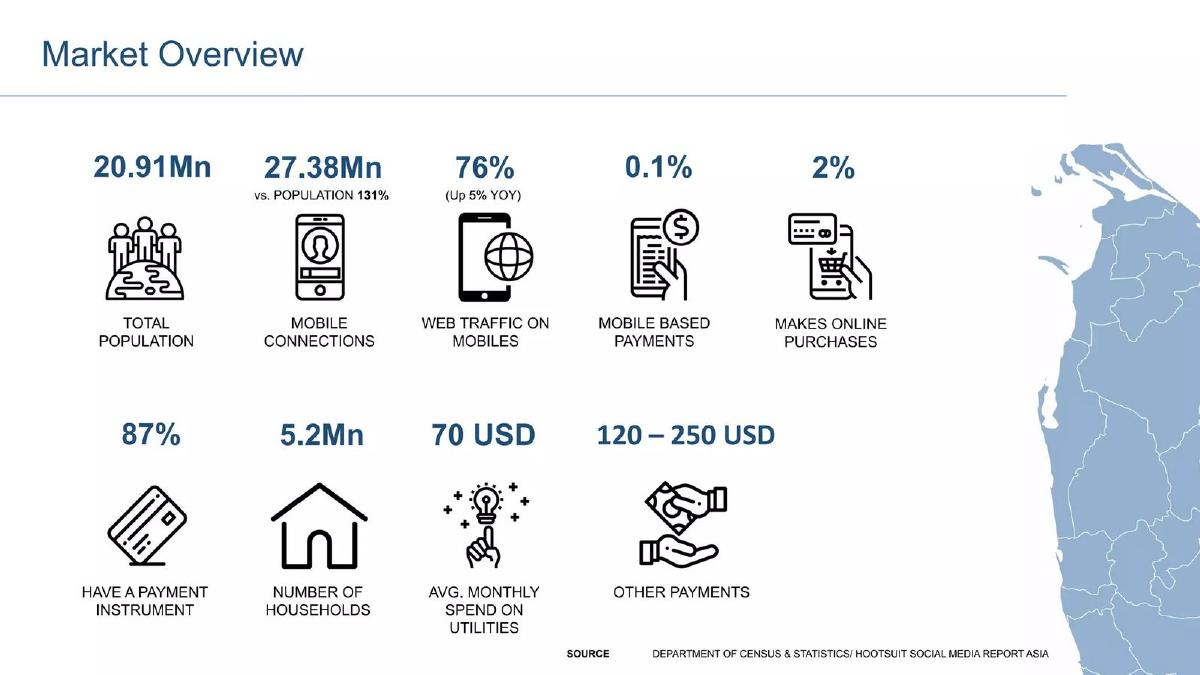
- Sri Lanka has 27.38Mn mobile connections against a 20.91Mn population, yet only 0.1% of payments are mobile-based (Slide 2).
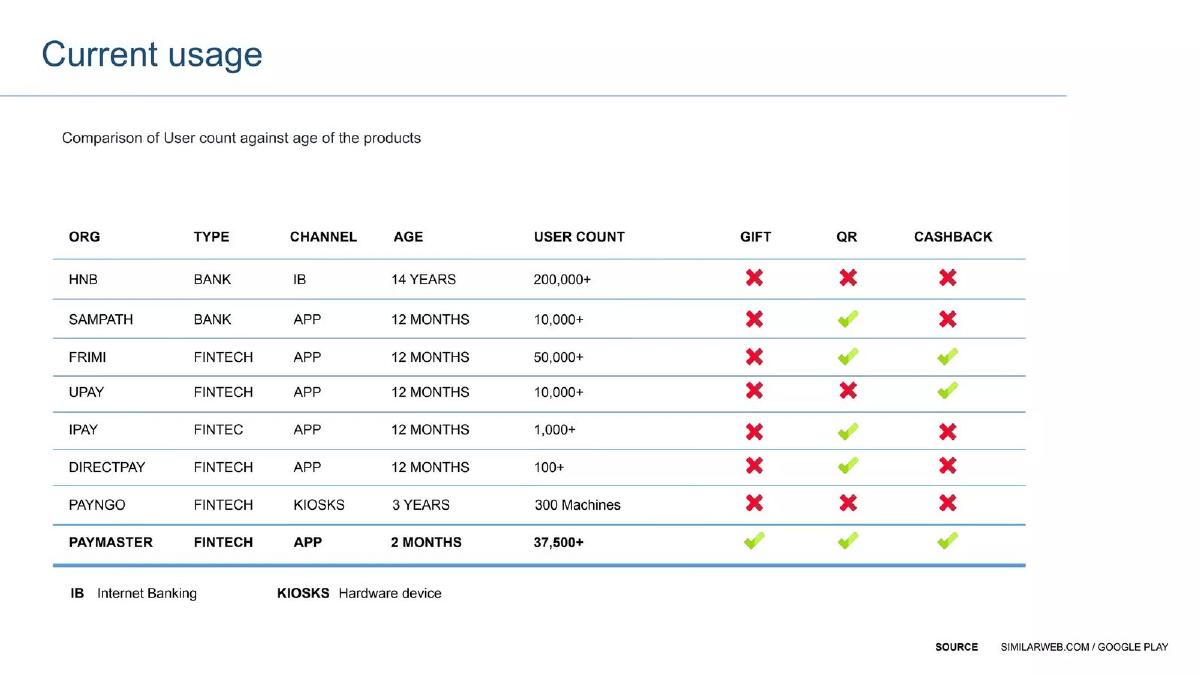
- PayMaster achieved 37,500+ users in just 2 months, outperforming several competitors who had been in market for 12 months (Slide 5).
- The product strategy is split into three distinct verticals: Retail, Merchant, and Platform Integration (Slide 7).
- The retail app includes utility payments, health services, government payments, and lifestyle features like movie ticketing (Slide 8).
- The business model includes a roadmap from a June 2018 initial release to a planned Series A in March 2020 (Slide 9).
- Unit economics highlight a very low customer acquisition cost, with Facebook Pay Per Click at US$ 0.02 and direct on-boarding at US$ 0.09 (Slide 13).
- The company is seeking a total cash requirement of US$ 460,000, with US$ 260,000 already raised at the time of the deck (Slide 14).
- Regional aspirations target a combined population of 1.7Bn across India, Pakistan, Bangladesh, Nepal, and Myanmar (Slide 17).
Executive Summary and Market Opportunity
Slide 1: Title Slide
The deck opens with a minimalist title slide featuring the PayMaster logo—a stylized blue 'P'—and the company name. It includes a 'Proprietary and Confidential' footer, which is standard for investor presentations.
Slide 2: Market Overview
This slide establishes the 'Why' for the business. It presents a stark contrast between digital readiness and digital adoption in Sri Lanka. Key figures include a total population of 20.91Mn and 27.38Mn mobile connections (131% penetration). However, only 0.1% of payments are mobile-based and only 2% of the population makes online purchases. This identifies a massive untapped market of users who have the hardware (phones) but lack the software/service to transact digitally. The slide also notes an average monthly utility spend of 70 USD , representing the primary transaction target for the app.
Slide 3: Payment Instrument – Penetration
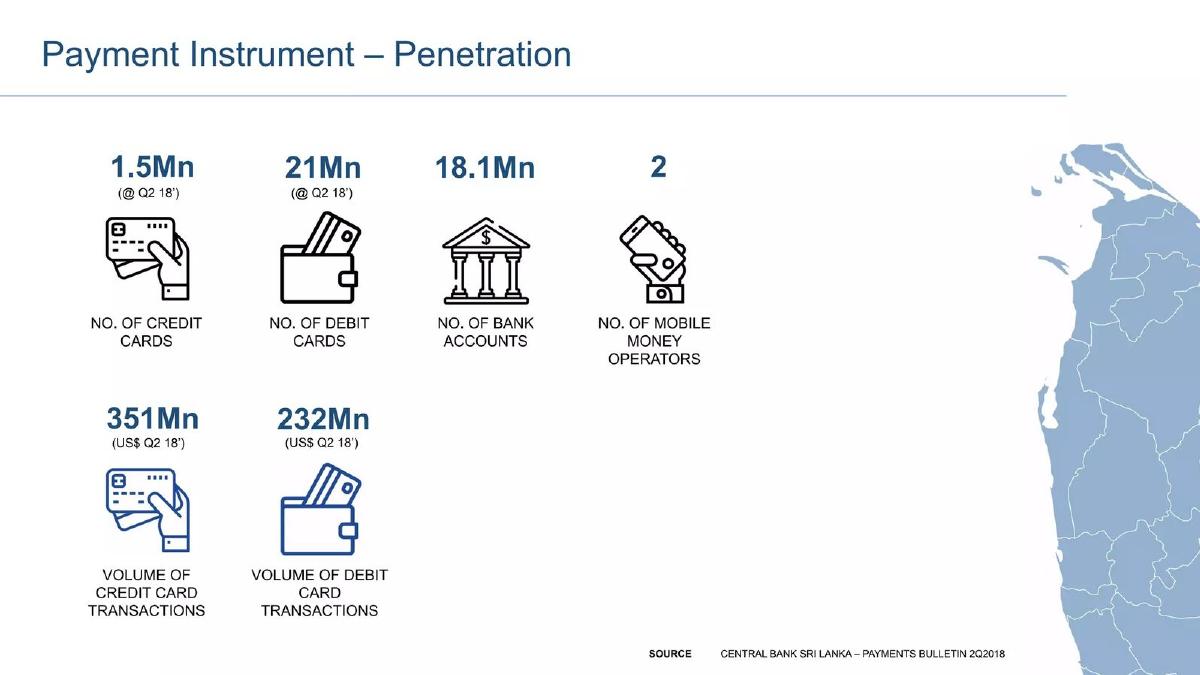
PayMaster drills deeper into the financial landscape. As of Q2 2018, there were 1.5Mn credit cards compared to 21Mn debit cards and 18.1Mn bank accounts . The volume of debit card transactions (232Mn) is lower than credit card transactions (351Mn), suggesting that while many people have debit cards, they are not using them for frequent digital transactions. This supports the need for a simplified mobile payment interface.
Competitive Positioning and Traction
Slide 4: Competitive Landscape
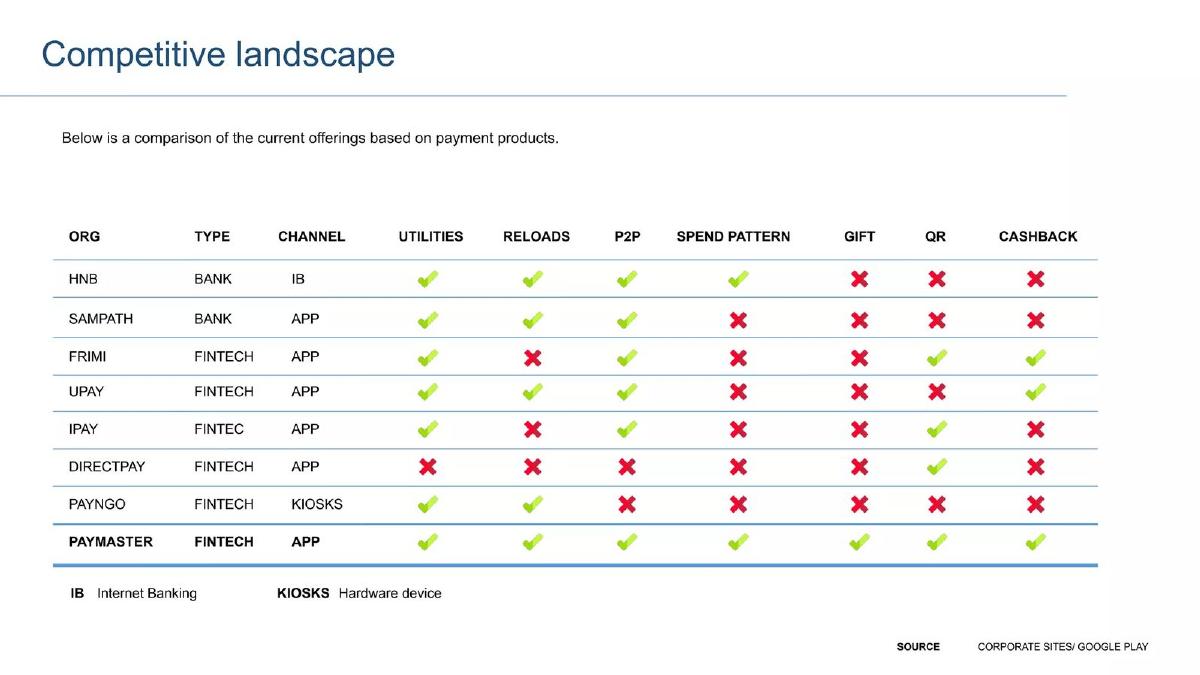
This is a standard 'check-box' competitive matrix. PayMaster compares itself against banks (HNB, Sampath) and other fintechs (Frimi, Upay, iPay, DirectPay, PayGo). PayMaster claims to be the only provider offering a full suite of services across Utilities, Reloads, P2P, Spend Pattern analysis, Gifts, QR, and Cashback. The banks are noted for lacking 'Gift', 'QR', and 'Cashback' features, while other fintechs are shown to have gaps in 'Reloads' or 'Spend Pattern' tracking.
Slide 5: Current Usage
This is a high-impact traction slide. It compares user counts against the age of the product. While HNB has 200,000+ users, it has been in the market for 14 years. PayMaster claims 37,500+ users in just 2 months . This growth rate is positioned as superior to Frimi (50,000+ in 12 months) and Upay (10,000+ in 12 months). It also highlights that PayMaster is the only one in the group offering 'Gift' functionality at this stage.
Slide 6: Why Now for Sri Lanka
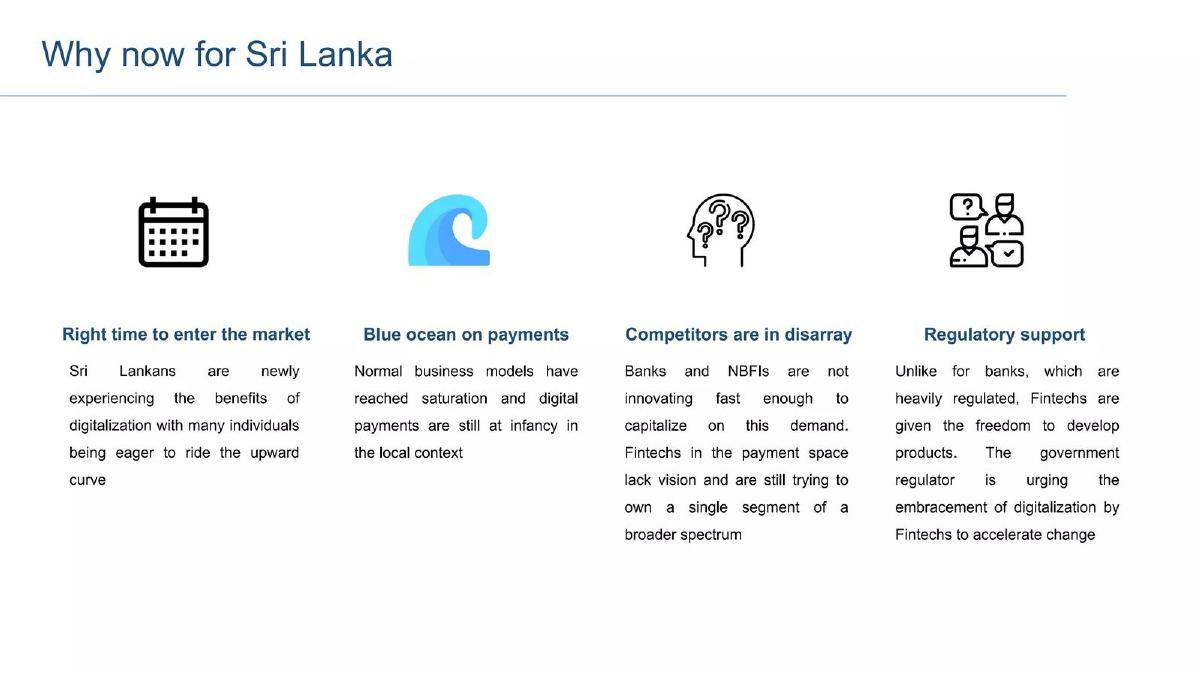
The founders argue that four factors make this the optimal time: 1) Sri Lankans are newly experiencing the benefits of digitalization; 2) Digital payments are in their infancy ('Blue ocean'); 3) Competitors (Banks and NBFIs) are in 'disarray' and not innovating fast enough; and 4) Regulatory support is increasing as the government urges digitalization.
Product Deep Dive
Slide 7: Product Verticals
PayMaster defines its business through three pillars: Retail Version (for average smartphone users), Merchant z Version (for non-tech savvy shop owners using conventional modes), and Platform Integration (API services for other platforms).
Slide 8: Retail App Features
This slide visualizes the 'Super App' ambition. The retail app is shown to handle:
Utility & Personal Payments: Mobile, Electricity, Water, Telephone, TV, Toll, QR, Split n Pay, and Spend Analytics. · Lifestyle: Movies, Train & Flight ticketing, and Gifts. · Personal Financial Services: Insurance, Health services, Charity, and Government payments.
Slide 9: Business Model and Roadmap
June 2018: Initial Release V1.0. · August 2018: 37,500 downloads. · September 2018: Release V2.0 and Seed Investment. · September 2019: Release V3.0. · March 2020: Ready for Series A.
The slide also mentions a partnership with Mastercard SEND for future remittances.
Slide 10: User Personas (Where do we fit in your day)
This slide uses emotional triggers (Happy, Sad, Frustrated, Lazy, Charitable, Fear) to explain use cases. For example, 'Frustrated' covers forgetting to pay a utility bill or a child running out of mobile credit. 'Fear' covers running low on credit when family is worried or needing to book a specialist cardiologist appointment urgently.
Slide 11: Merchant Version
The merchant offering focuses on a 'Single Wallet' for shop owners to handle all Telco top-ups, eliminating the need for physical stock. It highlights a 'Daily recurring charges' model instead of upfront hardware costs, and a 'Cash based operating model' where merchants pre-buy credit as needed.
Slide 12: Platform Integration
This slide details the B2B side of the business. It offers a single API for top-ups and utility payments. It lists two ongoing partnerships: Nanosoft (a software provider for SME/Micro banks with 75 branches) and Helakuru (a Sri Lankan keyboard app with 5Mn downloads).
Financials and Growth Strategy
Slide 13: Unit Economics
The unit economics are presented as 'Outflow' vs 'Inflow'. CAC (Customer Acquisition Cost) is remarkably low: FB Pay Per View at US$ 0.0027 , FB Pay Per Click at US$ 0.02 , and Direct on-boarding at US$ 0.09 . The inflow projections assume a net profit per customer based on 2-3 recharges and 1 utility payment per month, leading to a projected US$ 605,000 net profit in Year 3.
Slide 14: Investment Overview
The financial ask is framed as a Total Cash Requirement of US$ 460,000 . The founders invested US$ 30K , and US$ 260K has already been raised. The remaining funds are earmarked for:
Marketing and Business Development: US$ 260K (57%) · Corporate Expenses: US$ 140K (30%) · Recurring Operational Expenses: US$ 54K (12%)
Slide 15: Benchmark with India
To justify the potential, PayMaster compares the Sri Lankan market to India's PayTM . It notes PayTM's $20 billion GMV and $10Bn valuation. The slide points out that while India is 57x larger, only 2% are on digital payments, suggesting that a similar 'winner-take-all' fintech could emerge in Sri Lanka.
Team and Future Vision
Slide 16: Team
Ransika De Silva (Co-Founder/Director): 16 years of experience in app development and enterprise backends. · Lasitha Ranaweera (Co-Founder/Director): 10 years of experience in banking, digital payments, and ATMs.
The tech team includes Nimanthi Dissanayake (Operations/PM) and two senior developers. Advisors include Kelvin Teo and Mao Ching Foo , both associated with Funding Societies / Modalku.
Slide 17: Regional Aspirations
PayMaster looks beyond Sri Lanka to a combined population of 1.7Bn . The target countries are India, Pakistan, Bangladesh, Nepal, and Myanmar. The slide notes that these regions closely resemble the social media and mobile internet growth patterns seen in Sri Lanka.
Slide 18: Planned Growth Strategies
This slide outlines four specific growth areas: 1) Tuk-tuks & Kiosks for in-ride payments; 2) Tourists & Ex-Pats (3Mn visitors expected by EOY 2018); 3) Sri Lankans living overseas who need to send money home; and 4) Developing a Super App that includes chat, social, and games.
Slide 19: Our North Star
Using an iceberg metaphor, PayMaster illustrates its vision. Above the water (what customers see) is 100% satisfaction, simple UI/UX, and 200,000 payments processed a month. Below the water (what happens beneath) is adaptive security, automation, customer profiling, and analytics.
Slide 20: Contact Slide
Final slide with the company logo and contact emails for the two co-founders.
What Works / What is Missing
Market Gap Analysis: The deck does an excellent job of highlighting the disparity between mobile phone ownership and digital payment usage in Sri Lanka. · Traction Comparison: Comparing their 2-month growth to the 12-month or 14-year growth of competitors is a powerful way to demonstrate product-market fit. · B2B Strategy: The inclusion of platform integrations and specific partners (Helakuru) shows a diversified acquisition strategy beyond just direct-to-consumer marketing.
Regulatory Status: While the deck mentions 'Regulatory support', it does not explicitly state which licenses PayMaster holds (e.g., PSP or EMI licenses from the Central Bank of Sri Lanka). · Revenue Breakdown: The unit economics assume a 'Net Profit - Payments' figure but don't break down the take-rate or commission structure for different types of payments (utilities vs. mobile reloads). · Current Burn Rate: While the investment requirement is clear, the current monthly burn rate and runway are not disclosed.
Founder Takeaways
Focus on the 'Why Now': PayMaster successfully argues that the market is at a tipping point. Founders in emerging markets should always highlight the specific macro-economic or technological shifts that make their timing perfect. Leverage Low CAC: If you have found a way to acquire users for pennies (US$ 0.02 per click), make that a central part of your financial story. It proves that the capital you are raising will be deployed efficiently. Benchmark Wisely: Using PayTM as a benchmark helps investors visualize the 'Unicorn' potential of a regional fintech, even if the local market is smaller. It provides a blueprint for what success looks like in a similar demographic.
Frequently asked questions
- What is PayMaster's primary value proposition?
- PayMaster positions itself as a 'one-stop shop' for digital payments in Sri Lanka. It aims to bridge the gap between high mobile penetration and low digital payment adoption by offering a convenient, secure mobile app for utilities, lifestyle services, and e-commerce. It differentiates itself from banks by being more agile and offering a broader spectrum of services including health, insurance, and gift features.
- How does PayMaster compare to its competitors in Sri Lanka?
- According to Slide 4 and 5, PayMaster claims to offer a more comprehensive feature set than banks (HNB, Sampath) and other fintechs (Frimi, Upay). Specifically, it highlights its 'Spend Pattern' analysis and 'Gift' features as unique. Most notably, PayMaster reports reaching 37,500+ users in 2 months, which is significantly faster growth than competitors like iPay or DirectPay achieved in a year.
- What are the key financial projections in the deck?
- PayMaster projects growing from 196,000 active customers in Year 1 to 483,000 in Year 3. During this period, they expect payment volume to scale from 1.78Mn to nearly 20Mn annually. Net profit from payments is projected to grow from US$ 40,000 in Year 1 to US$ 605,000 in Year 3, assuming 2-3 mobile recharges and 1 utility payment per customer per month.
- What is the company's expansion strategy?
- The strategy is two-fold: vertical and geographic. Vertically, they plan to move from simple mobile reloads to a 'Super App' including chat, social, and games. Geographically, they aim to expand from Sri Lanka into the broader South Asian region, specifically targeting India, Pakistan, Bangladesh, Nepal, and Myanmar, citing a combined population of 1.7 billion people.
- What is the 'Merchant z Version' mentioned in the deck?
- The Merchant version (Slide 11) is designed for shop and kiosk owners who are 'not tech savvy.' It allows them to use a single wallet balance for all Telco top-up services, removing the need to manage multiple stocks of physical cards. It operates on a daily recurring charge model rather than an upfront hardware cost, making it more accessible for small businesses.