Pressure BioSciences (PBIO), an OTCQB-listed company, utilizes this 2017 presentation to pitch its proprietary pressure-based platforms to investors. The company centers its value proposition on solving the 'bottleneck' of sample preparation in the multi-billion dollar biopharma market. With approximately 270 PCT systems installed at 150 sites, PBIO demonstrates early market validation through partnerships with industry leaders like SCIEX and involvement in the Cancer Moonshot initiative. The deck also introduces Ultra-Shear Technology (UST) for the nano-emulsion market, targeting a $62 billi…
Key takeaways
- The company reported $2.0M in revenue for FY16 and a record $1.7M for Q1-Q3 2017 (Slide 3).
- PBIO has a global co-marketing agreement with analytical instrument leader SCIEX (Slide 3).
- The primary technology, Pressure Cycling Technology (PCT), is supported by 15 issued patents and over 100 publications (Slide 3).
- Sample preparation is identified as a multi-billion dollar market involving 500,000 scientists across 80,000 labs (Slide 7).
- The instrument portfolio includes the Barocycler 2320EXT, capable of reaching up to 45,000 psi (Slide 9).
- Customer logos include major pharmaceutical companies like Novartis, Roche, Janssen, Amgen, and Merck (Slide 12).
- Ultra-Shear Technology (UST) targets the $62 billion U.S. clean label food market by producing stable nano-emulsions (Slide 18).
- Growth strategy involves expanding the sales force from one to five field managers in 2017 (Slide 21).
Pressure BioSciences: A Technical Deep Dive into Sample Preparation
Pressure BioSciences (PBIO) presents an investor deck from December 2017 that positions the company as a critical infrastructure provider for the life sciences and food technology sectors. The presentation focuses on the transition from a research-heavy organization to a commercially focused entity, leveraging its proprietary pressure-based platforms. The following teardown examines the slides provided, analyzing the company's market position, technology, and growth strategy.
Slide 1: Title and Introduction
The cover slide introduces Pressure BioSciences, Inc. (OTCQB: PBIO) and its founder, President, and CEO, Richard T. Schumacher. The tagline, "Discovery Starts with Sample Preparation," immediately identifies the company's niche. The date, December 2017, establishes the context of the company's financial and operational status at that time. The visual of a scientist handling a molecular model reinforces the life sciences focus.
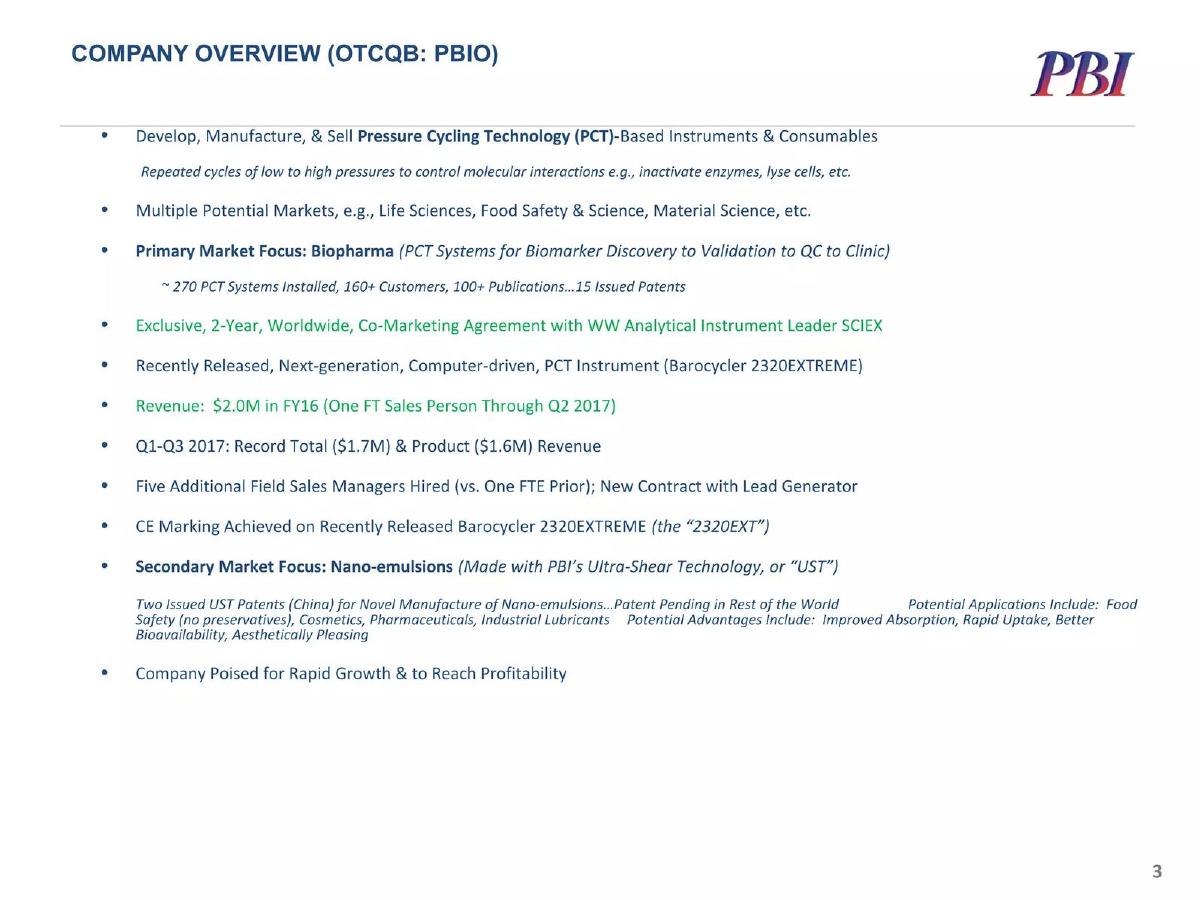
Slide 3: Company Overview
This slide serves as an executive summary, providing a high-level view of the company's operations and recent achievements. Key points include:
Core Business: Development, manufacture, and sale of Pressure Cycling Technology (PCT)-based instruments and consumables. · Market Validation: Approximately 270 PCT systems installed with over 160 customers and 100+ publications. · Intellectual Property: 15 issued patents for PCT and two issued in China for Ultra-Shear Technology (UST). · Financial Performance: $2.0M revenue in FY16 and a record $1.7M in Q1-Q3 2017. · Strategic Partnership: An exclusive 2-year worldwide co-marketing agreement with SCIEX. · Scaling Efforts: Hiring five additional field sales managers compared to just one previously.
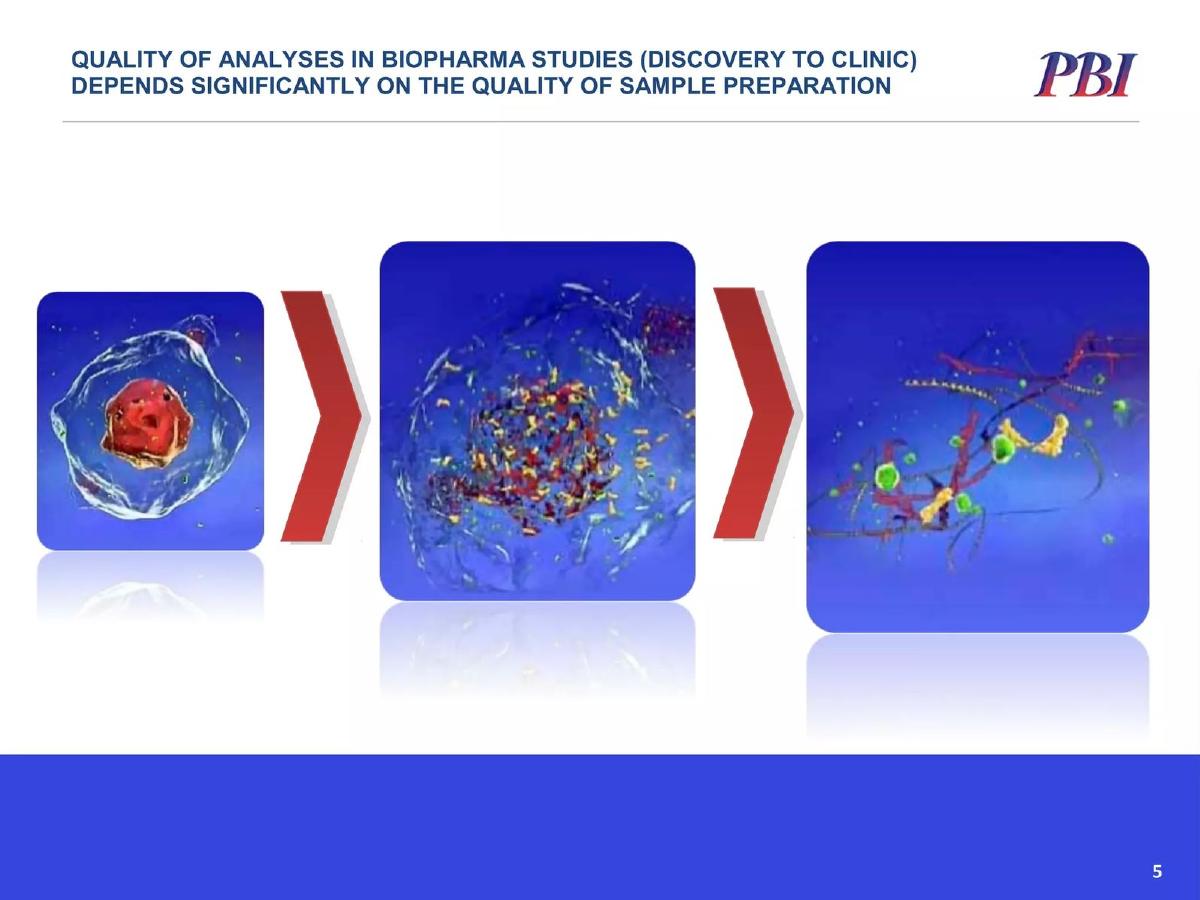
Slide 5: The Importance of Sample Preparation
Slide 5 uses a visual progression to argue that the quality of biopharma analysis is entirely dependent on the quality of sample preparation. It shows a cell being broken down into its constituent parts. The implication is that if the initial extraction or lysis is flawed, all subsequent data in the discovery-to-clinic pipeline will be compromised. This slide sets the stage for the "problem" that PBIO's technology solves.
Slide 7: Value Proposition in Biopharma
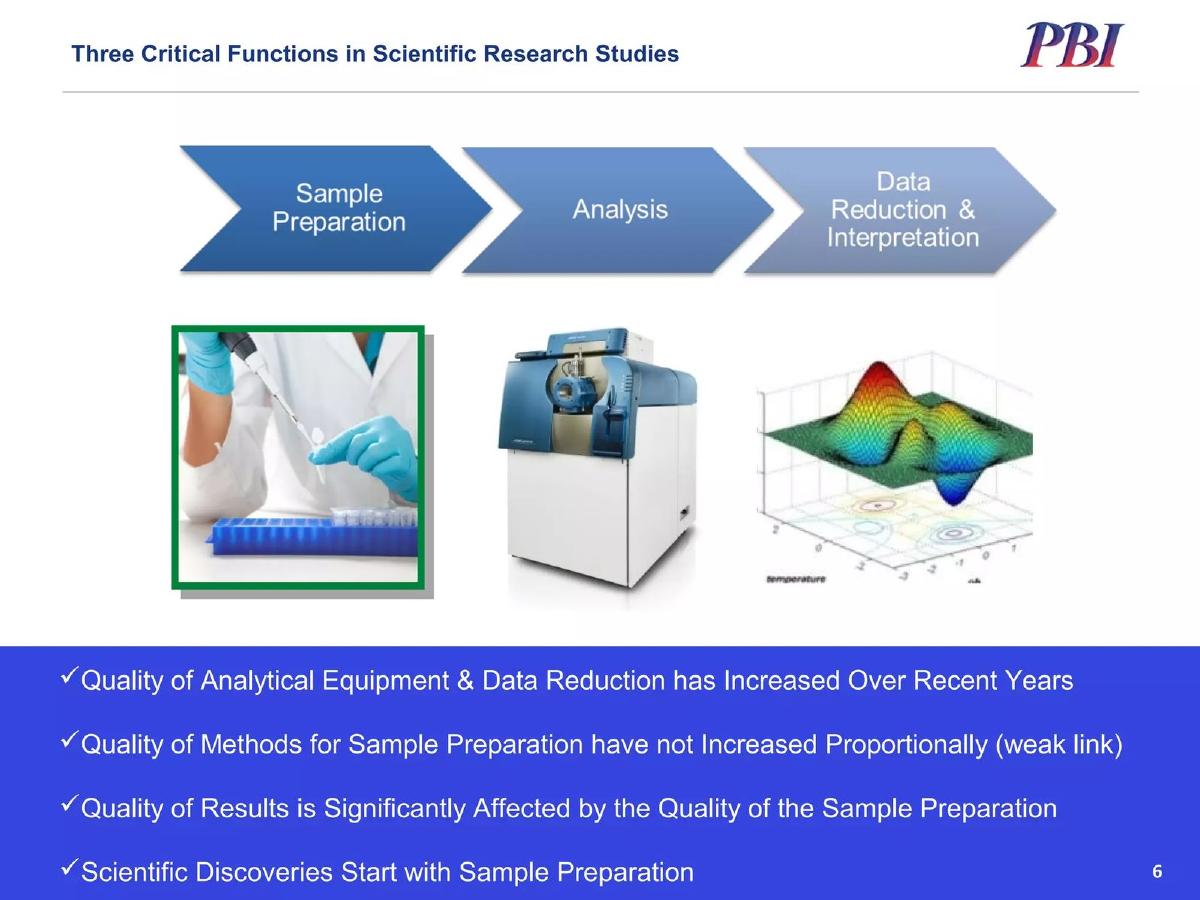
This slide expands on the market need. It identifies biological samples as the "key starting materials" for research and notes that current preparation methods are "highly inadequate" and represent a "bottleneck." The slide quantifies the market opportunity, citing an estimated 500,000 scientists in 80,000 research labs worldwide. By positioning PCT as a "proven sample prep platform," PBIO aims to establish itself as the standard solution for this global bottleneck.
Slide 9: PBI Instrument Portfolio
Slide 9 provides a product roadmap and technical specifications for the company's hardware. The portfolio includes:
Barocycler 2320EXT: An award-winning instrument capable of up to 45,000 psi. · HUB440 - HUB880: All-purpose pressure generators reaching up to 100,000 psi. · Barozyme HT48: A high-throughput analysis system reaching 20,000 psi. · XstreamPCT: On-line sample processors capable of 58,000 psi. · Future Tech: The timeline shows the development of Ultra-Shear Technology (UST) homogenizers slated for 2019-2020.
This slide demonstrates the breadth of their engineering capabilities and their ability to serve different pressure requirements across various lab scales.
Slide 12: Market Segments and Customer Logos
This is a classic "social proof" slide. It maps PBIO's products across the biopharma segments: Discovery, Development, and Clinic. The surrounding logos are impressive, featuring industry giants like Novartis, Roche, Janssen, Amgen, Merck, and Regeneron. It also includes top-tier academic institutions like Harvard, Stanford, and Penn. This slide effectively communicates that the technology is already being used by the most demanding organizations in the world.
Slide 16: Cancer Moonshot Initiative
Slide 16 highlights PBIO's involvement in the Cancer Moonshot Initiative, announced by President Obama in 2016. The slide features a photograph of Joe Biden (then Vice President) in a lab setting. It notes that the Barocycler 2320EXT plays an important role in this $1 billion program. This association provides significant political and scientific validation, suggesting that PBIO's technology is at the forefront of high-priority national research goals.
Slide 18: Nano-emulsions and Ultra-Shear Technology (UST)
This slide introduces the company's secondary market focus: nano-emulsions. UST is described as a novel technique using intense shear stresses (over 20,000 psi) to create stable emulsions. The market opportunity here is vast, with the "clean label" food market estimated at $62 billion in the U.S. and $165 billion globally. The slide lists potential applications in food safety, pharmaceuticals (drug delivery), cosmetics, and cannabis oil extracts (CBD). This represents a significant pivot or expansion beyond the core biopharma sample prep market.
Slide 21: Short-Term Growth Drivers
The final slide in this set outlines the company's immediate goals and catalysts for revenue growth. These include:
Up-listing to the NASDAQ in 2017. · Expansion of the U.S. field sales force and addition of international distributors. · Continued collaboration with Key Opinion Leaders (KOLs). · The release of four additional PCT-based instruments over the next 18 months. · Commercialization of the new Ultra-Shear Processing patent for scalable nano-emulsion production.
This slide is intended to give investors a clear picture of what to expect in the coming quarters and how the company plans to scale its recent revenue record.
What PBIO Does Well
The deck excels at establishing technical credibility. By citing over 100 publications and 15 patents, PBIO moves beyond mere claims and provides a foundation of peer-reviewed validation. The inclusion of high-profile customer logos and the Cancer Moonshot association further solidifies their market position. The product roadmap (Slide 9) is clear and shows a logical progression from specialized lab tools to high-throughput and industrial-scale applications (UST).
What is Missing from the Deck
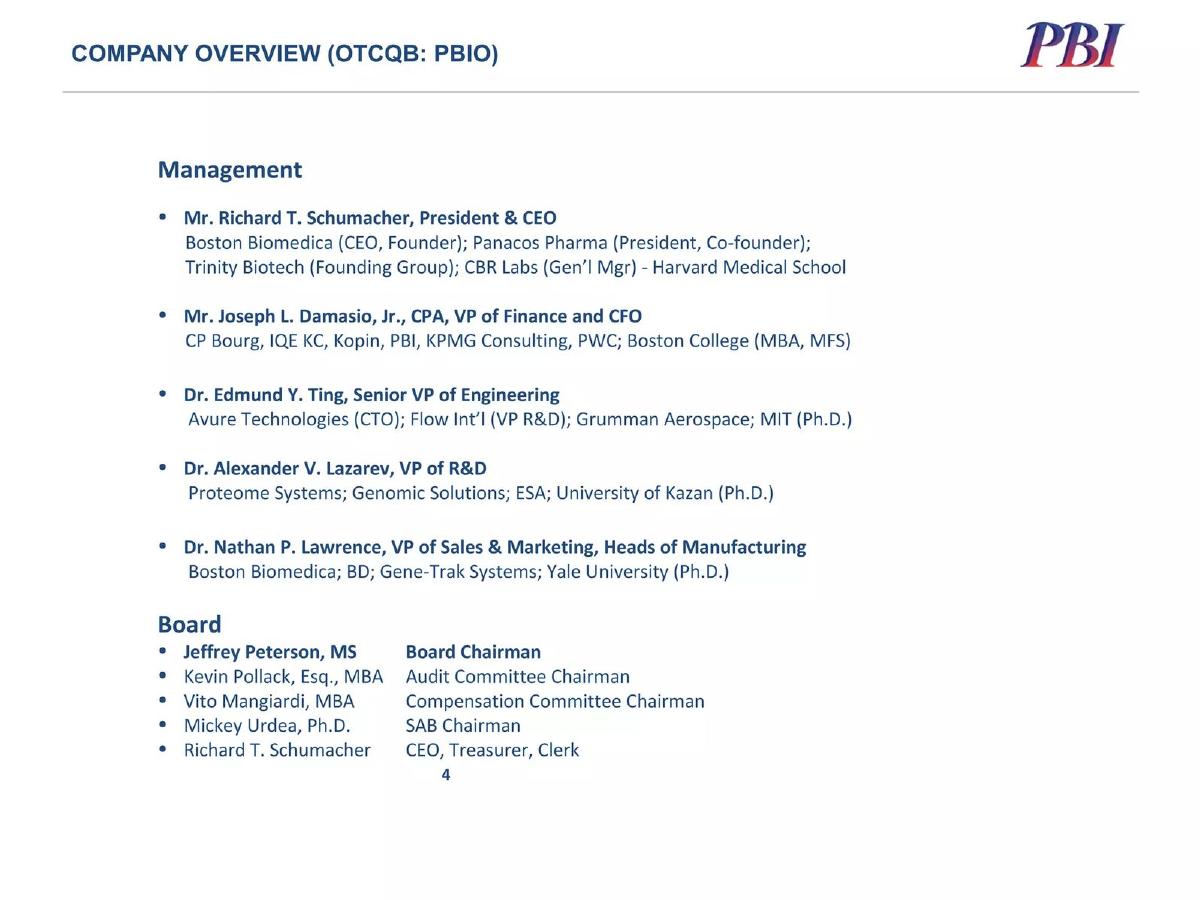
Despite the strong technical and market positioning, the deck has several notable omissions: 1. The Ask: There is no slide detailing how much capital the company is seeking, the terms of the offering, or the specific allocation of funds. 2. Unit Economics: While total revenue is mentioned, the deck does not break down the margins on the instruments versus the consumables. For a "razor-and-blade" model, understanding the lifetime value of a customer and the recurring revenue margin is crucial. 3. Competitive Landscape: The deck claims current methods are "inadequate" but does not name specific competitors or provide a side-by-side comparison of PCT versus traditional lysis methods (e.g., sonication or bead beating) in terms of cost, time, or yield. 4. Management Team: Only the CEO is mentioned on the title slide. A dedicated team slide highlighting the scientific and commercial leadership would be standard for this type of presentation.
Founder Takeaways
Focus on the Bottleneck: PBIO does an excellent job of identifying a specific, high-value problem (sample prep bottleneck) and positioning their technology as the unique solution. Founders should aim to articulate their "problem" slide with this level of clarity. Leverage Strategic Partnerships: The mention of the SCIEX co-marketing agreement is a powerful signal. It shows that a larger, established player has vetted the technology and sees value in bringing it to their own customer base. Quantify the IP: For deep-tech or life sciences startups, patents are a primary asset. Listing the number of issued patents and the geographic reach (e.g., China, US, Europe) helps build a "moat" in the eyes of investors. Show the Roadmap: The transition from PCT to UST shows that the company isn't a one-trick pony. It demonstrates how core competencies in high-pressure engineering can be applied to new, larger markets like food tech and CBD, providing a path for long-term growth beyond the initial niche.
Frequently asked questions
- What is the core technology behind Pressure BioSciences?
- The core technology is Pressure Cycling Technology (PCT), which uses repeated cycles of low to high pressure to control molecular interactions, such as lysing cells or inactivating enzymes. The deck also highlights Ultra-Shear Technology (UST), which uses intense shear stresses from ultra-high pressure valve discharge (greater than 20,000 psi) to create stable nano-emulsions for food, pharmaceuticals, and cosmetics.
- How does PBIO generate revenue according to the deck?
- Revenue is generated through the sale of PCT-based instruments and consumables. Slide 3 notes that the company achieved $2.0M in revenue in FY16 and $1.7M in the first three quarters of 2017. The business model relies on a 'razor-and-blade' approach, selling the hardware (Barocyclers) and the recurring consumables (micro-pestles) required for sample preparation.
- Who are PBIO's primary customers and partners?
- The company targets the biopharma industry, including discovery, development, and clinical segments. Slide 12 lists prominent customers such as Merck, Amgen, Roche, and academic institutions like Harvard Medical School and Stanford. A key strategic partner is SCIEX, a global leader in analytical instrumentation, with whom PBIO has a two-year worldwide co-marketing agreement.
- What is the significance of the Cancer Moonshot initiative for PBIO?
- Slide 16 indicates that PBIO's Barocycler 2320EXT plays an important role in the Cancer Moonshot initiative. This program, coordinated by the National Cancer Institute, aims to accelerate cancer research. PBIO's involvement places its technology in high-profile research environments, providing significant brand validation and potential for further adoption in government and academic laboratories.
- What are the company's stated growth drivers for the near future?
- As of late 2017, the company focused on up-listing to the NASDAQ and expanding its sales force from one to five field managers. Other drivers include the SCIEX partnership, the release of four additional PCT-based instruments over 18 months, and the commercialization of new patents related to Ultra-Shear Technology for the nano-emulsion market.