Plantee Innovations presents a compelling case for a premium IoT solution in the indoor gardening space, specifically targeting high-income 'serial plant killers.' The deck highlights a $9.7B economic loss in the US due to mistreated houseplants and positions their $999 all-in-one smart greenhouse as the solution. With $100K in Kickstarter validation and a strategic partnership with CEE gardening giant AGRO CS, the team demonstrates technical and market readiness. The financial roadmap is aggressive, projecting a jump from $55K in H2 2024 to $23M in 2026, predicated on a significant reduction…
Key takeaways
- The company is raising a $1.4M Seed round, with $0.4M already closed, to reach $1.7M in revenue by 2025 (Slide 1).
- Plantee identifies a $9.7B annual economic loss in the US from dead houseplants, noting that 73% of home growers kill multiple plants yearly (Slide 7).
- The flagship product is a $999 smart indoor greenhouse that automates watering, lighting, fertilization, and heating (Slide 9, 15).
- Market validation includes a $102K Kickstarter campaign and a 10K-person mailing list (Slide 11).
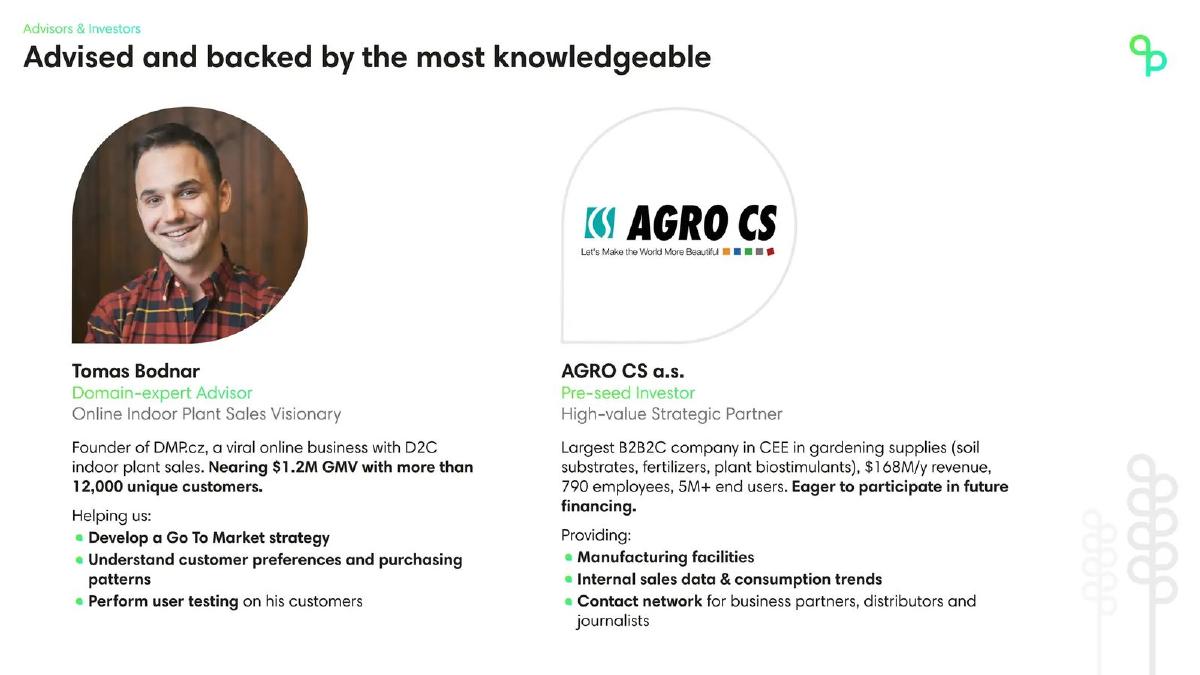
- Strategic backing comes from AGRO CS, a $168M/year gardening supply company providing manufacturing facilities and sales data (Slide 4).
- The business model includes a $15/month subscription for 'on-call gardeners' and remote data evaluation (Slide 15).
- Unit economics targets include reducing Bill of Materials (BOM) costs by 25% and assembly time from 3.5h to 2h by late 2025 (Slide 17).
- The long-term vision targets $0.5B in revenue by 2029 by expanding into the B2B office plant care market (Slide 16).
Executive Summary and Team
Slides 1-4: The Foundation
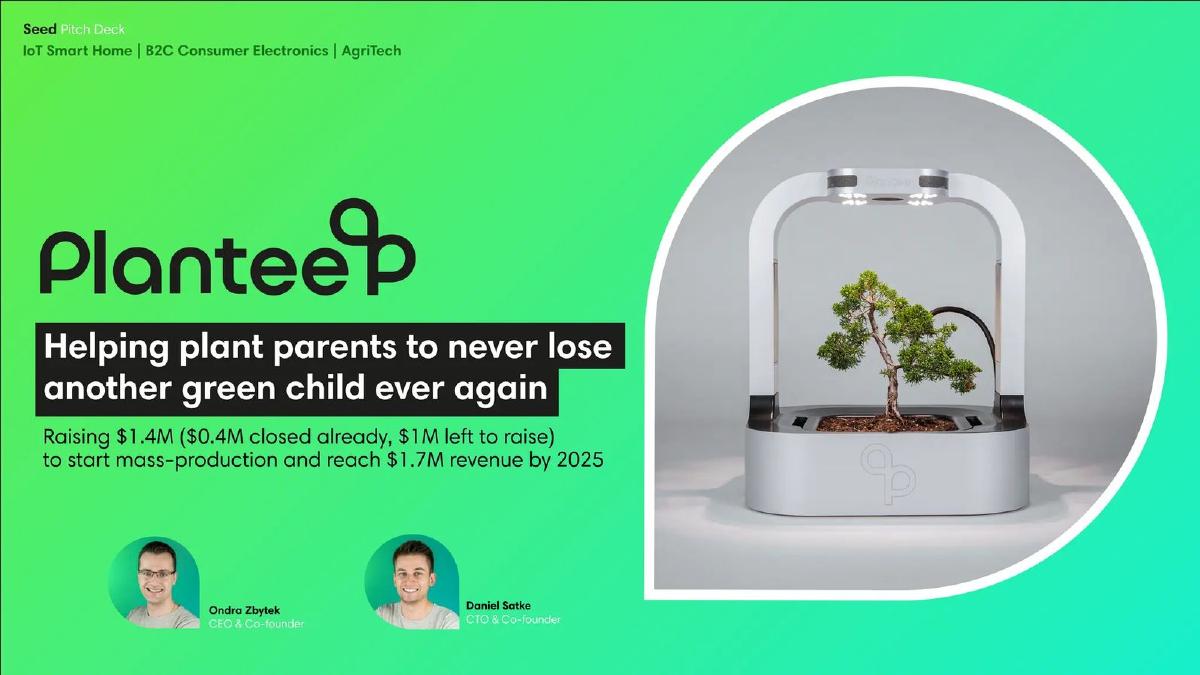
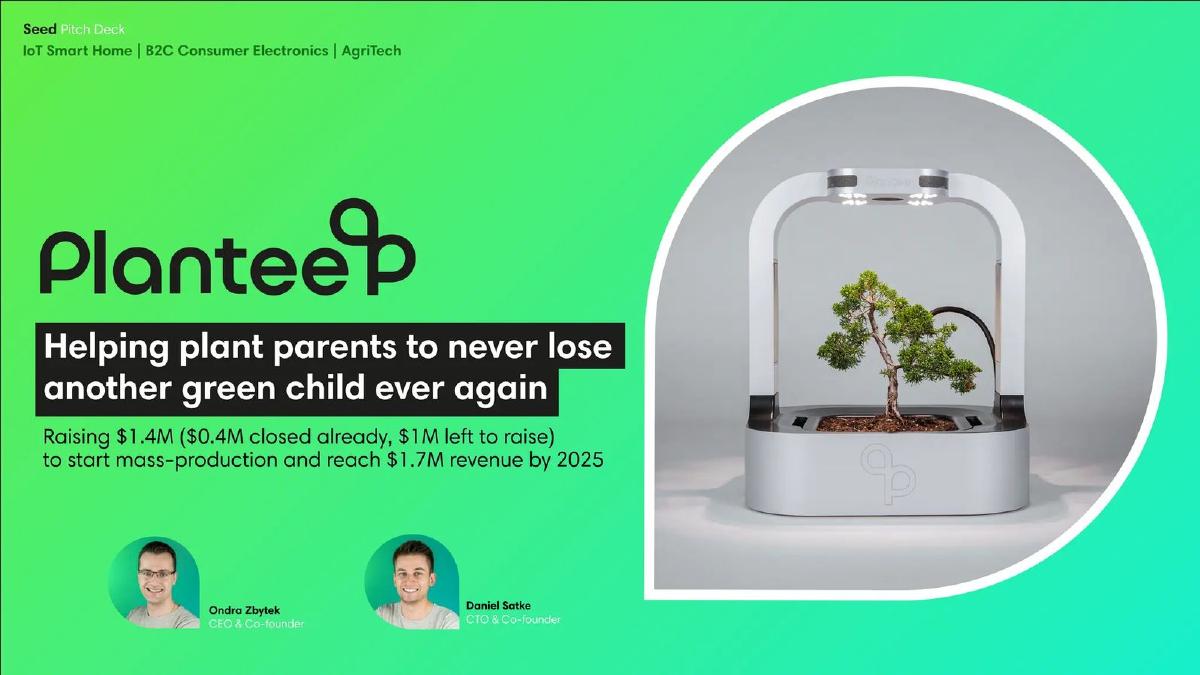
Plantee Innovations opens its Seed deck with a clear value proposition: "Helping plant parents to never lose another green child ever again." Slide 1 immediately establishes the funding status—raising $1.4M with $0.4M already closed—and sets a specific revenue target of $1.7M by 2025. This transparency regarding the "ask" and the immediate goal is a strong start for a hardware pitch.
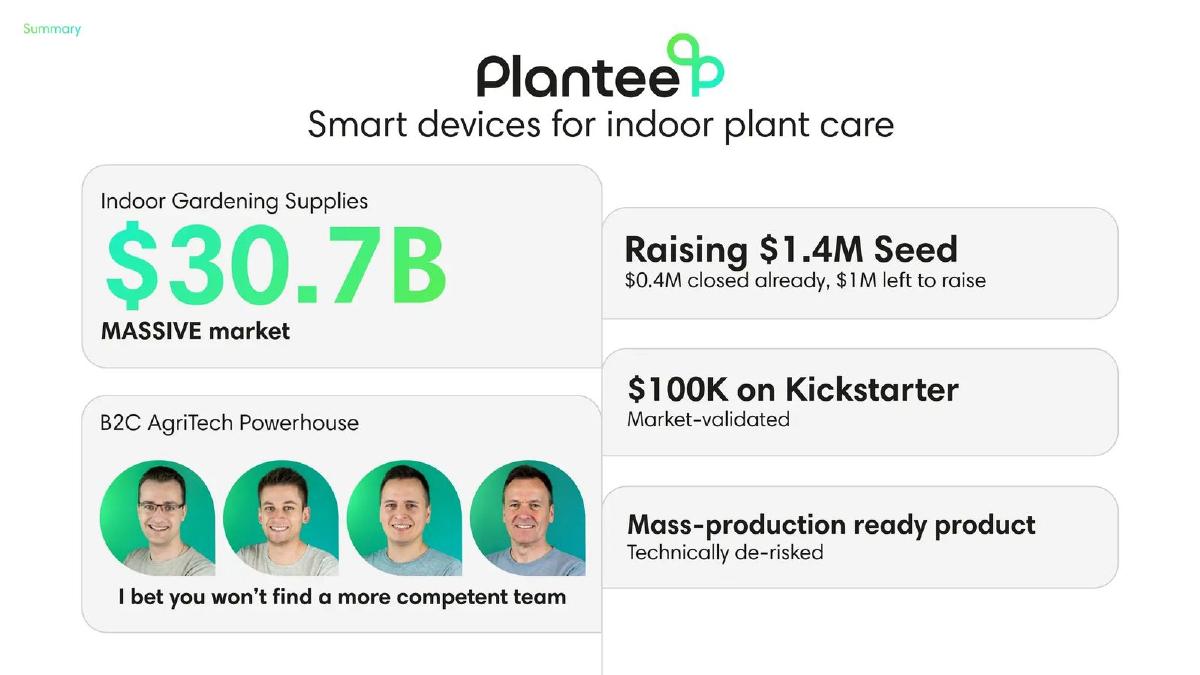
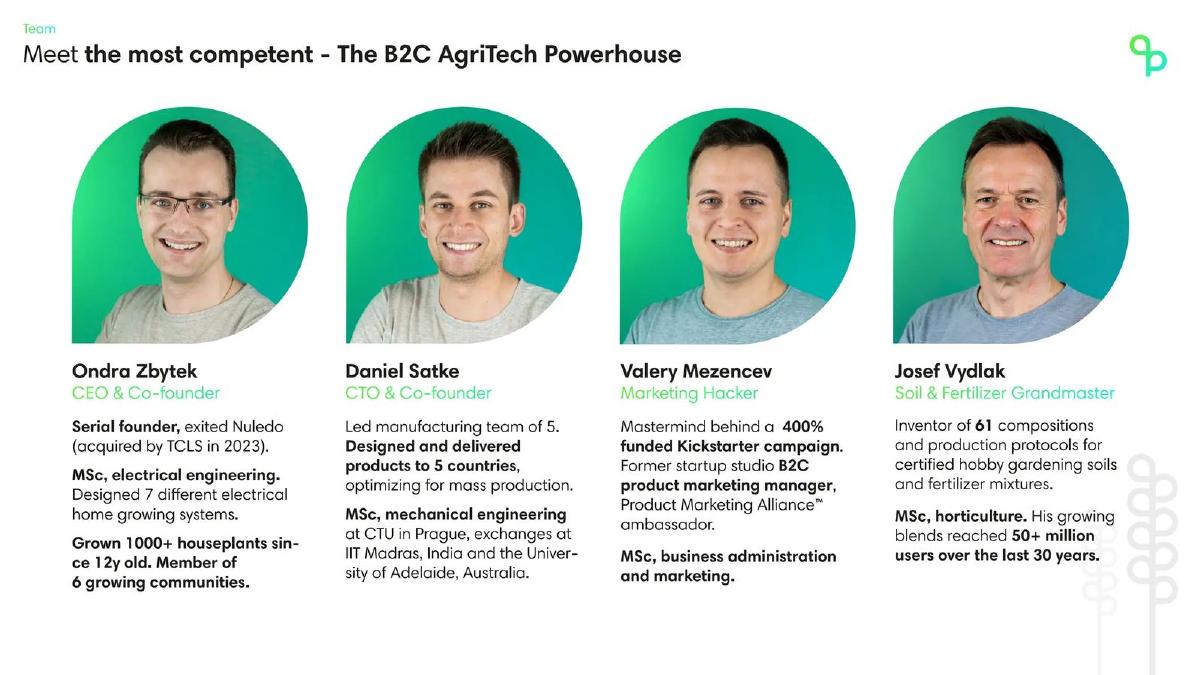
Slide 2 provides a high-level summary, citing a $30.7B market for indoor gardening supplies and highlighting $100K in Kickstarter validation. The team's self-description as a "B2C AgriTech Powerhouse" is backed by Slide 3, which details the founders' credentials. Ondra Zbytek (CEO) is a serial founder with a previous exit in the home growing space, while Daniel Satke (CTO) brings mechanical engineering expertise and experience in mass production. The inclusion of Josef Vydlak, a "Soil & Fertilizer Grandmaster" with 61 compositions to his name, adds significant domain authority that is often missing in pure tech plays.
Slide 4 introduces a critical strategic advantage: AGRO CS. As a pre-seed investor and the largest B2B2C gardening company in CEE ($168M/y revenue), they provide Plantee with manufacturing facilities and a distribution network. This partnership addresses the "hardware is hard" concern by showing established industrial backing.
The Problem and Solution
Slides 5-9: Defining the 'Plant Killer'
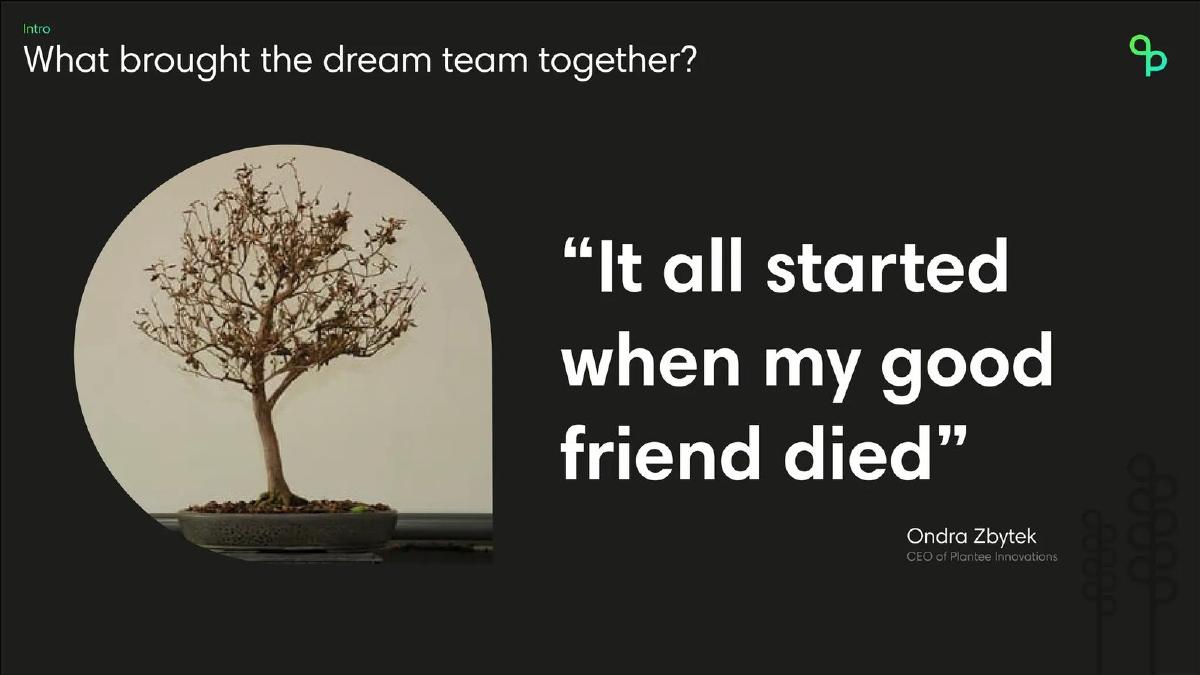
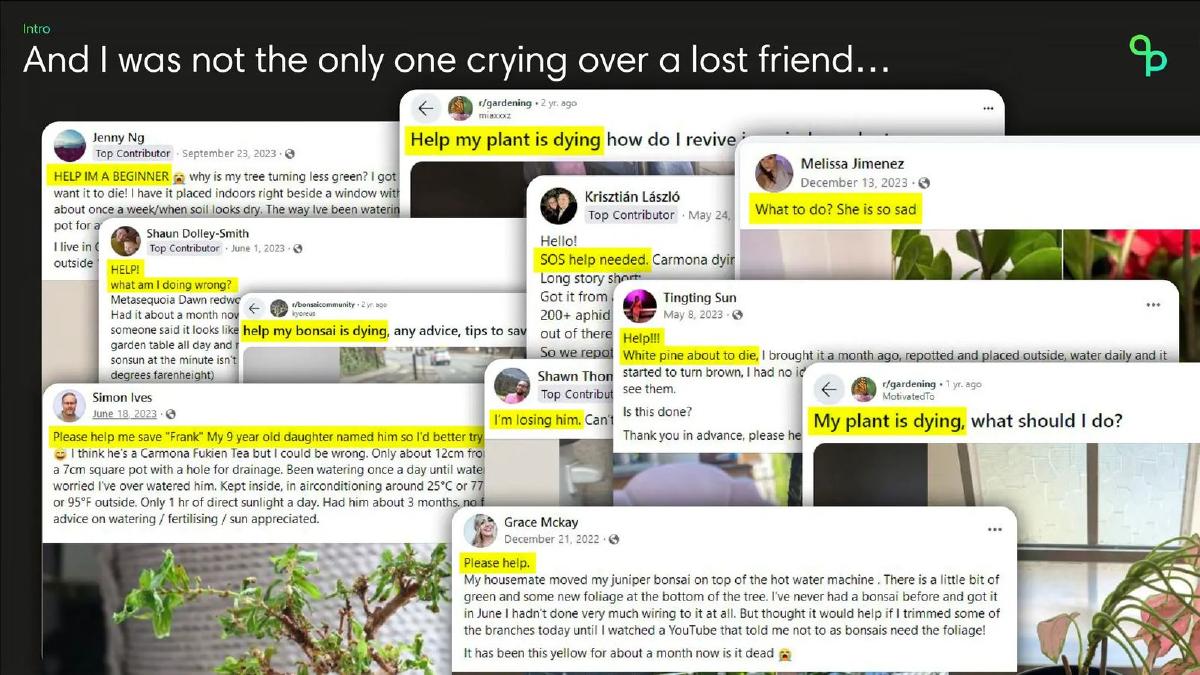
The narrative shift on Slide 5 is personal, using a quote from the CEO about the death of a "good friend" (a bonsai tree). Slide 6 uses social proof—screenshots from Reddit and Facebook—to show that this is a widespread emotional pain point. Slide 7 quantifies the problem: 73% of home growers kill multiple plants annually, resulting in a $9.7B economic loss in the US alone. By framing plant death as an "economic loss" and a "mental health" issue, Plantee elevates the product from a hobbyist toy to a necessary utility.
Slide 8 introduces the solution: a smart device connected to an AI-powered database of ideal growing conditions. The device handles watering, lighting, fertilization, and heating. Slide 9 showcases the flagship product, an all-in-one smart indoor greenhouse. It emphasizes two unique selling points: it uses any soil substrate and grows "all plants," including those that typically require glass enclosures. The mention of "proprietary electronics" as a "big MOAT" suggests a focus on intellectual property beyond just industrial design.
Market Analysis and Competition
Slides 10-13: The Michael Persona and Market Size
Slide 10 is a competitive landscape quadrant. Plantee positions itself in the "Easy to grow / Grows all plants" corner. It lists several well-funded competitors like Click & Grow ($17.9M Series B) and Gardyn ($55M Series B), but notes they only grow specific plants (herbs, mushrooms, etc.). This distinction is vital for justifying their $999 price point.
Slide 11 details traction, including the $102K Kickstarter, an 8K-member FB group, and a 10K-person mailing list. It also lists technical milestones like published iOS/Android apps and a mass-production-ready product. Slide 12 introduces "Michael," the target customer persona: a high-income, tech-loving remote worker in a cold climate. This specificity helps investors visualize the exact buyer profile for a $1,000 plant pot.
Slide 13 breaks down the market size (TAM/SAM/SOM). The TAM is $30.7B (258M indoor growers), while the SAM is narrowed to $5.1B (42.6M "plant killers"). The SOM target is a $0.5B capture within 5 years. The logic here is sound, moving from a broad global figure to a specific subset of high-income users who regularly neglect their plants.
Business Model and Financials
Slides 14-17: The Path to Profitability
Slide 14 outlines the Go-To-Market strategy, splitting spend between inbound (SEO, blogs), outbound (PR, influencers), and guerilla marketing. The deck is honest about its current CAC ($275) and sets a target of $85 by Q4 2025. Slide 15 details the unit economics. The $999 Plantee has a 51% gross margin. The model also includes "Extenders" ($199), accessories ($220 over lifetime), and a $15/month subscription. The projected Net Profit CLV is $510.
Slide 16 presents the "Big Vision," which involves expanding into the B2B office market and reaching $0.5B in revenue by 2029. Slide 17 is the most critical for Seed investors, detailing the use of funds. The $1.4M is earmarked for achieving $1.7M in revenue, reducing CAC, starting international shipping, and improving unit economics (reducing BOM by 25% and assembly time by 43%).
Slides 18-21: Projections and Appendix
Slide 18 provides a detailed roadmap through 2025. It shows total revenue growing from $55K in H2 2024 to $1.3M in H2 2025, with a massive leap to $23M projected for 2026. This 2026 figure is a significant jump that would likely require a Series A round not explicitly detailed here. The slide also tracks headcount and cash on hand, projecting break-even by August 2025.
The deck concludes with a contact slide (Slide 19) and an appendix (Slides 20-21). The appendix is particularly useful, showing future modular products (Smart light, Smart pot, Smart watering station) and providing a comprehensive list of sources for their market data. This level of documentation adds significant credibility to the figures presented in the main deck.
What Works and What is Missing
What Works
Strategic Partnership: The inclusion of AGRO CS as an investor and manufacturing partner is the strongest de-risking element in the deck. · Persona Targeting: The "Michael" persona clearly explains who would pay $999 for a plant pot, moving the product away from a general consumer audience to a high-intent niche. · Unit Economics Transparency: The deck doesn't hide the high current CAC; instead, it provides a roadmap for how to reduce it through specific marketing channels and operational improvements. · Domain Expertise: Having a "Soil & Fertilizer Grandmaster" on the team provides a unique competitive advantage in a space often dominated by software engineers.
What is Missing
Series A Timing: The jump from $1.7M revenue in 2025 to $23M in 2026 is enormous. The deck does not explain if this requires a subsequent large capital raise or if it's purely organic growth from the Seed round. · Patent Status: While they mention "proprietary electronics" and "registered trademark," there is no explicit mention of filed or granted patents, which is usually a key component of a "deep moat" in hardware. · Retention Data: While they project subscription revenue, they lack data on how long Kickstarter backers or early testers actually stay subscribed to the service.
Founder Takeaways
Quantify the 'Emotional' Problem: Plantee does an excellent job of taking an emotional pain point (killing a plant) and turning it into a hard economic figure ($9.7B loss). Founders should look for ways to attach dollar values to the frustrations their products solve.
Show, Don't Just Tell, De-risking: Instead of just saying they can manufacture the product, they show the logo of a $168M partner providing the facilities. If you have a strategic partner, make them a central pillar of your pitch.
Be Specific with Unit Economics: The breakdown of BOM, assembly time, and CAC targets shows that the founders understand the levers of their business. Investors appreciate a roadmap that includes operational efficiency, not just sales growth.
Use an Appendix for Credibility: The two-page appendix listing every source for their market data and showing future product iterations allows the main deck to remain clean while providing the "receipts" for due diligence.
Frequently asked questions
- What is the primary product and its price point?
- The flagship product is the Plantee, an all-in-one smart indoor greenhouse priced at $999. It is designed to grow any plant using any soil substrate by automating essential care tasks like watering, lighting, fertilization, and heating. The company also plans to sell 'Extenders' for $199 and various accessories, alongside a $15/month subscription service for advanced plant care support.
- How does the company justify the high $999 price tag?
- Plantee targets a specific persona: 'Michael,' a high-income remote worker who loves tech but consistently kills plants. The deck argues that the $9.7B lost annually on dead plants justifies the investment. Furthermore, they differentiate from competitors like AeroGarden or Click & Grow by offering a solution that grows 'all plants,' including sensitive ornamental plants and bonsais, rather than just herbs or mushrooms.
- What is the significance of their strategic partner, AGRO CS?
- AGRO CS is a major B2B2C gardening supply company in Central and Eastern Europe with $168M in annual revenue. As a pre-seed investor, they provide Plantee with critical infrastructure, including manufacturing facilities, internal sales data, and a vast contact network of distributors and journalists. This partnership significantly de-risks the production and distribution aspects of the hardware business.
- What are the key financial projections for the next two years?
- The deck outlines a roadmap to $1.7M in revenue by the end of 2025, primarily driven by hardware sales ($1.6M). They project reaching break-even by August 2025. Most notably, they forecast a massive jump to $23M in revenue for 2026, which would require a significant scaling of their sales and marketing efforts and a successful reduction in CAC.
- How does the company plan to reduce its Customer Acquisition Cost (CAC)?
- Currently, the measured CAC is $275. Plantee aims to reduce this to $85 by late 2025. Their strategy involves a mix of inbound marketing (50% of spend) via blogs and their 'Planteebase' database, outbound efforts (40% of spend) including PR and influencers, and 'guerilla marketing' (10% of spend) on community platforms like Reddit and Quora.